Beekeeping in Austria: Home of the Carnica Bee
Austria is the birthplace of the Carnica bee and a country with a rich beekeeping tradition. Alpine forage, strict regulations, and migratory beekeeping.
Austria is far more than just a neighbor to German beekeeping -- it is the birthplace of the Carnica bee, one of the most widely distributed honeybee races in the world. The Alpine republic combines a centuries-old beekeeping tradition with modern research, strict quality standards with regional diversity, and alpine challenges with unique forage opportunities. With approximately 33,000 beekeepers, Austria has one of the highest beekeeper densities per capita in Europe.
This article covers Austrian beekeeping regulations, organizations, and practices. While much of the practical beekeeping advice is universally applicable, the specific laws, quality standards, and organizational structures are unique to Austria.
Austria's Beekeeping in Numbers
Austria has approximately 450,000 bee colonies maintained by a mix of hobby and commercial beekeepers. The average operation size is about 14 colonies -- significantly higher than in Germany (7-8 colonies). This shows: in Austria, beekeeping is traditionally practiced somewhat more professionally.
The Beekeeping Landscape
- Carinthia: Home of the Carnica, strong breeding scene
- Styria: Fruit blossom, forest, diverse forage
- Tyrol and Vorarlberg: Alpine beekeeping in extreme locations
- Upper Austria: Largest state association, grassland and forest
- Lower Austria: Wine region to pre-Alps, diverse forage
- Salzburg: Mountain forage, alpine pasture beekeeping
- Vienna: Urban beekeeping with long tradition
- Burgenland: Pannonian climate, acacia honey
The Carnica Bee: Austria's Greatest Contribution to Beekeeping
The Carniolan bee (Apis mellifera carnica) is the most widely distributed honeybee race worldwide after the Italian bee. Its homeland lies in the Carinthian Alpine region and the Balkans -- and from here it has shaped beekeeping across all of Central Europe.
Why the Carnica Is So Successful
| Trait | Carnica | Significance for Beekeepers |
|---|---|---|
| Gentleness | Very gentle, rarely stings | Ideal for beginners and urban beekeeping |
| Swarming tendency | Medium to high | Regular swarm control needed |
| Spring buildup | Very fast, explosive development | Early use of fruit blossom |
| Winter hardiness | Excellent, small winter cluster | Low food consumption |
| Adaptability | High, adapts to forage availability | Works in various regions |
| Hygienic behavior | Pronounced | Good hygiene, fewer diseases |
Breeding and Mating Stations
Austria operates a dense network of mating stations for Carnica pure breeding. Controlled mating flights are conducted in isolated alpine valleys. The most important breeding organizations:
- ACA (Austrian Carnica Association): Austrian Carnica breeding association, coordinates breeding and performance testing
- Mating stations in Carinthia: Several isolated high-mountain stations
- Performance testing: Systematic recording of honey yield, gentleness, and swarming tendency
The Carinthian Beekeeping Act (K-BiWG) stipulates that only purebred Carnica bees may be kept in Carinthia. Keeping other bee races requires a permit from the state government. Additionally, pure breeding areas with a minimum radius of ten kilometers can be established -- a globally unique law for the protection of a bee race.
Forage Regions of Austria
The Alps: Beekeeping in Extreme Locations
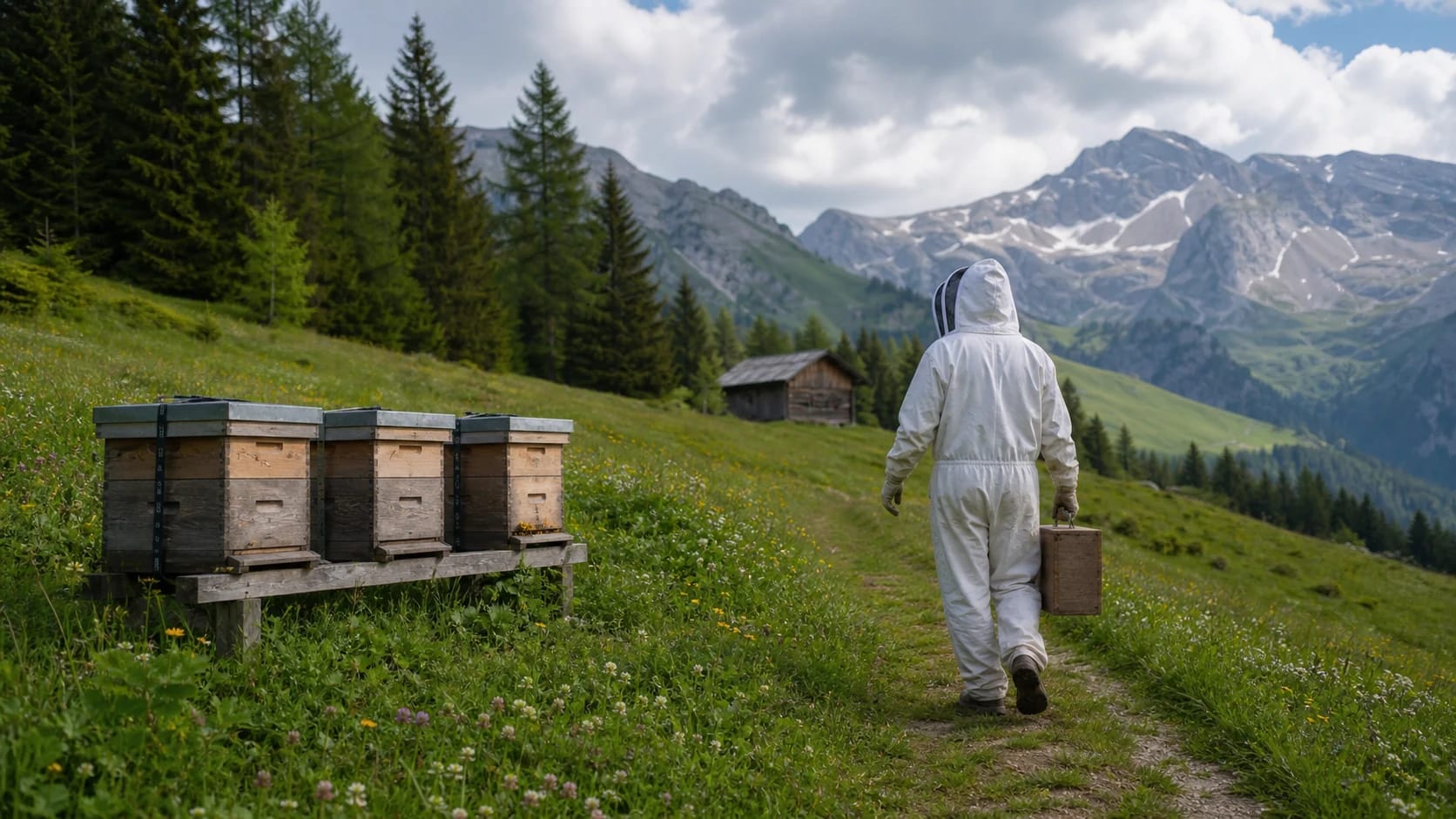
Alpine beekeeping in Tyrol, Salzburg, and Vorarlberg is a special challenge. Apiaries at 1,000-1,800 m elevation have a short but intensive season:
Alpine forage:
- Alpine rose honey: From Rhododendron blossoms in high elevations, rare and expensive
- Alpine herb honey: Mixture of mountain herbs, clover, and wildflowers
- Mountain forest honey: From spruce and fir forests at middle elevations
- Dandelion honey: On mountain meadows, bold yellow and sweet
The challenges are considerable: short season (May to August), weather changes, difficult access, and the risk of snowfall into June. In return, alpine beekeeping rewards with unique flavors that reflect the terroir of the mountain landscape.
 AI-generated
Carinthia and Styria: The Heart of Beekeeping
Carinthia and Styria form the center of Austrian beekeeping. The mix of fruit cultivation (especially in southern Styria), forestry, and alpine landscape provides optimal conditions.
Styrian specialties:
- Fruit blossom honey: Apple, cherry, and pear forage in southern Styria
- Sweet chestnut honey: In the warmer areas of southern Styria
- Pumpkin blossom honey: Styria is pumpkin country -- and the blossoms provide nectar
- Forest honey: From the extensive coniferous forests of the Mur and Muerz valleys
Lower Austria: From Wine Country to Pre-Alps
Lower Austria, alongside Upper Austria and Styria, is among the strongest beekeeping states. The landscape ranges from the warm wine region through the cider region to the pre-Alps:
- Weinviertel: Rapeseed, sunflowers, warm climate -- high yields
- Wachau: Fruit blossom and apricot forage -- unique blossom honey
- Mostviertel: Fruit tree meadows, mixed forest, diverse forage
- Waldviertel: Cooler locations, forest and heath
Vienna: The Imperial Bee City
Vienna has a surprisingly long beekeeping tradition. Empress Maria Theresa already promoted bee cultivation. Today, bee colonies stand on the roofs of the Vienna State Opera, the Natural History Museum, and numerous public housing buildings. Viennese city honey is a popular souvenir.
Burgenland: Pannonian Climate
Burgenland benefits from the Pannonian climate -- hot summers, little rain. Here the acacia (Robinia) thrives particularly well, and Burgenland acacia honey is among the finest varietal honeys in Austria: water-clear, mild, and slow to crystallize.
Austrian Regulations and Special Features
Legal Framework
Beekeeping in Austria is a state matter -- each federal state has its own beekeeping laws. Common principles:
- Registration requirement: All bee colonies must be registered in the Veterinary Information System (VIS) -- from the very first colony
- Migratory beekeeping: Health certificate and migration permit required
- Disease control: Strict regulations for foulbrood and Varroa
- Plant protection law: Protection of bees from poisoning by pesticides
In Austria, beekeepers can apply for the AMA quality seal for their honey. The requirements are strict: Austrian origin, regular quality controls, and compliance with production standards that exceed the EU Honey Directive. The quality seal enjoys high consumer trust.
Honey Regulations and Quality Standards
Austria traditionally has higher quality standards than the EU minimum:
- Water content: Maximum 17.5% (stricter than the EU standard of 20%)
- HMF value: Maximum 15 mg/kg for AMA honey (EU allows 40 mg/kg)
- Origin labeling: Clear designation "Austrian Honey" required
- No blending with EU or non-EU honey for AMA quality seal
Migratory Beekeeping in Austria
Migratory beekeeping has a long tradition in Austria. The topographic diversity -- from 115 m (Lake Neusiedl) to over 3,000 m -- makes it possible to specifically target different elevation zones and thus different bloom times.
- 1
Spring: Fruit Blossom in the South (March-April)
Start in the warm areas of southern Styria or Burgenland. Fruit blossom begins here 2-3 weeks earlier than in the Alps. Apple, cherry, and apricot forage provide the first honey of the year.
- 2
Early Summer: Acacia or Rapeseed (May-June)
Migration to Burgenland (acacia) or Weinviertel (rapeseed). Both forage types are productive and yield single-variety honeys with high market value.
- 3
Summer: Forest and Alpine Pasture (June-August)
The most productive phase: forest honey from the coniferous forests of the pre-Alps or alpine forage in the high elevations. In good forest honey years, yields can reach 30-50 kg per colony.
- 4
Late Summer: Back to Home Apiary (August)
Feeding, Varroa treatment, and winter preparation. In Austria, winter feeding often begins as early as mid-August, especially at alpine locations.
Migratory Beekeeping Infrastructure
Austria has a well-developed infrastructure for migratory beekeepers:
- Migration advisors from state associations advise on optimal locations and timing
- Forest forage monitoring organized by the Upper Austrian Bee Center
- Migration sites in consultation with municipalities and forest owners
- Veterinary certificates via the Digital Veterinary Program (VIS)
Austrian Beekeeping Organizations
Biene Oesterreich
Biene Oesterreich is the umbrella organization of Austrian beekeeping and represents beekeepers' interests at the federal level. It coordinates:
- Lobbying in EU agricultural reforms
- National honey quality programs
- Public relations and image campaigns
State Associations
Each federal state has its own state association:
- Carinthian State Association for Beekeeping: Focus on Carnica breeding, Carinthian Beekeeping School
- Styrian State Association for Beekeeping: Strong breeding scene, Styrian Beekeeping Center
- Tyrolean Beekeepers' Association: Specialist in alpine beekeeping
- Upper Austrian State Association for Beekeeping: Largest state association by membership
- Lower Austrian Beekeepers' Association: Second largest state association
AGES -- Bee Science
The Austrian Agency for Health and Food Safety (AGES) operates a Bee Science Institute at its Moedling location (Lower Austria) that serves as the National Reference Laboratory for Bee Health for research, diagnostics, and consulting.
Challenges
Small Operation Structures
Although the average colony count is higher than in Germany, many Austrian beekeepers struggle with profitability. Production costs in alpine locations are high, and cheap honey imports from non-EU countries suppress prices. The AMA quality seal helps to differentiate from imported products.
Climate Change in the Alps
The Alps are warming twice as fast as the global average. For beekeeping this means:
- Shifted bloom times and higher late frost risk
- Changed honeydew production in forests
- New pests migrating from the south
- More extreme weather events (heavy rain, hail)
Bear Population
An unusual topic: with the return of the brown bear to the Eastern Alps (Carinthia, Styria), there are occasional conflicts with beekeeping. Bears tear open beehives to reach the brood and honey. Electric fences provide protection.
Conclusion: Austria -- Tradition and Innovation in the Alpine Country
Austria is a beekeeping country with character: the Carnica bee as genetic heritage, the strict quality standards of the AMA seal, the alpine challenge, and the rich association culture shape a beekeeping scene that combines tradition and modernity. For German beekeepers, looking across the border is particularly rewarding -- many innovations in Carnica breeding, quality assurance, and migratory beekeeping come from Austria.
Beekeeping in Switzerland: Mountain Beekeeping and Tradition Beekeeping in Bavaria: Forage, Traditions, and Regional Specialties German Honey Varieties: A Flavor Journey Through the Regions- Advanced Beekeeping Practice -- Lesson 7: Breeding Selection and Bee Races
- Beekeeping for Beginners -- The Universal Beginner Course
Less paperwork. More time with your bees.
Hivekraft is free for up to 5 hives. Register in 30 seconds.