 AI-generated
Feeding Bees: When, How, and What to Feed Your Colonies
Knowing when and how to feed your bees can mean the difference between a thriving colony and a starved one. This complete guide covers every feeding scenario, from spring stimulation to emergency winter feeding.
Feeding bees is one of the most debated topics in beekeeping. Some beekeepers feed regularly throughout the season; others feed only as a last resort. The truth lies somewhere in between: knowing when to feed, what to feed, and how to deliver it can save colonies and dramatically improve outcomes. This guide covers every scenario you are likely to encounter.
Why Bees Sometimes Need to Be Fed
Honey bees are expert foragers, but they are not immune to food shortages. Several conditions commonly lead to a feeding response being necessary:
- Spring dearth: Early in the year, colonies have consumed winter stores but flowering has not yet begun.
- Summer dearth: A period in midsummer (often called the "July gap" or "summer dearth") where nectar flow drops off before fall plants bloom.
- New splits and nucs: Divisions have no time to build stores and often have no foragers yet.
- Late package installations: Packages installed too late in the season may not build enough stores.
- Fall preparation: Colonies need approximately 60–90 lbs (27–40 kg) of stores to overwinter safely in most of North America. If they fall short, supplemental feeding prevents starvation.
- Emergency winter feeding: A colony that runs short mid-winter must be fed immediately or it will die.
When to Feed: The Seasonal Calendar
| Season | Situation | Feed or Not? |
|---|---|---|
| Early spring (Mar–Apr) | Stores below 20 lbs, cold nights | Feed — 1:1 syrup or fondant |
| Spring (Apr–May) | Nectar flowing, colony strong | No feeding needed |
| New nuc / split (any season) | Just established, no stores | Feed until drawing comb and storing nectar |
| Summer dearth (Jul–Aug) | No nectar, stores dropping | Feed if below critical threshold |
| Fall preparation (Aug–Oct) | Pre-winter buildup | Feed 2:1 syrup until stores are full |
| Winter | Colonies light on stores | Feed fondant or dry sugar only |
| Emergency | Cluster starving | Feed immediately — fondant directly on cluster |
A simple test: heft the back of the hive. A colony entering winter should feel heavy. If you can lift the rear of a full-depth box with one hand, the colony is dangerously light.
What to Feed: An Overview
1:1 Sugar Syrup (Spring/Summer)
Equal parts white granulated sugar and water by weight. This thin syrup simulates a nectar flow and stimulates the colony to:
- Draw out new comb
- Expand brood rearing
- Increase forager activity
How to make it: Dissolve 1 lb of sugar in 1 pint of warm water (or 1 kg in 1 liter). Do not boil the sugar — this creates HMF (hydroxymethylfurfural), which is toxic to bees in high concentrations. Simply stir in warm water until dissolved.
When to use: Spring buildup, new packages, splits, any time you need to stimulate comb building. Do not use during a strong nectar flow — it is unnecessary and can cause the bees to store syrup instead of honey.
2:1 Sugar Syrup (Fall)
Two parts sugar to one part water by weight. This thick syrup is intended for fall feeding when you want bees to store it as winter reserves rather than use it for brood rearing. The higher sugar concentration is closer to ripe honey and requires less processing by the bees.
When to use: Late summer through fall, whenever you are building up winter stores. Stop feeding when temperatures drop below 50°F (10°C) because bees cannot process liquid syrup in the cold.
Fondant / Candy Boards
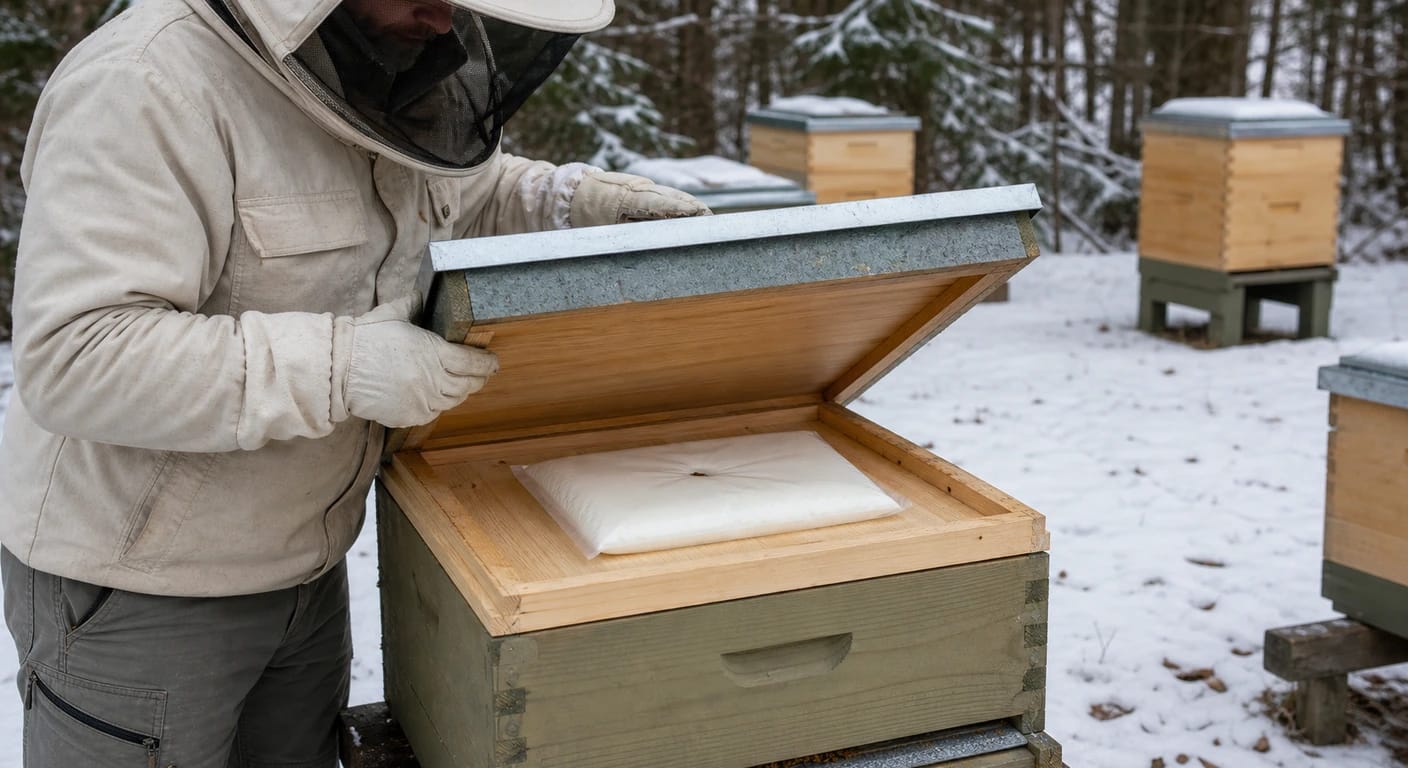
Fondant is a soft, pliable sugar candy used to feed bees during cold weather when liquid syrup cannot be fed. Commercial baker's fondant works well, or you can make your own by heating 2:1 syrup to 240°F (116°C) and letting it cool while stirring.
Candy boards are fondant formed into slabs that sit directly over the winter cluster, between the top bars of the upper box and the inner cover. This places food directly where the cluster is without requiring the bees to break cluster to find it.
When to use: Any time temperatures are too cold for liquid syrup — typically below 50°F (10°C).
Dry Sugar (Mountain Camp Method)
A simple emergency technique: pour granulated white sugar directly onto a sheet of newspaper on top of the winter cluster. The bees will use moisture condensing in the hive to dissolve and consume the sugar. It is not ideal nutrition, but it is fast, easy, and genuinely saves colonies.
When to use: Emergency mid-winter feeding when you cannot prepare fondant, or as a preventive measure when you suspect a colony is light.
Pollen Substitutes
Bees need protein (pollen) as much as carbohydrates (nectar). In late winter and early spring before pollen is available, a pollen substitute patty provides the amino acids needed for brood rearing.
Common products include:
- MegaBee — widely used, good palatability
- Global Patties — popular in North America
- AP23 (Mann Lake) — standard commercial product
Place patties directly on the top bars of the brood nest. Replace every 2 weeks. Do not use protein supplements during a strong pollen flow — bees will prefer natural pollen.
High-Fructose Corn Syrup (HFCS)
Used extensively in commercial beekeeping as a cheaper alternative to sucrose syrup. HFCS-55 (55% fructose) is roughly equivalent to spring syrup; HFCS-90 is used for fall feeding. It is fine for most bees but not appropriate if you are producing certified organic honey or if your buyers expect natural products.
What NOT to Feed
- Brown sugar, molasses, or raw sugars: Contain minerals and ash that bees cannot process, leading to dysentery.
- Honey from unknown sources: Risk of introducing American Foulbrood (AFB) — a deadly bacterial disease. Never feed store-bought honey.
- Any sweetened beverages (soda, juice): Too much impurity, wrong sugar profile.
- Artificial sweeteners: Bees cannot metabolize them.
Feeding Methods: Pros and Cons
Top Feeders (Hive Top Feeders)
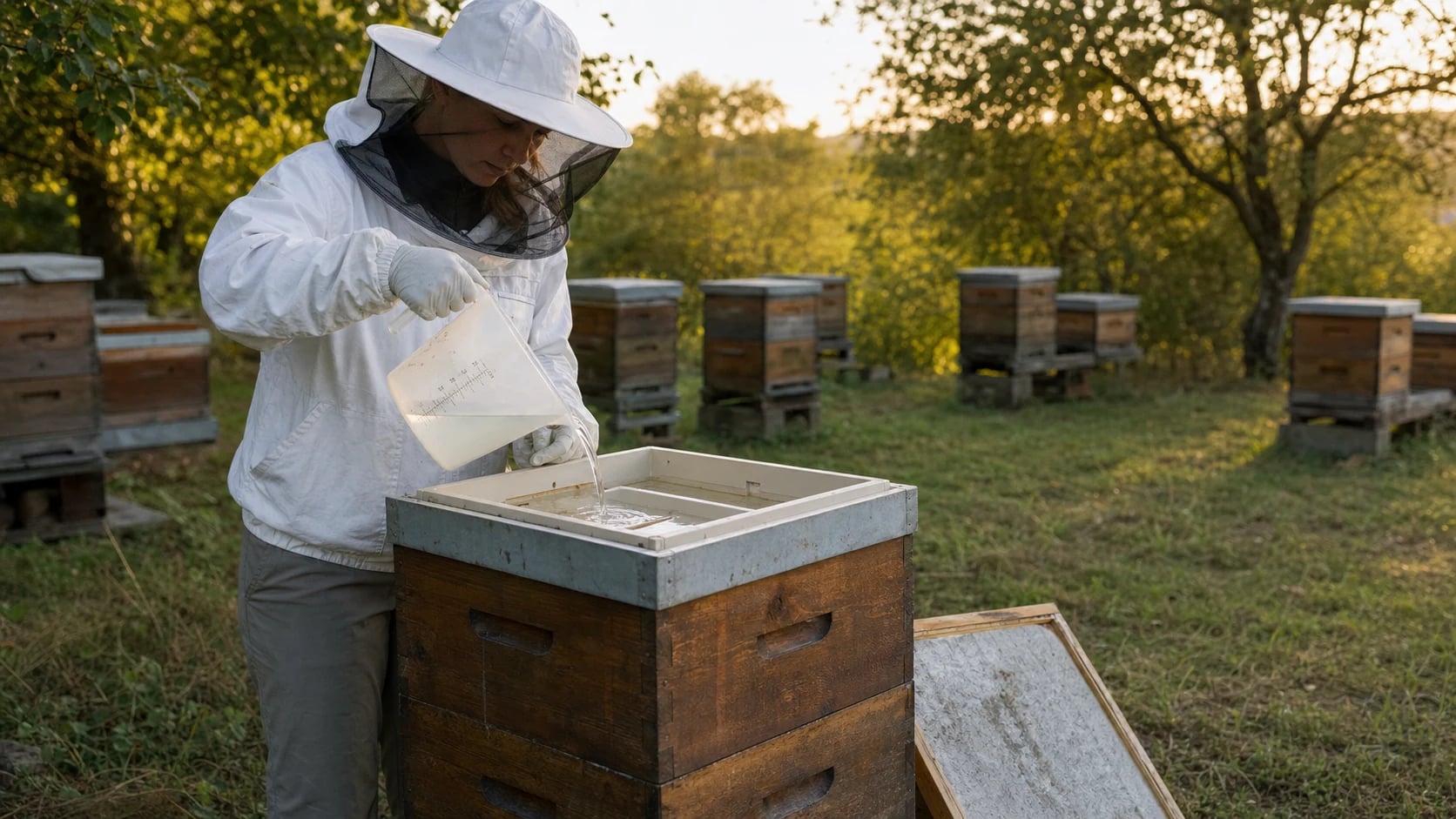
A reservoir that sits on top of the hive under the outer cover. Bees access the syrup through a screen or float from below, preventing drowning. Available in 1-gallon and 2-gallon sizes.
Pros: Large capacity (reduces refill frequency), easy to refill without opening the hive, minimal robbing stimulation. Cons: Can mold if not refilled frequently, some designs drown bees, takes up space that supers would otherwise occupy.
Frame Feeders (Division Board Feeders)
A feeder in the shape of a frame that replaces one or two frames inside the brood box. Bees climb down and drink from the syrup reservoir.
Pros: Keeps feed inside the hive where it is warmest, no external robbing stimulation, good for cold-weather feeding. Cons: Must open hive to refill, takes up frame space in the brood nest, can drown bees if not fitted with a float or ridged surface.
Entrance / Boardman Feeders
A small jar inverted over a tray that slides into the hive entrance. Inexpensive and widely sold.
Pros: Cheap, easy to see how much syrup remains without opening the hive. Cons: Small capacity, exposes the scent of syrup at the entrance and strongly stimulates robbing, ineffective in cold weather (bees cannot access it).
Recommendation: Boardman feeders are not recommended except for newly installed packages in warm weather where robbing is not yet a concern.
Baggie Feeding
Pour 1:1 syrup into a ziplock freezer bag, seal it, and place it flat on the top bars of the brood box. Cut a single slit of about 1–2 inches (2–5 cm) in the top of the bag with a razor blade. Bees drink from the slit.
Pros: Extremely cheap, minimal robbing stimulation, easy to see consumption, no drowning risk. Cons: Single-use plastic waste, must open hive to replace, can leak if punctured by bees.
Open Feeding (Communal Feeders)
Placing large trays of syrup in the apiary for all colonies to share. This is faster in commercial operations but has serious downsides for small apiaries.
Cons: Massively stimulates robbing behavior, spreads disease between colonies, difficult to control which colonies consume how much, attracts wasps and other pests.
Not recommended for hobbyist beekeepers.
Feeding Method Comparison
| Method | Capacity | Robbing Risk | Cold Weather | Refill Without Opening |
|---|---|---|---|---|
| Top feeder (hive top) | High (1–2 gal) | Low | Moderate | Yes |
| Frame feeder | Medium (0.5–1 gal) | Very Low | Good | No |
| Entrance/Boardman | Low (1 qt) | High | Poor | Yes |
| Baggie feeding | Medium (1 qt) | Very Low | Moderate | No |
| Fondant / candy board | High | None | Excellent | No |
| Dry sugar | High | None | Excellent | No |
How Much to Feed
Spring stimulation: 1–2 quarts of 1:1 syrup per week per colony. The goal is not to fully stock the hive — it is to mimic a nectar flow and stimulate brood rearing.
Fall preparation: Feed as much 2:1 syrup as the colony will take until stores are adequate. A healthy overwintering colony needs 60–90 lbs (27–40 kg) of stored honey or syrup. Check by weight or by counting frames of capped stores.
New splits: Feed freely (1:1 syrup) until the colony is established and the nectar flow begins. A new split with foundation may need 2–4 gallons before it stops accepting syrup.
Signs of Starvation
Catching a colony before it starves is the difference between a quick intervention and a dead colony. Watch for:
- Bees clustered tightly but not covering brood — a sign they are conserving heat and have stopped rearing brood
- Dead or dying bees with their heads inserted in cells — classic starvation posture
- No sealed honey in the upper box — the cluster is running out of food
- Lightweight hive in winter — heft the back regularly
- Bees crawling outside on cold days — often a sign of starvation, not disease
If you suspect starvation in winter, act immediately. Place fondant or dry sugar directly on top of the cluster. Do not wait until your next scheduled inspection.
A Note on Robbing
Any time you introduce syrup to a hive, you risk triggering robbing — where stronger colonies send scouts to steal the weaker colony's stores. To minimize robbing risk:
- Feed in the evening after foraging activity has stopped
- Reduce entrances on weaker colonies
- Do not spill syrup outside the hive
- Use internal feeders rather than entrance feeders
Conclusion: Track Every Feeding with Hivekraft
Good feeding decisions are based on data — knowing how much you fed, when, and what the colony weighed or consumed helps you identify patterns and make better choices next season. Did that colony always need supplemental feeding? Is the dearth hitting earlier than usual? Are your splits building up faster this year?
Hivekraft lets you log every feeding event — type, amount, feeder method, and colony response — so that feeding decisions become informed rather than guesswork. Pair that with hive weight data from an IoT scale and you can see exactly when a colony starts consuming stores and respond before starvation becomes a risk.
Healthy, well-fed colonies overwinter better, build up faster in spring, and produce more honey in summer. Feeding intelligently is not coddling your bees — it is good beekeeping.
Less paperwork. More time with your bees.
Hivekraft is free for up to 10 hives. Register in 30 seconds.