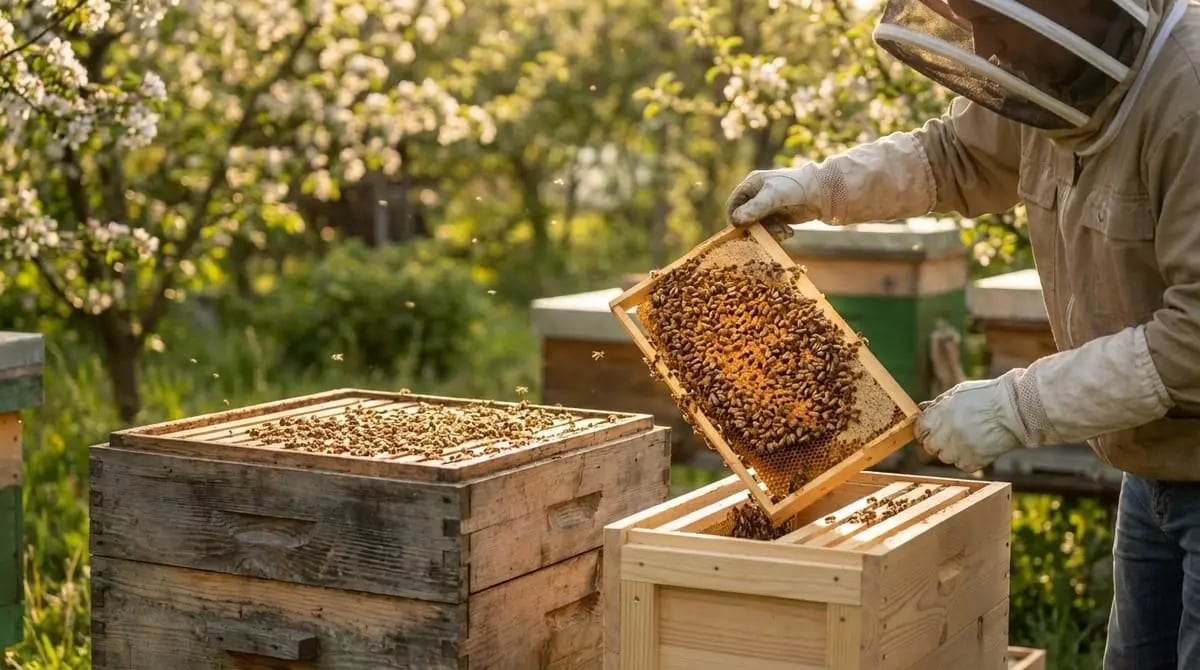
Making Splits: A Complete Guide to Nucleus Colony Creation
Learn how to make splits and create nucleus colonies with confidence. This guide covers timing, three proven methods, queen introduction, and aftercare — everything you need to expand your apiary without buying packages.
Making splits is one of the most valuable skills a beekeeper can develop. Whether you want to expand your apiary, prevent swarming, replace a failing queen, or simply produce more colonies without buying packages, the ability to create nucleus colonies gives you genuine control over your beekeeping operation. This guide walks you through everything — from choosing the right moment to caring for the new split weeks later.
What Is a Split and Why Make One?
A split (also called a divide or nuc) is the process of removing a portion of bees, brood, and resources from an established colony and placing them in a new hive body to form an independent colony. The original colony continues as before, while the new unit must either raise its own queen, accept an introduced queen, or be given a mated queen directly.
Beekeepers make splits for several reasons:
- Swarm prevention: Dividing a colony before it swarms is far more effective than chasing swarms.
- Apiary expansion: Splits let you grow your operation from existing colonies rather than purchasing bees.
- Queen replacement: A failing or aging queen can be replaced by splitting and introducing a superior one.
- Backup colonies: A strong split from a healthy colony gives you an insurance colony should another fail.
- Queen rearing: Splits form the backbone of almost every queen rearing system.
When to Make Splits
Timing is critical. Make splits too early and the colony is too small to thermoregulate properly; too late and you miss the most productive part of the season.
General Timing Guidelines
| Season | Condition | Suitability |
|---|---|---|
| Early spring (before main flow) | Colony covering 6+ frames, queen laying well | Ideal — prevents swarm buildup |
| During main nectar flow | Colony very strong, multiple supers | Good — but may slow honey production |
| Post-flow / midsummer | Colony still strong, warm nights guaranteed | Acceptable with mated queen |
| Late summer / fall | Colony declining, nights cooling | Not recommended without exceptional conditions |
In most of the US, the best window falls 4–6 weeks before the main nectar flow begins in your area. This allows the new colony to build up before forage is available, so they can take full advantage of it.
Signs Your Colony Is Ready for a Split
- At least 8–10 frames of bees covering the comb (more is better)
- The queen is laying a solid brood pattern on 6+ frames
- Honey and pollen stores are adequate — at least 2 frames of each
- The colony is showing early signs of swarm preparation (backfilling brood nest, crowding) OR it is simply very strong
Equipment You Will Need
Before opening any hive, have everything staged and ready:
- A new hive body (brood box) with frames and foundation or drawn comb
- A bottom board, inner cover, and outer cover for the new unit
- A queen (mated, or a cell, or the plan to let them raise one)
- Your hive tool, smoker, and protective gear
- A marking pen or paint marker (for queen marking)
- A queen cage if introducing a purchased queen
Method 1: The Walk-Away Split
The walk-away split is the simplest method and requires no queen. You divide the colony into two units, and the queenless unit raises a new queen from the larvae left in the split. It is called "walk-away" because after you make the division, you simply walk away and let the bees do their work.
Step-by-Step
-
Locate the queen. Before you do anything else, find the queen. Place the frame she is on into the new hive body. This ensures you know exactly which colony has the queen — the one that just received her.
-
Transfer frames to the new box. Move 3–4 frames of capped brood (with adhering bees), 1 frame of open brood with eggs and young larvae, and 1–2 frames of honey and pollen to the new box. Fill remaining space with frames of foundation or drawn comb.
-
Shake in extra bees (optional). To give the new colony a stronger start, shake another frame or two of nurse bees from the original hive into the new box.
-
Close up both hives. The original hive keeps the queen and will rebuild with her. The new split has no queen but has young larvae from which to raise one.
-
Requeen the split. Within 24 hours, the split will begin raising emergency queen cells. After 16 days from the egg stage, a virgin queen will emerge. Add another 5–7 days for mating flights and the first eggs. Total wait: 3–4 weeks before you see laying.
Pros: Simple, no queen purchase required, bees select for local genetics. Cons: Long wait for a mated queen, risk of poor mating (bad weather, drone-poor area), queen may be inferior.
Method 2: The Artificial Swarm
The artificial swarm mimics what happens in a natural swarm. It is the most effective swarm prevention technique because it recreates the trigger conditions that satisfy the colony's impulse to swarm.
Step-by-Step
-
Move the original hive to a new location in your apiary (at least 3 meters away).
-
Place a new hive body on the original hive's stand with drawn comb or foundation.
-
Find the queen in the original hive and transfer the frame she is on into the new box on the original stand.
-
Add 1–2 frames of stores (honey and pollen) to the new box.
-
Close up the new box. Field bees returning from foraging will fly back to the original stand — into the new box with the queen. This gives the queen a large population of forager bees immediately.
-
The original hive (now moved) retains all the brood, nurse bees, and existing queen cells. Leave the best queen cell and destroy the rest after about 10 days.
Pros: Excellent swarm prevention, queen in the new unit is proven and laying immediately, original colony raises a fresh new queen. Cons: Requires locating the queen, more disruptive than a simple split.

Method 3: The OTS (On the Spot) Method
The OTS method (developed by beekeeper Mel Disselkoen) is a structured approach to creating splits while simultaneously managing swarm prevention. It involves preparing queen cells within the original colony before splitting.
Step-by-Step
-
7–10 days before you want to split, find the queen and mark her.
-
Scratch through the midribs of 2–3 capped cells on frames of young larvae using a hive tool or toothpick. This signals the colony to build emergency queen cells at those locations.
-
On split day (7 days later), move the frame(s) with the prepared queen cells to the new box along with brood and stores.
-
The queen remains in the original colony. The new split has prepared queen cells that are now close to emergence.
-
Inspect both colonies 7 days after the split to confirm queen acceptance and laying.
Pros: Queen cells are built from larvae of your choosing (from a proven colony), timing is predictable, very effective. Cons: Requires two visits and a good understanding of queen cell development timelines.
Method Comparison
| Method | Skill Level | Time to Laying Queen | Queen Source | Best For |
|---|---|---|---|---|
| Walk-Away Split | Beginner | 25–35 days | Emergency cells | Simple expansion |
| Artificial Swarm | Intermediate | Immediate (original queen) | Known, proven queen | Swarm prevention |
| OTS Method | Intermediate | 14–18 days | Selected larvae | Managed queen rearing |
| Introduce mated queen | Any level | 5–7 days | Purchased queen | Fastest, most reliable |
Introducing a Purchased Queen
If you buy a mated queen (from a reputable breeder), the process is faster and more predictable than any of the above. Here is how to introduce her safely:
-
Make the split using frames of brood, bees, and stores as described above. Do not transfer the old queen — she stays in the original colony.
-
Wait 2–4 hours before introducing the new queen. This gives the queenless bees time to realize they are without a queen and become more receptive.
-
Remove the cork from the candy end of the queen cage and hang the cage between two frames of brood, candy-end up.
-
Leave the cage undisturbed for 5–7 days. The workers will slowly eat through the candy plug, gradually releasing the queen. By the time she is free, they have accepted her pheromones.
-
Check for eggs 10–14 days after introduction. If you see a laying pattern, the introduction was successful.
Aftercare: The First 30 Days
Your split needs attention after the divide:
Week 1
- Do not open the new split for at least 5 days (7 is better). Disruption can cause the colony to reject a queen or destroy queen cells.
- Ensure the entrance is manageable — reduce it to prevent robbing.
- Provide a frame feeder with 1:1 sugar syrup to stimulate comb drawing and brood rearing.
Week 2
- If using a walk-away or OTS split, check for queen cells. Leave the largest, most well-positioned cell. Remove all others to prevent multiple virgin queens from fighting or leaving as casts.
Week 3–4
- Check for eggs and young larvae — the sign of a successfully mated and laying queen.
- If no eggs are present by day 28, the queen may have been lost during mating. At this point you can introduce a new queen or merge the split back with another colony.
Feeding Guidelines for New Splits
| Situation | Feed Type | Amount |
|---|---|---|
| New split with foundation | 1:1 sugar syrup (spring) | Freely available |
| New split with drawn comb | 1:1 syrup, moderate | 1–2 quarts per week |
| Fall split (if necessary) | 2:1 sugar syrup | Until stores are adequate |
| Pollen shortage | Pollen substitute patty | 1 patty per 2 weeks |
Common Mistakes to Avoid
Splitting too early in the year. A small split in cold weather can fail to maintain hive temperature, killing the brood and sometimes the colony. Wait until your overnight lows are reliably above 50°F (10°C).
Not leaving enough bees. A split needs enough nurse bees to cover all the brood frames. Uncovered brood will chill and die, setting the colony back severely.
Opening the split too soon. Checking for the queen too early disturbs a colony in a critical stage. Resist the urge — 7–10 days is the minimum.
Forgetting to feed. A new split with foundation has no stores and needs every frame drawn quickly. Feed until nectar is flowing.
Ignoring the entrance. A small entrance on a weak new colony prevents robbers from stripping the stores before the colony is established.
Conclusion: Track Your Splits with Hivekraft
Making splits becomes more predictable and less stressful when you keep accurate records. Every time you make a divide, you should record the date, the method used, how many frames of each type were transferred, and when you expect to see a laying queen. Tracking those follow-up inspection dates prevents the most common outcome of a failed split: discovering weeks later that a colony has been queenless the entire time.
The digital hive record in Hivekraft lets you log splits directly against the parent and daughter colony, set automatic reminders for the follow-up inspection window, and track queen introduction outcomes over multiple seasons. Over time, you build a dataset that tells you which methods work best in your local conditions and climate — information no general guide can give you.
Start with one split this spring. By summer, you will wonder why you ever bought packages.
Less paperwork. More time with your bees.
Hivekraft is free for up to 10 hives. Register in 30 seconds.