Bee Biology: Queen, Workers and Drones
Meet the three castes of honey bees, understand the life cycle from egg to bee, and discover the fascinating division of labour within the colony.
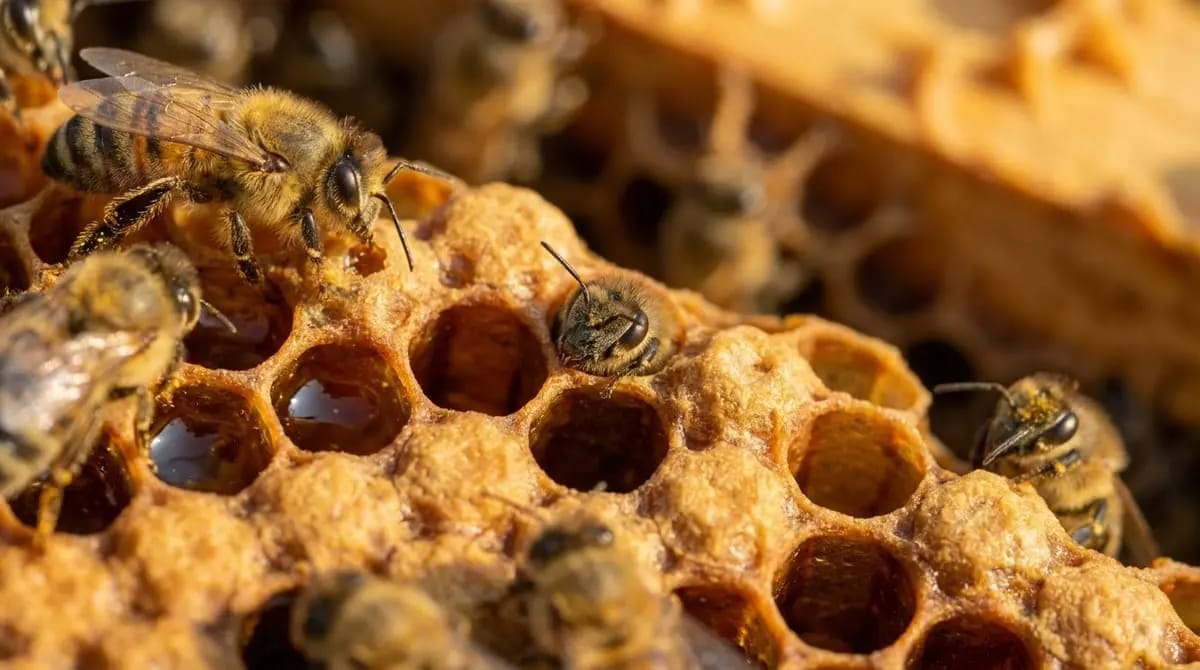
A bee colony is one of the most fascinating systems in nature. Up to 50,000 individuals work together without central control -- coordinated by pheromones, dances, and simple rules that give rise to astonishingly complex behaviour. Biologists speak of a superorganism: the colony as a whole behaves like a single living being.
To take good care of your bees, you need to understand how this system works. In this lesson, you will meet the three castes of bees, follow the journey from egg to adult bee, and discover the sophisticated communication system inside the hive.
The Three Castes
Every bee colony contains exactly three types of bees (called castes), which differ fundamentally in size, lifespan, and tasks.
The Queen -- the Heart of the Colony
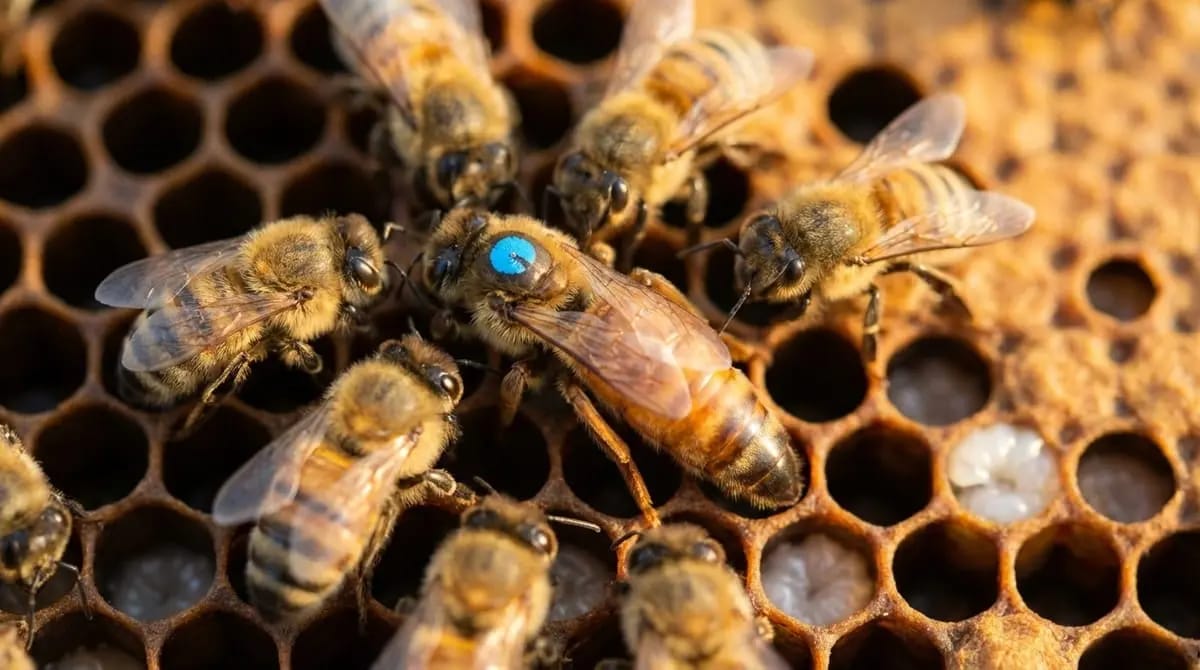
The queen is the only fully fertile female in the colony. She is about 18--22 mm long -- significantly larger than workers -- and has a slender, elongated abdomen. Her entire life revolves around a single task: laying eggs.
Characteristics of the queen:
- Slender, long abdomen (extends beyond the wings)
- Smooth stinger (can sting multiple times, but only does so against rival queens)
- Constantly surrounded by 8--12 retinue bees that feed and groom her
- Lives 3--5 years (compared to workers in summer: only 6 weeks)
- Often marked by beekeepers with a coloured dot (birth year colour)
Internationally, queens are marked by birth year: White (years ending in 1/6), Yellow (2/7), Red (3/8), Green (4/9), Blue (5/0). So in 2026, it is White. This lets you tell at a glance how old your queen is.
What the queen accomplishes:
At midsummer, the queen lays up to 2,000 eggs per day -- nearly her own body weight! She decides whether an egg is fertilised (producing a worker) or unfertilised (producing a drone). She makes this decision based on cell size: drone cells are noticeably larger than worker cells.
On her single mating flight (sometimes 2--3 flights in the first days of life), the young queen mates with 10--20 drones in mid-air. She stores the collected sperm in a spermatheca -- a special organ that keeps the sperm viable for years. After that, she normally never leaves the hive again, unless the colony swarms.
The Workers -- the Backbone of the Colony
Workers are infertile females and, at 98--99 %, make up the overwhelming majority of the colony. They are 12--15 mm long and true multi-talents: over the course of their short lives, they cycle through an astonishing series of professions.
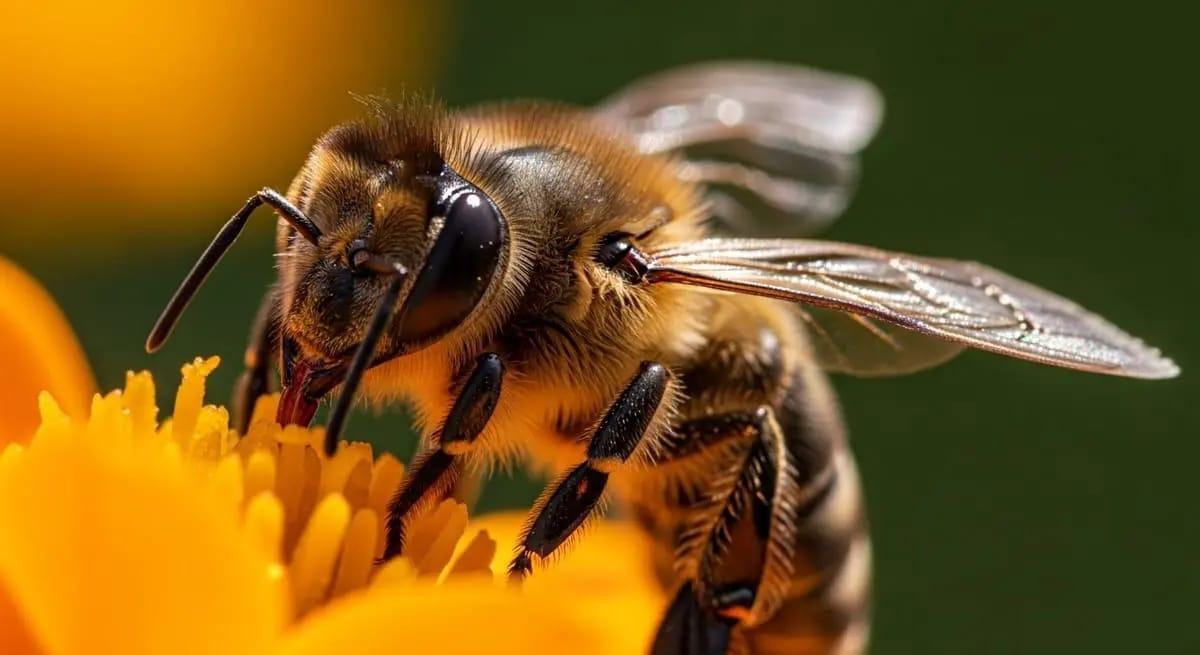
Physical features:
- Compound eyes with approx. 5,000 individual lenses (ommatidia)
- Wax glands on the abdomen (active between days 12--18)
- Venom gland and stinger with barbs (one sting = death of the bee)
- Pollen baskets (corbiculae) on the hind legs for pollen transport
- Honey stomach (crop) holding approx. 40 mg of nectar
- Scent gland (Nasanov gland) on the abdomen for orientation
The Drones -- the Male Bees
Male honey bee that develops from an unfertilised egg and whose sole purpose is to mate with young queens.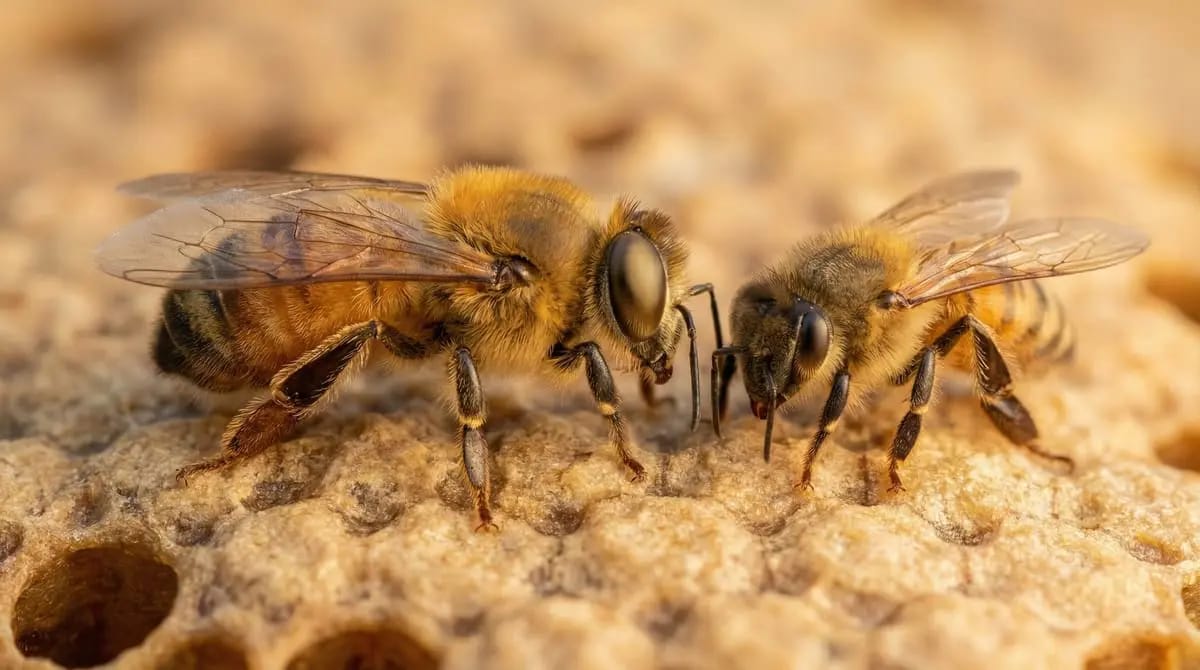
Drones are the male bees and, at 15--17 mm, are somewhat larger than workers. They have enormous compound eyes (nearly meeting at the top of the head), no stinger, and cannot feed themselves -- they are fed by workers.
Characteristics of drones:
- Large, round eyes (approx. 7,000--8,000 ommatidia -- significantly more than workers)
- Broad, blunt abdomen
- No stinger, no wax glands, no pollen baskets
- Loud, buzzing flight
- Live approx. 30--50 days (spring to summer)
A colony maintains 500--2,000 drones in summer. Their sole biological function: the mating flight with young queens. Drones from different colonies gather at specific locations at 15--30 m altitude -- so-called drone congregation areas -- and wait there for passing queens. Mating is fatal for the drone.
In late summer (July/August), when no more young queens are expected, the workers drive the drones out of the hive -- the so-called drone eviction. Since they cannot feed themselves, they starve. This sounds brutal but is biologically sensible: in winter they would only consume precious stores.
Comparison: Three Castes, One Colony
| Feature | Queen | Worker | Drone |
|---|---|---|---|
| Sex | Female (fertile) | Female (infertile) | Male |
| Number in colony | 1 | 20,000--50,000 | 500--2,000 (summer only) |
| Body length | 18--22 mm | 12--15 mm | 15--17 mm |
| Lifespan | 3--5 years | 6 weeks (summer) / 6 months (winter) | 30--50 days |
| Development time (egg to bee) | 16 days | 21 days | 24 days |
| Larval food | Royal jelly only | 3 days royal jelly, then pollen + honey | 3 days royal jelly, then pollen + honey |
| Stinger | Smooth (reusable) | Barbed (single use) | None |
| Main task | Laying eggs, holding colony together | All tasks in hive and field | Mating with young queens |
Genetically, queen and worker are identical -- both hatch from fertilised eggs. The difference lies solely in feeding: if a larva is fed exclusively with royal jelly beyond the first 3 days (instead of pollen-honey paste), she develops into a queen. The colony can therefore "create" a new queen from a young worker larva at any time -- an emergency queen (supersedure queen).
From Egg to Bee: The Development Cycle
Every bee goes through four stages: Egg - Larva - Pupa - Adult bee. The duration varies by caste.
- 1
Days 1--3: The Egg
The queen lays a tiny, rice-grain-shaped egg (1.3 mm) upright in a clean cell. During the first 3 days it stands upright; on day 3 it lies flat -- an important indicator for beekeepers to estimate the age of the brood.
- 2
Days 4--9: The Open Larva (Round Larva)
A tiny larva hatches from the egg, curled like a small "C" in its cell. It is intensively fed by nurse bees and grows extremely fast: in just 6 days it increases its weight by 1,500 times. Nurse bees visit each larva up to 10,000 times.
- 3
Day 9/10: Capping
When the larva is fully grown, workers seal the cell with a breathable wax cap. Inside, the larva spins a thin cocoon and begins its transformation.
- 4
Days 10--21 (Worker): The Pupa
Inside the capped cell, complete metamorphosis takes place: the grub-like larva transforms into a fully formed bee with legs, wings, compound eyes, and all organs. The duration of the pupal phase differs: queen 7 days, worker 12 days, drone 15 days.
- 5
Emergence: The Finished Bee
The young bee gnaws through the wax cap and emerges. She is still pale and soft (recognisable by the lack of hair). Within a few hours her chitin exoskeleton hardens and she begins her first task: cleaning cells.
The development times are crucial for swarm control: if you find a sealed queen cell during an inspection, you know the queen will emerge in a maximum of 8 days. That is why you check every 7 days during swarming season.
The Division of Labour: A Life of Professions
The most fascinating thing about workers is that over the course of their lives they cycle through different professions. This system is called age polyethism -- the task depends on age.
- 1
Days 1--3: Cell Cleaner
The freshly emerged bee cleans cells so the queen can lay new eggs in them. Each cell is cleaned up to 40 times and disinfected with a thin layer of propolis.
- 2
Days 3--10: Nurse Bee
Her food glands (hypopharyngeal glands) become active. She produces royal jelly and feeds the larvae -- an enormously energy-demanding task. A nurse bee visits each larva up to 10,000 times.
- 3
Days 10--16: Builder Bee
Now the wax glands on the abdomen become active. The bee produces tiny wax scales (8 glands, 0.8 mg each) and builds new comb from them. For 1 kg of beeswax, bees need about 6--7 kg of honey as an energy source.
- 4
Days 12--18: Honey Processor
She receives nectar from returning foragers, enriches it with enzymes (invertase splits sucrose into glucose and fructose), and dries it through repeated transfer to below 18 % moisture content -- only then is it ripe honey and gets capped.
- 5
Days 18--21: Guard Bee
At the hive entrance, she checks by colony scent (pheromones on the cuticle) whether arriving bees belong to the colony. Foreign bees or wasps are repelled.
- 6
From Day 21: Forager (Field Bee)
The last 2--3 weeks of her life are spent outside. She collects nectar, pollen, water, and propolis, flying up to 10 foraging trips daily. Per trip she visits 50--1,000 flowers. Her wings wear out in the process -- after approximately 800 km total flight distance, they are so worn that the bee dies.
The age sequence is not a rigid schedule. In emergencies, bees can skip or repeat professions: if nurse bees are suddenly missing, older bees can reactivate their food glands. If foragers are lacking, younger bees fly out earlier. The colony responds as a whole to its needs.
Communication: How Bees "Talk"
Bees do not have a brain comparable to ours -- yet they communicate with remarkable precision. They use three main channels: dance, pheromones, and vibration.
The Waggle Dance
 AI-generated
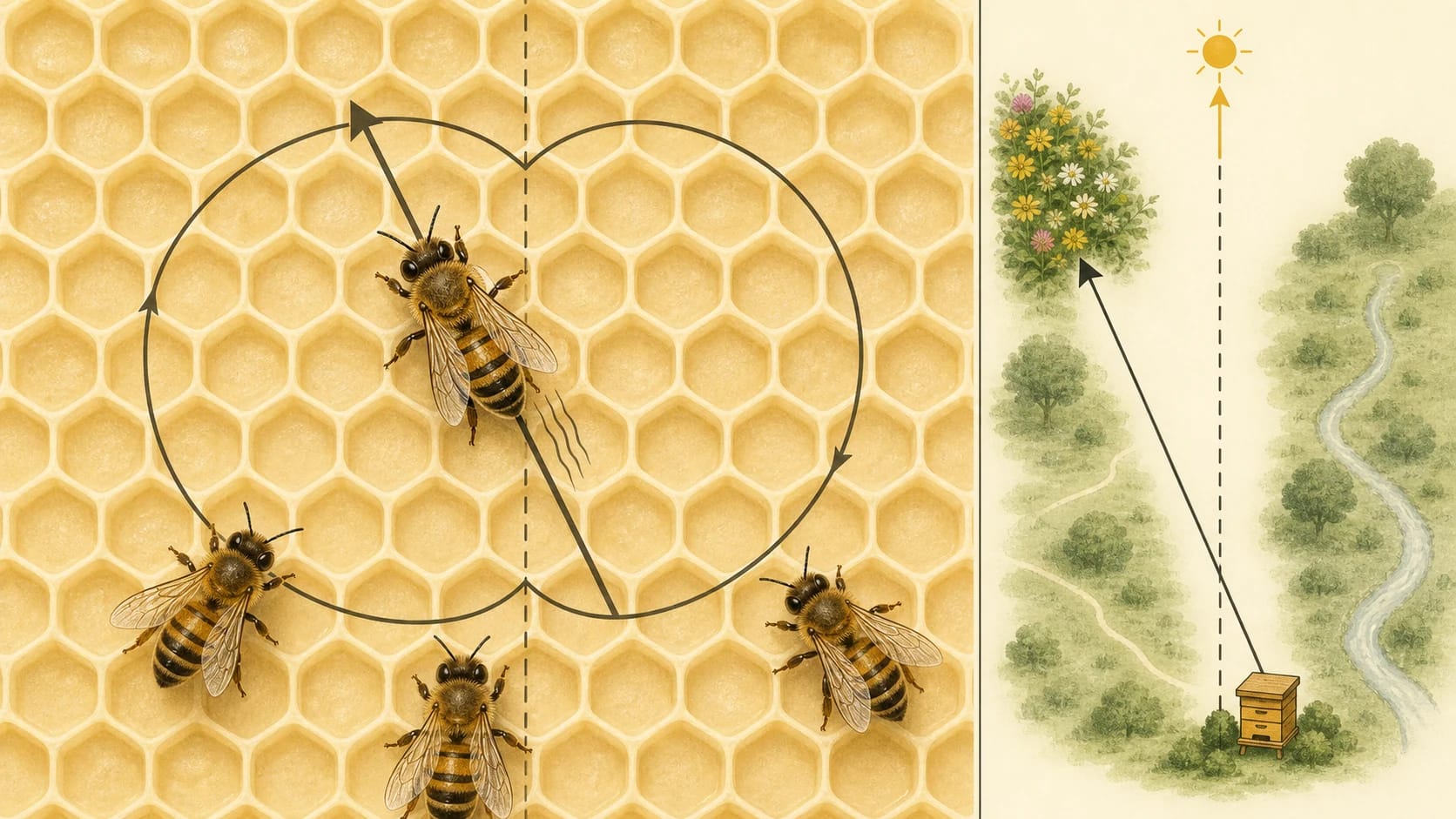
The Austrian behavioural scientist Karl von Frisch published his groundbreaking work on the language of bees in 1923 and received the Nobel Prize for it in 1973. Here is how the waggle dance works:
- Round dance: For a very nearby food source, the bee mainly runs in circles. Round and waggle dances grade into one another; there is no rigid distance threshold.
- Waggle dance: The bee repeatedly performs a straight waggle run, returning alternately to the left and right. The angle of the straight run from vertical indicates direction relative to the sun. Its duration increases with distance; there is no universally valid metres-per-second conversion.
- Intensity: The more productive the source, the more vigorous and prolonged the dance
Pheromones: The Chemical Language
Pheromones are chemical messengers that influence the behaviour of other bees. The most important ones:
- Queen Mandibular Pheromone (QMP): The queen produces a cocktail of scents that holds the colony together, suppresses ovary development in workers, and regulates the swarming impulse. When the pheromone wanes (ageing queen), the colony begins raising new queens
- Alarm pheromone: Released when stinging, it smells like banana and directs other bees to attack the same spot -- which is why you should never crush a sting
- Nasanov pheromone: The scent gland at the abdomen tip is "fanned" to provide orientation -- for example at the hive entrance or at a new home during swarming
- Colony scent: Each colony has its own odour (cuticular hydrocarbons), by which guard bees distinguish friend from foe
Vibration and Piping
Bees also communicate through vibrations in the comb:
- Piping: Shortly before emergence, mature queens "toot" in their cells -- the old queen responds. This is how they "negotiate" who stays and who leaves with a swarm
- Stop signal: Head-butt plus vibration -- signals a dancing bee that the source is dangerous
- Shaking signal: A bee grabs another and shakes her for 1--2 seconds -- a request to speed up work. Particularly frequent before swarming
Why All of This Matters for You as a Beekeeper
This knowledge is not just fascinating -- it is the foundation for good beekeeping practice:
- You can tell whether your queen is fine (closed brood pattern, eggs present)
- You understand why colonies want to swarm at certain times (insufficient queen pheromone, lack of space)
- You know why Varroa treatment after the honey harvest is so important (the mite reproduces in capped brood)
- You detect brood diseases earlier (irregular brood pattern, abnormal capping)
- You understand the rhythm of your bees and work with them rather than against them
The individual bee is not the subject of our observation, but rather the colony as a whole. Only those who understand the colony can understand the bee.
Knowledge Check
In the next lesson, it gets practical: you will learn what essential equipment you really need, what it costs, and where you can save money when buying.