Your Essential Equipment: What You Really Need
Hive, smoker, veil -- beekeeping equipment in detail. What you really need, what it costs, and where you can save money.
Getting started in beekeeping requires a certain initial investment. The good news: most equipment lasts many years, and you do not need everything from day one. In this lesson, you will learn what is truly essential, what is optional, and where you can save money strategically.
Buy the essentials first in good quality rather than everything at once in cheap versions. A solid hive lasts 20+ years, a good hive tool lasts a lifetime. Cheap equipment only frustrates and needs replacing soon.
Essential vs. Optional: The Overview
Before we dive into detail, here is a clear distinction: What do you absolutely need for the start, and what can wait?
| Essential (for the start) | Optional (can wait) |
|---|---|
| Hive (boxes + floor + roof) | Honey extractor (borrow from club!) |
| Frames + foundation | Uncapping equipment |
| Veil / bee hat | Refractometer |
| Gloves | Nucleus boxes |
| Hive tool | Queen excluder |
| Smoker | Wax melter |
| Bee brush | Bee escape board |
| Feeder (top feeder or frame feeder) | Hive scale (digital) |
Let us now look at each essential item in detail.
1. The Hive: Your Bees' Home
The housing (the "bee box") in which a bee colony lives. Modern hives consist of stackable boxes containing removable frames.The hive is the largest single investment and the most important decision you make at the start. Different countries and regions favour different hive systems.
Common Hive Systems
| System | Frame Size | Advantages | Disadvantages |
|---|---|---|---|
| Langstroth | 448 x 232 mm | International standard, huge range of accessories, well-documented | May need two brood boxes, heavy when full |
| Zander | 420 x 220 mm | Popular in central Europe, good compromise | Not compatible with Langstroth |
| Dadant (modified) | 435 x 300 mm (brood) | Large brood box (1 box suffices), professional standard | Heavy brood boxes (approx. 30 kg full), more expensive |
Use the same system as your mentor and your local beekeeping group! Then you can easily exchange frames, foundation, and nucleus colonies. Switching hive systems later is extremely laborious. Ask your local association before you buy.
Structure of a Modern Hive
A modern hive consists, from bottom to top, of:
- 1
Hive Stand
Raises the hive approx. 30--40 cm off the ground. Protects against moisture and mice, and saves your back during work. Simple solutions: two pallets, bricks, or a metal stand.
- 2
Floor Board (Screened Bottom Board)
The bottom of the hive. A screened bottom board (mesh instead of solid board) is now standard: it improves ventilation, lets Varroa mites fall through, and enables monitoring with a sticky board insert.
- 3
Brood Box (1--2 boxes)
This is where the colony lives: the queen lays eggs, brood is raised, pollen and honey are stored as reserves. Depending on frame size, you need one box (Dadant) or two (Langstroth/Zander).
- 4
Queen Excluder (optional)
A grid with exactly 4.2 mm mesh: workers pass through, but the larger queen cannot. This keeps the honey super brood-free -- important for clean honey. Not all beekeepers use one.
- 5
Honey Super (1--2 boxes)
This is where bees store the surplus honey you harvest. Honey supers are often shallower (half-depth or medium), so they do not get too heavy -- a full honey super weighs 20--25 kg!
- 6
Inner Cover + Outer Cover
The inner cover (film or board) seals the bee space at the top. The outer cover (metal roof) protects against rain and sun. Some beekeepers place additional insulation between them.
Frames and Foundation
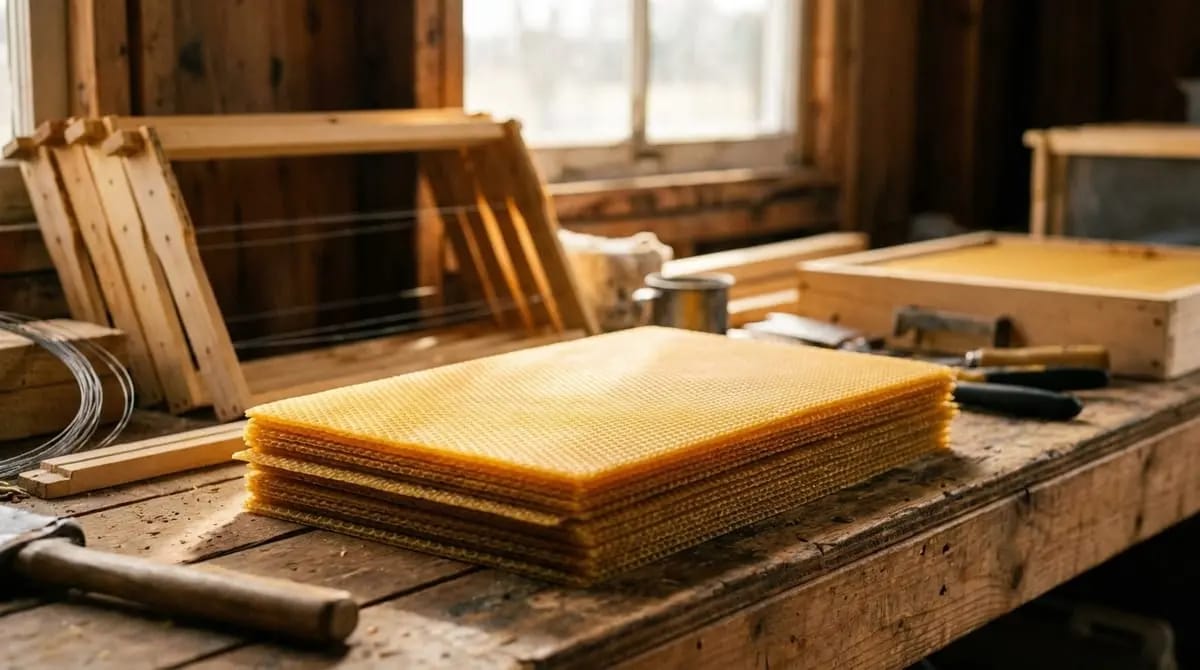
Each box holds frames (wooden rectangles) into which you install foundation (thin wax sheets with a pre-pressed cell pattern). The bees then build these out into complete combs.
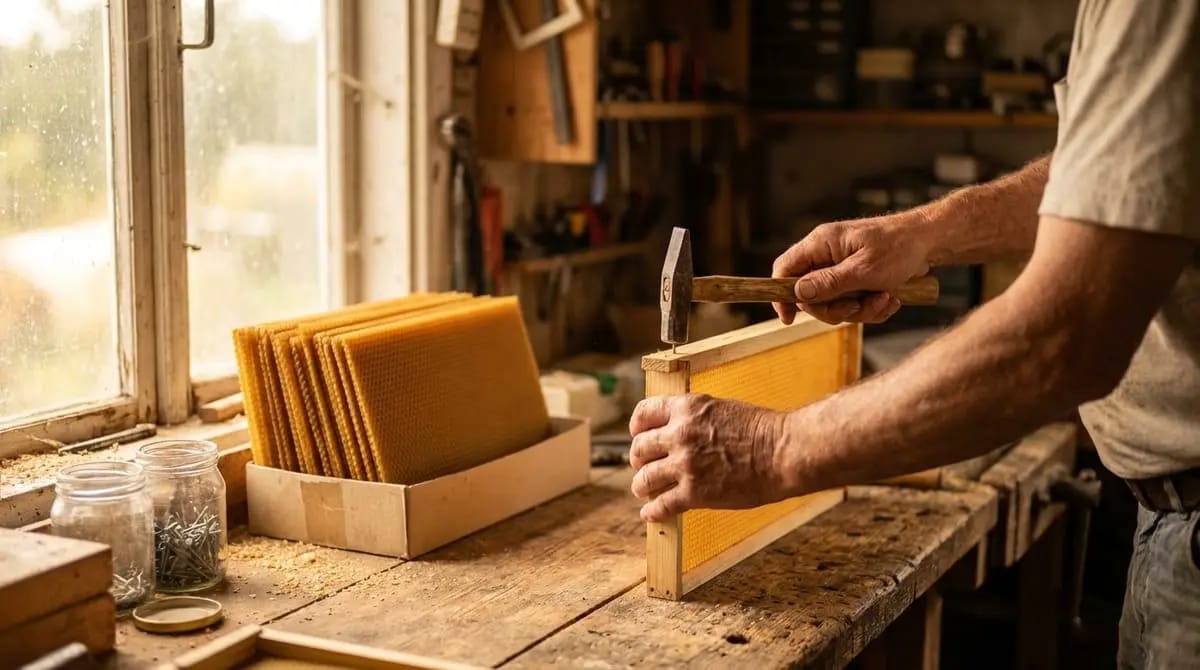
Many beekeepers assemble their own frames from pre-cut components -- this saves money and is enjoyable. A ready-made, wired frame with foundation costs approx. €2--3 in the shop; self-assembly comes to about €1--1.50. At 100+ frames, it adds up.
Cost for a hive (1 colony, complete):
- Hive (2 boxes + floor + roof): €80--150
- 20 frames + foundation: €40--60
- Honey super + frames: €50--80
- Total per colony: approx. €170--290
2. Protective Clothing: Safety First
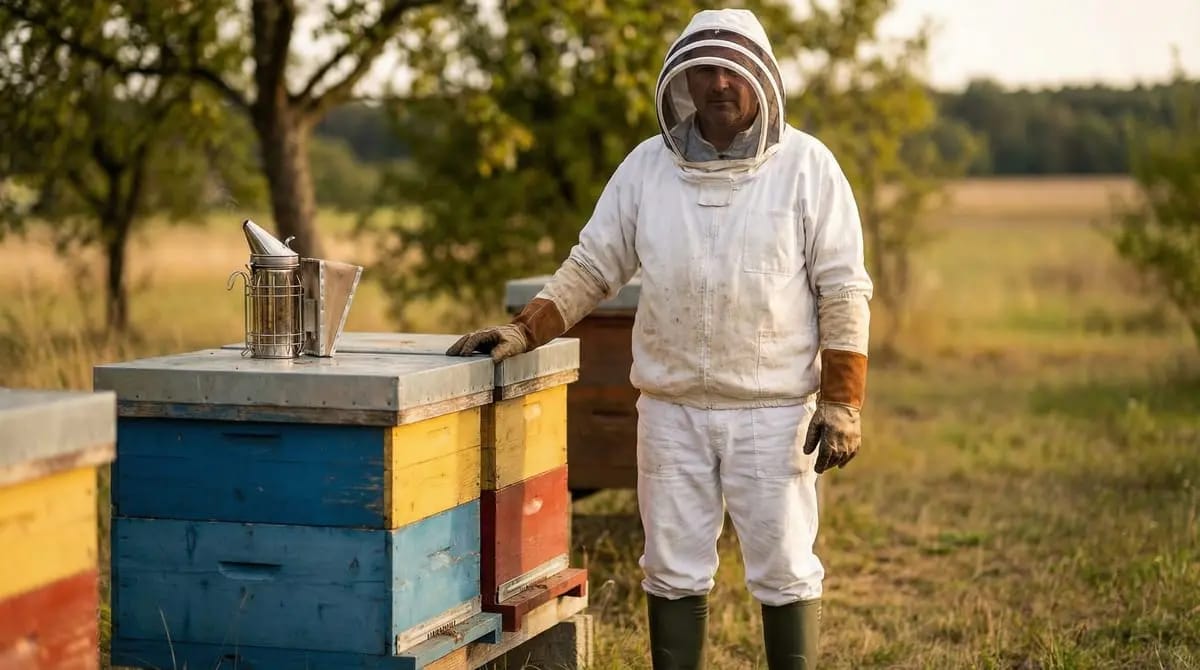
Bees sting when they feel threatened. Especially as a beginner, when you are still unsure and the bees sense it, good protective clothing is not a luxury but a necessity.
Veil / Bee Hat
The veil is the most important part of your protective gear. Stings to the face are not only painful but can be dangerous if swelling occurs around the throat.
There are various types:
| Type | Price | Advantages | Disadvantages |
|---|---|---|---|
| Round veil (hat veil) | €15–30 | Affordable, light, good visibility | Can press against face (sting through mesh) |
| Fencing veil with hat | €25–50 | Rigid standoff from face, good ventilation | Bulkier |
| Bee jacket with integrated veil | €50–100 | Full upper body + face protection, no slipping | Warm in high summer |
| Full-body suit | €80–150 | Maximum protection, ideal for beginners | Hot, slightly cumbersome to put on/take off |
Start with a bee jacket with integrated veil. It provides good protection, does not slip, and is quick to put on. You usually do not need a full-body suit -- long, light-coloured trousers and sturdy boots are sufficient below.
Gloves
Beekeeper gloves have long gauntlets that reach over the forearms. There are two philosophies:
- Leather gloves (thick): Good sting protection but little dexterity. Ideal for beginners and with defensive colonies.
- Nitrile/latex gloves (thin, disposable): Much better feel when handling frames, but less sting protection. Many experienced beekeepers prefer these.
Tip: Start with leather gloves. After a few months, once you have more routine and confidence, try thin disposable gloves -- you will immediately notice the difference.
3. Tools: The Essential Three
Three tools you will need at every single inspection. They are your everyday implements.
The Hive Tool
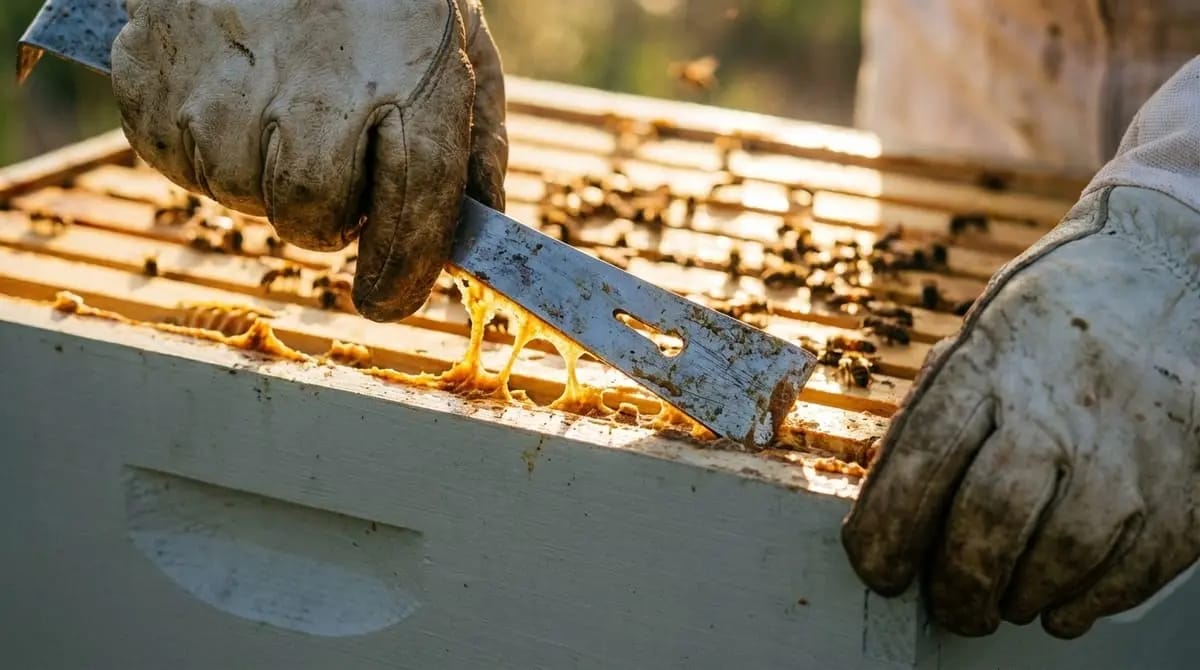
The hive tool is a flat metal implement with different ends:
- Flat end: For prying apart boxes and frames sealed with propolis
- Curved end: For levering out individual frames
- Scraping: For removing brace comb, excess wax, and propolis
Bees seal everything with propolis (a resinous substance collected from tree buds). Boxes, frames, gaps -- everything gets glued shut. Without a hive tool you literally cannot open a single hive.
Cost: €8--20 (stainless steel recommended -- does not rust)
The Smoker
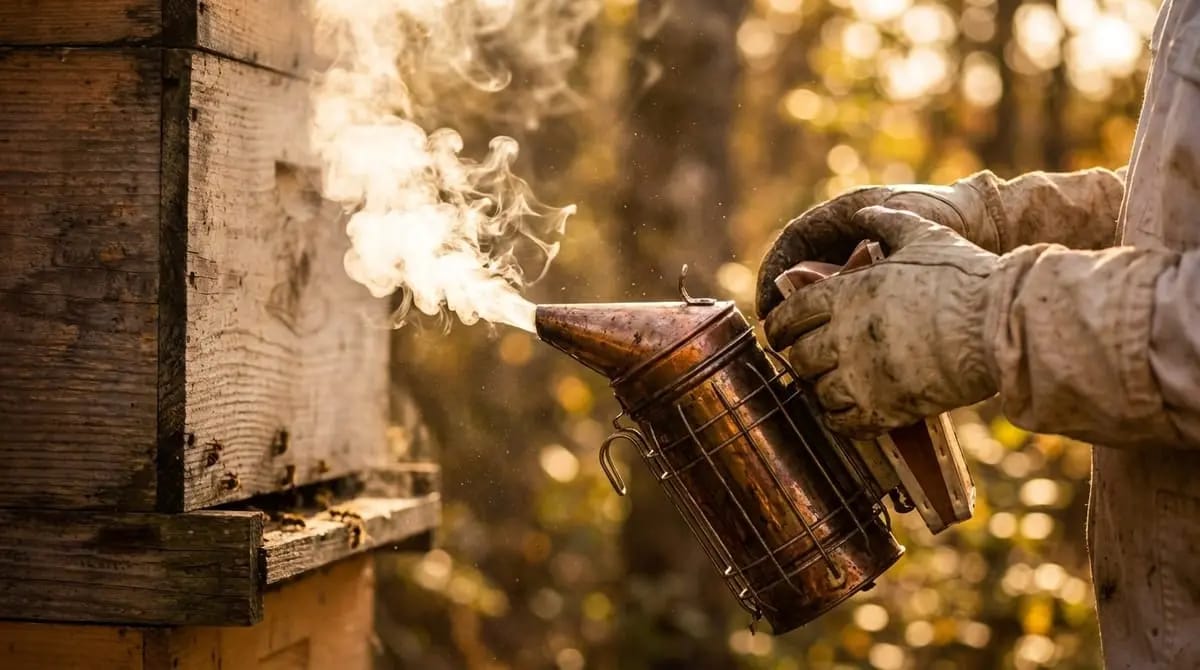
The smoker is a small metal canister with bellows in which you generate smoke. It is your most important tool for calming the bees.
Why does smoke work? When bees smell smoke, they instinctively think of wildfire and start gorging on honey -- in case they need to flee. Gorged bees are noticeably calmer because they physically cannot curl up to sting as easily. At the same time, smoke masks alarm pheromones.
Smoke fuel: Use natural, slow-smouldering materials:
- Good: Hessian/burlap, egg cartons, dry hay, wood shavings, herbs
- Bad: Newspaper (too hot, chemical ink), cardboard (smells bad)
Use the smoker sparingly: 2--3 gentle puffs at the entrance and under the cover usually suffice. Too much smoke stresses the bees unnecessarily and can taint the honey flavour. Experienced beekeepers often get by with just a few puffs per inspection.
Cost: €25--50 (stainless steel, medium size recommended)
The Bee Brush
A soft brush (natural or synthetic bristles) for gently sweeping bees off frames and boxes -- for example during honey harvest, when you need bee-free combs.
Cost: €5--12
4. Feeding: Be Prepared
After the honey harvest in summer, you must replace the honey you took with sugar syrup or feed so the bees have enough winter stores. For this you need:
Top Feeder or Frame Feeder
- Top feeder: A special box placed on top of the hive containing a trough for syrup. Holds 3--5 litres. Cost: €15--30
- Frame feeder: Hangs inside the hive like a frame. More space-efficient but smaller volume (1--2 litres). Cost: €8--15
Standard feed is a mixture of sugar and water (3:2 ratio) or ready-made bee syrup from specialist suppliers. Never feed honey from an outside source -- it could contain American Foulbrood spores that can destroy your colony!
The Complete Shopping List
Here is everything at a glance -- with realistic prices for starting with 2--3 colonies:
| Category | Item | Price (approx.) |
|---|---|---|
| Hive | 2--3 complete hives (boxes + floor + roof) | €250–450 |
| Hive | Frames + foundation (60--80 pieces) | €80–160 |
| Hive | Honey supers + frames | €80–150 |
| Protection | Bee jacket with veil | €50–100 |
| Protection | Leather gloves with gauntlets | €15–30 |
| Tools | Hive tool (stainless steel) | €10–20 |
| Tools | Smoker (medium, stainless steel) | €25–50 |
| Tools | Bee brush | €5–12 |
| Feeding | 2--3 top feeders or frame feeders | €30–60 |
| Misc. | Sugar for winter feed (approx. 40--60 kg) | €30–50 |
| Misc. | Varroa treatment supplies | €15–30 |
Where to Buy? Your Options
Not everything has to come from a specialist retailer -- there are smart alternatives.
Beekeeping Suppliers (online & local)
The most reliable source. Look for established suppliers in your country or region. In Germany, for example, major suppliers include Bienen Voigt, Holtermann, Bienenweber, and Bergwinkel. In the UK, try Thorne or Maisemore. In the US, Mann Lake and Dadant are well-known.
Many associations organise an annual group order from a supplier (usually in autumn/winter). This saves you shipping costs and often gets a volume discount. Ask your association chair!
Beekeeping Association
- Second-hand hives and equipment (often cheap or free)
- Honey extractor for loan (saves €300--800!)
- First-hand reports on which products work well
- Group frame-building evenings
Buying Second-Hand
Only buy used hives from trusted sources (mentor, association). Hives of unknown origin may be contaminated with American Foulbrood spores -- a highly contagious, notifiable pathogen that destroys a colony. The spores survive for decades in the wood. When in doubt, scorch the inside with a blow torch or use new hives only.
What NOT to Buy at the Start
Avoid these common beginner mistakes:
Money-Saving Tips for Getting Started
Want to start but the budget is tight? Here are the best strategies:
Money-Saving Checklist for Beginners
The most important thing at the start is not the best equipment, but a good teacher. An experienced bee mentor is worth more than the most expensive hive.
What Else You Need (But Do Not Have to Buy)
A Hive Record / Stock Card
From your very first colony, you should document your observations: When did you inspect? How was the brood? Did you find queen cells? When did you treat, feed, harvest?
This is not only extremely valuable as a learning aid -- since 2022, the colony record book is mandatory for all EU beekeepers (documentation of treatments).
You can do it classically on paper -- or digitally with an app like Hivekraft, which sends you reminders, detects patterns, and maintains the colony record book automatically.
Patience and Humility
Not a tool you can buy, but the most important "equipment": Bees are wild animals with a mind of their own. In the first year you will make mistakes -- and that is perfectly fine. Every experienced beekeeper once started out and paid their learning dues.
If you have not yet attended a beginner course: that is the single most important first step. There you learn hands-on bee handling under supervision, can try out all the tools, and often get a direct recommendation for which hive system and equipment is standard in your local group. Most courses run from February to September and cost €50--150.
Knowledge Check
Congratulations -- you now know the basics of beekeeping, the biology of your bees, and the equipment you need. In the next lessons, it gets really practical: we will look at different hive types in detail and how to find the perfect location for your bees.