Your First Inspection: Step by Step
Learn how to inspect your bee colonies safely and efficiently -- from preparation through pulling frames to documentation.
The hive inspection is the heart of beekeeping. Here you look over your bees' shoulders, check their health, and make decisions for the coming weeks. For beginners, the first inspection is often exciting and a little nerve-wracking at the same time. Do not worry: with the right preparation and a clear structure, it quickly becomes routine.
An inspection (also called colony check or hive examination) is the systematic assessment of a bee colony. You open the hive, pull individual frames, and evaluate the colony's condition. Depending on the season and goal, there are quick checks (5 minutes) and thorough inspections (10--15 minutes).
When Is the Right Time?
Not every day is suitable for an inspection. Bees are poikilothermic (cold-blooded) and react sensitively to cold and bad weather. If you open the hive under unfavourable conditions, you chill the brood nest and stress the colony unnecessarily.
Ideal conditions:
- Temperature at least 15 degrees C (better 18--25 degrees C)
- Calm or only light wind
- Sunny to lightly overcast
- Between 10:00 and 16:00 (many foragers are out, fewer bees in the hive)
- No thunderstorm approaching (bees become aggressive before storms)
Never open the hive in rain, temperatures below 12 degrees C, or strong wind. The brood nest chills within minutes, and brood can freeze. Also during a nectar dearth, bees are particularly defensive -- better to wait for the next good day.
Preparation: Before You Open the Hive
Good preparation is half the work. When you have everything to hand, you can work briskly and calmly -- and that is exactly what your bees prefer.
Checklist: Inspection Preparation
Lighting the Smoker Properly
The smoker is your most important tool. The smoke simulates a wildfire -- the bees instinctively fill their honey stomachs and become calmer and less inclined to sting.
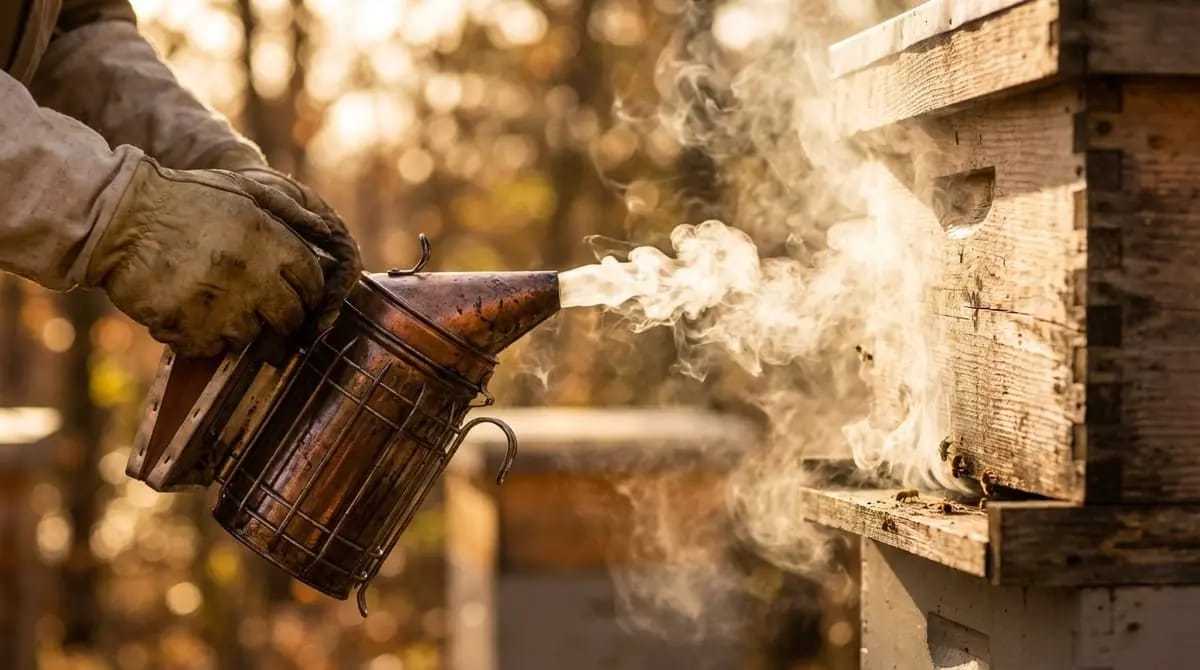
How to get the smoker burning reliably:
- Light newspaper and place it in the smoker
- Add some fuel (wood shavings, dried grass, egg carton)
- Pump vigorously until good smoke appears
- Add more fuel and pump gently
- Ready when cool, white smoke emerges -- not hot, acrid smoke!
Dried herbs like lavender or rosemary produce pleasant-smelling smoke. Never use plastic, treated wood, or chemical materials. The smoke should be cool and white -- hot, dark smoke irritates the bees.
The Inspection: Step by Step
Now it gets real. Stand to the side or behind the hive, never in front of the entrance. The bees' flight path must remain clear.
- 1
1. Apply Smoke
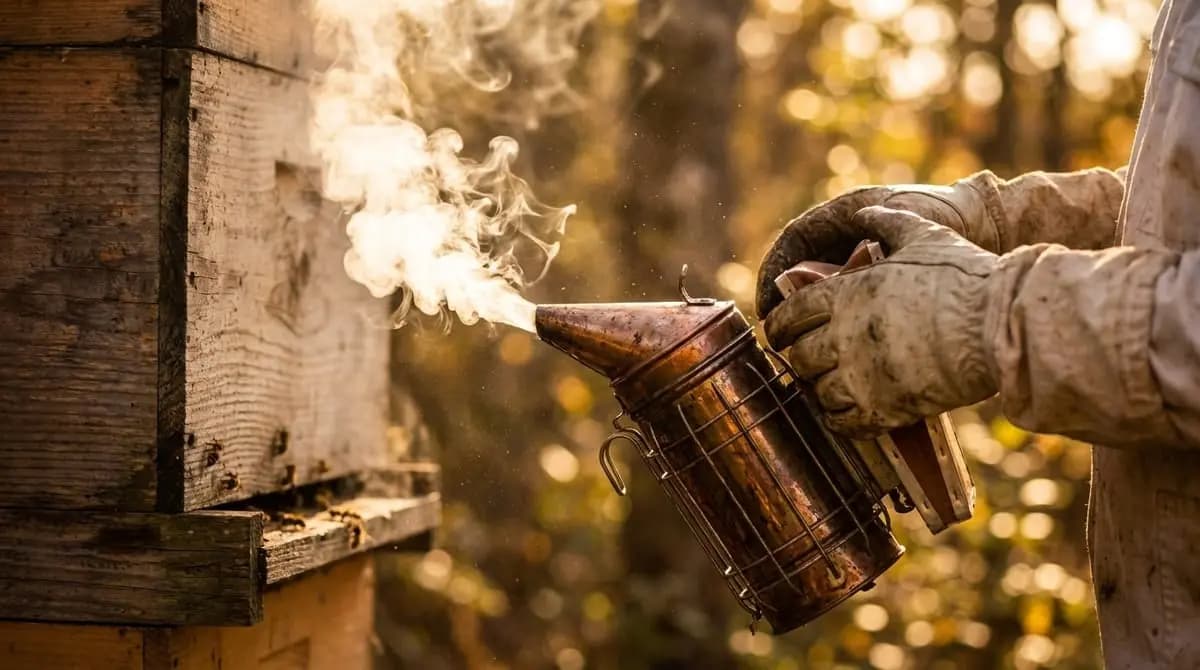
Give 2--3 puffs of smoke into the entrance and wait 30 seconds. The bees will now start filling up on honey. Then give 1--2 puffs from above under the cover before removing it.
- 2
2. Remove Cover and Film
Carefully lift off the cover and place it upside down beside the hive. If there is a cover film, loosen it slowly from back to front and fold it over. Another brief puff of smoke over the top bars.
- 3
3. Pull the Edge Frame
Always start with an edge frame (food frame). It is least populated and easy to remove. Loosen it from the rabbet with the hive tool and pull it up slowly and evenly. Lean it against the hive wall or place it in a frame holder.
- 4
4. Check Frames One by One
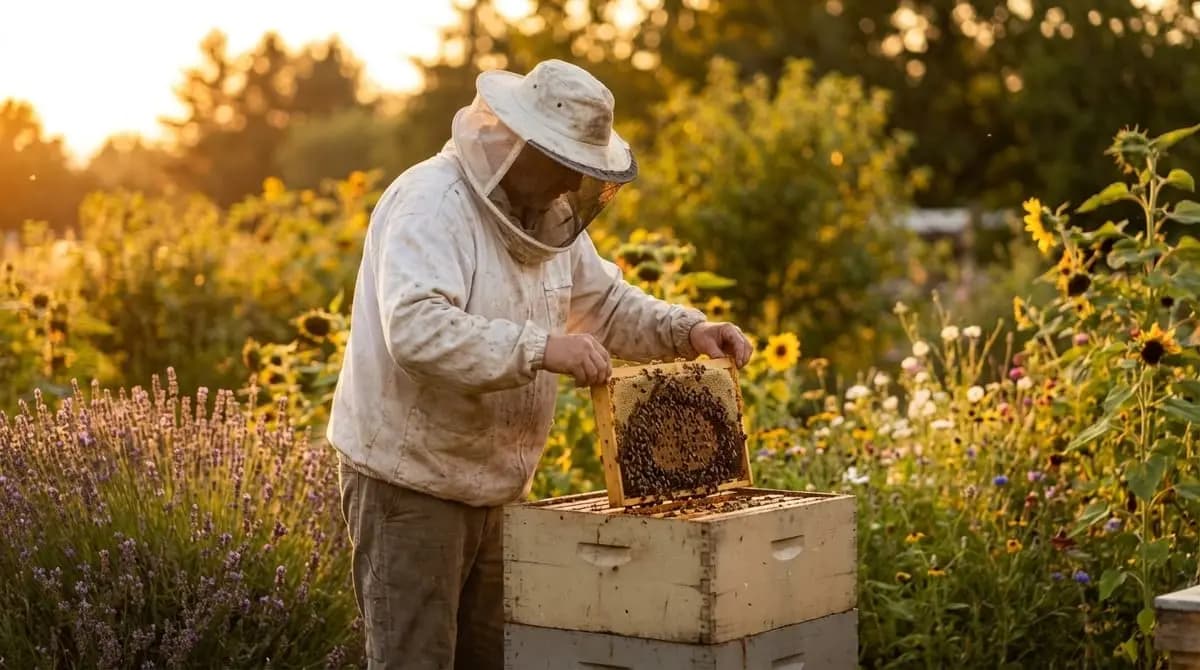
Now you have space. Slide the next frame into the gap and pull it out. Work through the colony frame by frame. Assess each frame for: brood, food, bee coverage, condition.
- 5
5. Assess Brood Frames
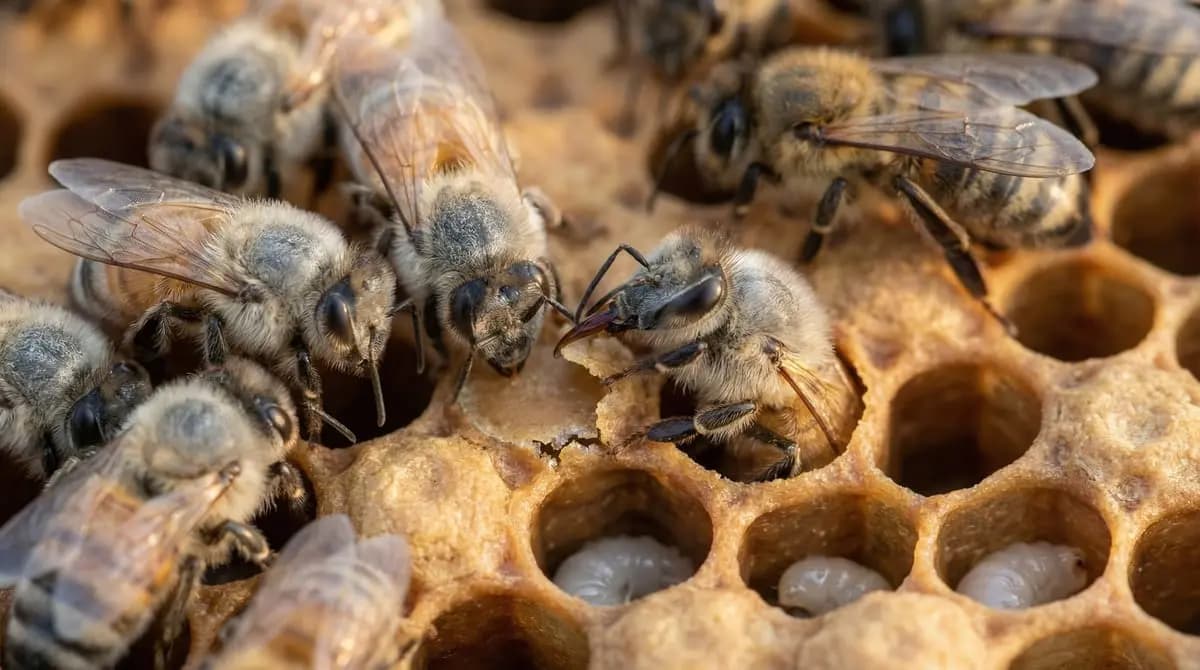
The brood nest is the heart of the colony. Here you look for: fresh eggs, open brood (larvae), capped brood. A closed brood pattern with few gaps indicates a healthy colony. Pay attention to the age of the brood -- eggs stand upright in the cell and are tiny.
- 6
6. Search for the Queen (optional)
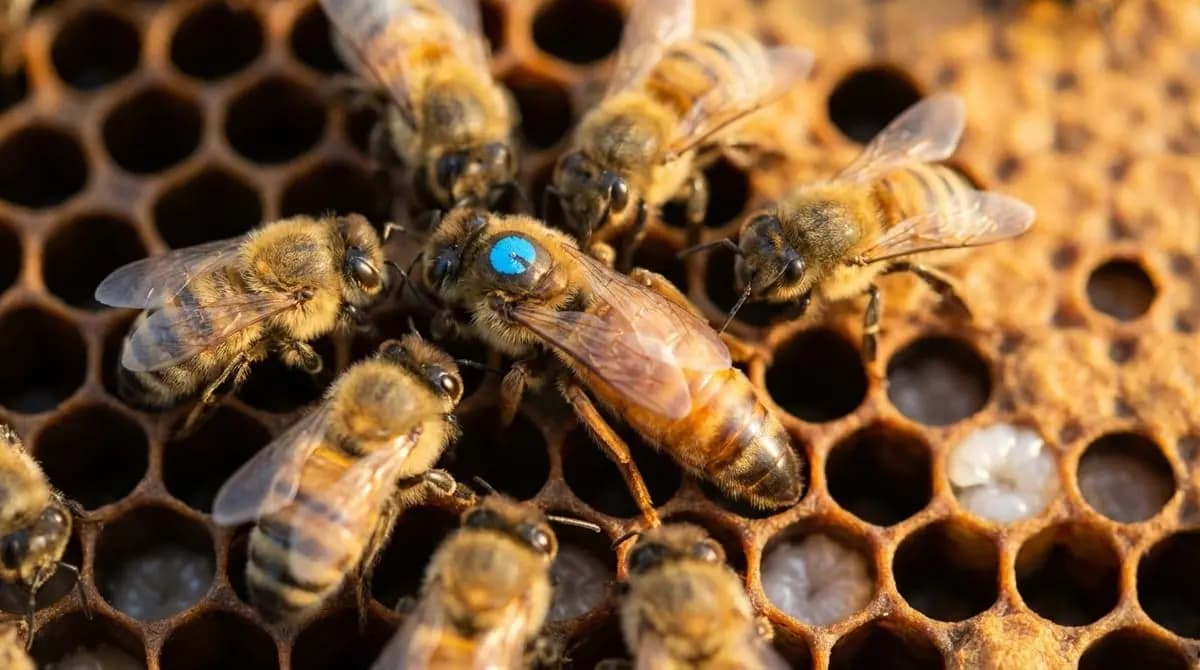
You do not need to find the queen at every inspection. Fresh eggs (max. 3 days old) are reliable proof that she is present and laying. If you see her: great. If not but eggs are present: no problem. With marked queens, searching is much easier.
- 7
7. Watch for Abnormalities
While checking frames, pay special attention to: queen cells or play cups (swarming mood?), spotty brood (disease?), unusual smell (foulbrood?), no eggs (queen gone?), chalkbrood mummies on the floor board. Note everything you observe.
- 8
8. Food Check
Estimate food reserves. In spring, at least 5 kg of food should be present. A fully capped standard frame contains about 2 kg of honey. If reserves are low, you must emergency-feed (sugar syrup 1:1 or fondant).
- 9
9. Replace Frames
Hang all frames back in the same order. The brood nest must not be split apart. Be careful not to crush any bees. Insert the edge frame last, carefully.
- 10
10. Close Hive and Document
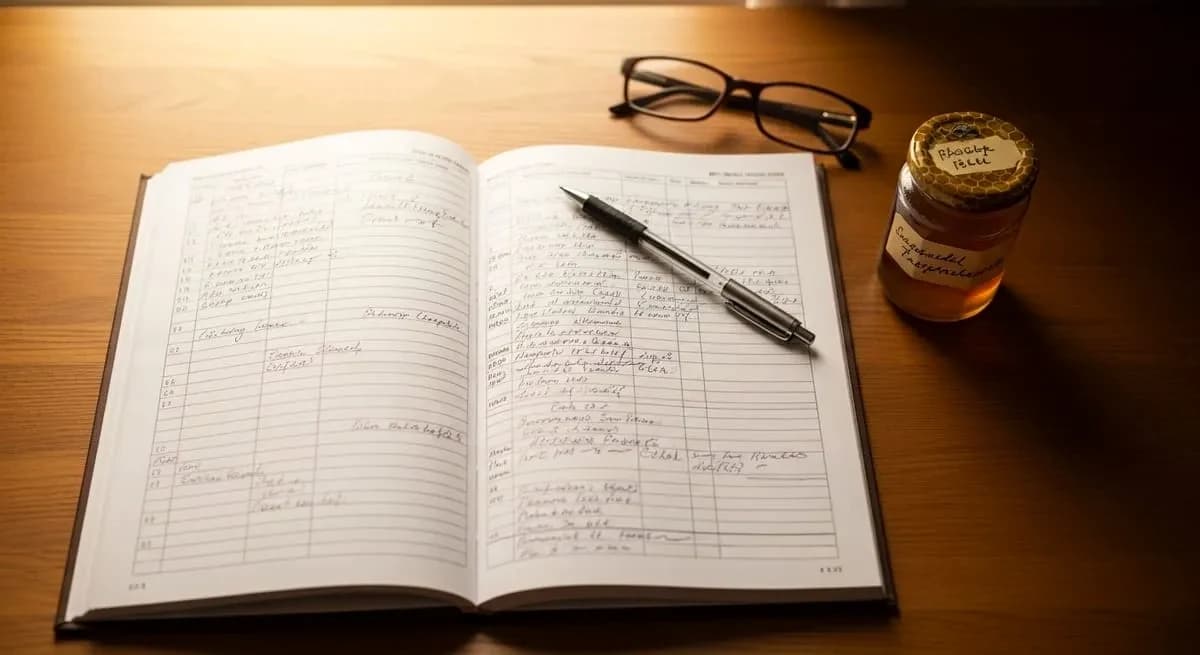
Replace the film and cover. Now immediately note down what you saw: colony strength, eggs yes/no, food level, abnormalities, next action. What you do not document, you will certainly forget by the next inspection.
How to Hold a Frame Correctly
Correct handling of frames is essential. A wrongly held frame can break, brood can fall out, and the queen can be lost.
The correct technique:
- Grip the frame by the lugs (ends of the top bar)
- Hold it vertically (upright) -- never tilt horizontally!
- To see the other side: rotate the frame around the vertical axis (like turning a page)
- Always hold frames over the hive -- if the queen falls off, she falls back into the colony
- Never rotate horizontally -- fresh honey and larvae will fall out
Fresh, uncapped honey and young larvae have no hold when the frame is held horizontally. They fall out, brood dies, and you have a mess. Always hold the frame vertically and only rotate around the vertical axis.
What Are You Looking For During an Inspection?
Depending on the season and situation, inspections have different focal points. Here are the key criteria you should assess at every inspection:
| Criterion | Good Sign | Warning Signal |
|---|---|---|
| Brood | Closed brood pattern, all stages | Spotty brood, no eggs |
| Queen | Eggs present (evidence suffices) | No eggs for more than 5 days |
| Food | 3--5 kg reserves (ring around brood nest) | Empty edge frames, colony starving |
| Colony strength | Occupied frames, calm colony | Few bees, aggressive behaviour |
| Queen cells | None or only empty play cups | Occupied/capped queen cells |
| Health | Clean brood, normal smell | Chalkbrood, foulbrood suspect, dysentery |
Documentation: What to Note?
The best inspection is useless if you do not record your observations. With 5, 10, or more colonies, you quickly lose track without records.
Note at least the following at every inspection:
- Date and time
- Weather and temperature
- Colony strength (occupied frame gaps)
- Eggs present? (Yes/No)
- Brood: open/capped, closed or spotty?
- Food reserves (estimated in kg)
- Queen cells seen? (Number, occupied?)
- Colony mood (calm, nervous, aggressive)
- Abnormalities and planned actions
As a beginner, the temptation is to examine everything in great detail at every inspection. But: every minute you have the hive open stresses the bees. Try, after a settling-in period, to limit pure inspection time to 5--10 minutes per colony. Experienced beekeepers complete a routine check in 3--5 minutes.
Common Beginner Mistakes
How Often to Inspect?
The frequency depends on the season:
| Period | Frequency | Focus |
|---|---|---|
| Spring (March--April) | Every 2--3 weeks | Colony development, food reserves |
| Swarming season (May--June) | Every 7 days | Queen cells, swarming mood |
| Summer (July--August) | Every 2--3 weeks | Nectar flow, honey supers, harvest readiness |
| Autumn (Sept.--Oct.) | Every 3--4 weeks | Feeding, Varroa treatment |
| Winter (Nov.--Feb.) | Not at all | Entrance observation from outside suffices |
Those who know their colonies well need to open them less often. A targeted 5-minute check says more than a half-hour search without a plan.
Knowledge Check
In the next lesson, you will learn all about swarming season -- the most exciting chapter in the beekeeping year.