Understanding and Managing Swarm Season
Recognising swarming mood, preventing swarms, and using the swarming instinct for colony multiplication -- the practical guide for beginners.
Swarming is one of the most fascinating natural spectacles you will experience as a beekeeper -- and at the same time one of the greatest challenges. A bee colony divides, thousands of bees rise into the air, and the old queen leaves with about half the colony for a new home. For the bees, this is reproduction at colony level. For you as a beekeeper, an uncontrolled swarm means lost harvest and a lot of work.
What Exactly Happens When Bees Swarm?
Swarming is the natural reproduction of the bee colony. Unlike mammals, which reproduce at the individual level, the bee colony reproduces as a whole: it divides into two halves.
The process in detail:
- The colony raises queen cells (new queens)
- Shortly before the first young queen emerges, the old queen leaves the hive with roughly half the bees
- The swarm initially gathers nearby as a swarm cluster (usually on a branch)
- Scout bees search for a new home (tree hollow, attic, empty hive)
- After a few hours to days, the swarm moves into the new dwelling
- In the mother colony, the new queen emerges, goes on her mating flight, and takes over egg laying
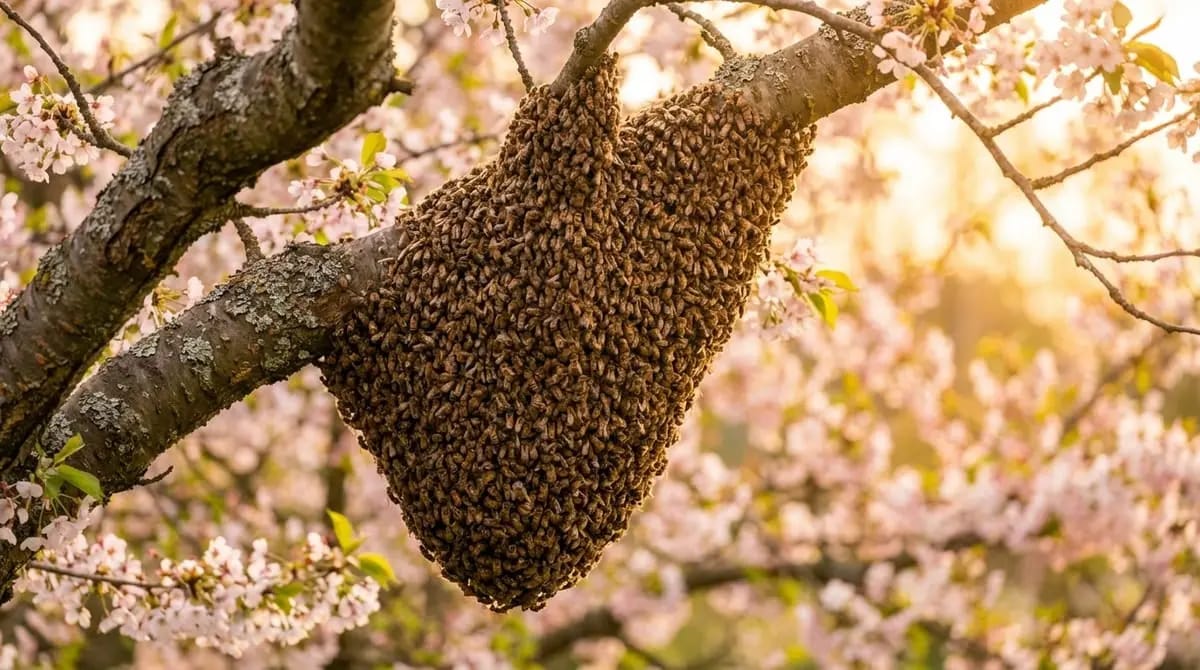
A swarm is surprisingly gentle. The bees gorged on honey before leaving and are sated and content. As long as you do not roughly grab into the swarm cluster, there is practically no risk of stinging. Nevertheless: wear protective gear.
Why Do Bees Swarm?
Swarming is not a sign of bad beekeeping -- it is a natural instinct. However, there are factors that strengthen the swarming drive:
- Lack of space: The most common trigger. The brood nest is full, the honey super is missing or too small
- Strong colony: Large, vital colonies are more inclined to swarm -- a sign of good health
- Old queen: Queens from their 2nd year onward swarm much more frequently
- Genetics: Some bee lines are more swarm-prone than others
- Nectar gap: Many bees but nothing to do -- boredom in the hive
- Heat and congestion: Warm early-summer weather in an overcrowded brood nest
The swarming drive is an expression of peak vitality. A swarming colony is not a sick colony -- it is a colony at the height of its development.
When Is Swarm Season?
Swarm season varies by region and climate. In central Europe it typically falls in May and June. In some years it starts as early as April; in mountain regions it can extend into July.
- MarchColony GrowthColonies grow strongly, drone brood begins. No swarming risk yet, but plan space.
- AprilFirst SignsPlay cups appear. Add honey super! Start swarm checks from mid-April.
- MayPeak PhaseMain swarming period. Checking every 7 days is mandatory. Most swarms leave in May.
- JuneSecond WaveAfterswarms possible. Continue weekly checks. Make splits as a pre-emptive swarm measure.
- JulySubsidingSwarming drive fades. Final checks, then focus on nectar flow and harvest.
- March
Colony Growth
Colonies grow strongly, drone brood begins. No swarming risk yet, but plan space.
- April
First Signs
Play cups appear. Add honey super! Start swarm checks from mid-April.
- May
Peak Phase
Main swarming period. Checking every 7 days is mandatory. Most swarms leave in May.
- June
Second Wave
Afterswarms possible. Continue weekly checks. Make splits as a pre-emptive swarm measure.
- July
Subsiding
Swarming drive fades. Final checks, then focus on nectar flow and harvest.
In Germany, swarm law is regulated in the Civil Code (BGB sections 961--964): when a swarm issues, the owner may immediately pursue it and may enter other people's property in doing so. If the owner does not pursue immediately or abandons the pursuit, the swarm becomes ownerless and may be captured by anyone. Similar principles exist in many countries, though specifics vary -- check your local regulations. Always inform your local beekeeping association if you capture a swarm.
Recognising Swarming Mood
Regular checking is the key. During swarm season (May--June), you must check every 7 days. Why exactly 7 days? Because a queen cell takes about 8 days from egg-laying to capping. If you check less frequently, a queen cell may be capped without you noticing -- and then the colony swarms.
The Three Alert Levels
Level 1 -- Observe:
- Play cups (empty, cup-shaped wax cells at the comb edge) -- this is normal and not yet cause for concern
- Increased drone comb building
Level 2 -- Act:
- Occupied queen cells (play cups with an egg or young larva)
- Much drone brood in the hive
- Bees "bearding" at the entrance (hanging as a cluster in front of the hive)
Level 3 -- Acute:
- Capped queen cells -- the swarm can leave at any time!
- Queen has reduced egg-laying (being slimmed down for flight)
- Foraging activity reduced despite nectar flow
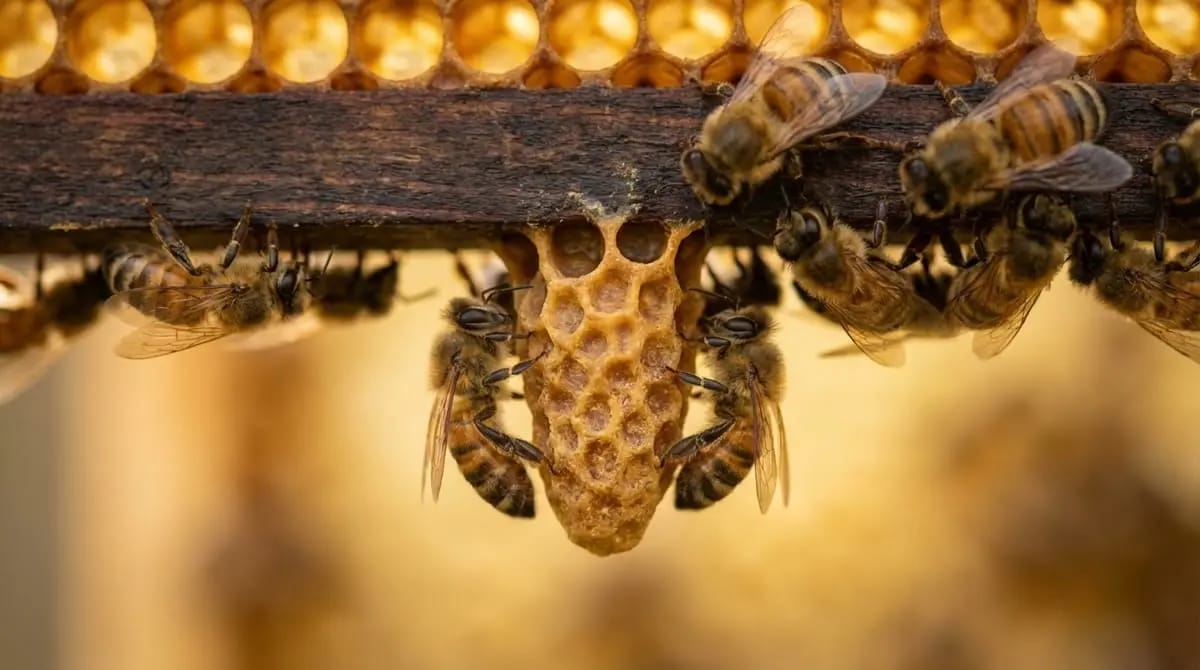
You do not need to pull every frame individually. For swarm control, it suffices to check the undersides of brood frames and look between the frames for queen cells. Experienced beekeepers simply tilt the box slightly. This takes 2--3 minutes per colony.
Swarm Prevention: What Can You Do?
1. Give Space in Time
The simplest and most important measure: add the honey super in time. A colony with enough space swarms less often.
- Add the honey super as soon as the brood box is well occupied (7--8 occupied frame gaps)
- Give a drone frame (empty frame for building) as a "pressure valve"
- Add a second honey super before the first is full
2. Make Splits (Pre-emptive Swarm)
The most effective method: you pre-empt the swarm by moving part of the colony into a new hive.
- 1
Remove Brood Frames
Remove 2--3 brood frames with the bees on them from the strong colony. Make sure the queen is NOT on the removed frames. At least one frame should contain open brood (eggs/young larvae).
- 2
Set Up the Nucleus Box
Place the brood frames in a nucleus box. Add a food frame and a frame of foundation. The bees on the frames will raise a new queen from the young larvae.
- 3
Choose a Location
Place the nucleus at least 3 km away -- or use a divider board above the mother colony (field bees would otherwise fly back). After 3 weeks, the nucleus can return to the intended location.
- 4
Check Both Colonies
After 3--4 weeks, check: Does the nucleus have a new queen? Is she laying eggs? Is the mother colony out of swarming mood? If yes: all good. If not: adjust accordingly.
3. Use Young Queens
Colonies with queens in their first year swarm significantly less often. A regular queen replacement (every 1--2 years) is one of the best swarm prevention measures.
4. Breaking Queen Cells (Emergency Measure)
Removing all queen cells can stop the swarming drive short-term -- but this is only a stop-gap. You must then check every 7 days and catch every single cell. Missing just one cell is enough for the colony to swarm.
Simply breaking queen cells without further measures (adding space, making splits) often leads to the colony building new cells again and again. You are treating the symptom, not the cause. Better: make a split and relieve the colony's pressure.
When a Swarm Leaves Despite Everything
It has happened -- despite all your checks, a swarm is hanging in your neighbour's apple tree. Do not panic. Catching a swarm is easier than you think.
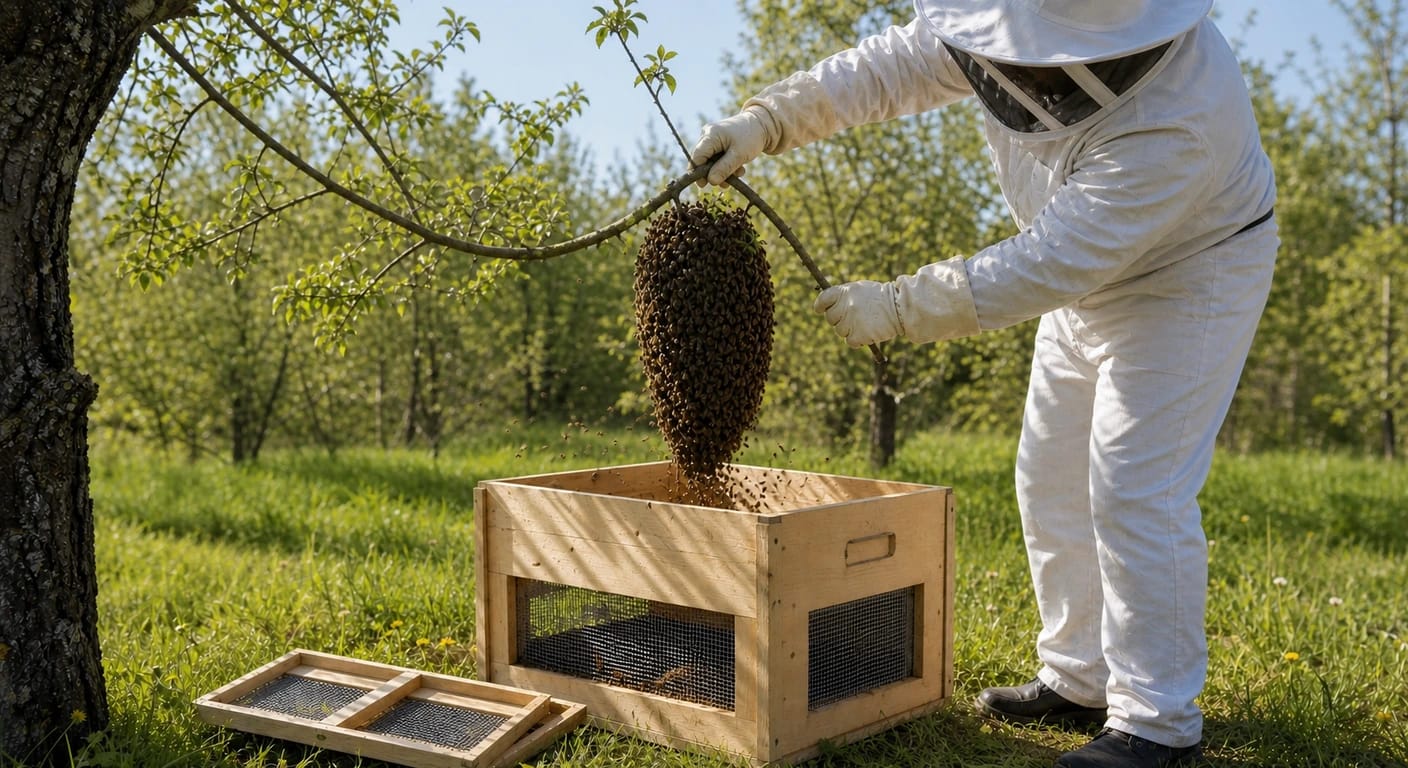
Swarm Catching in 6 Steps:
- Stay calm -- the swarm usually stays put for several hours
- Put on protective gear (even though swarms are peaceful)
- Position a container (swarm box, cardboard box, or empty hive) directly under the cluster
- Shake: Shake the branch firmly or knock the bees with a gentle jolt into the container
- Wait: Set the box up with a small gap. Are bees fanning at the entrance (scenting)? Then the queen is inside and the remaining bees will move in
- Install in the evening: Shake the swarm into a prepared hive with foundation. Do not forget to feed!
Using the Swarming Drive Rather Than Fighting It
A shift in thinking that experienced beekeepers often recommend: instead of seeing the swarming drive only as a problem, you can use it for targeted colony multiplication. Making splits from swarming mood produces particularly vital young colonies with high queen quality.
Swarm Control: Your 7-Day Rhythm
Weekly Swarm Check (May--June)
Knowledge Check
In the next lesson, it is time for the highlight of the beekeeping year: the honey harvest.