Winter Rest: Monitoring Without Disturbing
What happens inside the colony in winter? Learn how to monitor your colonies without disturbing them and how to apply oxalic acid correctly.
Winter is the quietest time at the apiary. While frost and snow reign outside, your bees live in their own little world -- huddled tightly together in a warming cluster. Your most important task now: do not disturb. But you should not be entirely idle either.

What Happens Inside the Colony in Winter?
As soon as outside temperatures drop below approx. 10 degrees C, the bees form a winter cluster. This is a spherical formation in which the bees warm each other.
The bees in the core of the cluster generate heat through muscle vibration. In the centre of the broodless winter cluster, a constant 25--30 degrees C is maintained, even when it is -15 degrees C outside. Once brood is present, the temperature rises to 34--35 degrees C. The outer bees form an insulating shell. All bees regularly alternate between core and mantle so no bee gets chilled.
The winter cluster slowly migrates across the food combs, consuming the stored reserves. A strong colony uses about 1--1.5 kg of food per month in winter. During cold snaps consumption rises; in mild weather it drops.
Why You Must NOT Open
Opening a hive in winter can be fatal for the colony. Here is why:
- Heat loss: The laboriously built-up warmth escapes suddenly. The bees must expend enormous energy to restore the temperature.
- Cluster break-up: Cold air can rupture the cluster. Individual bees that lose contact with the cluster become torpid and die.
- Stress: Disturbed bees begin consuming food more heavily, depleting reserves faster.
- Condensation: The temperature shock creates moisture that can lead to mould on the combs.
Between November and February the hive is not opened -- with a single exception: the oxalic acid winter treatment during the broodless period. Even then, you work quickly and purposefully.
What You Can Still Check
Even without opening the hive, you can learn a lot about your colonies' condition. Plan a brief monitoring visit roughly every 2--4 weeks.
1. Entrance Observation
The entrance tells you a lot about what is happening inside:
- Dead bees: A few dead bees in front of the entrance are normal. In winter, old bees constantly die, and cleaner bees push them out. Only if mounds of dead bees accumulate or the entrance is blocked should you take action.
- Faecal spotting: Brown spots at the entrance and on the hive wall indicate Nosema (intestinal disease). Healthy bees do not defecate inside the hive -- they wait for warmer days for a cleansing flight.
- Wax crumbs: Light wax crumbs on the floor board show the colony is consuming food -- a good sign!
- Quiet humming: A soft hum in response to a light knock on the hive is normal. Complete silence may indicate colony loss.

2. Weight Check
The weight check is the most informative method for assessing your colony's condition in winter -- entirely without opening.
Heft test: Lift the back of the hive slightly. With experience, you can feel whether the colony still has enough food. Compare several hives -- the lightest one needs attention first.
Hive scale: Digital hive scales deliver exact data and show daily food consumption. This lets you detect early when a colony is running low. Modern IoT solutions like Hivekraft send the data directly to your smartphone.
3. Check Mouse Protection
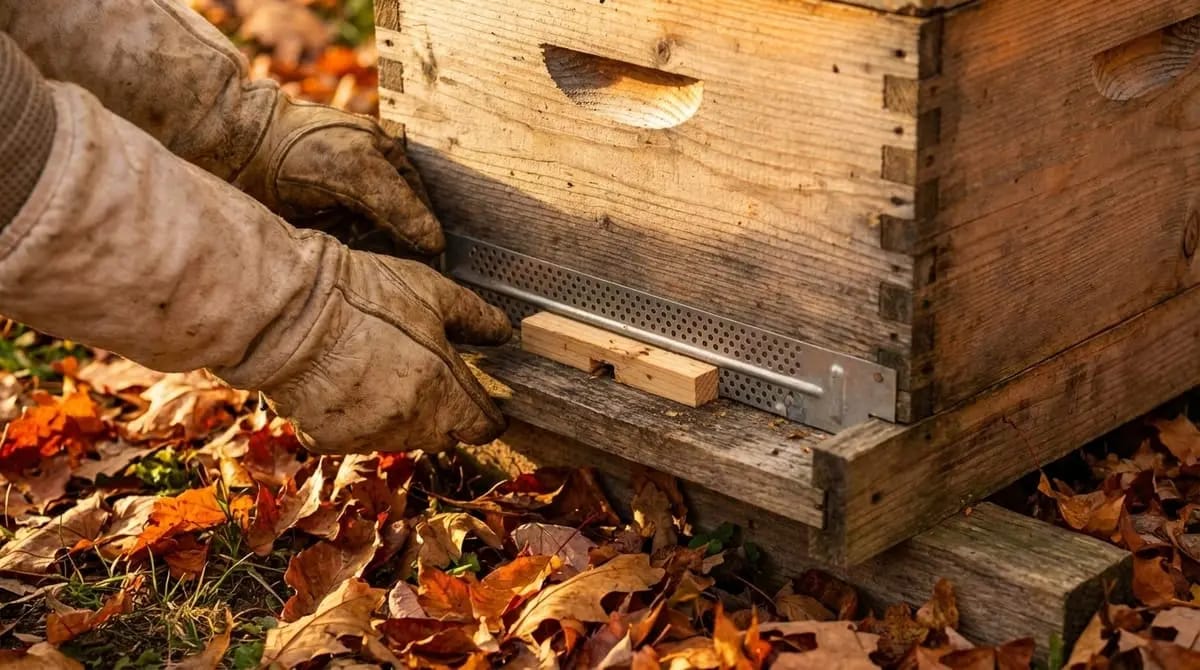
At every visit, check that the mouse guard is still firmly in place. Mice seek warm shelter in winter and can cause enormous damage inside a beehive: they gnaw through combs, contaminate the hive with droppings, and disturb the colony.
Winter Treatment with Oxalic Acid
The oxalic acid winter treatment is the second important pillar of your Varroa management -- after the formic acid treatment in late summer. It takes place during the broodless period, when all mites are on adult bees and none are hidden in capped brood.
Why Oxalic Acid?
Formic acid does penetrate brood, but some mites survive the summer treatment. Oxalic acid has an efficacy of over 95 % against mites on adult bees. In the broodless period, it therefore catches nearly all remaining mites.
The Right Timing
- When: Mid to late December, ideally 3 weeks after the first hard frost
- Prerequisite: The colony must be broodless (no capped brood). In mild winters, the broodless period may be delayed.
- Temperature: Preferably on a cool day (below 5 degrees C) so the cluster is tight and all bees are reached
Oxalic acid may be applied only once per winter. Multiple applications harm the bees more than they help. Choose the timing carefully.
Trickling Method (recommended for beginners)
- Oxalic acid solution 3.5 % (veterinary grade)
- Disposable syringe (50 ml) or dosing bottle
- Acid-resistant gloves
- Safety goggles
- Head torch
-
Prepare solution: Use ready-made oxalic acid solution 3.5 % (veterinary grade) from the pharmacy or supplier. It is ready to use.
-
Open the hive: Carefully remove the cover and film. Work quickly to minimise heat loss.
-
Count occupied seams: Count the occupied seams (gaps between frames where bees are sitting).
-
Dosage: Trickle 5--6 ml of oxalic acid solution per occupied seam evenly into the gaps. Maximum 50 ml per colony.
-
Close the hive: Replace the film and cover immediately.
Approved oxalic acid products and application methods vary by country. In Germany, trickling and sublimation are both approved. In the UK, Api-Bioxal is the standard product. In the US, several oxalic acid products are EPA-approved. Always follow your country's regulations and use only approved products.
Emergency Feeding: When Food Runs Low
Sometimes the stored reserves do not last until spring -- whether due to a mild winter with increased consumption or insufficient autumn feeding.
When Does It Become Critical?
- The colony feels noticeably light during the heft test
- The hive scale shows total weight under 25 kg (standard hive)
- It is only January/February and weight is dropping rapidly
How to Emergency-Feed?
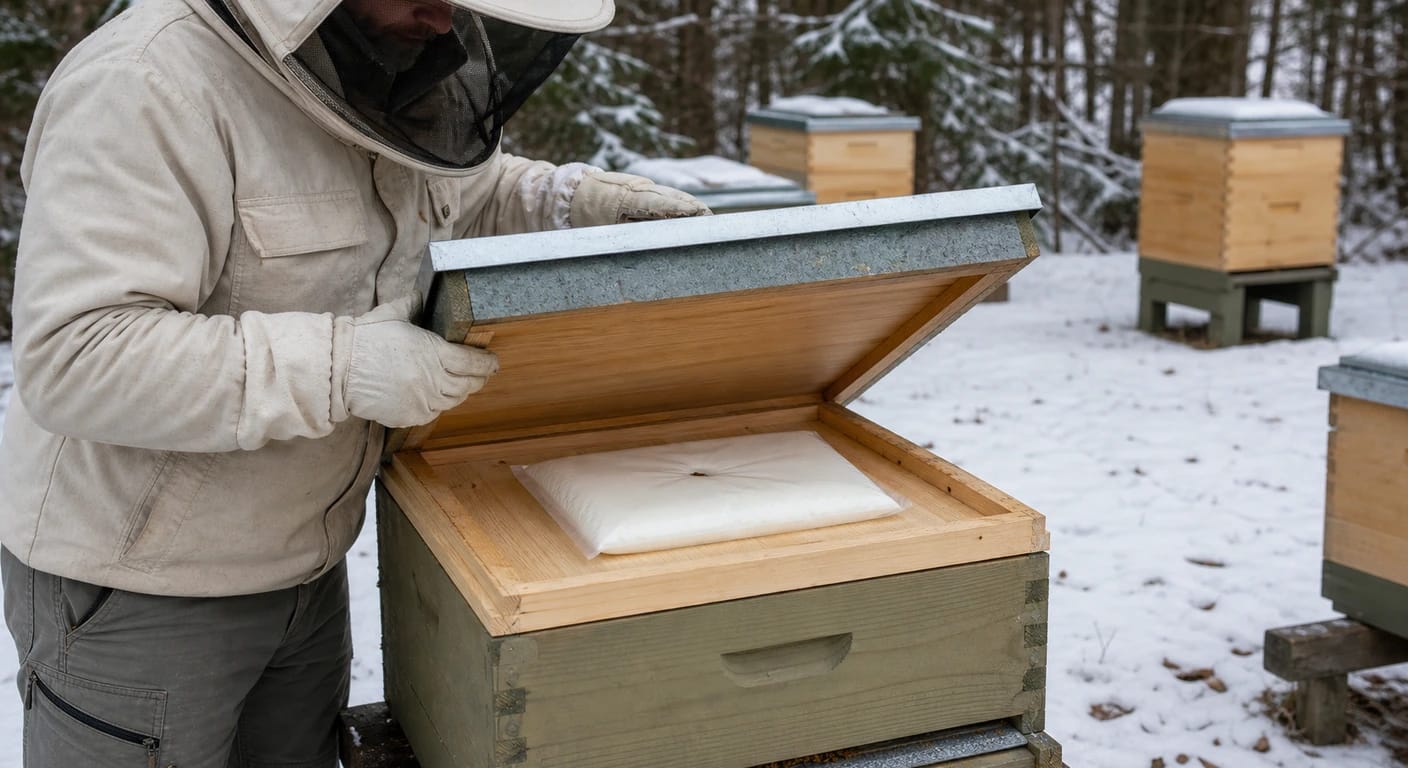
- Fondant is the feed of choice. It is placed directly on the frame top bars.
- No liquid feed in winter! Liquid feed stimulates brood-rearing and causes dysentery in cold weather.
- Give 1--2 kg of fondant and check after 2 weeks whether a top-up is needed.
The best emergency feeding is the one you do not need. Those who feed sufficiently in autumn (15--20 kg) and check the weight usually get through winter without problems.
Preparing for Spring
The winter months are also a good time to prepare for the coming season:
Winter Tasks Away from the Apiary
Winter is the time for planning. Those who study their hive records now and reflect on the season will start spring with a clear plan -- and that makes the difference between good and great beekeeping.
Knowledge Check
In the next and final lesson, we look back on your entire first year of beekeeping -- and plan your second!