Beekeeping Law: What Every Beekeeper Must Know
Swarm law, neighbour law, animal keeper liability and the Bee Disease Ordinance. The most important laws for beekeepers in Germany explained concisely.
The laws and regulations described in this lesson apply specifically to Germany. If you keep bees in another country, check with your local beekeeping association or veterinary authority for the rules in your area. Many EU-wide regulations (such as EU 2019/6 on the colony record book) apply across all member states.
Beekeeping in Germany is fundamentally permitted and requires no licence -- but it is far from free of rules. From the centuries-old swarm law in the Civil Code (BGB) to neighbour law and the Bee Disease Ordinance: anyone keeping bees must be familiar with a whole range of laws and regulations.
In this first lesson of the law course, we gain an overview of the most important areas of law relevant to beekeepers. Do not worry -- you do not need a law degree. But you should know what obligations you have and what rights you are entitled to.
Swarm Law in the Civil Code: Ancient Paragraphs, Still in Force Today
Sections 961 to 964 of the German Civil Code (BGB) have regulated so-called swarm law since 1900. These provisions go back to even older Germanic legal tradition and remain in force unchanged to this day. They regulate what happens when a bee swarm leaves the beekeeper's property.
Historically, bee swarms were extremely valuable. A colony could be worth as much as an ox. The regulation in the BGB was intended to prevent disputes between neighbours and create clear ownership rules. These paragraphs are a fascinating relic that shows how important bees were to society.
Section 961 BGB: Loss of Ownership of Bee Swarms
Section 961 BGBThe wording is clear: "If a bee swarm leaves its hive, it becomes ownerless if the owner does not pursue it without delay or if the owner abandons the pursuit."
In practical terms this means:
- A departing swarm remains your property as long as you pursue it
- The pursuit must begin without delay -- meaning without culpable hesitation
- If you abandon the pursuit or do not begin it promptly, the swarm becomes ownerless
- Anyone may capture and keep an ownerless swarm
You notice on Saturday afternoon that your strongest colony has swarmed. The swarm is hanging in your neighbour's tree. If you pursue it immediately -- go to the neighbour and capture the swarm -- it remains your property. If you wait until Monday because you "have no time," the swarm becomes ownerless. "Without delay" means: without culpable hesitation, not "immediately." Getting your equipment first is perfectly fine.
Section 962 BGB: The Right of Pursuit
Section 962 BGB"The owner of a bee swarm may enter third-party land when pursuing the swarm. If the swarm has moved into an unoccupied hive belonging to another person, the owner of the swarm may open the hive and remove or break out the combs for the purpose of capture."
This is a remarkable right: when pursuing a swarm you may enter third-party land -- even without prior permission. And if your swarm has moved into an empty hive belonging to another beekeeper, you may open it.
Important limitations:
- You may only open unoccupied third-party hives (Section 962 sentence 2 BGB)
- If the hive is occupied (another colony lives in it), Section 964 BGB applies
- You must compensate for any damage you cause when entering the property (Section 962 sentence 3 BGB)
- The right expires as soon as you abandon the pursuit
Section 963 BGB: Merging of Swarms
Section 963 BGB"If bee swarms from several owners unite, the owners who have pursued their swarms become co-owners of the captured combined swarm; the shares are determined by the number of swarms pursued."
This paragraph regulates an astonishingly specific case: What happens when several swarms from different beekeepers merge? The answer: co-ownership, based on the number of swarms involved, not their size. Three swarms from three beekeepers = one third each.
Section 964 BGB: Entry into an Occupied Hive
Section 964 BGB"If a bee swarm has moved into an occupied hive belonging to another person, the ownership and other rights in the bees with which the hive was occupied extend to the swarm that has moved in. The ownership and other rights of the former owner of the swarm are extinguished."
This sounds harsh but is logical: if your swarm moves into the occupied hive of another beekeeper, you lose your ownership. The other beekeeper becomes owner of all bees in his hive. Separation would be practically impossible -- the law follows biological reality here.
| Situation | Ownership | Legal Basis |
|---|---|---|
| Swarm pursued, captured on own land | Remains with the beekeeper | Section 961 BGB |
| Swarm pursued, captured on third-party land | Remains with the beekeeper, right of entry | Section 962 BGB |
| Swarm not pursued | Becomes ownerless, finder may keep it | Section 961 BGB |
| Multiple swarms merged | Co-ownership by number of swarms | Section 963 BGB |
| Swarm moved into occupied hive | Transfers to owner of the hive | Section 964 BGB |
| Swarm in empty third-party hive | Pursuing beekeeper may open the hive | Section 962 BGB |
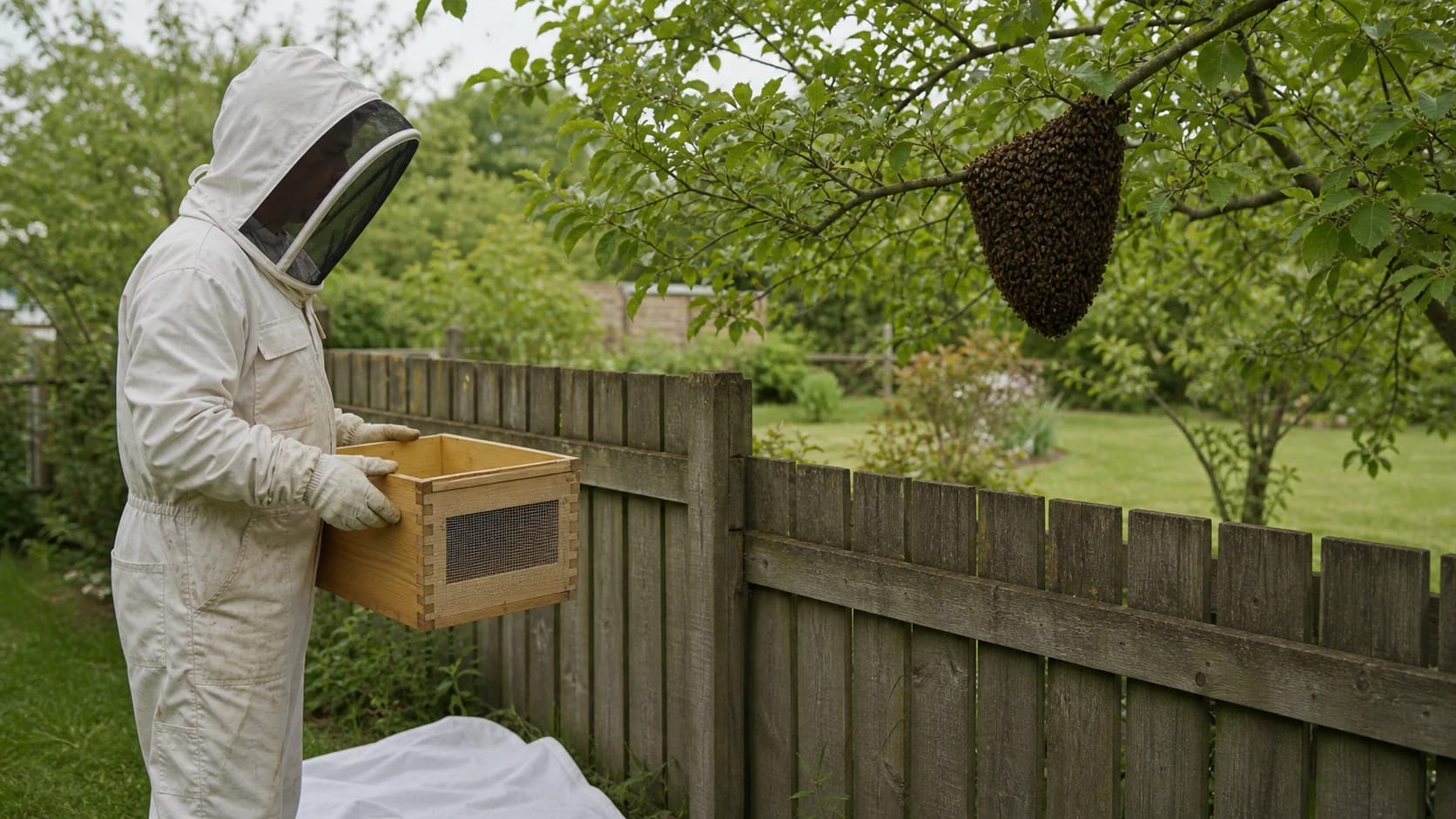 AI-generated
Neighbour Law: Distances and State Law
While the BGB applies nationwide, neighbour law is largely a matter for the individual German federal states. It regulates where and how close to the neighbouring property you may keep bees. The differences between states are considerable.
Basic Regulation
In most federal states there are no statutory minimum distances for beekeeping. This may sound surprising, but it is the case. Instead, the general principle of consideration under Section 906 BGB applies: neighbours must tolerate "customary" impacts as long as they are not substantially impaired.
Regardless of the legal situation: inform your neighbours before you begin beekeeping. A jar of honey and an open conversation prevent more conflicts than any law. Many neighbour disputes about bees arise because neighbours are surprised or not informed.
Differences Between Federal States
| Federal State | Distance Regulation for Beekeeping | Notes |
|---|---|---|
| Bavaria | No statutory distance regulation | Local ordinances may apply |
| Baden-Wuerttemberg | No statutory distance regulation | General duty of consideration |
| Lower Saxony | No statutory distance regulation | Lower Saxony Neighbour Law Act |
| NRW | No statutory distance regulation | Tolerance obligation for customary use |
| Hesse | No statutory distance regulation | Local beekeeping practice is decisive |
| Brandenburg | 3 m recommended (not statutory) | Brandenburg Neighbour Law Act |
| Saxony | No statutory distance regulation | Saxon Neighbour Law Act |
| Schleswig-Holstein | No statutory distance regulation | Neighbour Law Act SH |
Even if your federal state has no distance regulation, your municipality can enact its own statutes. In some localities there are rules that restrict beekeeping in residential areas or prescribe minimum distances. Always check the local statutes before starting beekeeping!
Case Law: Important Court Decisions
Since there are few statutory regulations, court decisions have significantly shaped beekeeper-neighbour law. Some important rulings:
- Courts classify bee flight as a "similar impact" within the meaning of Section 906 (1) BGB. Neighbours must tolerate it if it is customary and not substantially impairing.
- According to various court decisions, two bee colonies in a residential area are generally considered customary and must be tolerated.
- Local Court Munich, 2013: Even six colonies in an allotment garden can be permissible if the impairment is minor.
- Regional Court Heidelberg, 2014: A beekeeper with 16 colonies in a residential area was ordered to reduce to 6 colonies -- the number was no longer customary.
Animal Keeper Liability: Section 833 BGB
Animal Keeper LiabilityAs a beekeeper you are liable under Section 833 sentence 1 BGB for damage caused by your bees -- and this is strict liability regardless of fault, known as risk-based liability. This is one of the strictest forms of liability in German law.
Under animal keeper liability per Section 833 BGB, you as a beekeeper need no fault. It suffices that your bees caused the damage. You are therefore liable even if you did everything correctly. This is why beekeeper liability insurance is so important (more on this in Lesson 6).
Typical Damage Scenarios
In practice, the following situations most commonly lead to liability cases:
Personal Injury:
- Bee stings with allergic reaction (in extreme cases life-threatening)
- Stings to neighbours, passers-by or visitors
- Pain and suffering compensation and treatment costs can be substantial
Property Damage:
- Bee droppings on laundry, cars, facades (so-called "bee spots")
- Damage to fruit from excessive bee visitation (rare but possible)
- Contamination of swimming pools or garden furniture
Traffic Accidents:
- When bees cause a traffic accident (e.g. sting while driving)
- Migratory beekeepers: bees on the motorway after a transport accident
Exception: Livestock Keeper Privilege?
Section 833 sentence 2 BGB contains a liability relief for keepers of livestock. Whether bees qualify as livestock has long been debated. The prevailing opinion does not consider hobby beekeepers as livestock keepers -- so full strict liability applies. Only professional beekeepers who make their living from bees could potentially invoke the livestock keeper privilege.
The Bee Disease Ordinance
Bee Disease OrdinanceThe Bee Disease Ordinance (BienSeuchV) is a federal ordinance based on the Animal Health Act (TierGesG). It regulates the control of contagious bee diseases, especially American Foulbrood (AFB).
Duty to Report
Under Section 1 BienSeuchV there is a duty to report certain bee diseases. This means: if you suspect a notifiable disease, you must report it to the competent veterinary office.
Notifiable bee diseases in Germany:
- American Foulbrood (AFB) -- the most important and dangerous
- Infestation with the Small Hive Beetle (Aethina tumida) -- not yet present in Germany
- Infestation with the Tropilaelaps mite -- not yet present in Germany
Any suspicion of AFB must be reported to the veterinary office immediately (Section 4 TierGesG in conjunction with Section 1 BienSeuchV). Failure to report is an administrative offence and can be punished with a fine of up to 30,000 euros (Section 32 TierGesG). When AFB is suspected: better to report once too often than once too few!
Restricted Zone for AFB
When AFB is officially confirmed, the veterinary office orders a restricted zone of at least 1 km radius around the outbreak. Strict rules apply within the restricted zone:
- 1
Report of the Disease Outbreak
The veterinary office is informed and conducts an official investigation. Feed crown samples are taken and examined in the laboratory.
- 2
Establishment of the Restricted Zone
At least 1 km radius. All beekeepers in the restricted zone are notified. The restricted zone is publicly announced.
- 3
Prohibitions in the Restricted Zone
No moving of bee colonies, combs, equipment or honey out of the restricted zone. No moving of colonies within the zone without permission.
- 4
Examination of All Colonies
All bee colonies in the restricted zone are officially examined. Affected colonies are remediated or destroyed according to Sections 10-11 BienSeuchV.
- 5
Lifting of the Restricted Zone
The restricted zone is lifted when all examinations are negative and remediation is complete. This typically takes at least 3 months.
Registration Obligation for Beekeeping
Regardless of diseases, there is a registration obligation for beekeeping with the competent veterinary office in all federal states. This is regulated in Section 1a BienSeuchV and applies to every beekeeper, regardless of the number of colonies.
Required Information for Registration
Nature Conservation Law: Bees in Nature Reserves
A common question: May you place bee colonies in nature reserves? The answer is nuanced.
Federal Nature Conservation Act (BNatSchG)
Under Section 23 BNatSchG, "all actions that could lead to the destruction, damage or alteration of the nature reserve or its components" are prohibited in nature reserves. Placing bee colonies is generally regarded as such an action.
In practice this means:
- In most nature reserves, placing bee colonies requires a permit
- The competent nature conservation authority can grant an exemption under Section 67 BNatSchG
- In landscape protection areas (lower protection status), beekeeping is usually permitted
- In FFH areas (Natura 2000), it depends on the respective protection area ordinance
- National parks: beekeeping is generally not permitted
In the conservation debate, there is increasing discussion about whether honey bees in nature reserves compete with wild bees for food. Scientifically, the question is not conclusively resolved. Some conservation authorities therefore deny exemptions. As a beekeeper, you should be aware of this discussion and consciously limit the number of colonies at a location.
Species Protection: The Honey Bee Is Not a Wild Animal
A common misconception: the honey bee (Apis mellifera) is not a wild animal under species protection law, but a domesticated animal. It is therefore not subject to special species protection under Sections 44-45 BNatSchG. This does not apply to wild bees -- their approximately 600 species in Germany are strictly or specially protected.
Building Law: Bee Houses and Bee Wagons
If you plan to build a bee house, a bee wagon or a larger bee shelter, this may involve building law.
Permit Requirements
Whether a bee house requires a permit depends on the respective state building law and the size:
| Building Project | Permit Required | Note |
|---|---|---|
| Individual beehives (box hives) | No building permit needed | Not considered structural works |
| Bee house up to approx. 10 m2 (varies by state) | Usually permit-free | Exempt as ancillary building |
| Bee house over 10-30 m2 | Usually requires a permit | Threshold varies by state |
| Bee wagon (mobile, not permanent) | Generally permit-free | Must be genuinely mobile |
| Extraction room as annexe | Often requires a permit | Hygiene regulations apply |
| Bee house in outer area | Privileged under Section 35 BauGB | Agricultural use required |
Privilege in Outer Areas
Under Section 35 (1) No. 1 BauGB, projects that serve an agricultural or forestry operation are privileged in outer areas. Beekeeping counts as agricultural animal husbandry when operated at a certain scale. Hobby beekeepers with few colonies generally do not have this privilege.
Tenancy Law: Bees on the Balcony or in the Garden
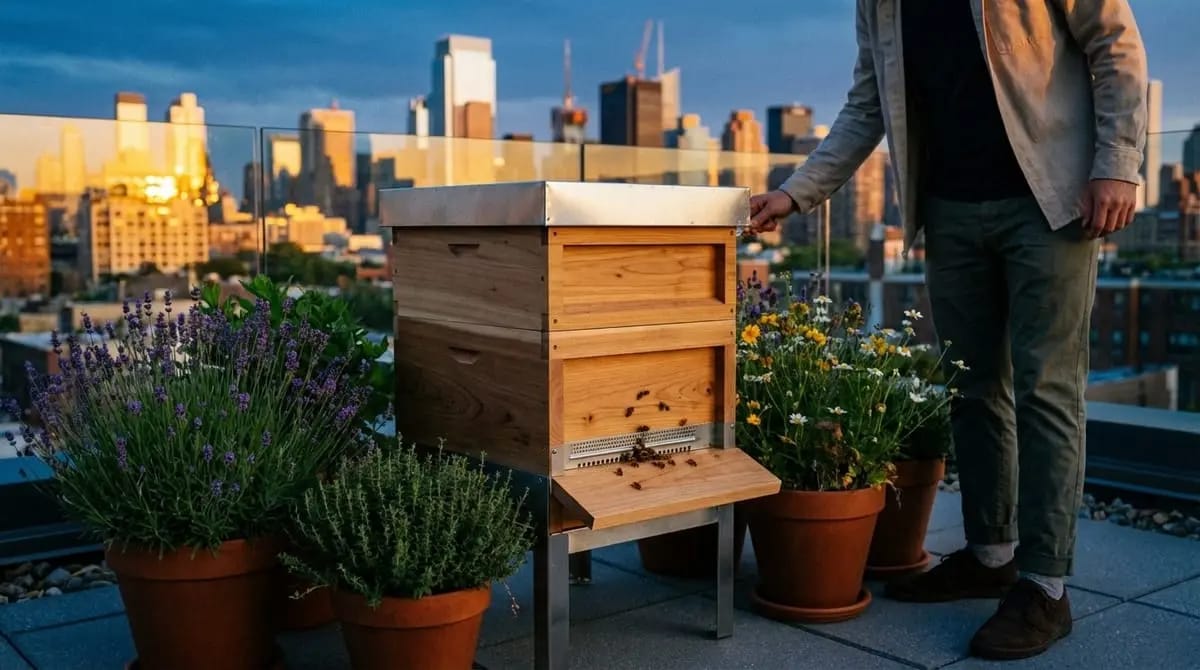
Increasingly, people want to keep bees in the city -- on the balcony, the roof terrace or in a rented garden. But what does tenancy law say?
Principle: No Automatic Right to Keep Bees
Beekeeping is not part of the contractual use of a rented apartment. This means:
- You generally need the landlord's consent
- A general pet prohibition in the lease may include beekeeping
- However, the landlord cannot arbitrarily refuse consent if no concrete impairments are expected
Case Law on Beekeeping in Tenancies
- Local Court Hamburg, 2014: Two bee colonies on the balcony are fundamentally permissible if there are no concrete impairments for other tenants.
- Local Court Munich, 2015: A landlord was permitted to prohibit keeping bee colonies in the tenant's garden because a neighbour had a diagnosed bee allergy.
- Regional Court Berlin, 2011: Beekeeping on a roof garden was classified as contractual use since the lease provided a roof garden for free use.
Always obtain your landlord's written consent before beginning beekeeping. Also inform the other tenants in the building. Document the landlord's consent -- verbal agreements are hard to prove in a dispute.
Municipal Statutes and Local Law
In addition to federal and state laws, municipalities can enact their own rules on beekeeping. These are typically found in:
- Local police ordinances (public safety and order)
- Animal husbandry statutes (regulating type and scope of animal husbandry)
- Development plans (may restrict animal husbandry)
- Allotment garden rules (in allotment associations, often 2-4 colonies permitted)
Most municipalities publish their statutes online. Search your municipality's website for "statutes" or "local law." When in doubt, call the public order office or municipal administration. Many beekeeping associations know the local regulations and can advise.
Overview: The Most Important Laws at a Glance
| Area of Law | Most Important Law | Key Point for Beekeepers |
|---|---|---|
| Swarm Law | Sections 961-964 BGB | Swarm remains yours if you pursue it |
| Neighbour Law | Section 906 BGB + State Law | Customary use must be tolerated |
| Animal Keeper Liability | Section 833 BGB | Strict liability -- you are liable without fault |
| Disease Control Law | BienSeuchV + TierGesG | Registration duty + reporting duty for AFB |
| Nature Conservation | BNatSchG | Permit required in protected areas |
| Building Law | BauGB + State Building Code | Bee house may require permit depending on size |
| Tenancy Law | BGB Tenancy Law | Obtain landlord's consent |
| Food Law | HonigV, LMIV, LMHV | Honey is a food product (more in Lesson 3) |
Duty Checklist for Every Beekeeper
Regardless of the number of colonies, every beekeeper in Germany has certain basic duties:
Basic Legal Duties
Knowledge of the legal framework is just as much part of responsible beekeeping as knowledge of bee biology and colony management. Keeping bees means bearing responsibility -- towards the animals, the neighbours and society.
Summary
Beekeeping law in Germany is not rocket science, but it encompasses more areas of law than most beginners expect. The key takeaways from this lesson:
- Swarm law (Sections 961-964 BGB) regulates ownership when swarms depart -- always pursue your swarm without delay
- Neighbour law is a state matter, case law shapes practice -- 2-6 colonies are usually considered customary
- Animal keeper liability is strict liability -- you are liable without fault, so liability insurance is essential
- The Bee Disease Ordinance requires registration of beekeeping and reporting of disease suspicion
- In nature reserves you need a permit to place colonies
- Building law becomes relevant for larger bee houses
- Tenants need the landlord's consent
In the following lessons we go deeper into the most important topics: the colony record book (Lesson 2), food labelling (Lesson 3), registration with the tax office (Lesson 4), organic certification (Lesson 5) and insurance (Lesson 6).