Colony Record Book: EU Regulation 2019/6 Step by Step
Since 28.01.2022, ALL beekeepers must keep a colony record book. EU 2019/6 explained: mandatory fields, sample entries, digital solutions and common mistakes.
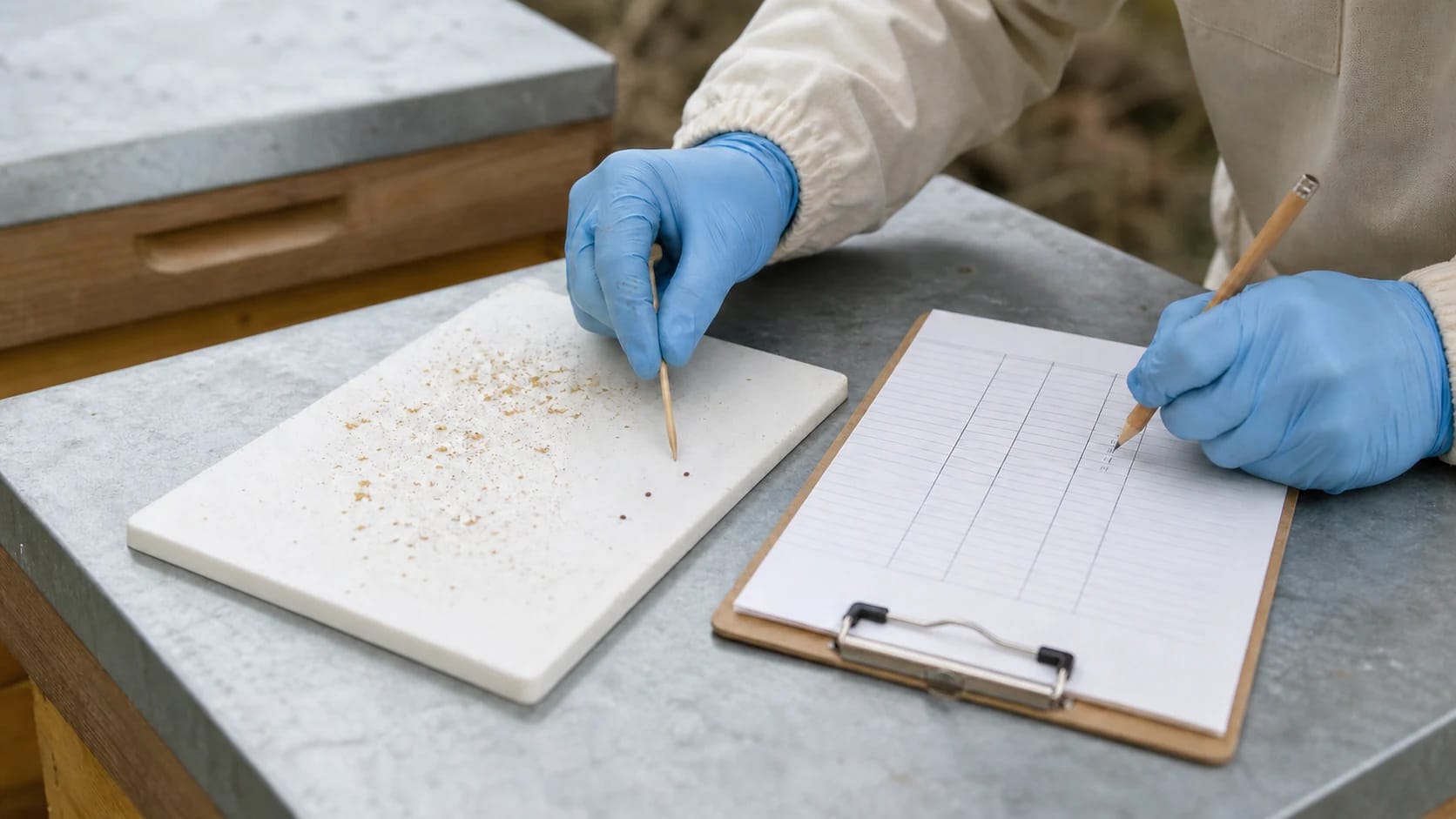 AI-generated
The colony record book obligation under EU Regulation 2019/6 applies to all beekeepers in all EU member states. The specific national implementation details described below (fines, national laws) apply to Germany, but the core EU requirements are the same across the EU.
Since 28 January 2022, EU Regulation 2019/6 on veterinary medicinal products has been directly applicable law in all EU member states. For beekeepers this means: everyone who keeps bees -- whether a hobby beekeeper with one colony or a professional with 500 -- must keep a colony record book documenting all medicinal product applications.
This obligation is no paper tiger. The veterinary office can carry out inspections at any time, and violations can result in significant fines. In this lesson we explain step by step what belongs in the colony record book, how to keep it correctly, and which mistakes you absolutely must avoid.
Why a Colony Record Book? The Background
EU Regulation 2019/6
Regulation (EU) 2019/6 of the European Parliament and of the Council of 11 December 2018 on veterinary medicinal products (in short: EU Veterinary Medicinal Products Regulation) replaced the previous Directive 2001/82/EC. It pursues several goals:
- Combat antibiotic resistance: Through complete documentation of medicinal product applications, resistance can be detected and prevented early
- Food safety: Honey is a food product. Traceability of all medicinal products protects the consumer
- Uniform standards: EU-wide harmonisation of documentation obligations
- Improve animal health: Better data foundation for control strategies
Unlike some other regulations, there is no exception for hobby beekeepers regarding the colony record book obligation. Anyone who keeps even a single bee colony and treats it with an approved veterinary medicinal product must document this in the colony record book. The regulation does not distinguish between hobby and profession.
Article 108 of EU 2019/6
The central article for beekeepers is Article 108 of EU 2019/6. It obliges animal keepers to keep records of all veterinary medicinal products they administer to their animals. The exact requirements arise from Article 108 (paragraph 3: record-keeping obligations, paragraph 6: retention period):
"Keepers of food-producing animals shall keep records of the veterinary medicinal products used and retain these records for at least five years."
Since honey is a food product, bees are considered food-producing animals -- even if you only use your honey privately and do not sell it.
National Implementation in Germany
In Germany, the EU Regulation is supplemented by the Veterinary Pharmacy Ordinance (TAEHAV) and the Veterinary Medicinal Products Implementation Ordinance. Sections 50-55 of the Veterinary Medicinal Products Act (TAMG) regulate documentation obligations in national law.
What Must Go in the Colony Record Book?
The mandatory fields of the colony record book arise directly from Article 108 EU 2019/6 in conjunction with the German TAMG. Each individual entry must contain the following information:
The 12 Mandatory Fields
Mandatory Information per Colony Record Book Entry
During an inspection by the veterinary office, every single entry is checked. Missing mandatory fields are classified as documentation deficiencies. The most commonly forgotten are: the batch number, the name of the veterinarian and the end of the withdrawal period. Make sure to note this information immediately when you apply a product.
Mandatory Fields Explained in Detail
Sample Entry: What a Correct Entry Looks Like
- Colony record book (paper or digital)
- Medicinal product packaging with batch no.
- Invoice/receipt from supplier
Example: Summer Treatment with Formic Acid
Step 1: Have the medicinal product packaging ready and note the batch number.
Step 2: Create the following entry in the colony record book:
| Field | Entry |
|---|---|
| Date | 15.07.2026 - 29.07.2026 |
| Medicinal Product | MAQS (Mite Away Quick Strips) |
| Active Ingredient | Formic acid 68.2 g per strip |
| Batch No. | Lot 2026-EU-0342 |
| Dosage | 2 strips per colony |
| Diagnosis | Varroosis, natural mite drop 8/day |
| Withdrawal Period | 0 days |
| End of Withdrawal | 29.07.2026 (= last day of treatment) |
| Treated Colonies | Colony 3, 5, 7, 8, 12, 14 (City Garden apiary) |
| Veterinarian | Not prescription-only |
| Supplier | Beekeeping Supplies Mueller GmbH |
| Invoice No. | RE-2026-07-0089 |
Step 3: Sign the entry (for paper) or confirm digitally.
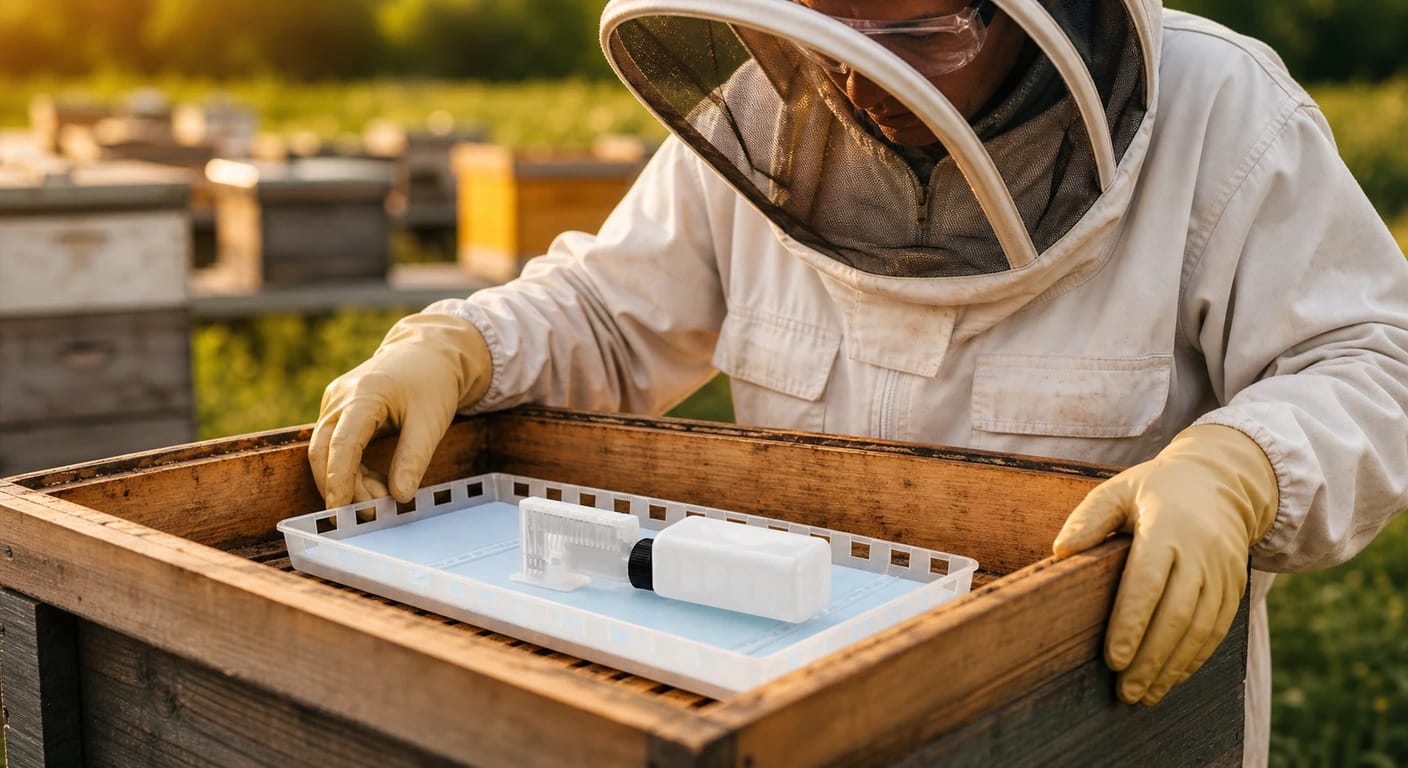
Further Example: Winter Treatment with Oxalic Acid
- Colony record book
- Api-Bioxal packaging
- Invoice
| Field | Entry |
|---|---|
| Date | 21.12.2026 |
| Medicinal Product | Api-Bioxal 886 mg/g powder |
| Active Ingredient | Oxalic acid dihydrate 886 mg/g |
| Batch No. | Ch.-B.: AB-2026-1187 |
| Dosage | 30 ml solution 3.5% per colony, trickled |
| Diagnosis | Varroosis, winter treatment during broodless period |
| Withdrawal Period | 0 days |
| End of Withdrawal | 21.12.2026 |
| Treated Colonies | All 14 colonies, Orchard and Forest Edge apiaries |
| Veterinarian | Dr. med. vet. Katharina Schmidt (herd care) |
| Supplier | Town Pharmacy, Frankfurt |
| Invoice No. | Receipt No. 4823 from 18.12.2026 |
Digital vs. Paper: Both Forms Are Permitted
| Criterion | Paper Colony Record | Digital Colony Record |
|---|---|---|
| Legally permitted? | Yes, expressly permitted | Yes, expressly permitted |
| Acquisition cost | A few euros (booklet/binder) | Free to premium app |
| Tamper resistance | Harder to manipulate (numbered) | Change log (audit trail) possible |
| Searchability | Tedious with many entries | Instant full-text search |
| Analysis | Only manually possible | Automatic statistics and reports |
| Backup security | Loss from fire/water | Cloud backup possible |
| Taking to the apiary | Physically carry it | Smartphone suffices |
| Veterinary office inspection | Show the booklet | Export as PDF/CSV |
| Error-proneness | Illegible writing, forgotten fields | Mandatory field validation possible |
| Long-term archiving | Physically store for 5 years | Automatically stored |
The digital colony record book in Hivekraft covers all 12 mandatory fields of EU 2019/6. Batch numbers, veterinarian data, withdrawal periods and supplier information are captured in a structured way. The PDF export delivers a complete, inspection-ready colony record book -- in German and optionally bilingual (DE/EN). More on this in the Hivekraft course.
Requirements for Digital Record-Keeping
If you keep your colony record book digitally, the software must meet certain requirements:
- Data security: The data must be protected against unauthorised access and loss
- Immutability: Once recorded entries must not be able to be silently deleted or changed (change log)
- Printout: The data must be available as a printout at any time
- Readability: The data must remain readable throughout the entire retention period
- 5 years retention: Even after cancelling an app subscription, data must be exportable
Inspections by the Veterinary Office
How Do Inspections Work?
The veterinary authorities carry out random and event-driven inspections. In practice, inspections occur particularly frequently in connection with:
- AFB restricted zones: When American Foulbrood occurs in your area
- Random checks: Routine inspections, especially for beekeepers who sell honey
- Tip-offs: When someone reports a violation (e.g. neighbour, another beekeeper)
- Honey complaints: When residues are found in honey samples
What Is Checked During an Inspection?
- 1
Identity Check
The inspector verifies who you are and whether your beekeeping is properly registered with the veterinary office.
- 2
Colony Record Book Check
The colony record book is examined. The inspector checks: Are all mandatory fields completed? Are entries chronological? Are batch numbers given? Do withdrawal periods match?
- 3
Medicinal Product Stock
Which medicinal products do you have in stock? Do they match the colony record book entries? Are they approved and not expired?
- 4
Colony Verification
Does the number of colonies match the registration? Can the treated colonies be identified?
- 5
Honey and Food Safety
For honey sellers: Are withdrawal periods being observed? Are there indications of unauthorised treatments during the nectar flow?
Consequences of Violations
| Violation | Possible Consequence | Legal Basis |
|---|---|---|
| No colony record book present | Fine up to 30,000 EUR | Section 89 TAMG |
| Incomplete entries | Warning or fine | Section 89 TAMG |
| Missing batch numbers | Deficiency report, grace period | Art. 108 EU 2019/6 |
| Retention period not observed | Fine | Art. 108 (6) EU 2019/6 |
| Unapproved medicinal products used | Fine + criminal proceedings possible | Sections 56-58 TAMG |
| Withdrawal periods not observed | Honey recall + fine | Section 89 TAMG + LFGB |
| Beekeeping not registered | Fine up to 30,000 EUR | Section 32 TierGesG |
The fine ranges are considerable. In practice, for first-time violations and hobby beekeepers, significantly lower amounts are usually imposed (often 100-500 EUR). But the risk exists -- and a completely maintained colony record book reliably protects you.
Which Treatments Must Be Documented?
Subject to Documentation: All Medicinal Product Applications
| Treatment | Colony Record Required? | Reason |
|---|---|---|
| Formic acid (MAQS, Nassenheider etc.) | Yes | Approved veterinary medicinal product |
| Oxalic acid (Api-Bioxal etc.) | Yes | Approved veterinary medicinal product |
| Thymol (Thymovar, Apiguard etc.) | Yes | Approved veterinary medicinal product |
| Lactic acid (spray treatment) | Yes | Approved veterinary medicinal product |
| Bayvarol (flumethrin strips) | Yes | Approved veterinary medicinal product (prescription-only) |
| Drone brood removal | No | Biotechnical measure, not a medicinal product |
| Trapping comb method | No | Biotechnical measure |
| Powdered sugar method (diagnosis) | No | Diagnostic procedure, not a medicinal product |
| Sugar syrup feeding | No | Feed, not a medicinal product |
| Feed crown sample (AFB diagnosis) | No | Diagnostics, not a medicinal product |
Biotechnical measures such as drone brood removal or the trapping comb method are not required to be documented in the colony record book. Nevertheless, it makes sense to record them in the hive record -- for your own overview and as evidence of your treatment concept.
Step-by-Step: Setting Up Your Colony Record Book
- 1
Choose Format
Decide on paper or digital. Recommendation: Digital with an app like Hivekraft -- mandatory fields are pre-populated, batch numbers are saved, export available at any time.
- 2
Record Apiaries and Colonies
Set up all your apiaries and colonies so you can clearly assign the treated colonies with each entry.
- 3
Record Medicinal Product Stock
Document all medicinal products on hand with trade name, active ingredient, batch number, expiry date and supplier.
- 4
Create First Entry
At the next treatment: immediately fill in all 12 mandatory fields. Photograph the packaging as backup.
- 5
Maintain Regularly
Create each entry immediately after treatment. Do not postpone! For digital solutions: export as PDF at least once a year.
- 6
Ensure Archiving
Retain old entries for 5 years. For paper books: secure storage location. For digital books: check backup.
Summary
The colony record book obligation under EU 2019/6 has been binding for all beekeepers since 28 January 2022. The key points:
- Every beekeeper must keep a colony record book -- from the first colony, even if honey is not sold
- 12 mandatory fields must be completely filled in per entry
- The retention period is 5 years
- Paper and digital are equally permissible
- The veterinary office can carry out inspections at any time
- Violations can result in fines up to 30,000 euros
- Batch number and veterinarian are most commonly forgotten
- Biotechnical measures (drone brood removal etc.) do not belong in the colony record book
The good news: with a digital solution like Hivekraft, keeping the colony record book is not a major effort. The mandatory fields are predefined, batch numbers are saved, and the export for the veterinary office is done with one click.