Organic Beekeeping: Requirements and Certification
EU Organic Regulation 2018/848 for beekeepers explained: requirements for hives, wax, feeding, location and treatment. Comparison of EU organic vs. Demeter, Bioland, Naturland.
"Organic" is not just a trend but a strictly regulated system with real requirements. For beekeeping, organic certification means: different hive materials, stricter feeding rules, restricted treatment methods and defined location requirements. In return, you may market your honey as "organic honey" -- a quality mark that is sought by ever more consumers and rewarded with higher prices.
In this lesson, we explain the legal foundations, the specific requirements and the path to certification. We also compare the differences between EU organic and the stricter association standards of Demeter, Bioland and Naturland.
Legal Basis: EU Organic Regulation 2018/848
The Regulation at a Glance
Regulation (EU) 2018/848 of the European Parliament and of the Council of 30 May 2018 on organic production has been in force since 1 January 2022 and replaced the old Organic Regulation (EC) No 834/2007. It is supplemented by Implementing Regulation (EU) 2020/464 with detailed rules for beekeeping.
EU Organic Regulation 2018/848 applies in all EU member states directly -- it does not need to be transposed into national law. This means: the rules for organic beekeeping are identical in Germany, Austria, France and all other EU countries. National control bodies supervise compliance.
What Does the Regulation Cover for Beekeepers?
The organic rules for beekeeping are found in Annex II, Part III of EU 2018/848 and cover:
- Origin of the animals (bees)
- Housing and husbandry conditions (hives)
- Feeding
- Disease prevention and veterinary treatment
- Location requirements
- Conversion period
- Beeswax
Requirement 1: Hive Materials
Hive materials (organic)Hives must be made from natural materials. This is one of the most visible changes compared to conventional beekeeping.
| Material | EU organic permitted? | Association (Demeter/Bioland/Naturland) |
|---|---|---|
| Wood (untreated or with approved products) | Yes (preferred) | Yes (mandatory for Demeter/Naturland) |
| Polystyrene (EPS) | No | No |
| Plastic (hives) | No (exception: queen excluder) | No |
| Aluminium (outer metal roof) | Yes (cover) | Yes (cover) |
| Wood with linseed oil finish | Yes | Yes |
| Wood with synthetic paint (exterior) | Yes (exterior only, lead-free) | Conditional (only approved coatings) |
| Straw (skep/basket) | Yes | Yes (especially valued by Demeter) |
The most common exclusion reason for organic certification: polystyrene hives (Segeberger hive). They are widely used in conventional beekeeping but not permitted in organic beekeeping. Anyone wishing to convert to organic must replace polystyrene hives with wooden hives. This is a real investment -- but also a clear signal for sustainability.
Protective Coatings
Wooden hives may be protected with approved coatings on the exterior:
- Linseed oil finish (natural, traditional)
- Natural paints based on linseed oil or casein
- Synthetic paints (exterior only, lead-free, no heavy metals)
- Interior coating: generally prohibited -- the wood must remain untreated on the inside
Requirement 2: Beeswax
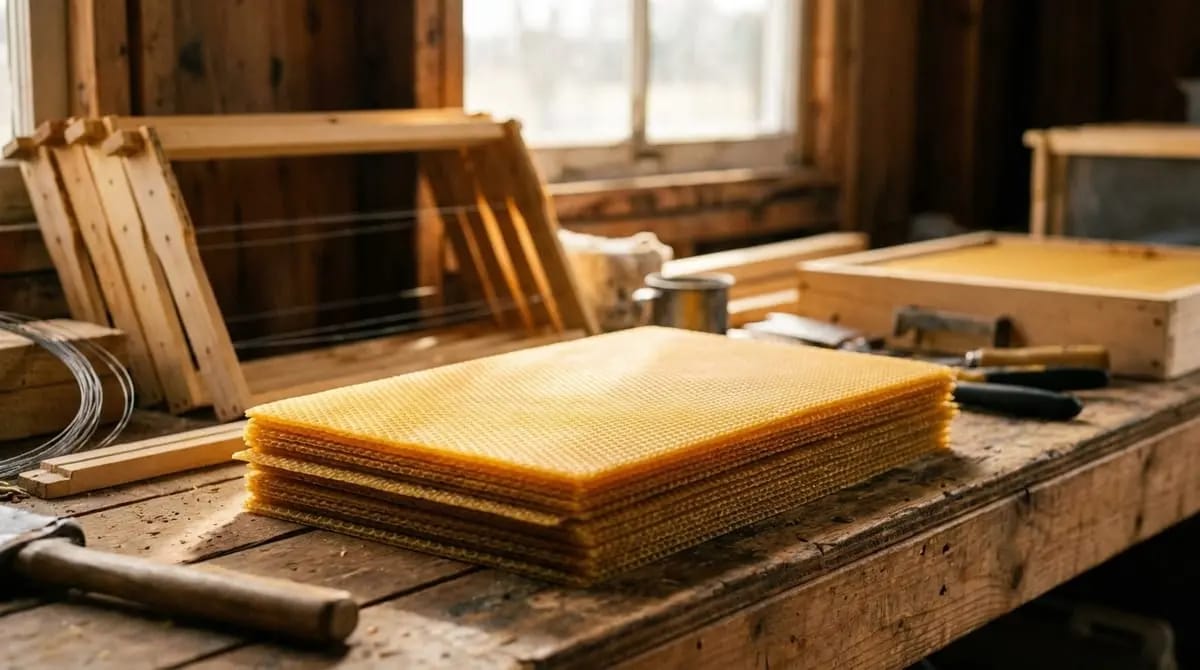
The wax question is one of the most critical points in organic beekeeping. Conventional beeswax may contain residues of treatment products (coumaphos, synthetic acaricides) that are not tolerated in organic beekeeping.
Wax Requirements
- Foundation sheets must be made from organic beeswax
- If organic wax is not available: wax from your own colonies (cappings wax, brace comb wax)
- During the conversion phase: a transition period for wax replacement is provided
- Residue analyses of the wax may be required by the control body
The safest route to residue-free wax is a closed wax cycle: you only use wax from your own colonies (cappings wax, natural comb) and have it processed into foundation sheets -- ideally by an organic-certified wax processor. This gives you full control over wax quality.
Requirement 3: Feeding
The feeding rules in organic beekeeping are significantly stricter than in conventional beekeeping:
Principle: Only Organic Feed
| Feed | EU organic permitted? | Association (stricter) |
|---|---|---|
| Own organic honey | Yes (preferred) | Yes (strongly preferred by Demeter) |
| Purchased organic honey | Yes | Yes |
| Organic sugar (beet or cane) | Yes (for winter feeding) | Yes (restricted by Demeter) |
| Organic sugar syrup | Yes | Yes (restricted by Demeter) |
| Conventional sugar | No | No |
| Inverted sugar syrup (conventional) | No | No |
| Bee candy (conventional) | No | No |
| Pollen substitute | No | No |
When Is Feeding Permitted?
- Only between the last honey harvest and the start of the next nectar flow
- Feeding serves the survival of the colonies, not honey production
- Sufficient honey and pollen stores must be left in the colony (no "plunder and feed" strategy)
- The quantity must be documented
Demeter has the strictest feeding rules of all organic associations: colonies should primarily overwinter on their own honey. Sugar feeding is only permitted in emergencies and in limited quantities. In practice, this means: you must leave enough honey in the colony, which reduces the harvest yield.
Requirement 4: Treatment and Disease Prevention
This is the decisive point for many beekeepers: which treatments are permitted in organic beekeeping?
Permitted Treatments
| Treatment | EU Organic | Demeter | Bioland/Naturland |
|---|---|---|---|
| Formic acid | Yes | Yes | Yes |
| Oxalic acid | Yes | Yes | Yes |
| Lactic acid | Yes | Yes | Yes |
| Thymol (essential oil) | Yes | Yes | Yes |
| Menthol (essential oil) | Yes | No (not common) | Conditional |
| Bayvarol (flumethrin) | No | No | No |
| Perizin (coumaphos) | No | No | No |
| Amitraz (Apivar) | No | No | No |
| Apilife Var (thymol+) | Yes | Yes | Yes |
| Biotechnical methods | Yes (preferred) | Yes (preferred) | Yes (preferred) |
Disease Prevention Principles in Organic Beekeeping
- 1
Prevention takes priority
Organic beekeepers must primarily focus on prevention: site selection, colony strength, hygiene, biotechnical methods (drone brood removal, trapping combs). Treatments are the last resort.
- 2
Prefer biotechnical methods
Drone brood removal, total brood removal, trapping combs and other biotechnical Varroa control methods are expressly preferred in organic beekeeping. They are chemical-free and reduce mite load naturally.
- 3
Use only approved products
When treatment is necessary: exclusively organic acids (formic acid, oxalic acid, lactic acid) and essential oils (thymol). Synthetic acaricides are strictly prohibited in organic beekeeping.
- 4
Antibiotics: Strictest rules
Antibiotic use in bees (e.g. against American Foulbrood) is fundamentally not permitted in EU organic beekeeping. In the event of AFB, colonies must be sanitised or destroyed in accordance with the Bee Disease Ordinance. In conventional beekeeping in Germany, antibiotics for bees are also not approved.
The colony record book obligation under EU 2019/6 also applies in organic beekeeping. Every treatment -- including with organic acids -- must be documented. The control body also checks the colony record book during inspections.
Requirement 5: Location (3 km Radius Rule)
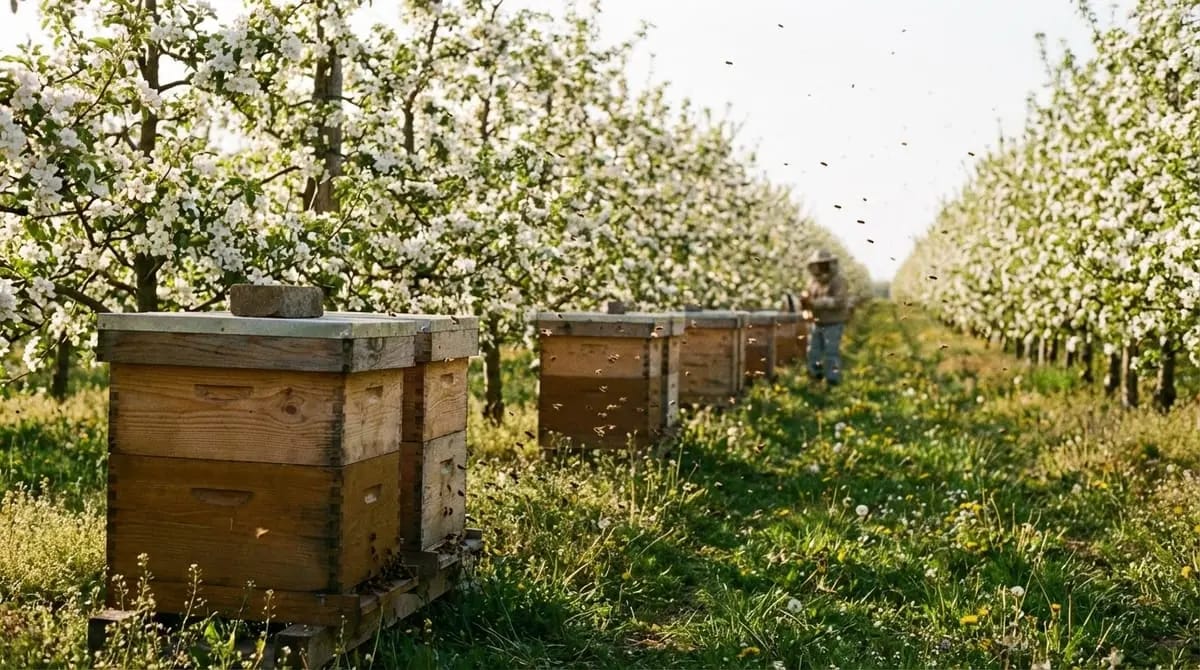
The location requirement is the biggest hurdle for many beekeepers on the path to organic certification.
The 3 km Rule
Within a radius of 3 km around the apiary, the nectar and pollen sources must predominantly come from the following:
- Organically farmed land (organic agriculture)
- Forest and natural vegetation
- Non-agriculturally used land (nature reserves, fallow land)
- Low-intensity managed land with low pesticide use
What Does "Predominantly" Mean?
The EU regulation does not define "predominantly" as an exact percentage. In practice, control bodies apply the following criteria:
- More than 50 % of the area within the 3 km radius should meet the requirements
- Intensive conventional agriculture (maize monocultures, intensive orcharding with pesticides) must be the minority
- Towns and settlements are assessed neutrally (low pesticides, but also few nectar sources)
The best locations for organic beekeeping are: forest edges, nature reserves, extensively managed grassland, areas with a high proportion of organic farming and mountain regions with little intensive agriculture. Urban fringe locations can also work if there is little conventional agriculture within the 3 km radius.
Site Assessment by the Control Body
During certification, the control body produces a site assessment:
- 1
Mapping the 3 km radius
The control body (or you yourself) creates a map of the 3 km radius around each apiary. Land uses are recorded: forest, grassland, arable, settlement, water bodies.
- 2
Land use analysis
Based on the map, it is assessed whether nectar sources predominantly meet organic requirements. Intensive conventional crops are identified.
- 3
Risk assessment
Special risk sources are evaluated: is there an intensively managed orchard with pesticide use within the radius? A large conventional rapeseed operation? Industrial facilities?
- 4
Decision
The control body decides whether the site is suitable for organic beekeeping. In borderline cases, honey analyses for pesticide residues may be required.
Requirement 6: Further Rules
Conversion Period: The Path to an Organic Operation
Conversion Period
The conversion from conventional to organic beekeeping takes at least 1 year (12 months). During this period, all organic rules must already be followed, but the honey may not yet be marketed as "organic".
- 1
Decision and planning (Month 0)
Inform yourself thoroughly about the requirements. Check whether your sites meet the 3 km rule. Calculate the costs for the switch (hives, wax, inspection).
- 2
Choose a control body (Month 1-2)
Choose an approved control body and conclude a control contract. The control body conducts an initial inspection.
- 3
Begin conversion (Month 3)
From the official conversion start, all organic rules must be followed: organic wax, organic feed, only approved treatment products, wooden hives.
- 4
Replace wax (Month 3-12)
Replace conventional foundation sheets with organic wax or own wax. This happens gradually over the season.
- 5
Replace polystyrene hives (Month 3-12)
If you have polystyrene hives: conversion to wooden hives. This can be done gradually (colony by colony).
- 6
Certification (after 12 months)
After successful completion of the 12-month conversion period and a positive inspection, you receive your organic certificate. From now on, your honey may be marketed as organic honey.
EU Organic vs. Association: The Big Comparison
In addition to the EU organic standard, there are four significant organic associations in Germany with their own, sometimes significantly stricter guidelines:
| Criterion | EU Organic | Bioland | Naturland | Demeter |
|---|---|---|---|---|
| Hive material | Natural material (wood, straw) | Wood | Wood | Wood or straw |
| Polystyrene permitted? | No | No | No | No |
| Wax | Organic wax or own wax | Organic wax | Organic wax | Only natural comb/own wax |
| Feeding | Organic sugar, organic honey | Organic sugar, organic honey | Organic sugar, organic honey | Primarily own honey, sugar only in emergency |
| Wing clipping | Prohibited | Prohibited | Prohibited | Prohibited |
| Artificial insemination | Permitted | Permitted | Permitted | Prohibited |
| Location radius | 3 km | 3 km | 3 km | 3 km (more strictly assessed) |
| Natural comb building | Not required | Partially | Recommended | Mandatory (min. brood box) |
| Conversion period | 12 months | 12 months | 12 months | 12 months |
| Inspection costs (approx.) | EUR 150-400/year | EUR 200-500/year | EUR 200-500/year | EUR 250-600/year |
| Association fee | None | Approx. EUR 100-200/year | Approx. EUR 100-200/year | Approx. EUR 150-300/year |
Demeter: The Strictest Rules
Demeter BeekeepingThe Demeter guidelines are based on the anthroposophical agricultural teachings of Rudolf Steiner and go far beyond the EU organic standard:
- Natural comb building is mandatory in the brood box -- no foundation in the brood box (only in the honey super)
- Feeding primarily with own honey, sugar only as an emergency measure
- Artificial insemination is prohibited -- only natural mating
- Queens should emerge from the natural swarming impulse, not through grafting
- Treatment: Same products as EU organic, but stronger emphasis on biotechnical methods
In natural comb building, bees build their combs without foundation sheets -- freely according to their own needs. This leads to a more natural comb structure with varying cell sizes. The bees build more drone brood (which benefits Varroa control). For the beekeeper, it means: less control over comb construction, but a more natural colony.
Choosing a Control Body
For organic certification, you need a contract with an approved control body. In Germany, there are currently around 20 approved control bodies. The most important for beekeepers:
Inspection Process
- 1
Initial inspection (on-site)
An inspector visits your operation, examines the apiaries, checks hives, wax, treatment product inventory and colony record book. Duration: approx. 2-4 hours.
- 2
Document review
Purchase receipts for organic wax, organic feed, treatment products are checked. The colony record book is reviewed. The site assessment is created or updated.
- 3
Annual follow-up inspection
At least once per year, a routine inspection takes place. This may be announced or unannounced.
- 4
Sampling (as needed)
The control body may take honey and wax samples and have them analysed for residues. This is usually done on a random basis or when there is suspicion.
Costs and Effort: Is Organic Worth It?
Costs of Organic Certification
| Cost Factor | One-Off/Annual | Approx. Amount |
|---|---|---|
| Control contract (base fee) | Annual | EUR 150-400 |
| On-site inspection (per visit) | Annual | EUR 100-250 |
| Sampling + analysis | As needed | EUR 50-150 per sample |
| Association fee (Bioland, Naturland, Demeter) | Annual | EUR 100-300 |
| Conversion polystyrene to wood (10 colonies) | One-off | EUR 500-2,000 |
| Organic wax (additional cost) | Annual | Approx. EUR 2-5/kg more than conventional |
| Organic feed (additional cost) | Annual | Approx. 20-40 % more than conventional |
Revenue Potential: What Does Organic Bring?
| Product | Conventional price (approx.) | Organic price (approx.) | Difference |
|---|---|---|---|
| Blossom honey 500g (direct sales) | EUR 7-9 | EUR 10-14 | +EUR 3-5 |
| Honeydew honey 500g (direct sales) | EUR 8-11 | EUR 12-16 | +EUR 4-5 |
| Varietal honey 500g (direct sales) | EUR 9-12 | EUR 13-18 | +EUR 4-6 |
| Honey wholesale (kg) | EUR 5-8 | EUR 10-15 | +EUR 5-7 |
| Comb honey | EUR 15-25 | EUR 25-40 | +EUR 10-15 |
Break-Even Calculation: When Does It Pay Off?
A simplified example calculation for a beekeeper with 20 colonies and 20 kg honey yield per colony:
- Annual organic costs: approx. EUR 400 (inspection fees + association + additional costs for wax/feed)
- Additional revenue from organic: 400 kg honey x approx. EUR 4 premium/500g = approx. EUR 3,200 additional revenue
- Result: Organic pays off clearly -- from just a few colonies, if you sell honey through direct sales
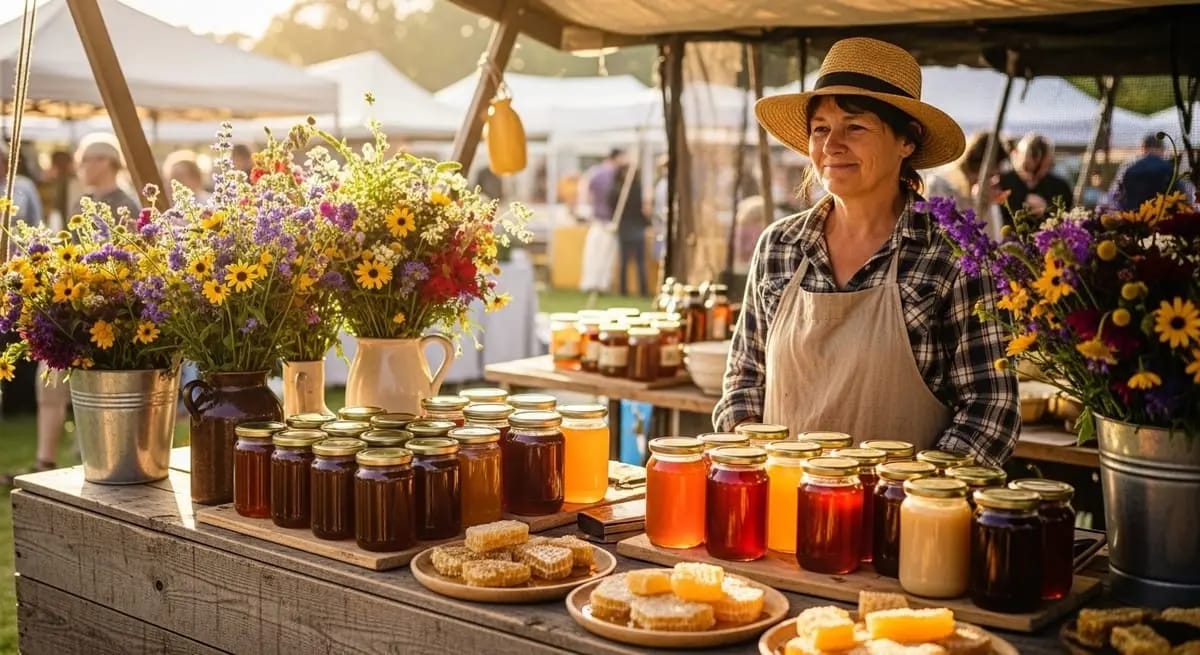
The price premium for organic honey is greatest in direct sales (weekly market, farm-gate, online shop). In wholesale, the difference is smaller. If you already market directly and the site conditions are favourable, organic certification is almost always economically worthwhile.
Frequently Asked Questions About Organic Beekeeping
Organic beekeeping is not a revolution but a consistent development of good beekeeping practice. Most requirements -- natural materials, own wax cycle, organic acids -- are things that many engaged beekeepers already practise. The step to certification is then smaller than expected.
Summary
Organic certification for beekeepers is demanding but achievable. The key takeaways:
- EU 2018/848 is the legal basis -- it applies uniformly across the EU since 1 January 2022
- Hive materials: Only wood and natural materials, no polystyrene
- Wax: Only organic wax or own wax, residue-free
- Feeding: Only organic sugar or organic honey, only after the last harvest
- Treatment: Only organic acids and essential oils, no synthetic acaricides
- Location: 3 km radius must predominantly be organic/near-natural
- Conversion period: 12 months, then certification
- Associations (Demeter, Bioland, Naturland) are stricter than EU organic, especially Demeter
- Economically, organic usually pays off with direct marketing -- price premium 40-60 %