Insurance for Beekeepers: What Do You Really Need?
Business liability, association insurance, SVLFG, theft protection and more. All relevant insurance for beekeepers compared with actual costs.
The insurance structures, association arrangements, and legal references (BGB, SVLFG) described in this lesson apply to Germany. Sections on Austria and Switzerland are included at the end. If you are based elsewhere, consult your national beekeeping association for insurance options in your country.
In Lesson 1, we learned: as a beekeeper, you are liable under Section 833 of the German Civil Code (BGB) through strict liability (Gefaehrdungshaftung) -- even without personal fault. If your bees sting an allergy sufferer or a neighbour sues because of bee flight, this can quickly cost five-figure sums. At the same time, storm, theft or vandalism can destroy your equipment in a single night.
The good news: there are suitable insurance policies for all these risks -- and for most hobby beekeepers, they are surprisingly affordable through the beekeeping association. In this final lesson of the law course, we examine all relevant insurance policies, compare costs and clarify what you really need.
Beekeeper Liability Insurance: ESSENTIAL
Why Liability Is the Most Important Insurance
Business Liability InsuranceBusiness liability insurance (also: beekeeper liability) is by far the most important insurance for every beekeeper. It protects you from the financial consequences of your bees causing damage to third parties.
Without liability insurance, you are liable with your entire personal assets. A single severe anaphylactic shock requiring hospitalisation and follow-up treatment can cost EUR 50,000 to 200,000 and more. Permanent injuries or even the death of an allergy sufferer can run into the millions.
Animal keeper liability under Section 833 BGB is strict liability: you are liable even if you did everything right. An allergy sufferer stung on the pavement outside your garden can claim compensation for pain and suffering, medical costs, lost earnings and a pension. Without insurance, you pay this out of your own pocket. Beekeeper liability insurance costs just a few euros per colony per year -- going without is grossly negligent.
What Does Beekeeper Liability Cover?
| Type of Damage | Covered? | Examples |
|---|---|---|
| Personal injury | Yes | Bee sting with allergic reaction, anaphylaxis, hospital costs |
| Property damage | Yes | Bee droppings on car/facade, soiled laundry |
| Financial loss | Yes (consequential) | Lost earnings after sting, lost rental income |
| Bee flight damage | Yes | Neighbour cannot use terrace, garden party disrupted |
| Damage during swarm pursuit | Yes | Field damage on another's property (Section 962 BGB) |
| Damage from migratory beekeeping | Depends on contract | Transport damage, damage at migratory site |
| Treatment damage to others' colonies | Depends on contract | When you treat colonies for other beekeepers |
| Intentional damage | No | Deliberately placing colonies to cause nuisance |
Coverage Amounts: How Much Protection Do I Need?
| Coverage Amount | Sufficient For | Recommendation |
|---|---|---|
| EUR 1 million lump sum | Hobby beekeeper with few colonies | Minimum protection |
| EUR 3 million lump sum | Hobby beekeeper up to 30 colonies | Good standard |
| EUR 5 million lump sum | Part-time beekeeper, honey sales | Recommended for direct sales |
| EUR 10 million lump sum | Professional beekeeper, large operations | Professional standard |
For hobby beekeepers, EUR 3 million lump sum is a good standard. The additional cost compared to EUR 1 million is minimal (often just a few euros per year), but the protection is significantly better. With severe personal injuries, even EUR 1 million can prove insufficient.
Insurance Through the Beekeeping Association: The Cheapest Option
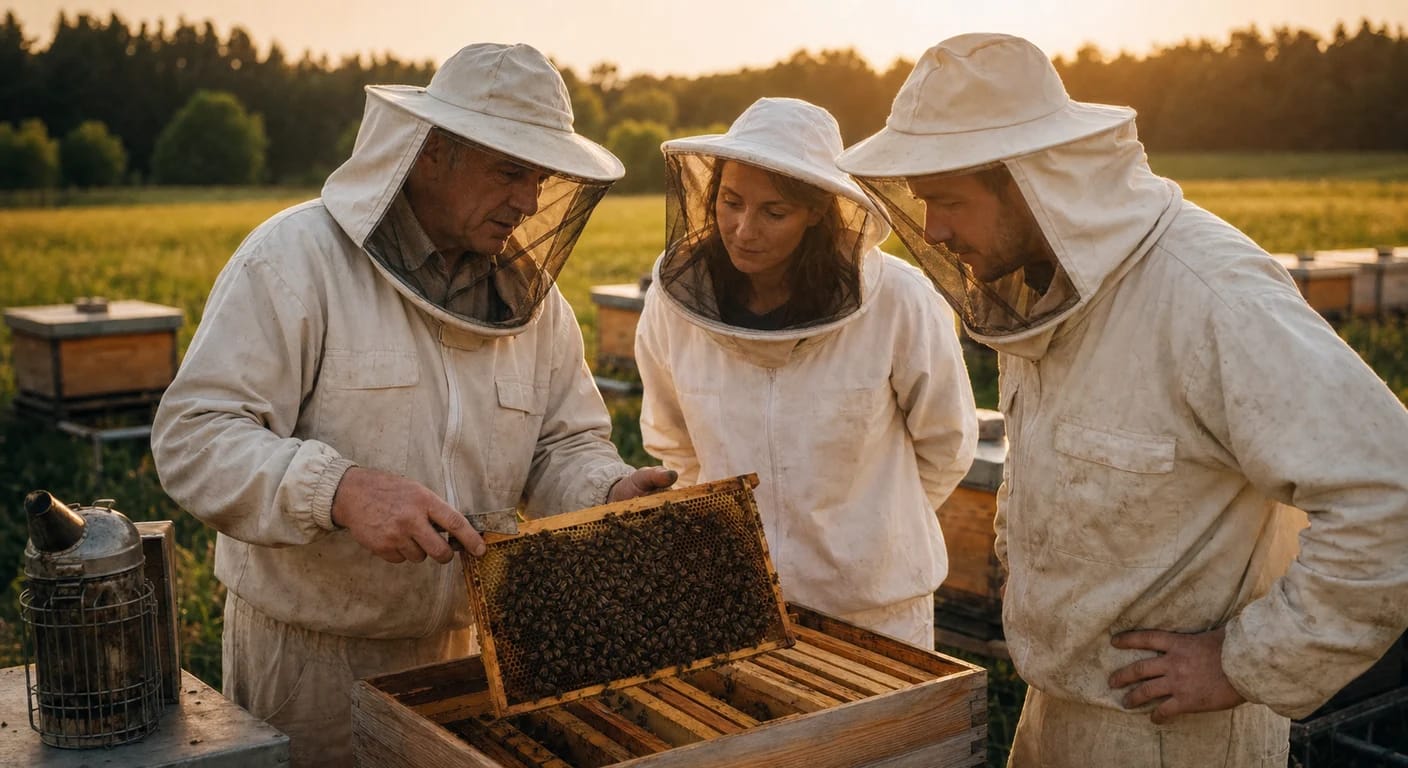
The cheapest and simplest way to obtain beekeeper liability insurance is through the beekeeping association. Most regional associations of the German Beekeepers' Association (DIB) have framework agreements with insurance companies that automatically provide insurance cover to their members.
How Does It Work?
- 1
Join a beekeeping association
You join a local beekeeping association that is a member of the regional association and thus the German Beekeepers' Association (DIB). The annual fee is typically EUR 30-80.
- 2
Report your colony count
You report your colony count to the association (usually annually, typically by 1 October or 1 January). Insurance contributions are calculated based on this figure.
- 3
Automatic insurance cover
Through your association membership, you are automatically covered under the framework agreement of the regional association. You do not need to take out a separate insurance contract yourself.
- 4
In the event of a claim
In case of damage, you report it to your association chairperson or directly to the insurer. Contact details are available through the regional association.
Costs Through the Association
| Regional Association (examples) | Contribution per colony (approx.) | Included benefits |
|---|---|---|
| Bavaria (LVBI) | EUR 2.50-3.50 | Liability + colony loss + legal protection |
| Baden-Wuerttemberg (LV) | EUR 3.00-4.00 | Liability + colony loss |
| North Rhine-Westphalia (IV NRW) | EUR 3.00-4.50 | Liability + colony loss + storm damage |
| Hesse (LV) | EUR 2.50-3.50 | Liability + colony loss |
| Lower Saxony (LV) | EUR 3.00-4.00 | Liability + colony loss + property damage |
| Saxony (LV) | EUR 2.50-3.50 | Liability + colony loss |
Association membership offers many additional benefits beyond insurance: exchange of experience, courses and training, group orders (lower prices for treatment products and supplies), access to extraction rooms, mentor beekeepers for beginners, and the right to use the DIB jar.
Alternative: Individual Liability Insurance
If you are not insured through an association (or do not wish to be), you can take out an individual business liability insurance policy. Some providers:
Property Insurance: Protecting Equipment

Your beekeeping equipment has a value that quickly reaches several thousand euros. Property insurance protects against damage from storms, fire, vandalism and theft.
What Needs to Be Insured?
| Item | Typical Value (per item) | Total Value for 10 Colonies |
|---|---|---|
| Complete hive | EUR 100-200 | EUR 1,000-2,000 |
| Honey extractor | EUR 200-800 | EUR 200-800 |
| Uncapping equipment | EUR 50-300 | EUR 50-300 |
| Honey buckets and bottling containers | EUR 50-200 | EUR 50-200 |
| Bee suit and protective equipment | EUR 80-200 | EUR 80-200 |
| Smoker, hive tool, tools | EUR 50-150 | EUR 50-150 |
| Bee colonies (value per colony) | EUR 100-200 | EUR 1,000-2,000 |
| Wax supply | EUR 50-200 | EUR 50-200 |
| IoT sensors/hive scale | EUR 100-400 | EUR 100-400 |
| **Total** | **EUR 2,580-6,250** |
What Damage Does Property Insurance Cover?
| Type of Damage | Typical Coverage | Frequency |
|---|---|---|
| Storm/hail | Yes (often included in association insurance) | Medium -- especially autumn storms |
| Fire/lightning | Yes | Rare, but catastrophic |
| Theft | Yes (often separate) | Increasing -- especially remote apiaries |
| Vandalism | Yes (often with theft) | Varies by region |
| Flooding | Only in special contracts | Rare, location-dependent |
| Colony loss (poisoning) | Yes (through association) | Rare, but total loss possible |
| Animal damage (bear, woodpecker) | Partial | Regional (bear extremely rare in Germany) |
Association Insurance vs. Private Insurance
Many regional associations offer basic property damage coverage as part of their member insurance:
- Storm damage insurance: Often automatically included
- Colony loss insurance: Compensation for colony losses due to poisoning or disease
- Theft: Often available as an add-on module
For more comprehensive cover (especially theft and vandalism), a separate property insurance may be worthwhile.
Bee colony theft is a growing problem. Entire colonies are stolen at night from remote apiaries -- the market value of a colony is EUR 100-200. Migratory apiaries in rural areas are particularly vulnerable. Some beekeepers use GPS trackers or surveillance cameras as preventive measures.
SVLFG: Agricultural Accident Insurance
SVLFG (Accident Insurance)The Social Insurance for Agriculture, Forestry and Horticulture (SVLFG) is the statutory occupational insurance body for beekeepers. We introduced it in Lesson 4 -- here we go into more detail on benefits and costs.
When Is Membership Compulsory?
| Colony Count | Status | Contribution (approx.) | Benefits |
|---|---|---|---|
| 1-25 colonies | Voluntary membership possible | Approx. EUR 50-100/year | Accident insurance when working with bees |
| 26-99 colonies | Compulsory member | Approx. EUR 70-150/year | Statutory accident insurance + prevention |
| 100+ colonies | Compulsory member | Depends on operation size | Full social insurance possible |
What Does the SVLFG Cover?
The SVLFG accident insurance is more comprehensive than private accident insurance in many areas:
- 1
Occupational accidents
All accidents during beekeeping activities: falling from a ladder during an inspection, injuries when extracting, falls on the way to the apiary, burns when melting wax. No excess.
- 2
Commuting accidents
Accidents on the direct route to and from the apiaries. Also accidents when transporting colonies or equipment.
- 3
Occupational diseases
Severe allergic reactions to bee stings recognised as occupational diseases. For beekeepers: bee venom allergy that developed through the activity.
- 4
Medical treatment
All necessary medical measures: doctor visits, hospital stays, medication, physiotherapy, aids. Free of charge.
- 5
Rehabilitation
Occupational and social rehabilitation after severe accidents. Retraining measures if the previous activity is no longer possible.
- 6
Pensions
In case of permanent reduced earning capacity from an occupational accident: accident pension. In case of death from an occupational accident: survivors' pension.
SVLFG contributions are tax-deductible as operating expenses. You can claim them in Annex L (agriculture and forestry) of your income tax return.
SVLFG vs. Private Accident Insurance
| Criterion | SVLFG (statutory) | Private Accident Insurance |
|---|---|---|
| Trigger for benefits | Occupational accident + commuting accident | Any accident (24/7) |
| Medical treatment | Complete, no excess | Depends on tariff |
| Rehabilitation | Comprehensive | Often not included |
| Disability benefit | Accident pension (ongoing) | Lump sum payment (capital) |
| Occupational diseases | Yes | No |
| Survivors' pension | Yes | Only in expensive tariffs |
| Scope | Only during beekeeping activity | Worldwide, around the clock |
| Costs | Approx. EUR 70-150/year | Approx. EUR 100-500/year |
The SVLFG only covers accidents during beekeeping. For accidents in everyday life, sports or leisure, you need a private accident insurance or are covered through your employer's statutory accident insurance (for employees). The two types complement each other -- they do not replace each other.
Further Relevant Insurance
Insurance Checklist: What Do You Really Need?
Minimal Setup (Hobby beekeeper, 1-10 colonies)
Must-Have Insurance
Nice-to-Have Insurance
Total cost minimal setup: Approx. EUR 50-100/year (association fee + insurance)
Standard Setup (Hobby beekeeper, 10-25 colonies)
Must-Have Insurance
Nice-to-Have Insurance
Total cost standard setup: Approx. EUR 100-250/year
Professional Setup (26+ colonies, part-time beekeeper)
Must-Have Insurance
Nice-to-Have Insurance
Total cost professional setup: Approx. EUR 300-600/year (incl. SVLFG)
Claim: How to Proceed
- 1
Document the damage
Photograph the damage immediately and comprehensively. Note the date, time, circumstances and any witnesses. In the case of personal injury: note the contact details of the injured party.
- 2
Inform the police (for theft/vandalism)
In cases of theft or deliberate damage: file a police report immediately. You will need the case reference number for the insurance claim.
- 3
Notify the insurer
Report the damage without delay (within a few days) to your insurer -- either directly or through the association chairperson. Late reporting can lead to reduced benefits.
- 4
Complete the claim form
Fill out the insurer's claim form completely. Attach photos, police reference number and witness statements.
- 5
Await settlement
The insurer reviews the claim and settles it. For liability claims, the insurer also undertakes the defence against unjustified claims -- an often overlooked but important benefit.
Liability insurance not only pays legitimate claims but also provides defence against unjustified claims. If your neighbour claims your bees "over-pollinated" their fruit tree (not a real problem), the insurer reviews and defends against this claim -- at their own expense. This passive legal protection is an enormous advantage.
Insurance in Austria and Switzerland
We strongly recommend every beekeeper to join a beekeeping association. In addition to the invaluable exchange of experience, association membership provides comprehensive insurance cover at conditions that no individual can achieve. Liability insurance in particular is essential for every beekeeper.
Common Insurance Mistakes
Mistake 1: "My private liability covers that"
Often not! Many private liability policies exclude animal keeper liability for bees -- especially when multiple colonies are kept. Check your policy or ask your insurer. When in doubt: take out separate beekeeper liability insurance.
Mistake 2: "I only have 3 colonies, I don't need insurance"
Yes you do! Even 3 colonies can cause significant damage. A single bee sting with anaphylactic shock can generate costs of EUR 50,000 and more. Animal keeper liability under Section 833 BGB applies from the 1st colony.
Mistake 3: "The colony count reported to the association is approximate"
Risky! If you report fewer colonies than you have, the insurer can reduce or refuse benefits in the event of a claim. Always report the actual colony count -- the additional cost per colony is minimal.
Mistake 4: "I reported the damage months later"
Problematic! Most insurance terms require prompt notification of claims. Delays can lead to reduced benefits. Report every claim immediately -- even if you are unsure whether it is covered.
Summary
Insurance cover for beekeepers does not have to be expensive -- but it must exist. The key takeaways:
- Beekeeper liability insurance is the most important insurance of all -- without it you risk your assets
- Through the beekeeping association, you get the cheapest and most comprehensive cover (from approx. EUR 2.50/colony/year)
- From more than 25 colonies (from the 26th colony), you are automatically insured with the SVLFG (accident insurance)
- Property insurance (storm, theft, vandalism) becomes especially important for remote apiaries
- Private liability often does not cover bee damage -- check your policy!
- In the event of a claim: immediately document and report without delay
- Always report the actual colony count -- under-reporting jeopardises your insurance cover
- Liability insurance also provides passive legal protection (defence against unjustified claims)
This concludes our course "Law and Regulations for Beekeepers". You now know the most important areas of law, the colony record book obligation, food labelling, authority registrations, the path to organic certification and the right insurance cover. With this knowledge, you are legally well set up and can focus fully on what really matters: your bees.