Processing Beeswax: From Hive to Finished Product
Beeswax is one of beekeeping's most versatile products. Learn how to render, clean, and process wax from cappings and old comb, then turn it into foundation, candles, lip balm, and more.
Beeswax is arguably the most elegant byproduct of beekeeping. Produced by young worker bees from abdominal glands, it is the structural material of the entire colony — the comb that stores honey, pollen, and developing brood. For the beekeeper, every harvest yields raw wax from cappings and old comb. That wax, properly rendered and processed, has real value: commercial foundation, hand-poured candles, natural cosmetics, and a dozen other products all begin with clean beeswax. This guide takes you through the full process.
Wax Sources: Cappings vs. Old Comb
Not all beeswax is equal. Understanding where your wax comes from affects how you process it and what it is suitable for.
Cappings Wax
When you uncap frames for extraction, you slice away a thin layer of wax — the cappings that seal each honey cell. Cappings wax is:
- The highest quality wax you will produce. It is fresh, light-colored, and minimally contaminated.
- The easiest to render. It contains minimal brood residue, propolis, and debris.
- Lightest in color — pale yellow to near-white — making it ideal for cosmetics, light-colored candles, and products where appearance matters.
- Smallest in quantity — typically around 1–1.5 lbs of wax per 100 lbs of honey extracted.
Collect cappings into a bucket as you uncap and keep them separate from other wax sources for best results.
Old Comb
Old, dark brood comb that you cycle out of the brood nest is a significant wax source, but requires more effort to process:
- Higher in debris: Old comb contains cocoon remnants (silk sheaths from larval metamorphosis), propolis, bee parts, and pollen.
- Lower yield: Old comb yields far less wax than its weight suggests — cocoon material can comprise 30–50% of the weight of very old, dark comb.
- Darker color: The rendered wax will be darker yellow, sometimes brown. Fine for candles; less suitable for cosmetics or foundation.
- Contamination risk: Old comb may contain residues of treatments (oxalic acid, amitraz, coumaphos). Always render and use old comb wax only for non-food products (candles, wood treatment, furniture polish) rather than lip balm or food wrap if you have used chemical treatments.
Rule of thumb: Keep cappings wax and old comb wax separate throughout the process and label them clearly.
Rendering Methods
Rendering is the process of melting wax, separating it from debris, and collecting clean wax for further processing.
Method 1: Solar Wax Melter
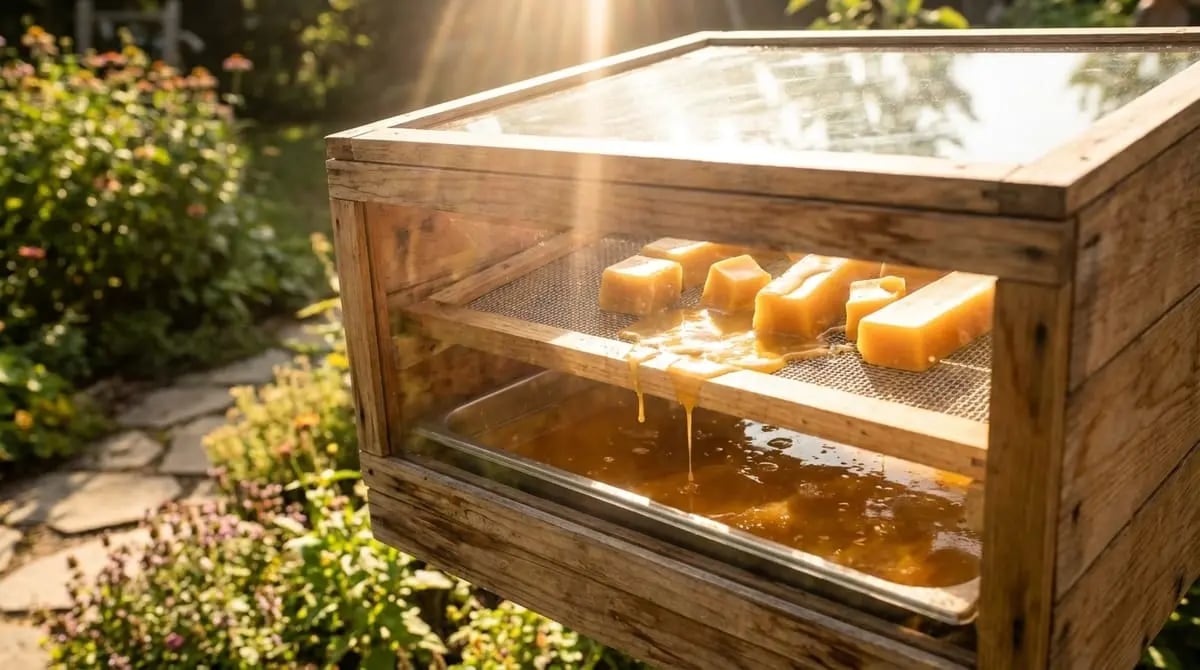
A solar wax melter is the simplest and most passive method available. It is a double-layered box, usually with a glass top, that captures solar heat to melt wax placed inside. Molten wax drips through a filter into a collection container; debris remains on the filter.
Pros:
- No active energy input — fully solar powered
- Very gentle heat — does not overheat or discolor fine wax
- Can be built from scrap lumber and a piece of glass for under $30
- Set-it-and-forget-it operation
Cons:
- Works only in direct sunlight; useless in overcast conditions
- Slow — may take all day for a full load
- Less effective for dense old comb with heavy cocoon content
- Temperatures inside may not fully liquefy old, heavily laden frames
Best for: Cappings wax and lightly used comb during sunny summer months.
Build notes: Line the inside with an aluminum roasting pan as the collection vessel. Use a paint strainer bag or old nylon stocking as the filter. Angle the base at 45° toward the sun.
Method 2: Double Boiler
A double boiler (or bain-marie) is the most controllable rendering method for home use. Place raw wax in an inner container set inside a larger container of boiling water. The steam from the outer container melts the wax gently without direct flame contact.
Protocol:
- Use a dedicated pot — wax is nearly impossible to fully remove from cookware. Buy cheap enamel or aluminum pots at a thrift store and designate them "wax only."
- Fill the outer pot with water and bring to a simmer.
- Place crushed or broken wax pieces in the inner pot.
- Melt completely, stirring occasionally.
- Strain through a paint strainer, cheesecloth, or a dedicated wax filter into a clean mold.
- Allow to cool slowly — rapid cooling can cause cracking.
Temperature: Beeswax melts at approximately 145°F (63°C) and should never exceed 175°F (80°C). Above 175°F, wax begins to discolor and can lose quality. Never melt wax over direct flame without a water bath — beeswax is flammable at high temperatures.
Pros: Good control, works year-round, accessible for any quantity. Cons: Requires attention, uses stove energy, equipment becomes permanently dedicated to wax work.
Method 3: Steam Extraction
Steam wax extractors are purpose-built tools used primarily in Europe but increasingly available in North America. They work like a pressure cooker: steam melts the wax in whole frames, which drips into a collection tank. The residual slum gum (wax + cocoon + debris) remains in the extractor.
Pros: Handles full frames and very old comb efficiently, highest yield of any method for old comb, minimal labor. Cons: Equipment cost ($150–400+ for commercial units), larger setup required.
Best for: Beekeepers regularly cycling large quantities of old comb.
Method Comparison
| Method | Best Wax Source | Energy | Yield | Cost | Best Season |
|---|---|---|---|---|---|
| Solar wax melter | Cappings, light comb | None (solar) | Moderate | $0–30 DIY | Summer (sunny days) |
| Double boiler | Cappings, any comb | Stove | Good | $0 (using scrap pots) | Year-round |
| Steam extractor | Old/dense comb | Propane or electric | Highest | $150–400+ | Year-round |
Filtering and Cleaning
Rendered wax typically still contains fine particles of propolis, pollen, and debris. Multiple filtrations produce progressively cleaner wax.
Filtration materials in order of fineness:
- Hardware cloth or paint strainer (coarse — removes large debris)
- Old nylon stocking or fine mesh bag (medium — removes fine particles)
- Coffee filter (fine — produces very clear wax, but slow)
- Commercial wax filter paper (finest — for professional quality)
The water method: For particularly dirty wax, add hot water to the melted wax, stir well, and allow to solidify. The impurities collect at the bottom of the wax block and can be scraped off. Repeat 2–3 times for very clean wax.
Expected wax color after proper filtration:
- Cappings wax: Pale gold to near-white
- Young brood comb: Medium yellow
- Old brood comb: Dark yellow-brown
Making Foundation
Beeswax foundation is one of the highest-value uses of your processed wax. Producing your own foundation closes the wax cycle completely — wax from your bees returns to your bees — and ensures that no foreign wax or contaminants enter your hives.
Equipment Required
- Foundation molds: Cast aluminum molds are available from beekeeping suppliers. They imprint the cell pattern on both sides of a wax sheet simultaneously.
- Wax bath: A shallow tank or tray kept at 145–150°F (63–66°C) for dipping.
- Thermometer (essential — temperature control is critical for foundation)
- Embedding wire and board for wired foundation
Basic Dipping Method
- Heat clean, filtered wax to 155°F (68°C) in a shallow flat tray.
- Wet the foundation mold and shake off excess water (prevents wax from sticking).
- Dip the mold into the wax for 1–2 seconds.
- Lift out and allow to cool for 30–60 seconds.
- Flex the mold slightly and peel off the foundation sheet.
- Trim edges and embed wire if desired.
Making consistent foundation takes practice. Commercial foundation machines produce far more consistent results at volume. Many beekeepers prefer to trade raw wax with a foundation supplier rather than produce their own.
Candle Making
Beeswax candles are the most popular value-added product for small beekeeping operations. They command premium prices at farmers markets and craft fairs, and customers appreciate their natural honey fragrance, clean burn, and long burn time.
Beeswax burns approximately 50% longer than paraffin and produces a brighter, whiter light. It also naturally releases negative ions as it burns, which some customers value — though the research on any health claims is limited.
Candle Making Methods
Dipped Candles
The traditional method. Repeatedly dip a wick into melted wax (155°F / 68°C), allowing each coat to cool before re-dipping. 20–30 dips produce a taper of the desired thickness. Dipped candles are beautiful and traditional but labor intensive.
Molded Candles
Pour melted wax (slightly hotter than dipping — around 160°F / 71°C) into silicone or aluminum molds. Allow to cool completely (do not rush — rapid cooling causes surface cracks and shrinkage). Beeswax shrinks as it cools, so you may need to top off the mold once a skin has formed.
Wax temperature matters: Too hot and the finished candle has a pitted surface; too cool and it does not fill the mold completely.
Rolled Candles (Foundation Sheets)
The easiest method, using commercial beeswax foundation sheets (available from beekeeping suppliers in various colors). Place a wick at one edge and roll the sheet tightly around it. No heat required — foundation is pliable at room temperature above 60°F (16°C). Excellent beginner project and a fast way to produce attractive products.
Candle Wicks
Use cotton wicks sized appropriately for your candle diameter. A wick that is too small produces a small, tunneling flame; too large causes smoking and sooting. Standard guidelines:
| Candle Diameter | Wick Size |
|---|---|
| Up to 1 inch (2.5 cm) | #2/0 or CD6 |
| 1–2 inches (2.5–5 cm) | 2/0 to 1/0 or CD10 |
| 2–3 inches (5–8 cm) | 1/0 to CD16 |
| 3+ inches (7.5+ cm) | CD20+ or multiple wicks |
Test every wick size before producing in quantity — burn time, flame height, and melt pool diameter all need to be checked.
Other Beeswax Products
Lip Balm
A simple formula: 1 part beeswax + 4 parts oil (sweet almond, jojoba, or coconut) + optional essential oil for fragrance. Melt together, pour into lip balm tubes or small tins, allow to cool. Use only cappings wax from treatment-free or oxalic-acid-only colonies in products applied to skin.
Beeswax Food Wraps
A growing market: cotton fabric coated with a mixture of beeswax, pine resin, and a carrier oil (jojoba works well). The wrap clings like plastic wrap when warmed by hand heat and can be washed and reused for up to a year. A 100% natural alternative to plastic food wrap.
Wood and Leather Treatment
Beeswax mixed with linseed oil makes a traditional furniture polish and wood conditioner. It is also excellent for conditioning leather boots, belts, and tool handles.
Equipment Maintenance
Pure beeswax rubbed on frame grooves reduces friction when inserting and removing frames. Applied to the threads of hive screws and bolts, it prevents corrosion and makes disassembly easier.
Contamination Risks
Acaricide residues: Synthetic varroa treatments (coumaphos, tau-fluvalinate, amitraz) accumulate in wax over time. Old comb from treated colonies contains measurable residues that cannot be removed by rendering. Never use wax from heavily treated comb in cosmetics, lip products, or food-contact items.
Wax adulteration (commercial risk): The commercial beeswax market has a serious adulteration problem — paraffin, carnauba, and other waxes are frequently mixed into commercial "beeswax." If you are selling wax products, use only wax from your own colonies or from trusted local sources you can verify.
The Closed Wax Cycle
The most sustainable approach to wax management is the closed wax cycle: wax from your hives is rendered, processed into foundation, returned to the hives, filled with comb, harvested as cappings at extraction, and rendered again. This cycle keeps wax with known history (your own colonies, known treatment history) in your own operation, minimizes contamination risk, and eliminates the cost of commercial foundation.
Conclusion: Track Your Wax Production with Hivekraft
Wax is a harvest product just like honey, and tracking it makes your operation more complete. In Hivekraft, you can log wax yield alongside every extraction event — noting the source (cappings vs. recycled comb), weight rendered, and finished products produced. Over several seasons, you will know exactly how much wax your apiary produces per kg of honey extracted and can plan your candle or foundation production accordingly.
Beeswax is slow to produce — each pound requires bees to consume approximately 6–8 pounds of honey to secrete. Treating it with the care and tracking it deserves is one of the best signs of a thoughtful, professional beekeeping operation.
Track harvests, print labels, market your honey.
Hivekraft is free for up to 10 hives. Register in 30 seconds.