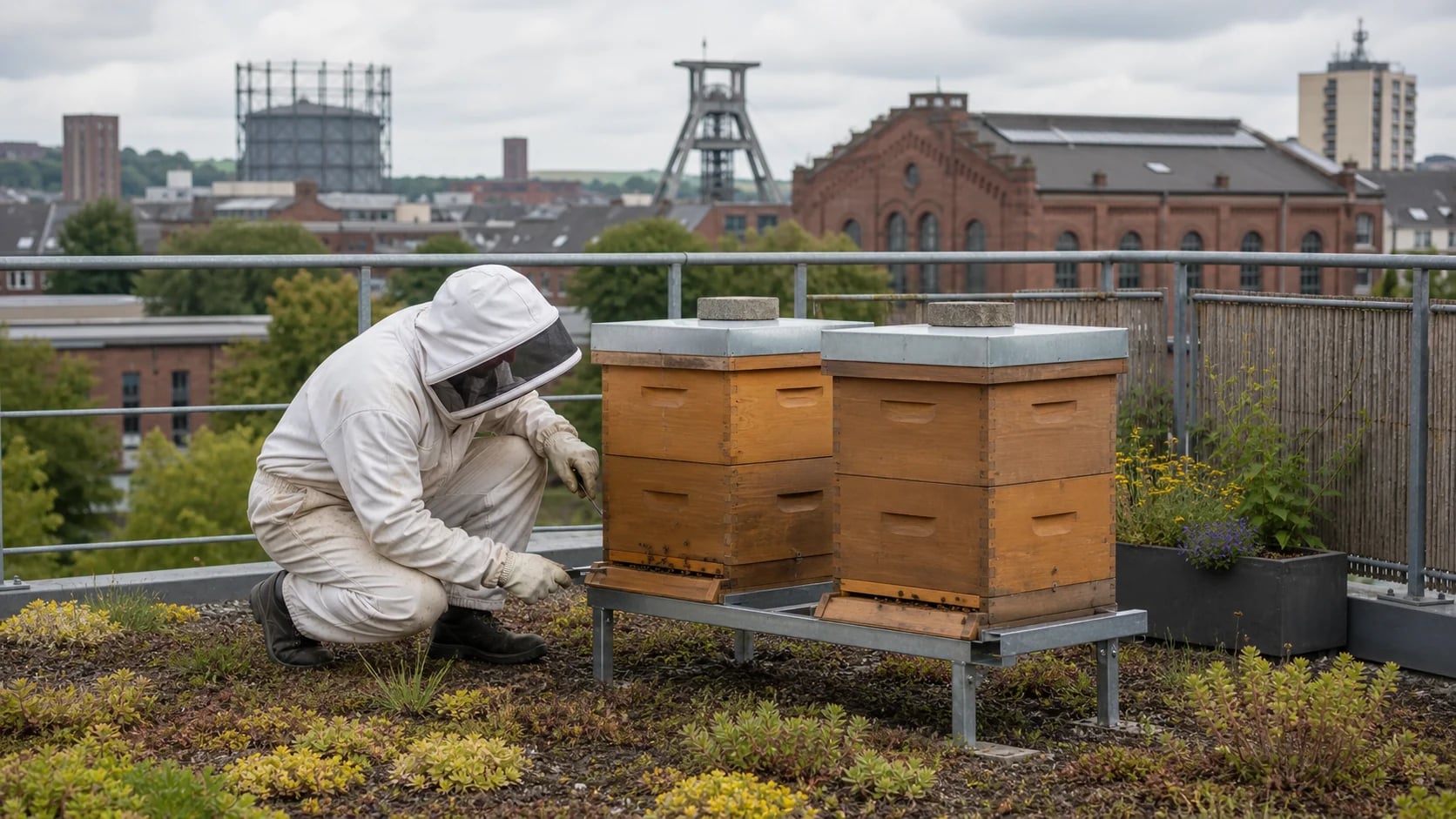
 AI-generated
Beekeeping in NRW: Urban Beekeeping in the Industrial Heartland
Beekeeping in North Rhine-Westphalia: Urban beekeeping in the Ruhr area, Rhineland forage sources and why NRW is Germany's most diverse beekeeping state.
North Rhine-Westphalia is the most populous federal state in Germany — and a surprisingly exciting beekeeping region. From the urban Ruhr area through the Rhine floodplains to the Sauerland and the Eifel, NRW offers a diversity that many underestimate. With approximately 17,000 beekeepers and a thriving urban beekeeping scene, NRW has long been more than just an industrial heartland.
The regulations, organizations and geographic details described in this article apply specifically to North Rhine-Westphalia, Germany. Rules and structures may differ in other countries and regions.
NRW: Diversity in a Compact Space
Hardly any other federal state combines such different landscapes and habitats as NRW. This is directly reflected in beekeeping:
- Ruhr area and cities: Rooftop beekeeping, parks, allotment gardens — surprisingly good urban forage
- Rhine plain: Fruit cultivation, floodplain landscapes, linden trees in old town centers
- Muensterland: Agriculture, rapeseed, meadows — classic forage sources
- Sauerland and Siegerland: Low mountain ranges with forest and heather forage
- Eifel: Wild herbs, beech forests, extensive agriculture
Urban Beekeeping: The Ruhr Area Revolution
Over the past ten years, the Ruhr area has developed into one of the most dynamic urban beekeeping centers in Germany. Where coal mines once smoked, bees now buzz on rooftops, in parks and on former industrial brownfields.
Why Cities Work for Bees
Urban beekeeping in NRW disproves the prejudice that bees only thrive in the countryside:
| Feature | City (Ruhr Area) | Countryside (Muensterland) |
|---|---|---|
| Forage diversity | High: Parks, gardens, avenues, brownfields | Medium: Rapeseed, grassland, little forest |
| Forage duration | Long: March–October through ornamental plants | Shorter: Nectar gap in summer |
| Pesticide exposure | Low: Little agriculture | Higher: Intensive arable farming |
| Space availability | Limited: Rooftop, allotment garden | Generous: Meadows, forest edge |
| Neighborhood | Coordination needed: Densely populated | Uncomplicated: Few residents nearby |
| Honey yield | 15–30 kg per colony | 20–40 kg per colony (rapeseed!) |
| Honey quality | Diverse, aromatic | Single-variety possible (rapeseed) |
Urban Beekeeping Hotspots in NRW
Cologne: The cathedral city is a paradise for urban bees. The Green Belt, the Rhine Park and countless allotment gardens provide abundant forage. The Cologne Beekeeping Association is one of the most active urban associations in Germany and operates a teaching apiary in the city.
Duesseldorf: On the rooftops of the state capital, hundreds of bee colonies now stand. Initiatives like "Deutschland summt!" (Germany Buzzes!) and local beekeeping associations have popularized urban beekeeping here.
Dortmund: The former steel city exemplifies the structural transformation: on the grounds of the old Hoesch steel mill (Phoenix Lake), bee colonies stand today, and the Westfalenpark hosts one of the finest teaching apiaries in the Ruhr area.
Essen: The European Green Capital 2017 has integrated bees as part of its concept. The Haus der Bienen (House of Bees) in the Grugapark offers visitors insights into the world of honey bees, and the nearby Bee Museum Duisburg in Rumeln-Kaldenhausen showcases the history of beekeeping in the Ruhr area.
Bochum: The Ruhr University Bochum operates around 85 bee colonies at the teaching apiary in the Lottental valley for research purposes and offers beekeeping courses.
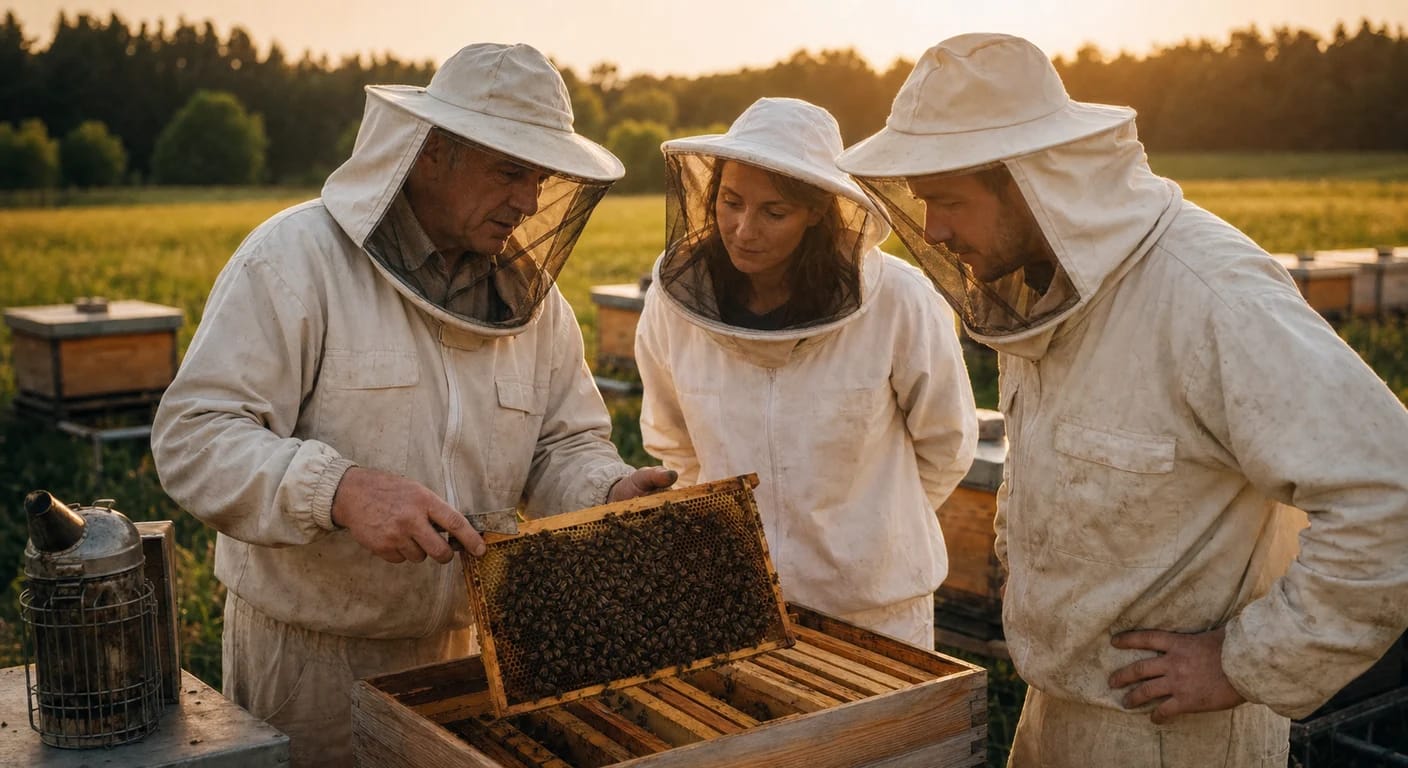
If you want to start beekeeping in an NRW city, first contact your local beekeeping association. Most offer beginner courses and help with finding a location. In Cologne, Duesseldorf and the Ruhr area, there are also numerous private initiatives that provide rooftop space for bee colonies.
Industrial Brownfields as Bee Pastures
A distinctive feature of the Ruhr area: the numerous former industrial brownfields have developed into valuable biotopes. On the nutrient-poor, open areas, pioneer plants such as viper's bugloss, wild carrot, sweet clover and willowherb grow — a paradise for honey bees and wild bees alike.
Notable brownfield biotopes:
- Zollverein (Essen): UNESCO World Heritage Site with species-rich flora on the former colliery grounds
- Landschaftspark Duisburg-Nord: Decommissioned steelworks with diverse vegetation
- Halde Hoheward (Herten): Renaturalized mining slag heap with flowering areas
- Emscher redevelopment: The renaturalization of the Emscher River is creating new floodplain landscapes
NRW's Forage Sources
Spring: Fruit Blossom and Rapeseed
The Rhineland and Muensterland offer abundant forage in spring:
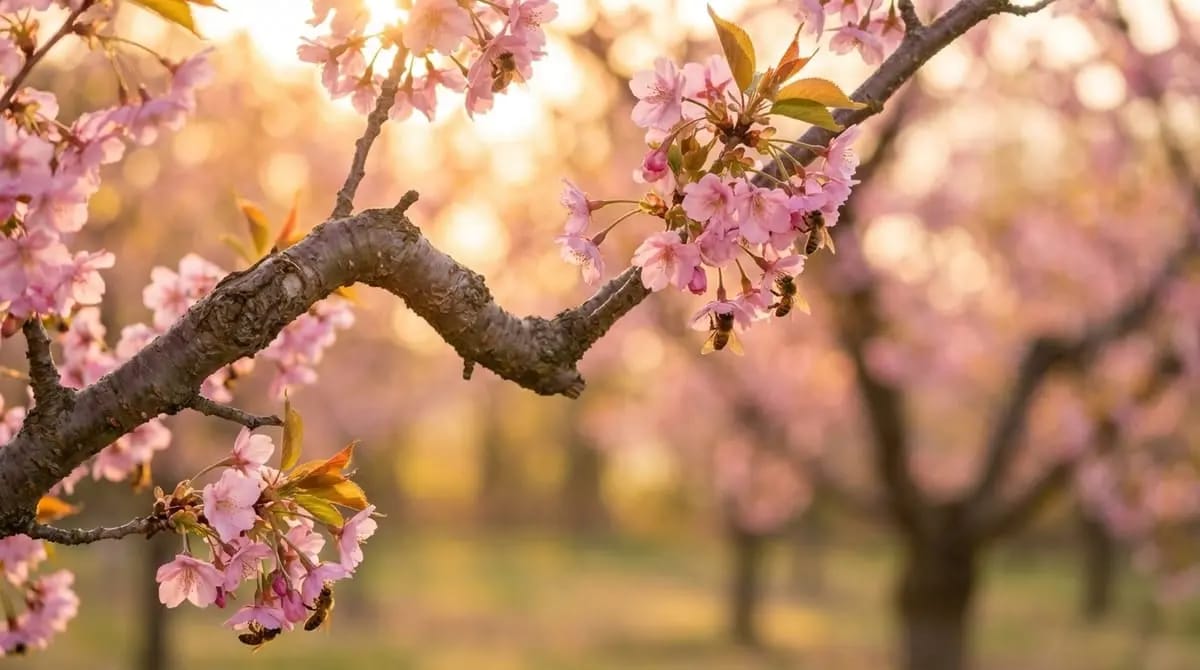
Fruit blossom (April–May): Especially in the Rhineland fruit-growing region around Meckenheim and in the Bergisches Land, cherries, apples and pears bloom. The fruit blossom yields aromatic, light honey with a fine, fruity flavor.
Rapeseed (April–May): In the Muensterland, the Soest Basin and the Lower Rhine, large rapeseed fields stand. Rapeseed honey is the highest-yielding single forage source in NRW.
Dandelion (April–May): On the grasslands of the Bergisches Land and the Sauerland, extensive dandelion meadows offer a reliable early forage.
Summer: Linden, Sweet Chestnut and Forest
Linden (June–July): NRW has an excellent linden tree population — especially the cities of Cologne, Bonn, Muenster and Duesseldorf are lined with linden avenues. Linden honey from NRW is light, fresh and slightly minty.
Sweet chestnut (June–July): In the Siebengebirge, the Eifel and the Bergisches Land, sweet chestnut stands produce a spicy-robust honey with a slight bitter note.
Forest honey (June–August): The Sauerland and the Eifel offer forest honey from spruce and fir stands in good years. Yields fluctuate considerably.
Late Summer: Late Forage
Himalayan balsam (August–September): Himalayan balsam (Impatiens glandulifera) has spread along many streams in NRW and provides a welcome late forage. The honey is light and mild, though it is controversially discussed since the balsam is an invasive neophyte.
Heather (August–September): In the Senne near Bielefeld and on the heights of the Sauerland, heather stands offer a late forage — smaller than the Lueneburg Heath but valuable for local beekeepers.
Beekeeping Associations and Organizations in NRW
NRW has a well-organized beekeeping community with strong associations:
Landesverband Westfaelischer und Lippischer Imker e.V.
The LV-WLI supports beekeepers in Westphalia-Lippe (eastern NRW) with approximately 6,400 members in 29 county and 212 local associations. It offers:
- Beginner and continuing education courses
- Honey testing and DIB certification
- Legal advice and insurance
- Bee breeding and mating station operation
Imkerverband Rheinland e.V.
The Rhineland Beekeeping Association supports beekeepers in western NRW as well as in parts of Rhineland-Palatinate (corresponding to the historic Rhine Province) with 238 associations and 34 county beekeeping federations. Besides the usual association services, it has particularly distinguished itself in promoting urban beekeeping.
Bee Institute of the NRW Chamber of Agriculture
The Bee Institute Muenster of the NRW Chamber of Agriculture is the central research and advisory institution for beekeeping in NRW. It cooperates closely with the Bee and Beekeeping Center in Mayen (Rhineland-Palatinate). It offers:
- Bee health examinations
- Honey analyses
- Continuing education and specialist conferences
- Consultation on suspected poisoning
NRW supports beekeeping through the State Ministry of the Environment and the Chamber of Agriculture. Funding is available for beginner equipment, bee pastures and training for beekeepers. Contact your county beekeeping association about current programs.
Special Challenges in NRW
High Bee Density in Cities
The growing popularity of urban beekeeping has led to a high bee density in some NRW cities. In Cologne and Duesseldorf, there are sometimes more than 15 colonies per square kilometer. This can lead to problems:
- Competition for forage sources — also with wild bees
- Increased disease risk due to spatial proximity
- Catching swarms in densely populated areas becomes more complex
More bees do not automatically mean more conservation. Pay attention to an appropriate colony count and do not forget: honey bees compete with the often more severely threatened wild bees for food. Ideally, combine your beekeeping with measures for wild bees — for example with nesting aids and native flowering plants.
Agricultural Monocultures in the Muensterland
The Muensterland and the Soest Basin are intensively farmed. After the rapeseed bloom, a pronounced nectar gap often occurs because corn and grain offer nothing to bees. Flower strip programs and cooperation with farmers are gaining importance here.
Motorway Networks and Traffic
NRW has the densest motorway network in Germany. For migratory beekeepers, this means good accessibility but also risks from traffic for the bees. Locations directly next to busy roads are not ideal — exhaust fumes and particulate matter can contaminate the honey.
Practical Tips for NRW Beekeepers
- 1
Choose Your Location Wisely
In NRW you have the choice between city and countryside. Both have advantages. In the city you benefit from forage diversity, in the countryside from rapeseed yields. Ideal: A city stand for basic supply and a migratory stand for the rapeseed flow.
- 2
Use the Association Network
NRW has over 500 beekeeping associations. Use this infrastructure: beginner courses, mentorships, honey testing and shared equipment use (extractor, wax melter) make getting started easier and more affordable.
- 3
Discover Rhineland Specialties
Try the regional specialties: sweet chestnut honey from the Siebengebirge, linden honey from Cologne's avenues or forest honey from the Sauerland. Regional honey varieties command premium prices in direct marketing.
- 4
Work Digitally
The short distances in NRW make it easy to manage multiple locations. A digital hive record like Hivekraft helps you keep track — especially when you combine city and countryside locations.
Showcase Projects of NRW Beekeeping
"Bees Make School"
Numerous schools in NRW operate their own bee colonies. The project combines natural science, environmental education and practical learning. Beekeeping associations often provide mentors who support the school beekeeping programs.
Bee Pastures on Industrial Brownfields
The "Industrienatur" (Industrial Nature) program of the Ruhr Regional Association promotes the creation of flowering areas on former industrial brownfields. These areas are valuable not only for honey bees but also for rare wild bee species.
Corporate Bees
More and more NRW companies are placing bee colonies on their premises — from the chemical park in Leverkusen to the technology park in Aachen. The corporate honey serves as employee gifts and sustainability symbols.
Conclusion: NRW — Underestimated and Full of Possibilities
North Rhine-Westphalia is a beekeeping region of contrasts: rooftop beekeeping on the Zollverein grounds, rapeseed flow in the Muensterland, forest honey in the Sauerland and sweet chestnut in the Siebengebirge. The dense population, the strong association culture and the pioneering work in urban beekeeping make NRW one of Germany's most exciting beekeeping locations. Those who keep bees here will find a vibrant community and surprisingly diverse forage opportunities.
Beekeeping in Bavaria: Forage, Traditions and Regional Specialties Urban Beekeeping Berlin: Capital of the Bees Bees in the Garden: 20 Simple Tips for Bee-Friendly Gardening- Forage Plants and Bee Pasture -- Lesson 7: Urban Beekeeping and Forage Sources
- Beekeeping for Beginners -- The Complete Course for Beginners
Less paperwork. More time with your bees.
Hivekraft is free for up to 10 hives. Register in 30 seconds.