Beekeeping in Switzerland: Mountain Beekeeping and Tradition
Swiss beekeeping: From mountain beekeeping in the Alps to BienenSchweiz to the strictest quality standards. A comprehensive overview.
Switzerland is a land of extremes -- and that applies to beekeeping as well. Apiaries at over 2,000 meters elevation, quality standards among the strictest in the world, and a beekeeping community that maintains its traditions without losing sight of the future. With approximately 16,500 beekeepers and one of the highest honey prices in Europe, Swiss beekeeping is unique -- and a fascinating model for the German-speaking world.
This article covers Swiss beekeeping regulations, organizations, and practices. While much of the practical beekeeping advice is universally applicable, the specific laws, quality standards, and organizational structures are unique to Switzerland.
Swiss Beekeeping at a Glance
Despite its small size, Switzerland has a remarkable beekeeping tradition. Some key figures:
- ~182,000 bee colonies across the country
- Average of 11 colonies per beekeeper
- Honey production: 2,000--3,500 tons per year (depending on the season)
- Self-sufficiency rate: Only about 25--30% -- Switzerland imports significantly more honey than it produces
- Honey price: 18--30 CHF per 500g jar -- one of the highest prices worldwide
Language Regions and Beekeeping
Multilingual Switzerland also has regional differences in beekeeping:
- German-speaking Switzerland: Largest beekeeping community, strong club culture, CH-hive widespread
- Romandie (Western Switzerland): French-speaking, stronger influence of French beekeeping tradition
- Ticino: Italian-speaking, Mediterranean forage, sweet chestnut
- Romansh: Small community in Graubuenden, alpine specialties
BienenSchweiz: The Largest Beekeeping Association
BienenSchweiz (formerly VDRB -- Association of German-Swiss and Romansh Bee Friends) is the beekeeping association of German-speaking and Romansh Switzerland and one of the best-organized beekeeping associations in Europe. It unites the German-speaking and Romansh sections, while the Romandie and Ticino have their own associations.
What BienenSchweiz Offers
- Basic training: Standardized beginner course over two years -- one of the most thorough in Europe
- Specialized courses: Specializations in breeding, honey quality, bee health
- Management concept: Recommendations for beekeeping practices, tailored to Swiss conditions
- Swiss Bee Journal: Monthly professional magazine of high quality
- Research coordination: Close cooperation with the Center for Bee Research
Swiss beekeeper training is exemplary: The basic course spans two beekeeping years and includes theory and practice. Only after passing the final examination may one use the Swiss Honey Gold Seal in many cantons. This training model is internationally regarded as best practice.
Other Associations
- Societe Romande d'Apiculture (SAR): Association of Western Swiss beekeepers
- Federazione Ticinese di Apicoltura (FTA): Ticino beekeeping association
- apisuisse: Umbrella organization of all three language associations
Forage Regions of Switzerland
Mittelland: The Heart of Swiss Beekeeping
The Swiss Mittelland between Lake Geneva and Lake Constance is the most productive beekeeping region. Most beekeepers live here and forage conditions are most favorable:
Typical forage:
- Fruit blossom (April--May): Cherries, apples, pears -- especially in Thurgau and around Lake Constance
- Rapeseed (April--May): In agricultural areas, though less than in northern Germany
- Dandelion (April--May): On the grasslands that characterize Switzerland
- Linden (June--July): In cities and along avenues
- Forest (June--August): Mixed forest with spruce, fir, and deciduous trees
The Alps: Mountain Beekeeping Par Excellence
Alpine beekeeping is what makes Swiss beekeeping most famous internationally. Apiaries at 1,000--2,000 meters elevation produce honeys with unique aromas:
| Elevation | Typical Forage | Season | Special Features |
|---|---|---|---|
| Valley floors (400-800 m) | Fruit, dandelion, linden | April-August | Similar to the Mittelland |
| Middle elevations (800-1,400 m) | Mountain herbs, forest, clover | May-August | Shorter but aromatic |
| High elevations (1,400-2,000 m) | Alpine flowers, rhododendron, clover | June-August | Very short season, specialties |
| Extreme elevations (>2,000 m) | Only occasionally possible | July-August | Rarity, extreme beekeeping |
Alpine rose honey (Rhododendron) from high elevations is one of the rarest and most expensive honey varieties in Switzerland. It is produced only in small quantities and commands prices of up to 50 CHF per jar.
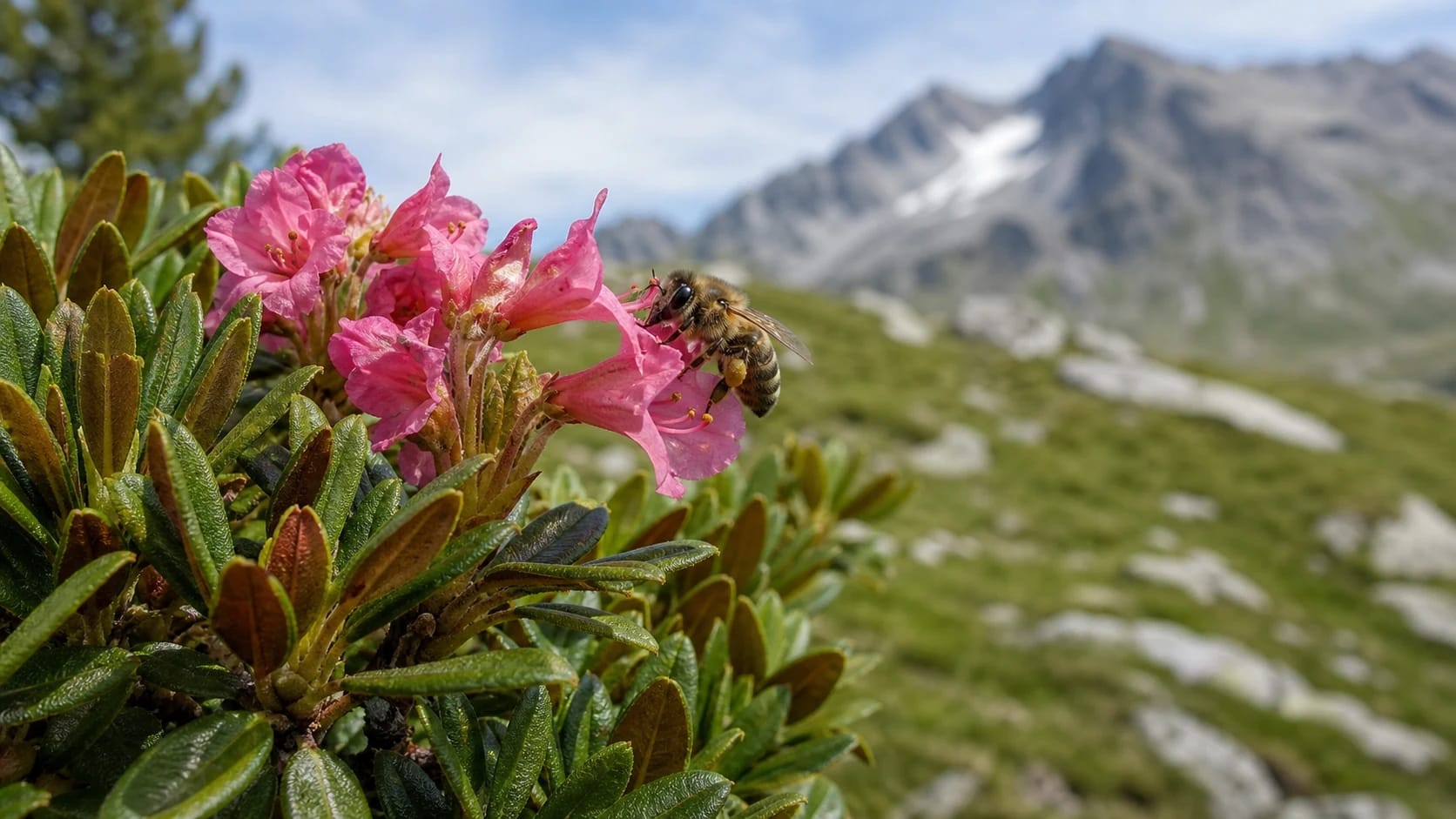 AI-generated
Ticino: Mediterranean Influences
Ticino is the southern exception: Mild, almost Mediterranean climate enables a longer season and special forage:
- Acacia/Robinia (May--June): Mild, light honey
- Sweet chestnut (June--July): The Ticino specialty -- dark, spicy, slightly bitter
- Linden blossom (June--July): In the urban areas of Lugano and Locarno
Ticino chestnut honey is a Slow Food product and enjoys an excellent reputation beyond Switzerland.
Jura: Wild Herbs and Forest
The Swiss Jura offers a mix of calcareous grassland and forest. The extensively managed Jura meadows harbor a rich wild herb flora that produces an aromatic blossom honey. At the same time, the coniferous forests of the Jura provide forest honey in good years.
The CH-Hive: A Swiss Specialty
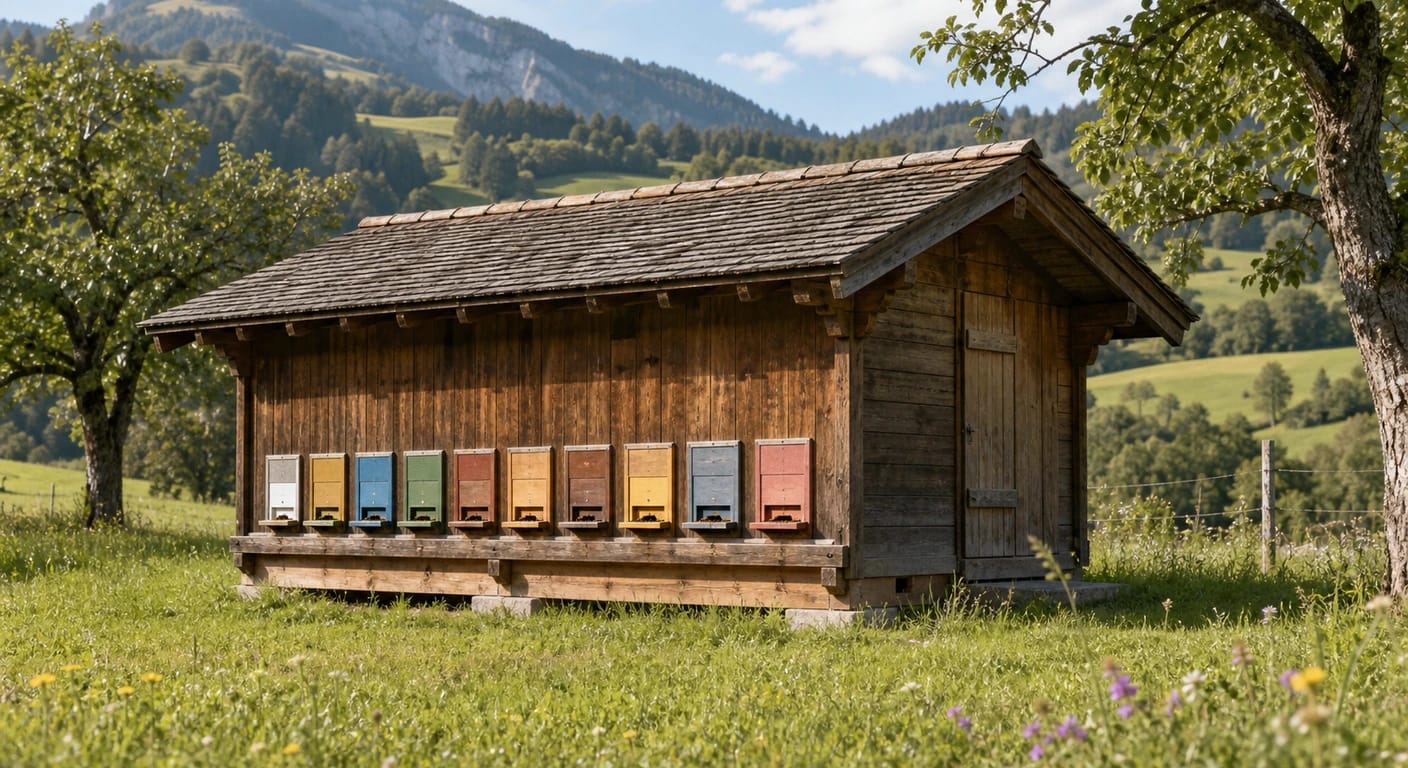
One of the most distinctive differences from German beekeeping is the Swiss hive (CH-Kasten). This traditional hive system is based on the rear-access principle -- the hives stand in a bee house, and the beekeeper works from behind on the combs.
Advantages and Disadvantages of the CH-Hive
Advantages:
- Excellent weather protection in the bee house
- Comfortable working in any weather
- The Swiss frame size is standardized and readily available
- Tradition: Generations of knowledge and experience
Disadvantages:
- Bee houses are expensive to acquire
- No possibility for migratory beekeeping
- More difficult entry for beginners using modern literature (mostly focused on movable-frame hives)
- Less flexibility compared to Langstroth or Dadant hives
In recent years, the trend in Switzerland has increasingly moved toward movable-frame hives (Dadant, Langstroth, or Swiss frame size as magazine). Especially younger beekeepers and migratory beekeepers prefer the more flexible magazines. BienenSchweiz supports both systems and offers courses for both management approaches.
Quality Standards: The Swiss Gold Seal
Switzerland has one of the strictest honey quality standards in the world. The Gold Seal from apisuisse (the umbrella association of all three language associations) guarantees:
- Origin: 100% Swiss honey, traceable origin
- Water content: Maximum 18.5% (stricter than the EU standard)
- HMF value: Maximum 15 mg/kg (EU allows 40 mg/kg)
- No heating: Not heated above 40 degrees Celsius
- Regular inspections: Random laboratory analyses
- Training: Only trained beekeepers may use the Gold Seal
These high standards come at a price -- literally: Swiss honey is among the most expensive in the world. But they also ensure high consumer trust and enable fair prices for beekeepers.
Research: The Center for Bee Research
The Center for Bee Research at the Agroscope location in Liebefeld (Bern) is one of the world's leading bee research institutions. Fundamental and applied research has been conducted here for decades:
- Varroa research: Development of the concept of "biotechnical Varroa control"
- COLOSS network: International coordination for research on bee colony losses (headquartered in Bern)
- Bee poisoning: Systematic investigation of suspected cases
- Breeding research: Selection for Varroa tolerance and vitality
- Honey analysis: Reference laboratory for honey analytics
Challenges of Swiss Beekeeping
High Production Costs
Swiss beekeeping struggles with high costs: Equipment, feed, and labor are more expensive than in neighboring countries. At the same time, expensive Swiss honey competes with cheap imports. The self-sufficiency rate of only 25--30% shows that demand far exceeds supply.
Climate Change in the Alps
The Alps are warming twice as fast as the global average. For mountain beekeeping, this means:
- Glacier retreat changes water supply for alpine plants
- Higher tree line: Forest displaces alpine meadows
- Late frosts: Fruit blossom becomes riskier
- New pests: The Small Hive Beetle has established itself since 2014 in southern Italy (Calabria, Sicily) and could reach Switzerland via northern Italy
Switzerland has established a comprehensive monitoring program for the Small Hive Beetle (Aethina tumida). Beekeepers in Ticino and Graubuenden should be particularly vigilant and immediately report suspicious observations to the cantonal veterinary office.
Colony Losses
Switzerland also struggles with above-average winter losses. COLOSS monitoring shows that in some years up to 25% of colonies do not survive winter. The causes are well known: Varroa, pesticides, forage scarcity, and climate stress.
Practical Tips for Swiss Beekeeping
- 1
Complete the Basic Course
Invest in the two-year BienenSchweiz basic training. It is not only the prerequisite for the Gold Seal but conveys solid knowledge that will serve you for years. Courses are offered in all national languages.
- 2
Choose Your Hive System
Make a conscious choice between the CH-hive and movable-frame hives. If you can take over an existing bee house, the CH-hive offers advantages. For newcomers without a bee house, magazines are more flexible and cost-effective.
- 3
Plan Your Location by Elevation
In Switzerland, elevation determines everything: season length, forage availability, and management approach. A valley location (400--600 m) offers a longer season, a mountain location (1,000--1,500 m) more exclusive honeys. Ideally, combine both elevations through migratory beekeeping.
- 4
Market Honey at Premium Prices
Swiss honey is a premium product -- market it accordingly. The Gold Seal, attractive labels, and the story of your apiary (location, forage, tradition) justify prices of 20--30 CHF per 500g. Direct marketing at weekly markets and through farm shops works best.
Swiss Specialties
Bee Houses as Cultural Heritage
Traditional Swiss bee houses are a cultural treasure. Particularly in the Emmental and Bernese Oberland, there are beautiful, often centuries-old bee houses with painted flight boards. Some are listed as heritage buildings and are maintained by associations or municipalities.
Swiss Mead (Honey Wine)
In Switzerland, mead (honey wine) is experiencing a renaissance. Small producers combine Swiss honey with regional ingredients -- alpine blossom honey mead, chestnut mead, or edelweiss mead are specialties with a devoted following.
Bees and Tourism
Several Swiss regions combine beekeeping and tourism: Bee educational trails, beekeeper experience days, and honey tastings in mountain huts make beekeeping a tourist attraction. The Swiss National Park in Graubuenden offers tours on the alpine bee world.
Conclusion: Switzerland -- Small, but Big in Beekeeping
Swiss beekeeping is a prime example of how quality triumphs over quantity. Strict standards, excellent training, and respect for tradition combine with modern research and a strong sense of community. For German-speaking beekeepers, looking to Switzerland is particularly inspiring: The way BienenSchweiz and apisuisse organize training, quality assurance, and association work sets standards -- and Swiss honey proves that high quality is worth its price.
Beekeeping in Austria: Home of the Carnica Bee German Honey Varieties: A Flavor Journey Through the Regions Beekeeping for Beginners - Your Introduction to Keeping Bees- Forage Plants and Bee Pasture -- Mountain and Alpine Forage
- Advanced Beekeeping Practice -- Migratory Beekeeping and Management Approaches
Less paperwork. More time with your bees.
Hivekraft is free for up to 5 hives. Register in 30 seconds.