Bees in Winter - How Your Colonies Survive the Cold Season
What do bees do in winter? How do you support your colonies properly? Everything about the winter cluster, feed, monitoring and common mistakes.
Winter is a time of waiting for beekeepers. But while you sit back, your bees are working hard to survive as a colony. Understanding what happens inside the hive helps you support your colonies optimally.
What Happens Inside the Hive in Winter?
The Winter Cluster
At about 10 degrees Celsius outside temperature, bees form a winter cluster - a spherical arrangement in which they warm each other.
- Outer shell: Bees sit tightly packed and insulate
- Core temperature: 20-25 degrees Celsius (without brood)
- With brood: Up to 35 degrees Celsius in the brood nest
- Energy source: Stored honey and sugar syrup
Feed Consumption
A typical colony consumes in winter:
- October-November: 1-2 kg per month
- December-January: 0.5-1.5 kg per month (coldest phase)
- February-March: 2-4 kg per month (brood rearing begins!)
- Total: 12-18 kg over the winter
Caution: The highest consumption comes in late winter when brood rearing begins again. This is when most colonies starve!
Proper Feeding
Timing and Quantity
Feeding should be completed by mid-September:
- Goal: 15-20 kg feed reserves (depending on region and colony strength)
- Feed: Inverted sugar syrup or sugar water (3:2)
- Use feed frames or feeders
- Do not feed too late - the bees must still be able to process the feed
Checking Feed Reserves
How to estimate feed reserves:
| Method | Accuracy | Effort |
|---|---|---|
| Hefting the hive | Medium | Low |
| Hive scale (IoT) | High | One-time |
| Frame inspection | High | Disturbance |
Conducting Winter Checks Properly
What You Should Check
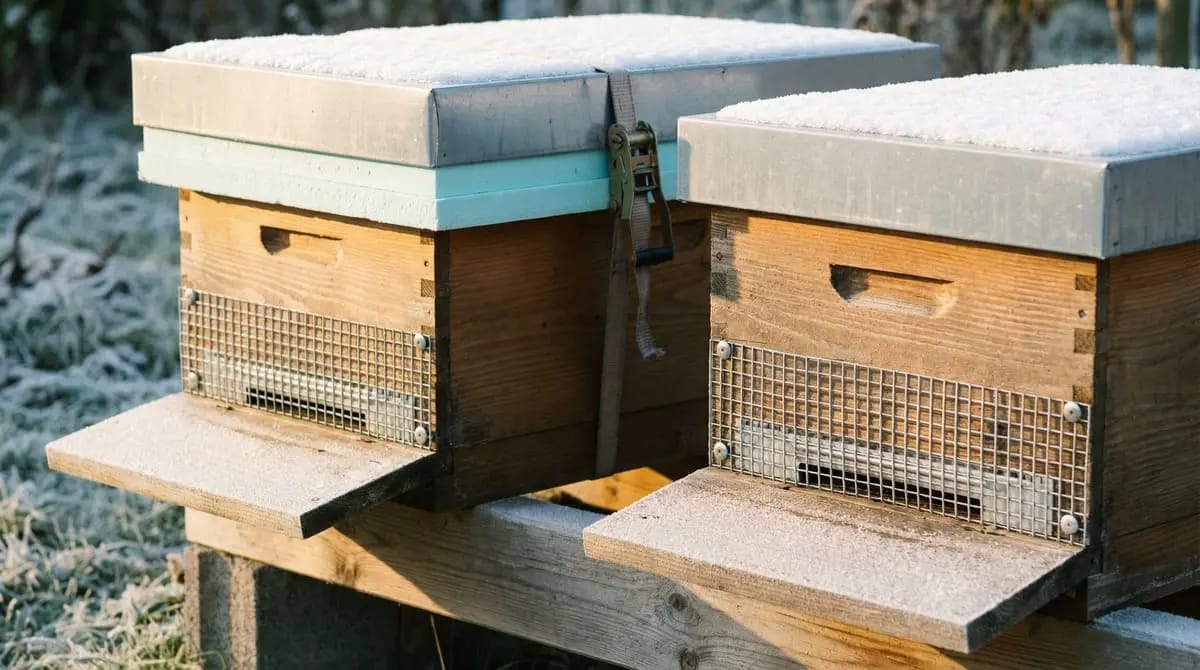
- Entrance: Free from dead bees and snow?
- Mouse protection: Mouse guard at the entrance?
- Storm protection: Lid weighted down?
- Moisture: Condensation on the bottom?
What You Should NOT Do
- Open the hive below 10 degrees
- Disturb colonies unnecessarily
- Feed bees during frost (they will not take feed)
- Move or relocate the hive
Common Winter Losses and Their Causes
Most Common Causes of Loss
-
Varroa infestation (70-80% of all winter losses are directly or indirectly caused by the Varroa mite, including viruses transmitted by Varroa such as DWV)
- Inadequate summer treatment
- Reinvasion from neighboring colonies
- Solution: Consistent treatment strategy
-
Feed shortage (~10%)
- Insufficient feeding
- Feed poorly positioned
- Solution: Ensure 15-20 kg reserves
-
Queenlessness (~5-10%)
- Queen lost in autumn
- No replacement possible
- Solution: Autumn check for queenrightness
-
Nosema and other diseases
- Plays a smaller role than previously assumed according to current research
- Colonies weakened by Varroa are more susceptible to secondary infections
- Humid hive atmosphere promotes fungal diseases
Preparing for Spring
Already in winter, you can prepare for the new season:
- Wire frames
- Embed foundation sheets
- Repair and clean equipment
- Plan apiaries and obtain permits
- Attend training (beekeeping courses, lectures)
Checklist: Winter-Ready in 5 Steps
- Complete feeding by mid-September (15-20 kg)
- Perform winter treatment during broodless phase
- Install mouse guard and storm protection
- Reduce entrance
- Monthly visual check from outside
Summary
Bees are perfectly adapted to winter. Your task as a beekeeper is to create the right conditions and then be patient. Good Varroa treatment, sufficient feed, and minimal disturbance - that is all you need for a successful winter. Document your winter preparations in the digital hive records so you keep track in spring.
Read also: Winter Treatment with Oxalic Acid - How Final Mite Removal Works Autumn Preparations: Reducing Winter Risks for Your Bees What comes next: Spring Awakening at the Beehive - What to Do NowWinter is planning time. Use it for your education:
- Beekeeping for Beginners -- Lesson 11: Winter rest, monitoring without disturbance
- Bee Health Complete Course -- Lesson 7: Analyzing and preventing winter losses
Less paperwork. More time with your bees.
Hivekraft is free for up to 10 hives. Register in 30 seconds.