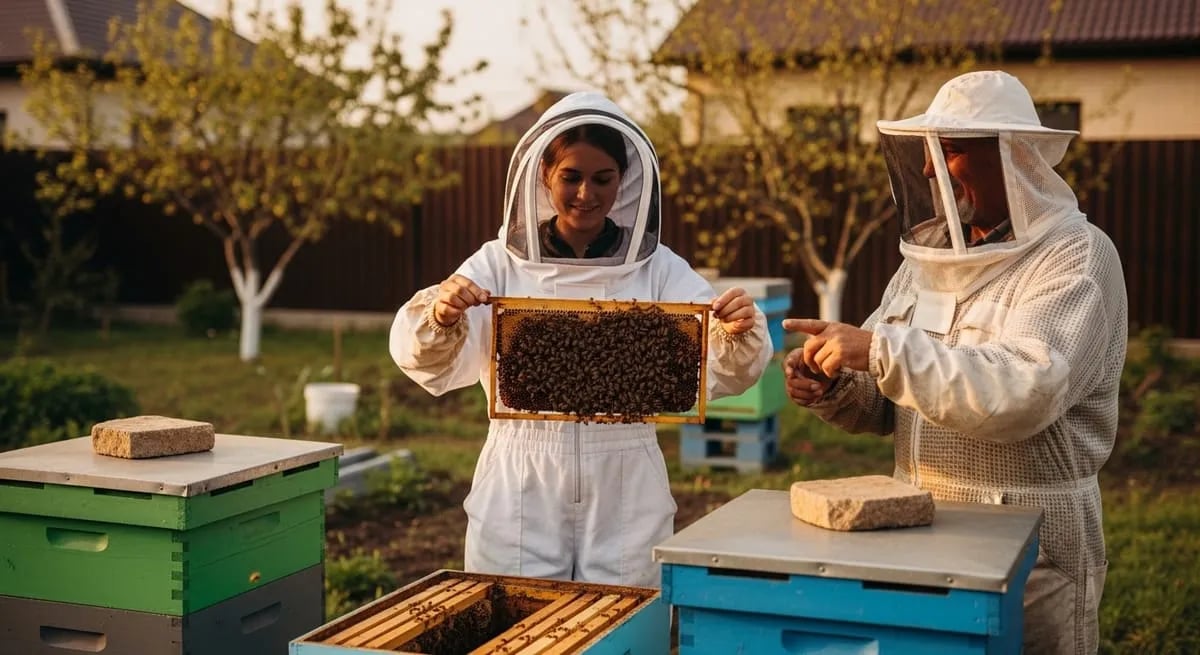
Beekeeping for Beginners - Your Guide to Getting Started
Want to start beekeeping? Learn everything about getting started: equipment, costs, time commitment, and your first steps.
Beekeeping is a wonderful hobby that brings you closer to nature and rewards you with delicious honey. But where do you start? In this article, we give you a comprehensive overview of everything you need to know to get started - from equipment and legal requirements to the most common mistakes you should avoid.
Before You Start: Take a Beekeeping Course
The most important first step is a beginner course at your local beekeeping association. Here you learn the basics from experienced beekeepers, gain practical insights, and make valuable contacts.
- Courses typically run from March to September
- Cost: 50-150 euros (weekend introductory courses), comprehensive season-long mentoring 200-350 euros
- You work with real colonies
- You often get paired with a beekeeping mentor
Beekeeping cannot be learned from books alone. Hands-on work with a bee colony under the guidance of an experienced beekeeper is irreplaceable. Every colony is different, and that is what makes it so fascinating.
A course is also important because it helps you discover whether beekeeping is truly for you. You learn how to handle buzzing bees, find out if you have allergic reactions, and get a realistic picture of the workload involved.
What a Good Beginner Course Covers
- Theory: Bee biology, hive systems, management methods
- Practice: Working with open colonies, swarm control, honey harvest
- Annual cycle: Accompaniment through at least one season
- Varroa: Basics of mite treatment
- Regulations: Registration, colony records, neighborhood law
Essential Equipment
Starter Kit for Beginners - Complete Cost Breakdown
Note: The regulations described here apply to Germany. Rules may differ in other countries.
| Equipment | Budget Option | Mid-Range Option | Premium |
|---|---|---|---|
| 2 complete hives (boxes, frames, bottom board, cover) | 150-200 EUR (used) | 250-350 EUR (Segeberger) | 400-600 EUR (stainless steel/wood) |
| Bee suit with veil | 40-60 EUR | 80-120 EUR | 150-250 EUR |
| Smoker | 20-30 EUR | 35-50 EUR | 60-90 EUR (stainless steel) |
| Hive tool | 8-12 EUR | 12-18 EUR | 20-35 EUR |
| Bee brush | 6-10 EUR | 10-15 EUR | 15-25 EUR |
| Queen excluders (2x) | 10-15 EUR | 15-25 EUR | 25-40 EUR |
| Feeder frames (2x) | 20-30 EUR | 30-50 EUR | 50-80 EUR |
| 2 nucleus colonies/package bees | 100-150 EUR (mentor) | 180-250 EUR (association) | 250-350 EUR (breeder) |
| Beginner course | 50 EUR | 100 EUR | 150 EUR |
| Total 1st year | 404-557 EUR | 712-978 EUR | 1,120-1,620 EUR |
What You Will Need Later
In the second or third year, additional purchases will be needed:
- Honey extractor (often available for loan at your association, purchase: 200-500 EUR)
- Uncapping equipment (fork + tray: 30-60 EUR)
- Honey buckets and strainers (20-40 EUR)
- Refractometer (measuring moisture content: 20-40 EUR)
- Bottling container (15-30 EUR)
Many associations lend extractors and uncapping equipment for free or a small fee. Some mentors offer used hives at a good price. Always ask at your association first before buying new. A good used hive is better than a cheap new one.
Your First Bees
Where Do I Get Bees?
- From your mentor: You often receive a nucleus colony as a gift or at a low cost
- From your beekeeping association: Many associations arrange nucleus colonies
- From a breeder: Package bees or nucleus colony (80-150 euros)
Nucleus Colony vs. Package Bees - Which Is Better?
| Criterion | Nucleus Colony | Package Bees |
|---|---|---|
| Price | 80-120 EUR | 100-150 EUR |
| Queen | Already present, often mated | Included, often young |
| Brood nest | Present (3-5 frames) | Must be built from scratch |
| Disease risk | Combs may carry pathogens | Lower risk (no old combs) |
| Development | Faster, often honey super same year | Slower, first year is build-up |
| For beginners | Recommended | Requires more experience |
For starting out, a nucleus colony from your mentor is the best choice. You know the origin, can ask questions, and receive support.
When to Start?
The best time to start is in spring (April/May). Then you can:
- Let a nucleus colony build up
- Accompany the colony through summer
- Carry out the first Varroa treatment in autumn
- Harvest your first honey the following year
Finding the Right Location
Choosing the right location is crucial for the well-being of your bees and honey yield.
- 1
Check the orientation
The entrance should face south or southeast. Morning sun encourages bees to fly early. Avoid pure north-facing orientation - bees tend to be more sluggish there.
- 2
Ensure wind protection
A hedge, wall, or building to the north and west protects against cold winds. Bees that have to fly against the wind use more energy and bring in less nectar.
- 3
Evaluate forage availability
Bees fly up to 3 km for nectar and pollen. Check what blooms within this radius: fruit trees, lindens, rapeseed, meadows, gardens. The more diverse, the better. Urban beekeeping is often more productive than rural beekeeping!
- 4
Plan access and space
You need space for at least 2 hives with 1-2 meters apart. Plus working space behind the hives (1.5 m) and access for heavy honey supers. Also consider having a water connection nearby.
- 5
Inform your neighbors
Talk to your neighbors beforehand. Bees in the garden are permitted in most regions, but good neighborly relations are invaluable. A jar of honey as a gesture works wonders. Point the entrance away from patios or playgrounds if possible.
Cities often offer better forage than rural monoculture. Parks, gardens, balconies, cemeteries, and street trees provide continuous blooming from March to October. Guidelines: In the city about 25-40 kg per colony, in rural monoculture areas about 15-25 kg. In good forage areas (e.g., rapeseed, linden), 40-50 kg per colony is also possible in rural settings.
The Beekeeping Year at a Glance - What to Do When
As a beginner, a clear annual overview helps. This way you always know what is coming next:
| Month | Task | Time per colony |
|---|---|---|
| January-February | Rest, planning, theory | 0-15 min/week |
| March | First look, check food reserves | 15-20 min/week |
| April | Spring inspection, provide space | 30-45 min/week |
| May | Swarm control (every 7 days!), make splits | 45-60 min/week |
| June | Swarm control, add honey supers | 45-60 min/week |
| July | Final swarm control, honey harvest | 60-90 min/week |
| August | Feeding, Varroa treatment (late summer care, e.g., "split and treat" method or formic acid) | 45-60 min/week |
| September | Complete feeding, check for queen | 20-30 min/week |
| October | Mouse guards, final check | 15 min/week |
| November-December | Oxalic acid winter treatment (brood-free) | 5-10 min/colony one-time |
With 2-3 colonies, you can expect about 2-4 hours per week during the main season. This is manageable alongside a job. In winter, there is barely any work - ideal for maintaining your equipment and continuing education.
Time Commitment in Detail
Many beginners wonder: How much time does beekeeping take?
- Spring (March-May): 30-60 minutes per week per colony
- Main season (May-July): 45-90 minutes per week per colony
- Harvest: A full day per extraction session
- Autumn/Winter: Low effort, occasional check
Additional Time to Plan For:
- Continuing education: Association meetings, lectures, literature (2-4 hours/month)
- Equipment maintenance: Wiring frames, embedding foundation, painting hives (in winter)
- Harvest processing: Extracting, straining, stirring, bottling, labeling
- Documentation: Keeping hive records, logging treatments
Legal Requirements in Detail
Note: The regulations described here apply to Germany. Rules may differ in other countries.
Registration
- Veterinary office: Bee colonies must be registered with the responsible veterinary office. This is mandatory in all federal states and free of charge.
- Animal disease fund: Mandatory in 9 of 16 federal states, sometimes free of charge. Contribution is about 0-2 EUR per colony per year. In return, you are compensated in case of disease outbreak (e.g., American Foulbrood) with up to 200 EUR per colony.
- Beekeeping association: Not mandatory, but strongly recommended. Membership: 20-50 EUR/year, including global beekeeper insurance (liability up to 10 million EUR, property insurance against theft/vandalism, and legal protection).
Colony Record Book - Mandatory for ALL Since 2022
Since January 28, 2022, all beekeepers (including hobbyists with just one colony) must keep a colony record book. The basis is the national Veterinary Medicinal Products Act (TAMG), which implements EU Regulation 2019/6.
What must be documented:
- Every treatment with approved veterinary medicinal products
- Date, product, batch number, dosage
- Treated colonies, treating person
- Supplier and withdrawal period
Retention period: 5 years. Violations can result in fines up to 30,000 EUR.
Many beginners are unaware that the colony record book has been mandatory for every beekeeper since 2022 - including hobbyists. Use a digital solution like Hivekraft to handle the documentation automatically. This way you are always on the safe side during an inspection.
Neighborhood Law
- Beekeeping in the garden is generally permitted - neighbors must tolerate customary immissions (up to 5 colonies are considered customary)
- No nationwide minimum distance is legally prescribed, but at least 3 meters to the property line is recommended
- For rental properties: Landlord must consent (bees do not count as small pets)
- Recommendation: 3 meters distance to the neighbor's property, entrance away from paths and patios
The Most Common Beginner Mistakes
-
Too many colonies at the start: Start with 2 colonies. One can have problems - then you have a second one for comparison and assistance.
-
Inspecting too infrequently: Every 7 days during spring and summer you should do a brief inspection, as bees cap queen cells on day 8. This way you recognize swarming mood in time.
-
Forgetting Varroa treatment: The mite will not wait. Stick to the treatment schedule.
-
No documentation: Those who do not write things down, forget. Use a digital hive record or an app like Hivekraft.
-
Wrong location: Bees need morning sun, wind protection, and sufficient forage within a 3 km radius.
-
Expecting honey too early: In the first year with nucleus colonies, there is usually no honey. The bees need the reserves for building up and for winter. Plan your first harvest for the second year.
-
Improperly wired frames: Poorly wired frames break during extraction. Take your time for clean work - or buy pre-wired frames.
-
No mentor: Starting alone is the biggest mistake. A mentor can see in 5 minutes at the colony what takes a beginner an hour to figure out.
The beginners who learn fastest are those who find a mentor and regularly work at the hives together. Book knowledge is important, but hands-on experience with living colonies is irreplaceable.
Which Hive System Should I Choose?
As a beginner, you face the choice of hive system. The three most common in Germany:
| Criterion | Dadant (modified) | Zander | German Normal (DNM) |
|---|---|---|---|
| Brood chamber | 1 large box | 2 boxes | 2 boxes |
| Frame size | 448 x 285 mm | 420 x 220 mm | 370 x 223 mm |
| Weight of full box | 25-30 kg | 18-22 kg | 15-18 kg |
| Beginner-friendly | ★★★★☆ | ★★★★★ | ★★★★☆ |
| Prevalence | Growing | Very high | High (Southern Germany) |
| Swarm control | Easier (1 brood box) | Standard | Standard |
| Recommendation | Ambitious beginners | Universally recommended | Regionally common |
Our tip: Choose the system that your mentor and your association use. This way you can exchange frames and combs, take over used hives, and get the best support.
The Path to Your Own Honey - Step by Step
- 1
Take a course and find a mentor (Winter/Spring)
Sign up for a beginner course at your local beekeeping association. Most courses start in March. During the course, you typically also find a beekeeping mentor who will accompany you through the first year.
- 2
Get your equipment (March/April)
Order or buy your basic equipment: 2 hives, bee suit, smoker, hive tool. Ask at the association first for used parts. Set up the hives at your chosen location.
- 3
Install your bees (April/May)
Pick up your 2 nucleus colonies and install them in the prepared hives. Feed with sugar water (1:1) if needed so the colonies get a good start.
- 4
Learn inspections (May-July)
Look into your colonies every 7-10 days. Watch for: Is the queen there (eggs = freshly laid)? Are there queen cells? Do the bees have enough space? Document every inspection.
- 5
First Varroa treatment (July/August)
After the last honey harvest (usually none in the first year), treat the colony against the Varroa mite (e.g., "split and treat" method or formic acid). Then feed for winter (15-20 kg sugar per colony as syrup).
- 6
Winter rest and winter treatment (November-January)
From October, leave the colonies alone. During the brood-free phase (usually December), the oxalic acid winter treatment follows. After that, it is time to wait for spring - and for your first harvest in the second year!
FAQ - Frequently Asked Questions
Can I Become a Beekeeper With Allergies?
A bee allergy is not an automatic disqualification. Many allergy sufferers beekeep successfully with good protective equipment. However, get tested beforehand by an allergist. With a severe insect venom allergy (anaphylaxis), beekeeping is not recommended. Desensitization therapy can help.
How Much Honey Does a Beginner Harvest?
In the first year with nucleus colonies: usually nothing. From the second year, realistically: 15-30 kg per colony (spring flow + summer flow). Experienced beekeepers harvest 25-50 kg per colony, more in good nectar years.
Can I Keep Bees on a Balcony?
In principle yes, but it is challenging. The balcony should be at least 8 square meters, preferably south-facing, and not directly next to a heavily used neighboring balcony. Landlord permission is mandatory.
What Are the Annual Running Costs of Beekeeping?
After the initial equipment, expect 50-150 EUR per year for feed (sugar, about 30-50 EUR), treatment products (15-30 EUR), consumables (frames, foundation, about 20-40 EUR), and association membership (20-50 EUR).
Conclusion
Beekeeping is a rewarding hobby that requires patience and a willingness to learn. Start with a course, find a mentor, and begin with two colonies. With the right preparation, you will quickly find joy in your bees - and the first honey from your own hives simply tastes incomparable.
Annual Planning: The Beekeeping Year at a Glance Digital Hive Records: Paper vs. Digital vs. Excel Compared Treating Bee Stings: First Aid and PreventionThis article gives you a first overview. In our free learning paths, you can dive much deeper:
- Beekeeping for Beginners - The Complete Course -- 12 lessons from your first colony to harvest
- Law and Compliance for Beekeepers -- Registration, colony records, and regulations
- Forage Plants and Location Selection -- Optimize the location for your bees
Less paperwork. More time with your bees.
Hivekraft is free for up to 10 hives. Register in 30 seconds.