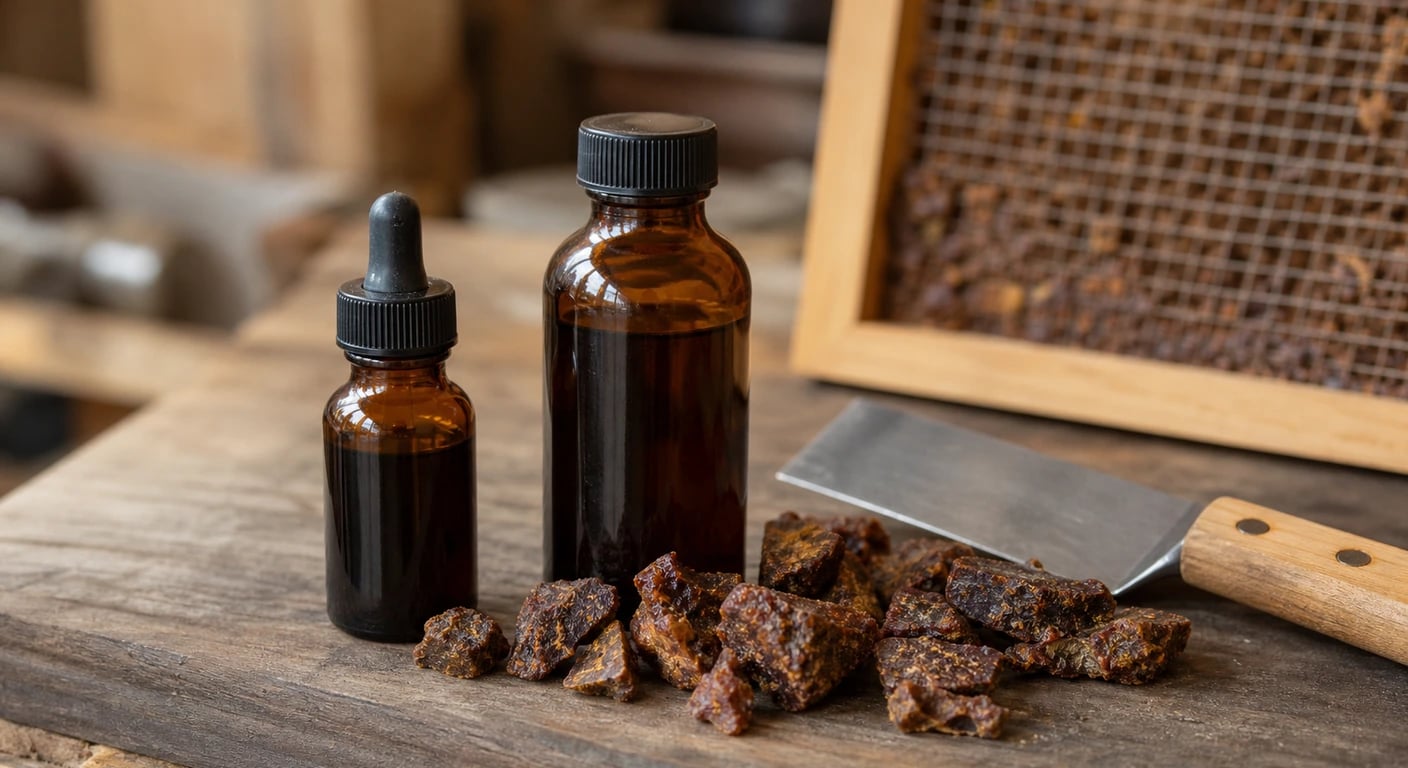
Harvesting Propolis: Collection, Processing, and Uses
Propolis is one of beekeeping's most undervalued products. Learn how bees make it, how to harvest it cleanly, and how to process raw propolis into tinctures, salves, and more.
Propolis is the remarkable resinous substance that bees collect from tree buds, bark, and plant wounds and use to seal, disinfect, and fortify their hive. For beekeepers, it is one of the most valuable yet most overlooked products of the hive. Harvesting propolis requires minimal equipment, fits naturally into your existing workflow, and produces a product with genuine market demand. This guide covers everything from collection to finished tincture.
What Is Propolis?
Bees collect plant resins from the buds and bark of trees such as poplar, birch, pine, willow, and alder, then mix these resins with beeswax, secretions from their own glands, and other compounds to produce propolis. The word comes from the Greek: pro (before) and polis (city) — it guards the entrance to the city.
Inside the hive, propolis serves several critical functions:
- Sealing gaps and cracks — any opening under about 5mm that bees cannot walk through gets sealed with propolis
- Reducing entrance size in preparation for winter
- Encapsulating foreign objects — dead mice, snails, or other intruders too large to remove get mummified in propolis to prevent decay
- Antimicrobial defense — propolis lines the brood cells and the inside of the hive with a natural antimicrobial layer that suppresses bacteria and fungi
What Is Propolis Made Of?
The exact composition varies by region and what trees are available, but propolis typically contains:
- 50% resins and balsams (from plant sources)
- 30% wax (from the bees' own production)
- 10% essential oils
- 5% pollen
- 5% other organic compounds
The bioactive compounds vary considerably. Temperate-zone propolis (North America, Europe) is rich in flavonoids and phenolic acids. Tropical propolis can contain different compound classes entirely.
Where Propolis Accumulates in the Hive
Before you can harvest propolis, you need to know where to find it:
- Around the inner cover and the top edges of frames
- Beneath the crown board or quilt box
- Along the joints between hive bodies (the bee space)
- Around the entrance reducer
- Propolis traps placed between the top bars and the inner cover (the most productive collection method)
Certain bee races produce far more propolis than others. Caucasian bees are particularly heavy propolis producers — sometimes frustratingly so — while Italian bees tend to use less. If you want to harvest propolis regularly, a colony with some Caucasian genetics will be more productive.
Harvesting Method 1: Propolis Traps
Propolis traps are the most efficient and cleanest collection method. A propolis trap is a thin plastic or rubber sheet with a grid of small slits (typically 3mm wide) that sits between the top bars of the upper box and the inner cover.
How Propolis Traps Work
The slits in the trap are just small enough that bees perceive them as drafts that need to be sealed. Workers fill the slits with propolis over a period of 4–6 weeks. Once the trap is full, you simply remove it and harvest the propolis.
Harvest Protocol
- Remove the full trap and place it in a freezer bag.
- Freeze for at least 2 hours at 0°F (-18°C) or below. Freezing makes the propolis brittle.
- Flex and bend the trap over a clean container. The frozen propolis cracks away from the slits and falls out cleanly.
- Pick out any debris (bees, wax flakes, wood fragments).
- Replace the trap in the hive for the next harvest cycle.
Expected yield: A productive colony with a propolis trap can yield 50–200 grams of raw propolis per season depending on the colony genetics, local resin sources, and how long the trap is left in place.
When to Use Propolis Traps
Propolis production peaks in late summer and early fall, when bees are instinctively working to seal the hive before winter. This makes August and September the most productive collection months. However, traps can be used any time the colony is active.
Harvesting Method 2: Scraping
If you do not use traps, you can scrape propolis from the inner cover, frame tops, and hive body joints using your hive tool. This is less efficient and more contaminated with wax and debris, but requires no additional equipment.
To scrape propolis:
- Work quickly on a cool morning when the propolis is less sticky and brittle rather than soft and gummy
- Use your hive tool at a low angle to lift propolis strips from flat surfaces
- Collect into a glass jar or paper bag — propolis stains plastic containers permanently
- Expect higher contamination with wax and debris compared to trap-collected propolis
Cleaning Raw Propolis
Raw propolis — whether trap-collected or scraped — typically contains wax, dead bees, wood fragments, and other debris. Before processing into any product, it should be cleaned.
Basic cleaning:
- Freeze the raw propolis until brittle
- Crumble and break it into small pieces
- Place in a bucket of cold water and stir vigorously — wax and lighter debris float; propolis sinks
- Skim off floating material
- Collect the propolis from the bottom and spread it on paper towels to dry
- Repeat if necessary
Alternatively, dissolve the raw propolis in high-proof alcohol (see tincture section below). The alcohol dissolves the propolis but not the wax and debris, which can then be filtered out.
Processing: Propolis Tincture
The most common and commercially valuable propolis product is propolis tincture — raw propolis dissolved in high-proof ethanol. It is easy to make at home and has a long shelf life.
Propolis Tincture Recipe
Ingredients:
- 20 g cleaned, frozen, crumbled raw propolis
- 100 ml food-grade ethanol (95% grain alcohol — Everclear 190 proof works well in states where it is legal; pharmaceutical-grade ethanol is ideal)
Equipment:
- Dark glass jar with tight-fitting lid (propolis degrades in UV light)
- Coffee filter or multiple layers of cheesecloth
- Small dark glass bottles for storage
Instructions:
- Crumble frozen propolis into the jar
- Pour the alcohol over the propolis
- Seal and shake for 1–2 minutes
- Store in a cool, dark location for 7–14 days, shaking once or twice daily
- Filter through a coffee filter (this takes 30–60 minutes — do not squeeze the filter or the tincture becomes cloudy)
- Transfer the finished tincture into dark dropper bottles
- Label with date, propolis percentage, and alcohol base
Result: A dark amber to brown tincture, approximately 20% propolis (by weight of raw material to volume of alcohol). Shelf life is 2–5 years stored in a dark, cool location.
Note on alcohol concentration: Propolis compounds are only partially soluble in lower-proof alcohol. For maximum extraction, use at least 70% ethanol (140 proof). Higher is better — 95% alcohol is ideal.
Other Propolis Products
Propolis Oil Extract
For those who want an alcohol-free option, propolis compounds can be extracted in carrier oils such as olive oil, coconut oil, or jojoba oil. The extraction is less complete than alcohol (many compounds are not oil-soluble), but the result is usable in salves and balms.
Method: Gently warm the oil to 140°F (60°C) — do not exceed this temperature. Add crumbled propolis at a ratio of 1:5 (propolis to oil by weight). Hold at temperature for 4–8 hours, stirring occasionally. Filter while warm through cheesecloth.
Propolis Salve / Balm
Combine propolis oil extract with melted beeswax (about 10–15% wax by weight) for a solid salve. Pour into small tins or jars while warm. Used topically for minor skin irritation, cuts, and dry skin.
Raw Propolis
Some consumers prefer raw, unprocessed propolis — small pieces or "green propolis" pellets that can be chewed. Be aware of significant bitterness and the strong resinous flavor.
Storage and Shelf Life
| Product | Storage | Shelf Life |
|---|---|---|
| Raw propolis (frozen) | Freezer (-18°C) | Indefinite |
| Raw propolis (dried) | Cool, dark, airtight container | 1–2 years |
| Alcohol tincture | Dark glass, room temperature | 2–5 years |
| Oil extract | Dark glass, refrigerated | 6–12 months |
| Propolis salve | Cool, dark | 1–2 years |
Safety Considerations and Allergy Risk
Propolis contains many bioactive compounds that can cause allergic reactions in sensitive individuals. The reaction can range from mild skin irritation (contact dermatitis) to, in rare cases, systemic allergic response.
Important precautions:
- Always disclose propolis content in any product you sell
- Individuals with known bee product allergies should not use propolis without consulting a physician
- Do not use propolis tincture near the eyes
- Propolis can stain skin, clothing, and equipment — it is nearly impossible to remove once dried
FDA and Regulatory Considerations (US)
In the United States, propolis products marketed with specific health claims are regulated by the FDA. Selling propolis tincture as a "dietary supplement" is permissible if it does not make specific disease or treatment claims. However, claiming that propolis "treats infections," "cures cold sores," or has any other specific medical effect constitutes a drug claim under US law and requires FDA approval — which no propolis product currently has.
Practical guidance for small producers: Sell propolis tincture as a natural bee product and avoid making any health claims on the label or in marketing materials. Consulting a regulatory professional or your state's department of agriculture before commercial sale is always advisable.
Market Value and Selling Propolis
Propolis commands a significant premium compared to honey. Raw propolis typically sells for $15–40 per ounce ($500–1300 per kg) in the US market. Finished propolis tincture sells for $15–30 per 1-ounce (30 ml) bottle at farmers markets and natural food stores.
Demand comes from:
- Natural health product consumers
- Cosmetics manufacturers (small-batch soap, balm producers)
- Dietary supplement companies (who buy in bulk)
Conclusion: Log Every Harvest with Hivekraft
Propolis yield varies significantly by colony, location, season, and bee genetics. Tracking your propolis harvests in Hivekraft alongside your honey and wax harvests gives you a complete picture of what each colony produces over a season. You will quickly identify which colonies are your best propolis producers — and that may inform decisions about which queens to favor when making splits.
Propolis is already being produced in every hive in your apiary. The only question is whether you are capturing it or scraping it off your hive tool and discarding it. Once you start collecting and processing it systematically, it becomes one of the more profitable additions to your product lineup.
Track harvests, print labels, market your honey.
Hivekraft is free for up to 10 hives. Register in 30 seconds.