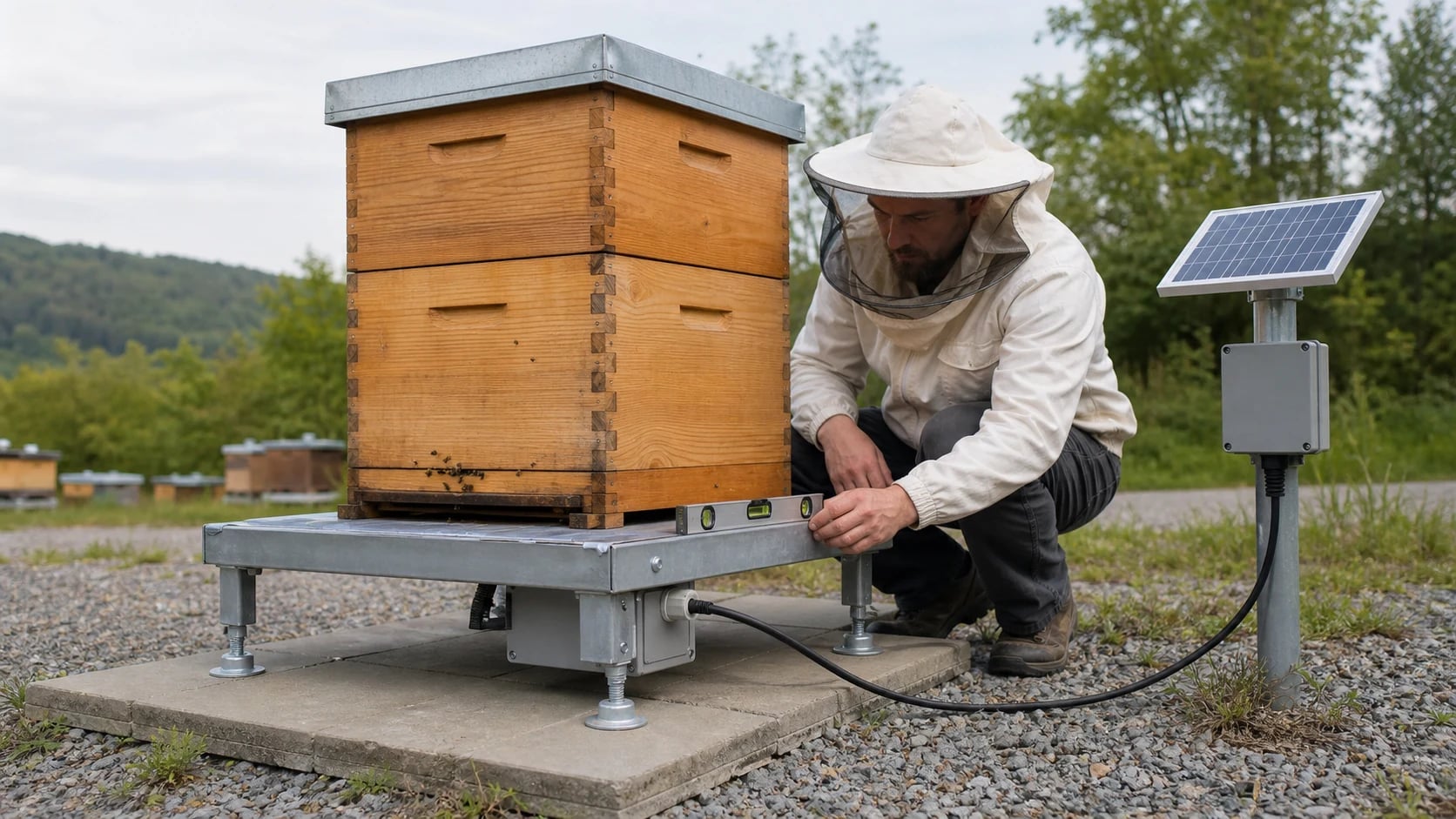
 AI-generated
IoT Hive Scales: Digital Monitoring for Modern Beekeepers
A hive scale gives you continuous insight into colony weight, nectar flows, swarming events, and robbing — without opening the hive. This guide covers everything from reading weight curves to choosing between commercial and DIY scale solutions.
The hive scale is the single most informative instrument a beekeeper can add to an apiary. Where an inspection gives you a snapshot of one colony's condition during a brief window of time, a hive scale gives you a continuous record — day by day, hour by hour — of exactly what is happening inside and around your hives. The ability to read a weight curve and understand what it is telling you is one of the skills that separates data-driven beekeepers from those who rely purely on periodic inspections.
This guide covers why hive scales matter, how to interpret what you see, which commercial and DIY solutions are available, and how to integrate scale data into your overall hive management system.
Why Hive Weight Matters
A colony's weight changes constantly, and almost every meaningful event in the colony's life produces a recognizable signature in the weight data:
- Nectar flows appear as sustained daily weight gains, sometimes exceeding 5–10 lbs (2–4 kg) per day during a strong flow
- Swarming produces a sudden, sharp weight drop as the swarm (and often a substantial number of bees) leaves the hive
- Robbing appears as rapid weight loss, often in a sawtooth pattern, during periods of nectar dearth
- Winter starvation risk is visible as a steadily declining weight curve that reaches a dangerous threshold
- Successful feeding shows as a gradual increase in hive weight after intervention
- Queen loss often shows up indirectly as slower-than-expected population growth, visible as a flatter weight curve in spring
The weight curve effectively gives you a continuous biometric of the colony's condition, available without ever opening the hive.
Reading a Weight Curve: Practical Examples
Example 1: The Nectar Flow
During a strong nectar flow, weight typically increases in the morning hours as foragers return with full honey stomachs and decreases slightly in the early evening. The net daily gain is positive. A classic spring flow (black locust, fruit trees, or tulip poplar in much of eastern North America) might show:
- +3 to +8 lbs per day during peak flow
- Flattening or slight decline as the flow ends
- A stable plateau once nectar is capped and the moisture is driven off
When the daily weight gain drops to near zero, the main flow is over — and that is your signal to harvest before the bees begin consuming their stores.
Example 2: A Swarm Event
A swarm produces one of the most distinctive weight curve signatures:
- A sudden drop of 5–15 lbs (2–7 kg) within an hour or two
- Often in the mid-morning (10am–2pm) on a warm, calm day
- Frequently preceded by a slight weight gain over several days as bees gorge on honey before departing
If you see this pattern in your scale data and you have not inspected recently, check immediately for a queen or queen cells. The colony will need management.
Example 3: Robbing
Robbing appears as rapid, chaotic weight loss — bees from neighboring colonies or the same apiary attacking a weaker colony and stealing stores. The pattern looks like:
- Sudden onset, often during dearth
- Irregular, rapid decline (hundreds of grams per hour)
- Often visible as aggressive flight activity around the entrance
A scale alert set to trigger when weight drops more than 1 lb per hour can catch a robbing event before serious damage is done.
Example 4: Winter Weight Decline
Over winter, a colony consuming stores shows a slow, steady decline in hive weight. A healthy colony typically consumes 20–30 lbs (9–14 kg) of stores between October and March in a cold-climate location. If the weight curve shows consumption accelerating or if it approaches a predetermined minimum threshold, you have time to intervene with fondant or candy boards before the colony starves.
Types of Hive Scales
Commercial Solutions
The commercial hive scale market has matured significantly over the past decade. Several well-regarded systems are now available:
BroodMinder
Based in Wisconsin, BroodMinder produces a modular ecosystem of hive sensors including scales, internal temperature/humidity sensors, and connectivity hubs. The scale sensor fits under one end of the hive and uses a tipping method to estimate full weight.
- Weight accuracy: ±0.3 lbs (135g)
- Data transmission: Bluetooth to a gateway hub, then to cloud
- Subscription: App is free; premium features (alerts, advanced analytics) require subscription
- Battery life: 1–3 years on standard batteries
- Price range: Scale sensor ~$100–130 USD; hub required for automatic upload
HiveWatch (formerly Perizin)
A European-market system with North American distribution. Offers a precision under-hive scale with optional temperature and acoustic sensors.
Arnia
UK-based, targeted at commercial and research-level beekeeping. Offers highly accurate weight data, acoustic monitoring (for swarm detection), and internal temperature. Premium price point — better suited for serious operations and research.
Hivemind and Other DIY-Kit Systems
A growing ecosystem of open-source and semi-commercial kit scales based on Arduino, ESP32, or Raspberry Pi platforms. These typically use load cell sensors under the hive (similar to industrial scales) and transmit data via WiFi, LoRa, or cellular.
DIY Scales
Building your own hive scale is a well-documented project in the beekeeping community. The core components are inexpensive and widely available:
| Component | Cost (approx.) |
|---|---|
| HX711 load cell amplifier module | $3–5 |
| 4x 50kg load cells (beam type) | $15–25 |
| ESP32 microcontroller | $8–15 |
| Solar panel + LiPo battery | $20–40 |
| Weatherproof enclosure | $10–20 |
| LoRa module (optional, for range) | $8–15 |
| Total (approximate) | $65–120 |
A DIY scale based on an ESP32 + HX711 can transmit data via WiFi (if a router is within range) or LoRa to a local gateway. Platforms like Hiveeyes (Germany), OpenHiveMonitor, and various GitHub repositories provide ready-to-use firmware.
The trade-off is time and technical knowledge. Setting up a DIY system takes hours rather than minutes, and troubleshooting connectivity and calibration issues requires comfort with electronics.
Additional Sensors Worth Considering
Weight is the most informative single measurement, but pairing it with other sensors dramatically increases what you can understand about your colonies.
Internal Temperature
A temperature probe placed in the brood nest monitors:
- Whether the cluster is actively thermoregulating (30–35°C in winter cluster, 34–36°C in active brood nest)
- Loss of a queen (temperature regulation becomes less precise)
- Potential disease events
Humidity
Relative humidity inside the hive reflects the colony's ability to evaporate moisture from nectar. Unusually high humidity can indicate inadequate ventilation or a very heavy nectar flow.
Sound / Acoustic Monitoring
This is an emerging area with genuine scientific backing. Several studies have shown that the acoustic profile of the hive changes measurably before and during swarming. Arnia and some other systems record hive acoustics continuously. Swarm prediction via acoustics is not yet fully reliable, but the technology is improving rapidly.
External Weather Station
Pairing hive weight data with local weather data (temperature, humidity, wind speed, rainfall) is one of the most powerful ways to understand nectar flow patterns. Over multiple seasons, you can identify which weather conditions produce the strongest flows from which plant species in your area.
Connectivity Options
| Connectivity | Range | Power | Cost | Best For |
|---|---|---|---|---|
| WiFi | 30–100m | Moderate | Low | Apiaries near buildings |
| Bluetooth + Hub | 30–100m | Low | Low–Moderate | Small apiaries |
| LoRa | 1–15 km | Very Low | Moderate | Remote apiaries |
| Cellular (4G/LTE) | Nationwide | Moderate–High | Higher (SIM cost) | Remote, no WiFi available |
| Sigfox / NB-IoT | Wide | Very Low | Low (per message) | Specialized, limited regions |
For most hobbyist beekeepers with apiaries within range of a home WiFi network, WiFi or Bluetooth connectivity is the simplest option. For remote outyards, cellular or LoRa connectivity is the practical choice.
Practical Setup Guide
1. Calibration
Every scale must be calibrated before use. The procedure varies by system, but the general principle is:
- Place the scale under an empty hive body
- Record the zero (tare) reading
- Place a known weight (a 20 lb bag of sugar works well) and confirm the reading matches
- Adjust calibration factor as needed
Recalibrate at the start of each season or if the scale has been moved or disturbed.
2. Placement
Most commercial scales fit under one end of the hive (they measure half the weight and double the reading). A four-corner scale gives the most accurate reading. Place the scale on a level, stable surface — an uneven footing will produce erratic readings.
3. Alert Thresholds
Set alerts based on your local conditions and colony history:
| Event | Suggested Alert |
|---|---|
| Swarm | Weight drop >5 lbs within 2 hours |
| Robbing | Weight drop >1 lb per hour during dearth |
| Winter starvation risk | Total colony weight below 30 lbs (varies by region) |
| Nectar flow start | Sustained weight gain >2 lbs per day for 3+ days |
4. Data Interpretation Over Time
A single season of scale data is useful. Multiple seasons are transformative. After 2–3 seasons, you can identify:
- Exact start and end dates of major nectar flows in your area
- Which colonies consistently outperform others
- Whether your winter feeding is adequate
- How quickly splits build up compared to established colonies
IoT Integration in Hivekraft
Hivekraft integrates directly with IoT hive sensors, including scale data. Within the platform, you can:
- Connect scale devices and view weight curves alongside inspection records
- Set custom alert thresholds for weight loss and gain events
- Compare weight trends across multiple colonies in your apiary
- Correlate weight data with weather conditions and bloom calendar events
- Export historical weight data for analysis
When a scale alert fires — whether for a potential swarm, robbing event, or winter starvation concern — Hivekraft logs it as an event you can review alongside the colony's full inspection history. This gives you the context to decide whether immediate intervention is needed or whether the weight change can be explained by a benign cause.
Is a Hive Scale Worth It?
A commercial scale costs $100–300 and a DIY scale costs $70–120. The question of whether it is "worth it" depends on what you value:
Quantifiable benefits:
- Catching a swarm event immediately rather than finding an empty hive weeks later
- Detecting robbing before stores are depleted
- Avoiding winter starvation through early intervention
- Knowing exactly when the nectar flow starts and ends (optimizing super management and harvest timing)
For a beekeeper who loses even one colony per year to a preventable cause — starvation, undetected swarm, unchecked robbing — the scale pays for itself quickly. For a beekeeper interested in data and continuous improvement, it is simply the most informative tool in the apiary.
Conclusion: Data-Driven Beekeeping Starts with a Scale
The hive scale does not replace inspections. It tells you when to inspect, what to look for, and whether your interventions are working. Paired with Hivekraft's colony management tools, it creates a feedback loop between continuous sensor data and human observation that makes your beekeeping more responsive, more efficient, and more successful over time.
If you keep more than three or four colonies, putting a scale on your strongest or most strategically important hive is one of the best investments you can make in your beekeeping operation.
Less paperwork. More time with your bees.
Hivekraft is free for up to 10 hives. Register in 30 seconds.