 AI-generated
Hive Scales Compared: IoT Monitoring for Modern Beekeepers
Hive scales compared: we test scales from BroodMinder to DIY solutions and show which system suits which beekeeper.
A hive scale is the eye you have at the apiary when you're not there. It measures your beehive's weight around the clock and sends the data to your smartphone. Nectar flow start, swarm departure, food consumption in winter — the scale sees everything. But which scale suits you? We compare the common systems by price, function, and practical suitability.
Why a Hive Scale?
Before we dive into the comparison: what does a hive scale actually deliver?
- Nectar flow start and end: You can see to the day when the bees are bringing in nectar — and when it stops
- Swarm departure: A sudden weight loss of 1–3 kg during the day = swarm
- Robbing: Unusual weight loss in other colonies at the same apiary
- Winter monitoring: Food consumption shows whether the colony is alive and how long supplies will last
- Harvest optimization: You recognize the perfect time for harvest — when intake decreases
A hive scale doesn't replace inspections. But it tells you when you absolutely need to check — and when you can skip the trip. Note the ongoing costs for cellular systems: SIM card (1–5 €/month) and with some providers cloud or software fees (20–80 €/year).
 AI-generated
Types of Hive Scales
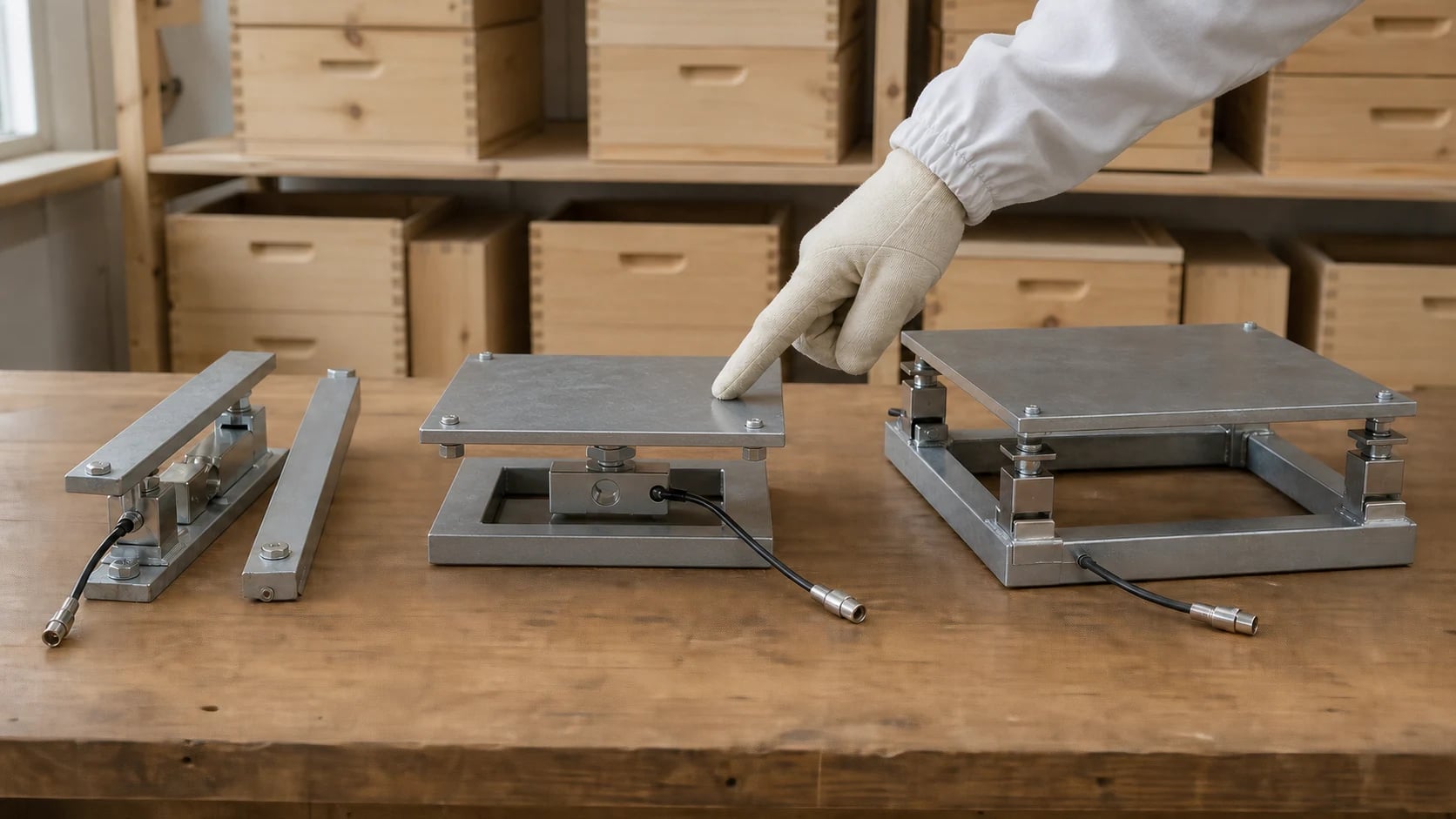
Single-Point Scales
A single load cell under one side of the hive. The measured weight is doubled to estimate total weight. Affordable (from 80 euros), easy to install, but less precise. For trend analysis (gain or loss), completely sufficient.
4-Sensor Platforms
Four load cells, one under each corner. Significantly more precise, regardless of how weight is distributed in the hive. More expensive (150–350 euros), but recommended for performance comparisons between colonies and exact harvest weights.
Combined Systems
Scale plus temperature, humidity, and sometimes acoustic sensors in one device. These systems deliver the most comprehensive picture but also cost the most (250–450 euros).
The Big Comparison
| System | Type | Connectivity | Price (approx.) | Strength |
|---|---|---|---|---|
| BroodMinder-W | Single-point | Bluetooth + Hub | 100–150 € | Affordable, large ecosystem |
| BroodMinder-W3 | 4-sensor | Bluetooth + Hub | 220–330 € | Precise, DIY kit available |
| Arnia Remote | 4-sensor | 4G cellular | 300–400 € | Pro system, acoustics |
| HiveWatch | 4-sensor | 4G / LTE-M | 200–300 € | Swiss quality, swarm alarm |
| Beep Base | 4-sensor | LoRa | 180–250 € | Open source, community |
| Solutionbee HM-6 | Single-point | Bluetooth + WiFi | 250–320 € | Long battery life |
| Emsystech Penso | 4-sensor | 2G/4G | 250–350 € | Proven in DACH region |
| DIY (ESP32 + HX711) | Variable | WiFi/LoRa | 30–80 € | Maximum flexibility |
BroodMinder: From Entry-Level to Pro Scale
BroodMinder from the USA offers a broad ecosystem. The entry model BroodMinder-W is a true single-point scale (one load cell under one side of the hive) from about 100 euros. The W3 version is a 4-sensor platform with four temperature-compensated load cells for significantly higher precision (from about 220 euros). Both transmit via Bluetooth. For real-time monitoring, you need the BroodMinder Hub (about 180 euros extra), which sends data via WiFi or cellular to the cloud. Without Hub: data is synchronized at the next visit via the app.
Advantages: Graduated range, well documented, large community, API available Disadvantages: Hub extra for real-time, US servers (consider data privacy)
Arnia Remote: The Professional System
Arnia from the UK delivers the most comprehensive system: 4-sensor scale plus temperature, humidity, and acoustic sensor. Data is sent directly to the cloud via 4G cellular. The software offers sophisticated analysis including swarm detection and beehive acoustics.
Advantages: Highest data quality, acoustic analysis, professional software Disadvantages: Expensive, ongoing costs for SIM + cloud, UK provider
Beep Base: Open Source for Tinkerers
The Beep project from the Netherlands is fully open source — hardware and software. The Beep Base is a LoRa-based platform with 4 load cells and temperature/humidity. Data goes via a LoRa gateway (The Things Network or your own) to the Beep cloud. Ideal for tech-savvy beekeepers and associations.
Advantages: Open source, community-driven, LoRa = low energy costs Disadvantages: LoRa gateway required, setup is not trivial
DIY: ESP32 + HX711
The cheapest option for tinkerers: an ESP32 microcontroller, an HX711 load cell module, and one or four load cells. With a solar panel and a LoRa module, you build a complete hive scale for under 80 euros. Open-source projects like BeeLogger, HoneyPi, or Hiveeyes provide ready-made firmware and build instructions.
Advantages: Extremely affordable, full control, educational Disadvantages: Soldering required, software setup, no warranty, weatherproofing is your responsibility
Connectivity in Detail
Data transmission is often the decisive factor when choosing a system:
Bluetooth
Range: 10–100 meters Power consumption: Very low Real-time capable: No — data syncs during visits Costs: No ongoing costs Suitable for: Apiaries in your own garden, where you pass by daily
WiFi
Range: 30–100 meters (more with repeater) Power consumption: High — usually needs mains power Real-time capable: Yes, data every 5–15 minutes Costs: None (your own WiFi) Suitable for: Home garden with WiFi coverage
LoRaWAN
Range: 2–15 kilometers (depending on terrain) Power consumption: Very low — solar operation possible Real-time capable: Yes, data every 15–60 minutes Costs: Gateway (100–200 euros) or The Things Network (free if gateway is in range) Suitable for: Remote locations, associations with multiple apiaries
Cellular (4G / NB-IoT)
Range: Anywhere with cellular coverage Power consumption: Medium — solar operation possible with larger panel Real-time capable: Yes, data every 5–60 minutes Costs: 1–5 euros/month (SIM) Suitable for: Migratory beekeepers, remote locations, professional operations
Power Supply: Solar vs. Battery
| Power Source | Runtime | Effort | Suitability |
|---|---|---|---|
| AA batteries (2x) | 3–12 months | Low (change 1–2x/year) | Bluetooth systems |
| Lithium battery (internal) | 6–18 months | Low (USB charging) | WiFi/LoRa systems |
| Solar panel + battery (2–5W) | Unlimited | One-time (installation) | All systems |
| Mains power (USB/230V) | Unlimited | No changes | Home garden only |
Our tip: a 2-watt solar panel with a 3000 mAh battery is sufficient in Central Europe even in winter for LoRa and NB-IoT systems. WiFi systems need a larger panel (5 watts) or mains power.
Integration with Beekeeping Software
The best scale data is of little use if it sits isolated in its own app. The real added value comes from combining it with your inspection data, treatments, and harvests.
What Good Integration Offers
Integration: Hive scale + beekeeping software
Hivekraft supports the connection of IoT hive scales via an open API. The data is directly assigned to the colony and displayed with inspections, weather data, and treatments in one view. Supported import formats include common CSV exports as well as direct API connections.
Practical Tips for Installation
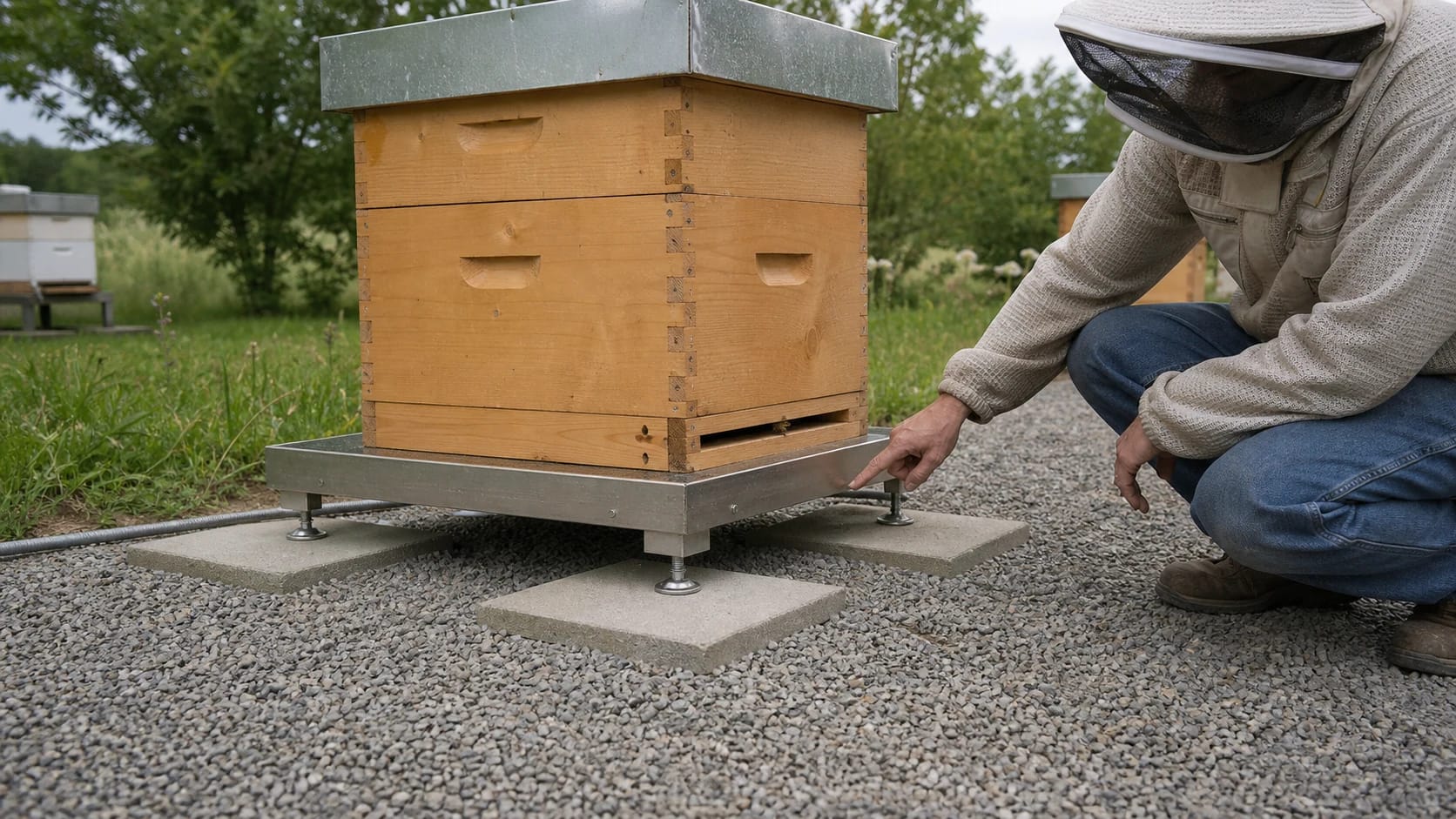
Base Surface
The scale needs a level, solid surface. Grass or soft ground distorts measurements. A concrete slab, wooden pallet, or leveled board is ideal.
Weather Protection
Rain, snow, and direct sunlight can damage the electronics. Look for:
- IP65 protection rating or better (standard for commercial systems)
- Don't point solar panel north (in the Northern Hemisphere)
- Protect cables from rodent bites (cable duct or corrugated tubing)
Calibration
After installation, calibrate with a known weight (e.g., 10 kg bucket of water). Most systems have automatic zero-point correction that compensates for thermal drift.
Security
Hive scales are unfortunately also interesting for thieves. Recommendations:
- Use screws instead of clips
- Hide the scale under the hive (not visible)
- Install a separate GPS tracker if the scale doesn't include one
Which Scale for Which Beekeeper?
- 1
Hobbyist with 3–10 colonies in the garden
Recommendation: BroodMinder-W (Bluetooth, single-point) or DIY solution with WiFi. No cellular needed since the apiary is within range. Budget: 80–150 euros. One scale on a reference colony is enough to start.
- 2
Engaged hobbyist with 10–30 colonies, multiple apiaries
Recommendation: HiveWatch or Beep Base with LoRa/cellular. Real-time monitoring from home, especially valuable for remote apiaries. Budget: 200–300 euros per scale, 2–3 scales on reference colonies.
- 3
Migratory beekeeper / professional with 50+ colonies
Recommendation: Arnia Remote or Emsystech Penso with cellular. Reliable even at remote locations, professional analysis software. Budget: 300–400 euros per scale, investment in 3–5 scales at key locations.
- 4
Tech enthusiast / association
Recommendation: DIY with ESP32 + LoRa or Beep Base (open source). Joint tinkering project, build knowledge, share costs. One gateway for multiple apiaries in the association's territory. Budget: 30–80 euros per scale + 100–200 euros gateway.
The Future: AI-Powered Scale Analysis
Current developments go beyond simple weight measurement:
- Pattern recognition: AI identifies typical daily patterns and only warns for genuine anomalies
- Swarm prediction: Combination of weight curve, temperature, and acoustics predicts swarms 1–3 days in advance
- Forage forecast: Historical data + weather + bloom calendar = forage prediction
- Automatic feeding recommendation: Weight loss in autumn is monitored and alerts triggered at critical thresholds
Hivekraft is working on exactly such analyses with the Intelligence module — the combination of scale data with AI analysis and weather data from the German Weather Service (DWD) delivers recommendations that would never be possible manually.
Conclusion: A Hive Scale Is Worth It
Start with one scale on your most productive colony. Observe the weight curve for one season. You'll be amazed at how much you learn about your bees — and how quickly you'll want to buy a second scale. For getting started, a BroodMinder or DIY solution for under 150 euros is sufficient.
The hive scale is the investment with the highest knowledge gain per euro in modern beekeeping. It shows you what happens between inspections — and makes you a better beekeeper. Combined with good software that brings together weight, weather, and your observations, a picture emerges that would never be visible to the naked eye.
More on IoT monitoring in beekeeping can be found in our detailed article on digital beekeeping and in the Hivekraft IoT feature overview.
- Digital Beekeeping with Hivekraft -- Lesson 9: Setting up IoT sensors
- Advanced Beekeeping -- Lesson 9: Data-driven decisions
Less paperwork. More time with your bees.
Hivekraft is free for up to 10 hives. Register in 30 seconds.