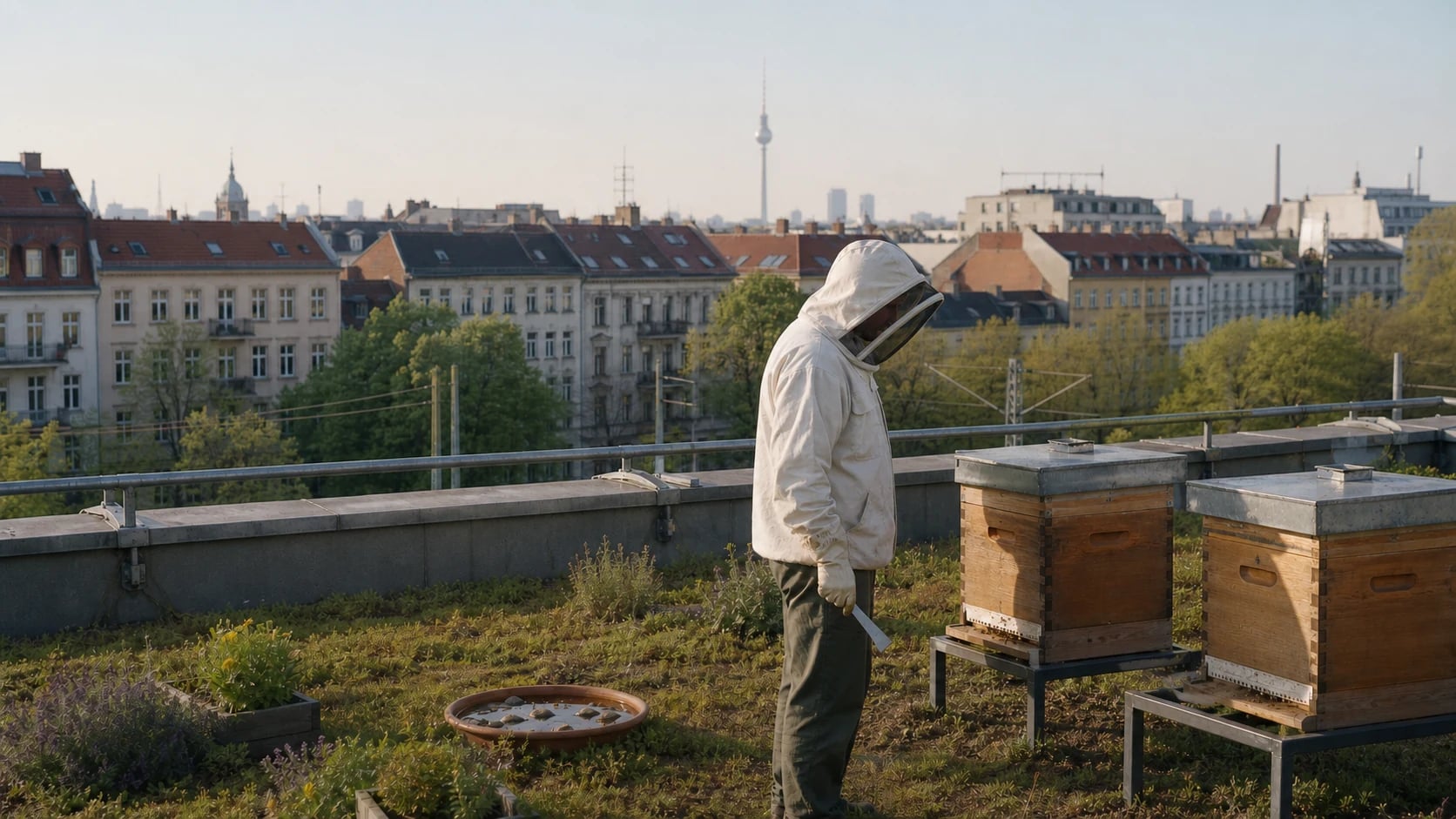
 AI-generated
Urban Beekeeping in Berlin: Capital of the Bees
Berlin is Germany's secret bee capital: Rooftop beekeeping, community gardens, and surprisingly good urban honey. A guide for Berlin beekeepers.
Berlin is Europe's greenest capital -- and Germany's secret bee capital. With over 1,400 organized beekeepers in the beekeeping association alone and an estimated 10,000 bee colonies across the city, Berlin has one of the highest bee densities of any German city. On rooftops, in allotment gardens, community gardens, and even on the roof of the state parliament, bees are buzzing -- and their honey tells the story of Germany's most diverse city.
This article focuses on Berlin's unique beekeeping scene, local organizations, and specific forage conditions. While many urban beekeeping principles apply universally, the specific locations, organizations, and regulations described here are particular to Berlin.
Berlin: A City Like a Bee Paradise
At first glance, a city of nearly 4 million people seems like no ideal place for bees. But Berlin thoroughly disproves this assumption. The city has one of the highest green spaces per capita among European metropolises: Parks, cemeteries, allotment gardens, street trees, and brownfield sites form a dense network of forage sources.
Why Berlin Works for Bees
- About 39% green and recreational space: Berlin consists of roughly one-third parks, forests, allotment gardens, and waterways
- Diverse plantings: Parks and gardens offer exotic and native blossoms
- Long bloom calendar: From crocus (February) to ivy (October) -- 8 months of forage
- Heat island: 2--3 degrees Celsius warmer than the surrounding countryside -- longer flight season
- Few pesticides: Hardly any plant protection products are used in the city area
Berlin's Forage Landscape
Spring: Crocus to Horse Chestnut
Berlin starts the season early. The urban heat island and the many early bloomers in parks and gardens ensure that bees often begin their first foraging flights as early as mid-February.
Important early forage:
- Crocus and winter aconite (February--March): In parks and cemeteries
- Willow (March--April): Especially at Lake Mueggelsee and in Wuhlheide
- Fruit blossom (April--May): In allotment gardens and the Werder area nearby
- Horse chestnut (May): The grand chestnut avenues of Kurfuerstendamm and Strasse des 17. Juni
Early Summer: The Great Linden Bloom
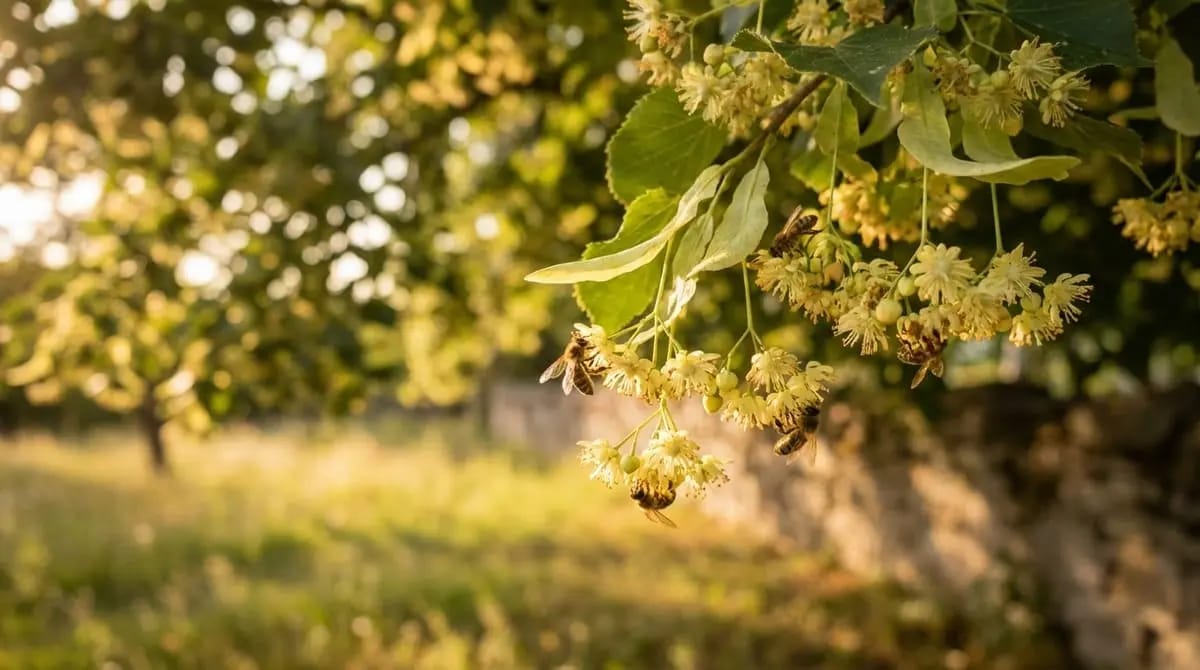
The linden tree is Berlin's most important single forage source. The famous street "Unter den Linden" is not named that for nothing -- and it is just one of thousands of linden locations in the city. Berlin has one of the largest linden tree populations of any European city.
Berlin linden honey:
- Bloom time: Mid-June to mid-July (depending on species: small-leaved lime, large-leaved lime, silver lime)
- Flavor: Fresh, slightly menthol-like, with a floral note
- Color: Light yellow to golden yellow
- Yield: In good years, 15--25 kg per colony from linden alone
Berlin is home to three linden species that bloom in succession: The large-leaved lime (Tilia platyphyllos) from early June, the small-leaved lime (Tilia cordata) from mid-June, and the silver lime (Tilia tomentosa) until mid-July. Together, they create a linden bloom of 4--6 weeks -- a massive forage window.
Summer and Autumn: Diversity Until October
After the linden bloom, Berlin's parks and gardens still offer plenty of forage:
- Robinia/Acacia (June): Large populations in the eastern districts
- Tree of Heaven (July): Invasive neophyte, but good bee pasture
- Phacelia and sunflowers (July--August): In allotment gardens
- Ivy (September--October): Berlin's underestimated late forage -- blooming when almost nothing else offers nectar
Berlin's Beekeeping Scene: Diverse and Creative
Community Gardens and Bees
Berlin is the capital of the urban gardening movement, and bees are an integral part of it:
Prinzessinnengarten Kollektiv (Neukoelln): One of Germany's most famous community gardens, originally founded at Moritzplatz in Kreuzberg. The main project moved in 2019/2020 to the former Neuer St. Jacobi Cemetery in Neukoelln. From the very beginning, bee colonies were part of the holistic garden concept. The Prinzessinnengaerten significantly popularized urban beekeeping in Berlin.
Allmende-Kontor (Tempelhofer Feld): On the former Tempelhof Airport, hobby gardeners and beekeepers jointly manage plots and beehives -- in the middle of one of the largest inner-city open spaces in the world.
Himmelbeet (Wedding): An intercultural community garden with bee colonies that understands beekeeping as part of environmental education. The garden moved to a new location on Gartenstrasse in 2022.
Prominent Bee Locations
Berlin has some of Germany's most unusual bee locations:
- Berlin House of Representatives: About 50,000 honey bees on the roof of the state parliament -- a project of the "Berlin summt!" initiative
- Berlin Cathedral: Bees on the church roof -- honey is sold in the cathedral shop
- Haus der Kulturen der Welt: Bee colonies as part of the cultural program
- Markthalle Neun (Kreuzberg): Regional beekeepers sell Berlin city honey directly here
- Alexanderhaus (Alexanderplatz): Four bee colonies on the roof of the historic building
- 1
Take a Beekeeping Course
Berlin offers numerous beginner courses -- from the classic club course to trendy workshops in Kreuzberg. The Berlin beekeeping associations, as well as private initiatives like "Stadtbienen e.V." and "Berlin summt!" offer introductory courses.
- 2
Find a Location
Allotment garden, rooftop, community garden, or backyard -- Berlin offers many options. In many allotment garden associations, beekeeping is permitted and even welcomed. For rooftop locations, you need the building owner's consent and possibly a structural assessment.
- 3
Register with the District
In Berlin, every beekeeper must register their colonies with the responsible veterinary and food safety office of the district. This is mandatory and serves disease surveillance. Registration is free and straightforward.
- 4
Inform the Neighbors
In a densely populated city like Berlin, communication is key. Inform your neighbors about the beekeeping, answer questions kindly, and give away a jar of honey -- that creates acceptance.
Berlin Beekeeping Clubs and Organizations
Imkerverband Berlin e.V.
The umbrella association of Berlin beekeepers organizes 18 beekeeping clubs and offers:
- Beginner courses and continuing education
- Honey testing and consultation
- Swarm catcher network (particularly in demand during summer)
- Legal advice for urban beekeepers
Stadtbienen e.V.
The association Stadtbienen has revolutionized urban beekeeping in Berlin. With the "BienenBox" -- a compact hive for balconies and small spaces -- Stadtbienen has made getting started easier for thousands of Berliners. The association offers:
- Sponsorships for bee colonies
- Online courses and workshops
- Advice on species-appropriate urban beekeeping
Berlin summt!
The initiative "Berlin summt!" was the pioneer of the nationwide campaign of the same name. It places bee colonies on prominent buildings and uses the attention to raise awareness for insect conservation.
City Honey: Quality and Characteristics
Is City Honey Clean?
One of the most common questions: Is honey from a major city even safe to eat? The answer: Yes, and often even better than rural honey. Several studies, including research from the Free University of Berlin, have shown:
| Parameter | City Honey Berlin | Rural Honey Brandenburg |
|---|---|---|
| Pesticide residues | Very low to undetectable | Partially detectable (rapeseed, corn) |
| Heavy metals | Minimally elevated (lead, cadmium) | Low |
| Variety diversity | High (blended honey) | Low to medium (varietal honey) |
| Aroma complexity | Complex, multi-layered | Variety-specific, clearer |
| Water content | Optimal (16-18%) | Optimal (16-18%) |
| Health assessment | Safe, edible | Safe, edible |
The minimally elevated heavy metal values are well below legal limits and pose no health concerns. At the same time, Berlin honey benefits from lower pesticide exposure compared to intensively farmed agricultural regions.
Berlin Honey as a Brand
Berlin city honey has developed into a lifestyle product. Honey with district designations -- "Kreuzberg Linden Honey," "Prenzlauer Berg Summer Honey," or "Neukoelln Acacia Honey" -- commands premium prices of 8--15 EUR per 250g jar. The storytelling works: Every district has its own character, and the honey reflects the local flora.
Berlin city honey is an excellent souvenir and gift. Design attractive labels with district names and Berlin motifs. At markets like the Mauerpark flea market or Markthalle Neun, Berlin honey is a bestseller.
Challenges of Berlin Urban Beekeeping
Overcrowding: Too Many Bees?
The growing enthusiasm for urban beekeeping has led to a debate in Berlin: Are there too many honey bees? With an estimated 10,000 colonies over 892 square kilometers, the bee density is high. Critics warn of:
- Food competition with wild bees and other pollinators
- Increased disease risk due to the close proximity of colonies
- Swarming issues in densely populated areas
The Berlin beekeeping community responds with education and self-regulation: Not every balcony needs bees, and qualified training is more important than sheer numbers.
Swarms in the City
Bee swarms in the city regularly make headlines and unsettle passersby. The Berlin Beekeeping Association operates a swarm catcher network that responds quickly. During the summer months of May and June, hundreds of swarms are captured in Berlin -- from traffic lights, bicycles, subway stations, and balconies.
In the city, swarm prevention is particularly important. A swarm on the neighbor's balcony or at a bus stop creates trouble and bad press for all urban beekeepers. Check your colonies weekly from April for swarm cells and act in time.
Vandalism and Theft
Unfortunately, bee colonies in publicly accessible areas are not always safe. Vandalism to hives and even theft of entire colonies occur in Berlin. Countermeasures:
- Locations in fenced areas (allotment gardens, company grounds)
- Inconspicuous placement
- Contact with neighbors as social control
- Digital monitoring with hive scales and sensors
Berlin vs. Brandenburg: City and Country
Many Berlin beekeepers keep colonies in the Brandenburg countryside alongside their city apiaries. The combination offers advantages:
- City: Diverse blended honey, long season, strong demand
- Country: Varietal honey (rapeseed, linden, acacia), higher yields, more space
Brandenburg is the region's "breadbasket": Rapeseed, sunflowers, and the vast pine forests (pine honey!) offer forage that doesn't exist in the city. The commuter rail connections make commuting between city and country apiaries practical.
Practical Tips for Berlin Urban Beekeepers
Hive Types for the City
Various hive types have established themselves in Berlin:
- Zander/DNM frames: The classic, also proven in the city
- BienenBox: Compact single-box system for balconies and small spaces
- Top-Bar Hive: Simple construction, popular in the alternative scene
- Warre hive: Extensive beekeeping with minimal intervention
Best Locations by District
- Kreuzberg/Neukoelln: Many allotment gardens, community gardens, backyards
- Pankow/Prenzlauer Berg: Large parks (Buergerpark Pankow, Mauerpark), cemeteries
- Spandau: City edge with forest proximity (Spandauer Forst)
- Treptow-Koepenick: Greenest district, Lake Mueggelsee, Wuhlheide
- Steglitz-Zehlendorf: Villa gardens, Botanical Garden
Conclusion: Berlin -- The Buzzing Capital
Berlin shows that a major city and beekeeping are not only compatible but mutually enriching. The city offers bees an astonishing forage diversity, few pesticides, and a mild microclimate. Connect with other Berlin beekeepers through the community map and market your Berlin city honey with personalized labels and QR codes. Those who keep bees in Berlin are part of a vibrant, creative community -- and produce honey that an entire city enjoys.
- Forage Plants and Bee Pasture -- Lesson 7: Urban Beekeeping and Surprising Forage Sources
- Beekeeping for Beginners -- Lesson 5: Finding the Perfect Location
Less paperwork. More time with your bees.
Hivekraft is free for up to 10 hives. Register in 30 seconds.