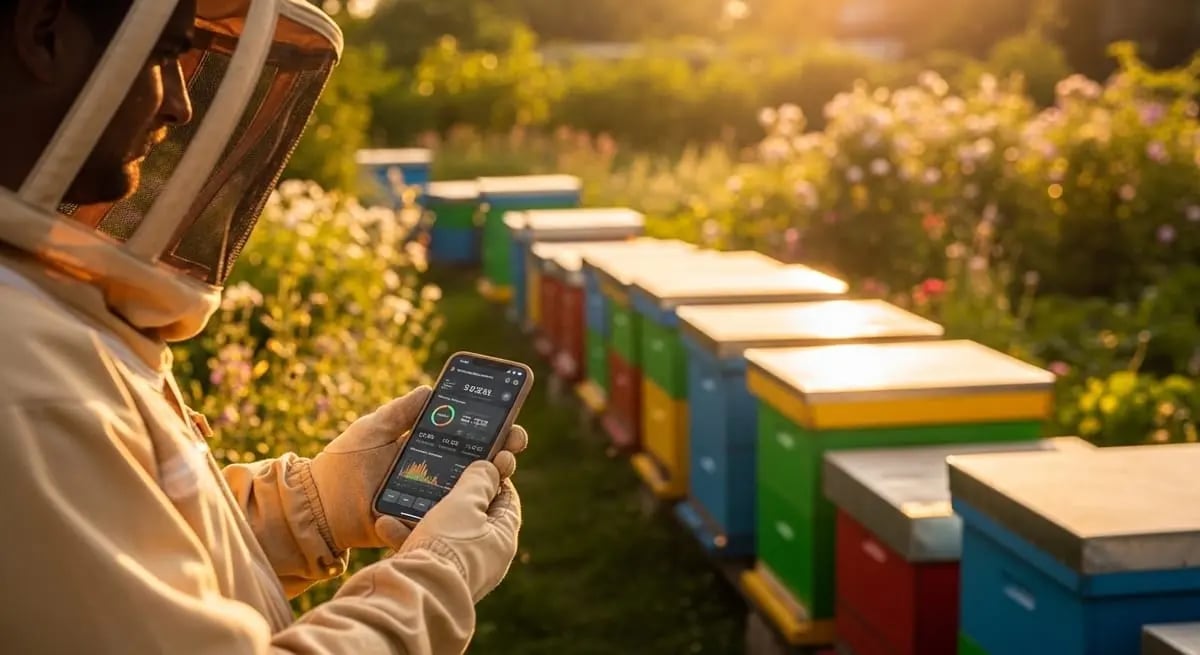
 Example representation · not an actual app screen
Field Test: Voice Input at the Beehive
Voice input instead of typing at the apiary: we test voice recording during inspections and show how well AI-powered recognition works.
Your hands are in gloves, the smoker is puffing, a frame is hanging on the hook — and now you're supposed to type data into an app? At the apiary, your hands are almost never free. This is exactly where voice input comes in: you speak your observations into your smartphone, and the app automatically recognizes what you mean. We tested voice recording throughout an entire season in daily practice — with all its highs and lows.
The Problem: Documentation vs. Practice
Every beekeeper knows the situation: the inspection is done, your hands are sticky with propolis, the bees are buzzing impatiently — and you should really be documenting 8 colonies now. The reality? Many beekeepers drive home, shower, eat — and document from memory in the evening. Or not at all.
The problem isn't a lack of discipline but an impractical recording method. When you have to unlock your smartphone at the apiary, open the app, find the colony, and then tap tiny fields, you give up quickly. Voice input solves this problem radically: you speak, the app writes.
How Does Voice Input Work in Beekeeping?
The idea is simple: instead of typing data, you dictate it. The app uses speech recognition to convert your words into text, and then AI extracts the relevant information and assigns it to the correct fields.
- 1
Step 1: Start the inspection
Open the app and select the colony. Tap the microphone icon. This works even with slightly sticky fingers — a large button is all you need.
- 2
Step 2: Dictate your observations
Speak naturally: "Colony 7, six frames of bees occupied, queen seen, fresh eggs, food sufficient, two play cups empty." You don't need to use commands or keywords.
- 3
Step 3: Review AI recognition
The app shows you what it understood: Colony strength 6 frames, queen seen: yes, brood status: eggs, food reserves: sufficient, queen cells: 2 (empty). You confirm or correct.
- 4
Step 4: Save
One tap on "Save" — the inspection is documented. The whole process takes 15 to 30 seconds per colony.
The Field Test: A Season with Voice Input
Setup
We tested Hivekraft's voice input throughout the 2026 season — from the spring inspection in March to fall feeding in September. Testing was conducted at three apiaries with a total of 22 colonies, under various weather conditions and ambient noise levels.
Speech Recognition
Voice input works directly in the Hivekraft web app and requires no separate app installation. Transcription primarily uses AssemblyAI Universal-3 Pro with EU processing; recognition of beekeeping terminology was surprisingly good in the field test:
| Speech Example | Recognized As | Correct? |
|---|---|---|
| Six frames of bees occupied | Colony strength: 6 frames | Yes |
| Queen seen, marked blue | Queen: seen, color: blue (2020/2025) | Yes |
| Fresh eggs on three frames | Brood status: eggs laid | Yes |
| Two queen cells with eggs | Queen cells: 2, with eggs | Yes |
| Food will last another two weeks | Food reserves: low | Yes |
| Varroa count three mites per day | Varroa: 3/day (natural drop) | Yes |
| Drone laying | Status: drone laying | Yes |
| Oxalic acid trickled, 3.5 percent | Treatment: oxalic acid, 3.5% | Yes |
AI-Powered Assignment
The real magic happens after speech recognition: AI assigns the recognized text to the fields of an inspection. This works surprisingly well in most cases because the AI understands context.
When you say "Colony is strong, ten frames, lots of capped brood, queen not seen but fresh eggs on three frames," the AI recognizes:
- Colony strength: 10 frames (strong)
- Brood status: capped brood + eggs
- Queen seen: No (but eggs present = queenright)
- Note: "lots of capped brood, fresh eggs on three frames"
Where It Gets Difficult
No system is perfect. Voice input had difficulties with:
Loud ambient noise: A loudly buzzing apiary, wind, and passing tractors impair recognition. Solution: step away from the hives or use a headset with a directional microphone.
Dialect: Strong regional accents are sometimes misinterpreted. Standard pronunciation delivers significantly better results. Technical terms like "queen cell" or "drone frame" are reliably recognized.
Very fast speaking: When you rattle off five observations in one breath, the assignment can become imprecise. Better: short pauses between observations.
Numbers in context: "Three frames of brood, two frames of food, one drone frame" — here the AI must understand that "three," "two," and "one" describe different things. This worked correctly about 85% of the time.
A simple Bluetooth headset (from 15 euros) drastically improves recognition rates at the apiary. The directional microphone filters background noise, and you don't need to hold your smartphone. In-ear models with hooks have proven especially effective — they don't slip out under the veil.
Time Comparison: Typing vs. Speaking vs. Paper
We measured the average documentation time per colony across 50 inspections:
| Method | Time per Colony | Error Rate | Completeness |
|---|---|---|---|
| Paper (at the apiary) | 60–90 seconds | High (illegible) | Often incomplete |
| Paper (evening from memory) | 45–60 seconds | Very high (forgotten) | Fragmentary |
| App typing (at the apiary) | 45–75 seconds | Low | Complete |
| App voice input (at the apiary) | 15–30 seconds | Low (with review) | Complete |
| App voice input (experienced) | 10–20 seconds | Very low | Complete |
The time difference becomes especially apparent with many colonies: with 10 colonies, voice input saves you about 5 to 8 minutes per inspection tour. Projected over an entire season (20 tours), that's 2 to 3 hours.
When Voice Input Is Especially Useful
Quick Checks with Large Operations
Those managing 30 or more colonies don't do a full inspection on every colony. Often a quick check suffices: flight entrance observation, brief look from above, estimate weight. By voice: "Colony 14, flight entrance normal, bees foraging, estimated 20 kilos" — done in 5 seconds.
Migratory Beekeeping
On the road, every minute counts. The colonies are on the trailer, the sun is blazing, and you want to get through quickly. Voice input is invaluable here: you speak your observations while opening the next colony.
Queen Evaluation
During queen assessment, you note details like temperament, comb adherence, brood pattern, and laying performance. These are many parameters that lend themselves to natural voice description: "Queen 2026-A3, very gentle, good comb adherence, closed brood pattern, laying performance good."
Teamwork at the Apiary
When two people work at the apiary — one holds the frames, the other documents — voice input is ideal. The observer dictates, the app records. No clipboard, no pen.
Hivekraft Voice Input in Detail
The voice recording in Hivekraft uses AssemblyAI Universal-3 Pro through EU processing for transcription and an AI service for intelligent assignment. The Web Speech API is used only as a technical fallback in supported browsers. The system understands:
Inspection parameters:
- Colony strength (frames/box size)
- Brood status (eggs, open/capped brood, drone brood)
- Queen status (seen, marking, age)
- Queen cells (number, condition)
- Food reserves (quantity, assessment)
- Temperament (calm, nervous, aggressive)
- Special notes (free remarks)
Treatments:
- Medication (formic acid, oxalic acid, lactic acid, thymol, etc.)
- Dosage and application method
- Batch number (when dictated)
Feedings:
- Type (sugar syrup, fondant, honey)
- Quantity
- Concentration (1:1, 3:2, etc.)
The recognized data is displayed as a suggestion — you always retain full control and can correct before saving.
Tips for Better Recognition Rates
From our experience over an entire season, the following practices have proven effective:
Checklist for optimal speech recognition
Voice Input in Other Apps
Hivekraft isn't the only solution with voice functionality. The built-in dictation function of iOS and Android works in any app — but it only gives you text, not structured assignment. You still have to manually copy the dictated notes into the correct fields.
The difference with specialized solutions like Hivekraft: the AI understands context and assigns automatically. "Six frames" is not just stored as text but as a numerical value in the "colony strength" field. That's the difference between dictation and intelligent recording.
Limitations of the Technology
Honesty is important: voice input is not a cure-all.
- Internet connection: Speech recognition requires an active connection. At locations without mobile reception, it doesn't work. Manual entry (which works offline) remains the better choice there.
- Learning curve: The first two or three times, dictating feels unfamiliar. After a week, it becomes routine.
- Not suitable for everything: Complex observations with many details ("The queen has a slight wing deformation on the left forewing, could be DWV") are better added as free-text notes.
- Privacy: If you don't want your neighbors to hear what you're dictating at the apiary — use a headset.
Conclusion: Voice Input Is a Game Changer
Voice input raised our documentation rate from about 60% to over 95% — not because we became more disciplined, but because it's simply faster than any alternative. Anyone managing more than 5 colonies should at least try voice recording.
The combination of server-side transcription and AI-powered assignment makes inspection documentation so fast and uncomplicated that the excuse "I didn't have time to document" no longer holds. 15 seconds per colony — anyone can manage that, even at the end of a long day.
Hivekraft offers voice input in the free plan. You can try it at your next inspection — or test it in the demo with data from a fictional beekeeping operation.
Goodbye Excel: Why Digital Hive Records Are the Future Automatic Alerts: Never Miss Problems at the Beehive Again Discover Hivekraft: Get to Know All Features in 10 Minutes- Digital Beekeeping with Hivekraft -- Lesson 8: Voice input at the beehive
- Digital Beekeeping with Hivekraft -- Lesson 3: Documenting inspections
Less paperwork. More time with your bees.
Hivekraft is free for up to 10 hives. Register in 30 seconds.