Professional Swarm Management
Recognise swarming mood early, prevent it or use it strategically. From tilt checks to swarm catching -- all techniques for experienced beekeepers.
Swarming is the natural reproduction mechanism of a honey bee colony. For the beekeeper, a departed swarm means losing half the bees and often the honey harvest. Professional swarm management means: understanding the biology, recognising the signs and intervening strategically.
Biology of the Swarming Impulse
The swarming impulse is triggered by an interplay of several factors:
| Factor | Effect | Controllability |
|---|---|---|
| Colony strength | From approx. 40,000-60,000 bees the swarming impulse increases | High (space, splits) |
| Lack of space | Overcrowded brood chamber, no room for nectar | High (expand) |
| Queen age | Declining pheromones in queens older than 2 years | Medium (requeen) |
| Genetics | Some lines more prone to swarming than others | Medium (breeding selection) |
| Weather/forage | Forage gaps and humid weather promote swarming | Low |
The Swarming Timeline
From the first sign to swarm departure takes 8-14 days:
- 1
Play cup phase (Day -14 to -10)
Bees build empty wax cups on comb edges. This alone is not yet alarming -- only when the queen lays eggs in them.
- 2
Egg-laying in cups (Day -9)
The queen lays eggs in the cups. From this point, genuine swarming mood. Typically 5-20 queen cells simultaneously. Foraging activity declines.
- 3
Capping of the first cell (Day 0)
The trigger point: the colony typically swarms on the day of capping or 1-2 days afterwards in good flying weather. The old queen departs with approximately 50-60 % of the bees.
- 4
Afterswarms (Day +7 to +14)
Further virgin queens emerge. If the colony is still strong enough, afterswarms depart -- even more damaging to colony strength.
Between egg-laying and capping of a queen cell there are 9 days. Your inspection interval must be shorter than 9 days (ideally 7 days). Otherwise a cell can be started and capped without you noticing.
Recognising Swarming Mood
Play Cups vs. Real Swarm Cells
| Feature | Play Cups (harmless) | Real Swarm Cell (alarm!) |
|---|---|---|
| Shape | Small wax cup, round, open | Elongated, peanut-shaped, hanging |
| Contents | Empty or polished | Egg or larva + royal jelly |
| Number | 1-5, scattered | 5-20+ throughout brood chamber |
| Bee coverage | No special attention | Closely attended by nurse bees |
| Action needed | None | Intervene immediately! |
The Tilt Check
The fastest and most effective method for swarm inspection. Instead of pulling every frame, you tilt the brood box and inspect the bottom edges from below.
- 1
Remove honey super
Set honey super and queen excluder to the side.
- 2
Tilt the brood box backwards (45-60 degrees)
Look from the front at the bottom edges of all frames. Use a torch. Look for cells containing eggs or larvae.
- 3
If needed: pull edge frames additionally
Swarm cells can also appear on side surfaces, corners and between tightly spaced frames.
The tilt check is the best invention since the queen excluder. In 3 minutes I know whether a colony is in swarming mood -- and I disturb the bees minimally.
Additional Swarm Indicators
Besides queen cells, there are supplementary signs of approaching swarming mood:
- Bearding at the entrance: Bees hang in dense clusters in front of the entrance in warm weather. However, this is also possible with overheating alone -- only alarming in combination with other signs.
- Reduced foraging activity: The colony brings in less despite good forage -- the bees are "conserving energy" for the swarm.
- Queen becomes slimmer: Nurse bees reduce feeding so the queen becomes flight-capable. Experienced beekeepers notice the slimmer queen on the frame.
- Many drones: An above-average drone proportion is often an accompanying sign.
- Changed buzzing tone: Experienced beekeepers recognise an "agitated" buzzing that differs from the normal working sound.
None of these signs is conclusive by itself -- but in combination with occupied queen cells they paint a clear picture.
Swarm Prevention: 5 Strategies
1. Provide Space (preventive)
The most important measure: add the honey super in time, as soon as bees fill the brood chamber. Better one day too early than too late. For strong colonies, add a second honey super as well.
During strong nectar flow, bees store nectar directly above the brood nest and compress it. The queen has no room to lay = swarming mood. Solution: hang empty comb between brood frames or place the honey super directly on the brood nest.
2. Cut Drone Comb
Place an empty building frame in the brood chamber -> the bees build drone comb -> inspect it regularly from about day 10. Remove it once capping is well advanced — ideally more than half capped — and always before emergence, then melt or freeze it promptly. A fixed three- or four-week date never replaces checking actual brood development.
3. Brood Split / Flying Bee Split as Intervention
When queen cells have been started: act immediately!
- 1
Destroy all queen cells
All cells containing eggs or larvae. Check hidden spots too: between frames, corners, behind the follower board.
- 2
Make a flying bee split
Move parent colony aside, place new box at old location with 1-2 brood frames + empty comb. Loss of forager bees breaks the swarming mood.
- 3
Check again after 7 days
Swarming mood can return. Maintain the 7-day rhythm.
4. Requeening
Young queens (1-2 years) produce more pheromones and suppress swarming impulse. Requeen every 2 years, annually for swarm-prone colonies. Ideal timing: July-August.
5. Total Brood Removal (Emergency)
For persistent swarming mood that cannot be broken by conventional measures: remove all brood frames and replace with foundation. The colony is placed in an artificial swarm situation.
Total brood removal sets the colony back significantly. It is only justified when all other methods have failed and you absolutely must prevent swarming (e.g. a varietal honey harvest is imminent or swarm catching is not possible). Advantage: as with an artificial swarm, an ideal window for Varroa treatment opens (all mites phoretic). The removed brood frames can be given to a nucleus or, if mite load is high, melted down.
Catching a Swarm
Despite all precautions, a swarm may depart. Fresh swarms are very gentle (gorged with honey, no brood nest to defend).
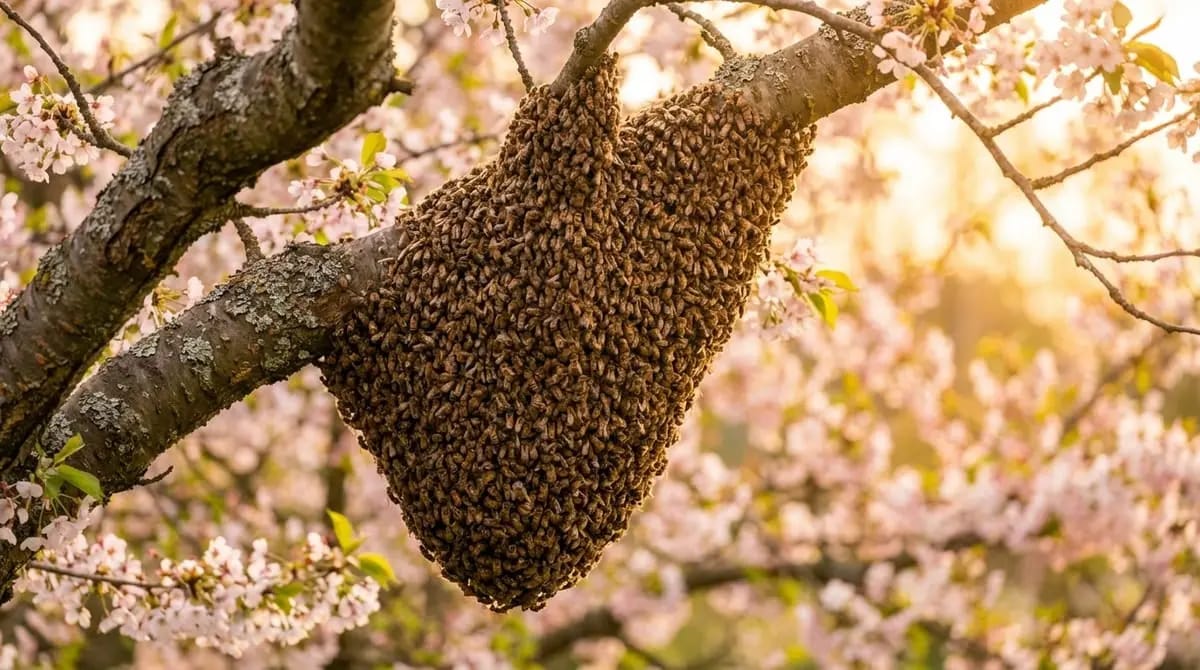
Swarm Catching Equipment
- 1
Locate swarm and spray
Spray the swarm cluster with water (prevents them from flying off). The swarm usually stays in one place for 1-3 hours.
- 2
Collect the swarm
Hold catching box under the swarm and shake vigorously, or brush bees in. When the queen is in the box, bees fan at the entrance (Nassanoff gland) and stragglers follow.
- 3
Close in the evening and relocate
Leave until evening (stragglers gather). Then close and move to the new location.
(1) Hive on foundation -- immediate oxalic acid treatment possible (broodless!). (2) Merge with a weak colony (newspaper method). (3) Strengthen a nucleus. Important: Always keep foreign swarms in quarantine and test for foulbrood.
Merging with the Newspaper Method
- Newspaper (1 sheet)
- Needle
- Spray bottle with sugar syrup
- Remove the swarm's queen first (only if the existing colony already has a queen)
- Place a single sheet of newspaper on the top bars of the existing colony
- Poke 5-10 small holes with a needle (scent contact)
- Set the swarm box (without queen) on top
- Bees chew through in 1-2 days and merge peacefully
- Check after 3 days
Natural Swarm vs. Controlled Split
| Aspect | Natural Swarm | Controlled Split |
|---|---|---|
| Timing | Unpredictable | Planned by beekeeper |
| Queen quality | Old queen, emergency cells | Bred queen can be introduced |
| Honey harvest | Major loss (50 % of bees gone) | Minimal impact |
| Genetics | Swarming tendency is inherited | Selection possible |
| Neighbour problems | Swarm in the neighbour's garden | None |
A beekeeper who lets colonies swarm makes life harder for themselves. They lose bees, honey and worsen the genetics. Professional swarm management is the foundation of productive beekeeping.
Swarming Season Calendar
- MarchPreparationInsert drone frames, prepare materials. First play cups possible (still harmless).
- AprilSwarming Season BeginsFirst tilt checks (every 7 days). Add honey supers. Watch strong colonies.
- MayPeak Swarming SeasonWeekly checks are mandatory! Make splits, cut drone comb. Highest risk when oilseed rape finishes.
- JuneSwarming Season PeakHigh vigilance. Summer solstice: swarming impulse gradually subsides. Last chance for splits.
- JulySwarming Season EndsSwarming impulse fades. Focus shifts to honey harvest and Varroa treatment.
- March
Preparation
Insert drone frames, prepare materials. First play cups possible (still harmless).
- April
Swarming Season Begins
First tilt checks (every 7 days). Add honey supers. Watch strong colonies.
- May
Peak Swarming Season
Weekly checks are mandatory! Make splits, cut drone comb. Highest risk when oilseed rape finishes.
- June
Swarming Season Peak
High vigilance. Summer solstice: swarming impulse gradually subsides. Last chance for splits.
- July
Swarming Season Ends
Swarming impulse fades. Focus shifts to honey harvest and Varroa treatment.
Knowledge Check
Next lesson: Migratory Beekeeping -- following nectar flows and harvesting varietal honey.