

Lesson 5 of 10
Your Own Wax Cycle: Residue-Free Beekeeping
25 min
Melting, cleaning and pressing your own foundation. Everything about the closed wax cycle for the highest quality and independence.
Beeswax is more than a by-product -- it is a highly sensitive natural product that stores residues for years and directly affects the health of your colonies. Anyone who wants full control over their product quality cannot avoid their own wax cycle.
0.5-1.5 kgnew wax a strong colony produces per year through its wax glands
Why Your Own Wax Cycle?
The Residue Problem
Beeswax is lipophilic (fat-soluble) and accumulates substances:
- Varroacides: flumethrin, coumaphos, amitraz -- detectable for years even after a single application
- Pesticides: neonicotinoids, fungicides from agriculture
- Adulteration: paraffin and stearin in purchased wax -- in the worst case damages the brood nest
| Aspect | Purchased Wax | Own Cycle |
|---|---|---|
| Residue-free | Uncertain (without lab analysis) | Guaranteed |
| Adulteration risk | Present | Excluded |
| Cost/foundation sheet | 1.50-2.50 EUR | 0.20-0.50 EUR |
| Independence | Dependent | Complete |
| Bee acceptance | Usually good | Excellent (own scent) |
Your own wax cycle is the life insurance for healthy bee colonies. Those who control their own wax have one of the most important risk factors under control.
Melting Wax: Three Methods
1. Solar Wax Melter
The simplest method -- ideal for smaller quantities and as a supplement.
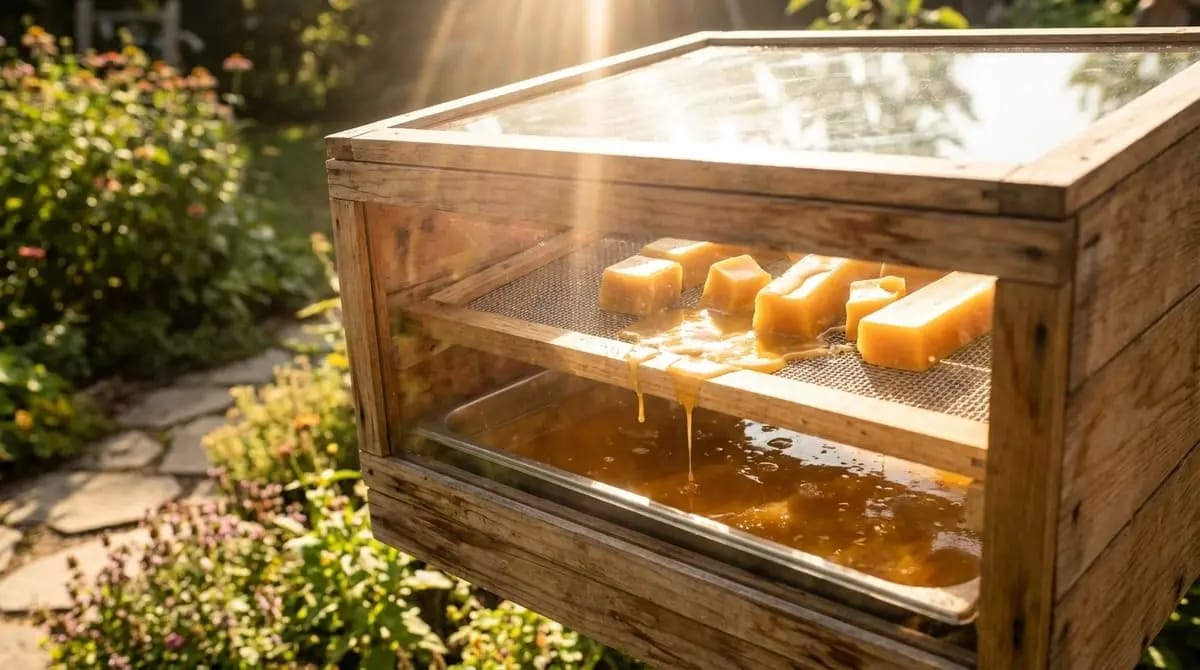 AI-generated. This image was created with AI. It does not show a real apiary.
- Solar wax melter
- Old combs/wax scraps
- Fine filter (nylon stocking)
- Collection container
- Place in a sunny, wind-sheltered spot, glass pane facing south
- Place combs/wax scraps on the grate
- Wax melts at 62-65 °C, drips through filter into container
- Re-melt the residue (still contains 30-50 % wax)
- Remove wax block in the evening
Reaches internal temperatures of 80-90 °C, melts 5-8 frames/day. Sufficient as sole device for up to 20 colonies. DIY from an old window + wooden box: 30-50 EUR.
2. Steam Wax Melter
The standard method for medium to large operations (20-100 colonies). Hot steam melts combs directly in the super.
- 1
Direct steam into the super
Connect steam generator (wallpaper stripper or similar). Place super with old combs over collection system (sieve over bucket).
- 2
Let steam work for 30-60 minutes
Internal temperature 95-100 °C. Wax-water mixture drips into the collection container.
- 3
Let cool and lift off wax block
Cool for 12-24 hours. Wax floats on top, water remains below. Scrape off the dirt layer on the underside.
3. Steam Juicer (Household Method)
For beginners and small quantities (up to 10 colonies). An ordinary steam juicer from the kitchen suffices.
| Method | Capacity | Yield | Cost | Ideal for |
|---|---|---|---|---|
| Solar wax melter | 3-8 frames/day | 70-85 % | 30-200 EUR | Hobby (up to 10 colonies) |
| Steam wax melter | 10-12 frames/batch | above 95 % | 150-400 EUR | 20-100 colonies |
| Steam juicer | 2-4 frames/batch | 85-90 % | 30-60 EUR | Entry-level, small quantities |
Cleaning Wax
- Raw wax
- Stainless steel pot (10-20 L)
- Water (rainwater optimal)
- Fine filter (cotton cloth)
- Heat source
- Break raw wax into pieces, place in stainless steel pot with double the amount of water
- Heat slowly to 80-85 °C (NOT above 90 °C -- discolours the wax)
- Pour through fine filter into clean container
- Let cool very slowly (wrap in blankets, 12-24 hours)
- Lift off wax block, scrape off dirt layer
- Repeat if necessary
Detecting Wax Adulteration
| Test | Pure Beeswax | Paraffin Adulteration | Stearin Adulteration |
|---|---|---|---|
| Melting point | 62-65 °C | below 60 °C | above 65 °C |
| Smell | Honey-like, warm | Neutral/petroleum-like | Slightly rancid |
| Breaking behaviour | Smooth, slightly granular | Glassy, brittle | Crumbly, matte |
| Kneading test (body heat) | Pliable, malleable | Remains brittle | Becomes powdery |
For absolute certainty: laboratory analysis (specialist labs, 50-150 EUR). Tests for adulteration and residues.
62-65 °Cmelting point of pure beeswax -- an important metric for purity testing
Making Your Own Foundation
Method 1: Casting
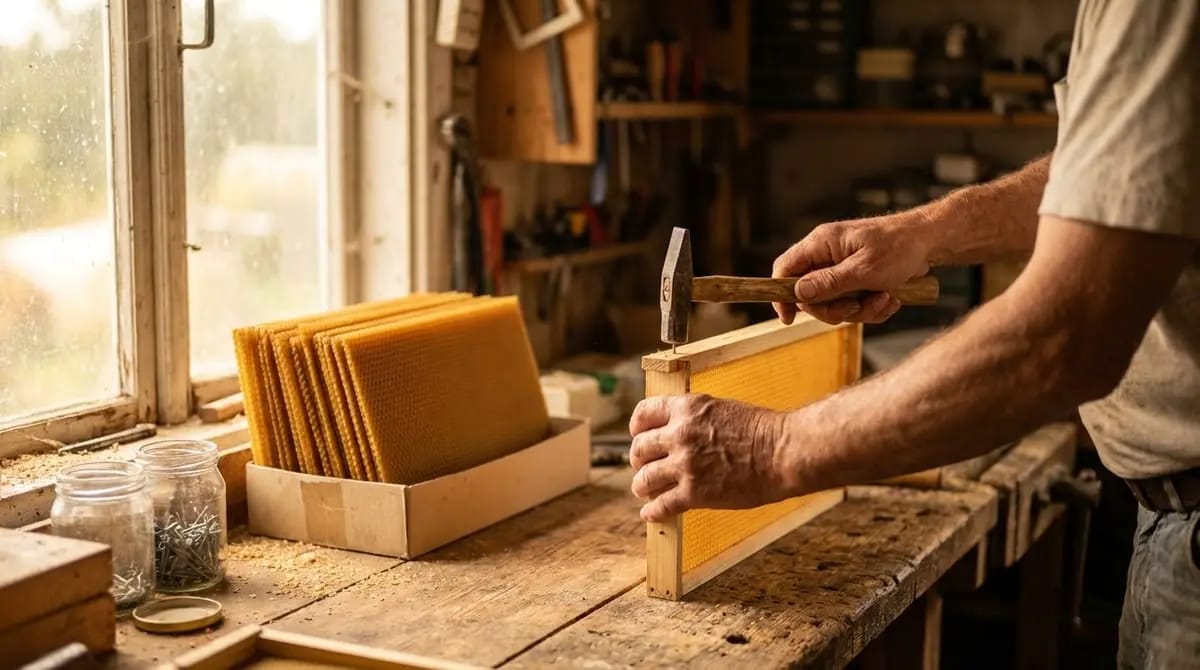 AI-generated. This image was created with AI. It does not show a real apiary.
- Silicone or aluminium casting mould
- Cleaned wax
- Wax melting pot (water bath!)
- Thermometer
- Release agent (diluted washing-up liquid)
- Heat wax in water bath to 75-80 °C (no hotter!)
- Spray casting mould with diluted washing-up liquid (release agent)
- Pour wax briskly over the lower mould half
- Close upper half, press firmly for 30-60 seconds
- Let set for 1-3 minutes, carefully remove
- Trim edges to exact comb dimensions
- Store flat and cool
Flexible, releases foundation easily. Available for all common comb sizes. Lifespan: several hundred foundation sheets. Note: do not use overheated wax (above 90 °C).
Method 2: Rolling
For larger quantities (above 100/year): feed wax sheets through counter-rotating embossing rollers. Pre-warm sheets to 35-40 °C.
50-100 foundation sheets/hour. Motor-driven from 1,500 EUR. A worthwhile collective investment for associations.
| Feature | Casting | Rolling |
|---|---|---|
| Cost | 60-120 EUR (mould) | 300-800 EUR (roller) |
| Speed | 20-30/hour | 50-100/hour |
| Embossing quality | Very good | Good to very good |
| Practice needed | Little | Medium |
| Ideal for | Up to 30 colonies | Large operations, associations |
Business Case
For 20 colonies (100-150 foundation sheets/year):
- Purchased wax: 150-375 EUR/year
- Own cycle: 100-200 EUR/year (after equipment depreciation over 5 years)
- Savings: 50-175 EUR/year plus guaranteed residue-free quality
One-time investment: 270-620 EUR (solar melter + steam melter + casting mould + accessories).
Wax Analysis: What the Lab Reveals
For maximum safety, have your wax regularly analysed in a laboratory. An analysis covers:
- Adulteration test: detection of paraffin, stearin, microwaxes through gas chromatographic analysis. Pure beeswax has a characteristic "fingerprint profile" of hydrocarbons.
- Residue analysis: quantitative determination of varroacides (flumethrin, coumaphos, amitraz metabolites) and pesticides (neonicotinoids, pyrethroids). Note threshold values.
- Physical parameters: melting point (62-65 °C), saponification value (87-102), acid value (17-22). Deviations indicate adulteration.
Recommendation: have an analysis done every 2-3 years (50-150 EUR depending on scope). Especially important when first establishing your own cycle or integrating wax from an uncertain source.
| Parameter | Pure Beeswax | Suspicious |
|---|---|---|
| Melting point | 62-65 °C | below 60 °C or above 67 °C |
| Saponification value | 87-102 | below 80 or above 110 |
| Acid value | 17-22 | below 12 or above 30 |
| Hydrocarbons | 12-14 % | above 17 % (paraffin) |
The Closed Cycle
- 1
Cull old comb (Spring)
During the spring inspection: sort out oldest brood combs, replace with foundation. One-third rule: renew 1/3 of brood combs each year -- no comb older than 3 years.
- 2
Collect cappings wax (Summer)
During extraction: collect light cappings wax separately in a clean container. The most valuable material in your cycle.
- 3
Melt (Summer/Autumn)
Light wax -> solar wax melter -> for foundation. Dark old comb wax -> steam melter -> for candles/cosmetics.
- 4
Clean (Autumn/Winter)
Water clarification. Process light and dark wax separately.
- 5
Cast/roll foundation (Winter)
From cleaned light wax. Build up stock for the next season.
- 6
Wire and embed (Late Winter)
Embed foundation into pre-wired frames. Cycle closed!
Collaboration in the Association
Wax Products
15-25 EUR/kgpure, analysed beeswax fetches in direct sales
Knowledge Check
With this, the five core topics of advanced colony management are complete: Colony Multiplication, Queen Rearing, Swarm Management, Migratory Beekeeping and Wax Cycle. These skills make you a self-reliant, professionally working beekeeper.