Migratory Beekeeping: Following Nectar Flows
From route planning to transport logistics and profitability: professional migratory beekeeping for varietal honey and maximum yield.
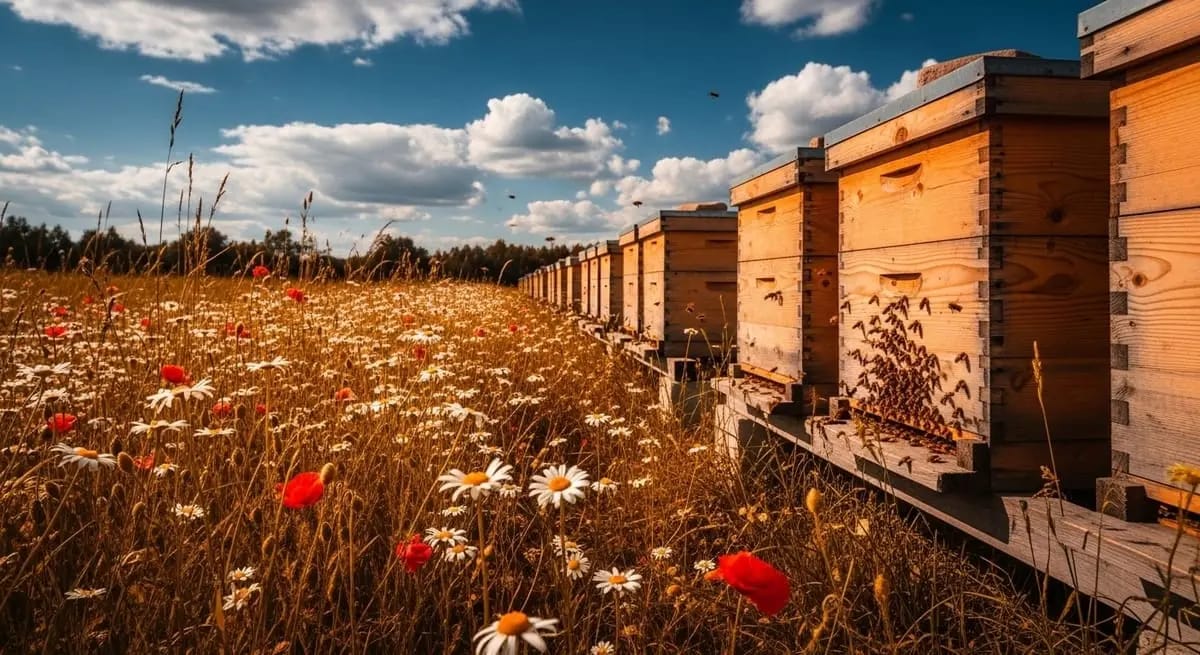
While stationary beekeeping waits for the nectar flow to come, migratory beekeeping reverses the principle: the bees follow the blossoms. Through targeted relocations you tap multiple nectar flows per season, harvest valuable varietal honeys and significantly boost your yield.
Why Migrate?
| Aspect | Stationary Beekeeping | Migratory Beekeeping |
|---|---|---|
| Honey yield/colony/year | 15-25 kg | 30-50 kg |
| Varietal honey | Only if flow at home apiary | Targeted planning possible |
| Honey price/kg | 10-14 EUR (blossom honey) | 12-22 EUR (varietal honey) |
| Pollination fees | Rare | 50-150 EUR/colony possible |
| Investment | Low | High (trailer, transport) |
| Time commitment | Moderate | High (logistics) |
Additional benefits: continuous forage keeps colonies in laying mode and helps prevent swarming. Forage gaps at the home apiary are bridged.
Migratory beekeeping is as old as beekeeping itself. In ancient Egypt, beehives were already transported on Nile barges to the flower fields.
Legal Requirements
The following legal requirements apply specifically to Germany. Other countries have their own regulations regarding colony health certificates and movement of bees. Check with your local veterinary authority or beekeeping association for the rules in your area.
Health Certificate
The most important document for migratory beekeeping -- without it, moving bees is illegal in Germany.
- 1
Take food-ring samples
1 tablespoon of honey from the food ring per colony. Mix up to 6 colonies into one pooled sample. Send to the laboratory (20-40 EUR/sample, 2-4 weeks turnaround).
- 2
Apply for health certificate at the veterinary office
With a negative result (no foulbrood spores) at the veterinary office of your district. Validity: 9 months from issue (standardised under the German Bee Disease Regulation).
- 3
Carry with every migration
Original or certified copy. Your proof during inspections or in quarantine zones.
Fines apply, and in foulbrood quarantine zones colonies without proof may be destroyed. No varietal honey is worth this risk.
Legal Checklist
The Migration Plan
Classic Plan for Northern Germany
- Mar-AprFruit BlossomApple, cherry, pear at orchards. Pollination fees possible (50-100 EUR/colony). Colony build-up phase.
- Apr-MayOilseed RapeMass flow No. 1. Rapid honey ripening, crystallises quickly -- extract promptly! Yield: 15-30 kg/colony.
- May-JunBlack Locust (Acacia)Valuable varietal honey (14-20 EUR/kg). Main occurrence in eastern Germany, Rhineland. Bloom only 10-14 days, weather-dependent.
- Jun-JulLime/LindenCharacteristic menthol-like honey. Bloom 2-3 weeks. 10-20 kg/colony. Often available at home apiary.
- Jul-AugForest (Honeydew)Spruce/fir honeydew in upland regions. Yield unpredictable (0-40 kg). Watch for melezitose risk.
- Aug-SepHeatherCalluna honey (20-30 EUR/kg). Thixotropic -- requires pressing or loosening. Labour-intensive but highly profitable.
- Mar-Apr
Fruit Blossom
Apple, cherry, pear at orchards. Pollination fees possible (50-100 EUR/colony). Colony build-up phase.
- Apr-May
Oilseed Rape
Mass flow No. 1. Rapid honey ripening, crystallises quickly -- extract promptly! Yield: 15-30 kg/colony.
- May-Jun
Black Locust (Acacia)
Valuable varietal honey (14-20 EUR/kg). Main occurrence in eastern Germany, Rhineland. Bloom only 10-14 days, weather-dependent.
- Jun-Jul
Lime/Linden
Characteristic menthol-like honey. Bloom 2-3 weeks. 10-20 kg/colony. Often available at home apiary.
- Jul-Aug
Forest (Honeydew)
Spruce/fir honeydew in upland regions. Yield unpredictable (0-40 kg). Watch for melezitose risk.
- Aug-Sep
Heather
Calluna honey (20-30 EUR/kg). Thixotropic -- requires pressing or loosening. Labour-intensive but highly profitable.
Hivekraft displays the current forage situation based on weather and phenology data. Additionally, TrachtNet.de offers regional reports via a hive scale network.
Logistics and Transport
Transport Systems
| System | Advantages | Disadvantages | Cost |
|---|---|---|---|
| Standard hive + ratchet straps | Flexible, no special equipment | Time-consuming, each hive secured individually | 50-100 EUR |
| Migratory hives (polystyrene) | Light, good ventilation, stackable | Less sturdy, sun exposure | 30-50 EUR/piece |
| Bee trailer | Fastest system, professional | High investment, storage space needed | 2,000-8,000 EUR |
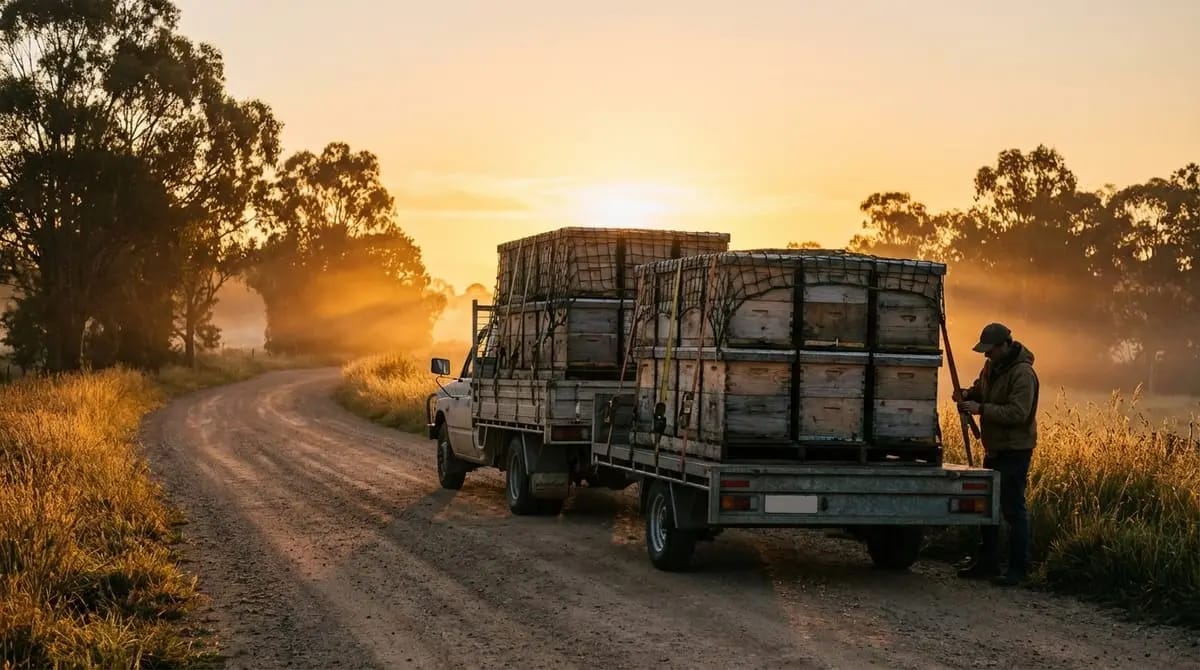
Transport Technique
- 1
Evening before: close entrances
When all forager bees are inside: foam or entrance slide. Fit migratory lids with mesh (ventilation is essential!). Secure hives with ratchet straps.
- 2
Load at dusk (4:00-5:00 AM)
At temperatures above 25 °C there is suffocation risk. Entrances facing direction of travel (airflow cools). Lift carefully (comb breakage!).
- 3
Secure the load
Ratchet straps (at least 2 per row), anti-slip mats. Hives must withstand emergency braking (0.8 g).
- 4
Transport: smooth and steady
Max. 80 km/h on country roads. Avoid emergency braking, tight curves and potholes. For journeys exceeding 1 hour in warmth: stop and spray hives with water.
- 5
Set up at migratory location
Point entrances in different directions (minimise drifting). Wait 10-15 minutes, then open entrances. Best to set up at dusk.
At temperatures above 30 °C, colonies in closed transport can suffocate in 30-60 minutes. Never transport in the midday heat. Optimal: evenings 21:00-05:00. If daytime transport is unavoidable: spray with water every 30 minutes.
Transport Packing List
Finding Locations
The ideal location offers: forage source within 1-2 km, paved access for trailers, wind shelter (hedge, forest edge), no pesticides (agreement with farmer!), water source within 500 m and distance from other apiaries (200-500 m).
Agreements with Farmers
The relationship with the farmer is fundamental. The farmer benefits from pollination, the beekeeper from the site and insider knowledge about spray schedules.
Put it in writing: placement period, site, access, crop protection agreement (beekeeper is informed before spraying), liability and any fee. Protects both parties.
Managing Crop Protection Risks
The most dangerous aspect of migratory beekeeping is potential exposure to crop protection products. Especially critical:
- Neonicotinoids (systemic insecticides): Banned for outdoor use in the EU since 2018. The CJEU in 2023 also ruled national emergency authorisations inadmissible. Nevertheless, stay informed about the current situation in your region.
- Bee-toxic insecticides (highest hazard class): May only be applied outside bee flight hours, but not every farmer complies.
- Fungicides: Often classified as bee-safe, but can be toxic in combination with other products.
- Spraying during oilseed rape bloom: Especially critical, as bees forage intensively in the crop.
Your best protection: a written agreement with the farmer to be informed before every spray application (at least 24 hours in advance), so you can close the entrances or temporarily move the colonies.
Dead bees in front of the entrance (above 500 bees/day), trembling bees, missing foragers: immediately take samples (at least 500 dead bees frozen in a clean jar) and report to your national authority. Document everything with photos and dates. An official report is important for compensation claims and protecting other beekeepers.
Preparing Colonies for Migration
Not every colony is suited for migration. Migratory colonies should be:
- Strong and vital: at least 30,000 bees, active brood nest, productive queen (max. 2 years old)
- Healthy: low Varroa load, no signs of disease
- Swarm-free: colonies in swarming mood swarm even faster during transport
- Well-built: stable combs that withstand transport vibrations. Freshly drawn foundation breaks more easily than older comb.
Prepare colonies 1-2 weeks before migration: add honey super (if not yet done), fit migratory lids and floors, check hive connections.
Special Case: Heather Migration
Heather (Lueneburg Heath, August-September) is the crown jewel of migratory beekeeping.
- Heather honey is thixotropic -- cannot be extracted normally by spinning
- Harvest: loosening with a spiked roller or pressing
- Price: 20-30 EUR/kg in direct sales
- Weather lottery: bloom is extremely weather-dependent
Profitability
Honest calculation for 20 colonies, one migration:
| Item | Costs | Revenue |
|---|---|---|
| Transport (fuel, wear) | 50-150 EUR | -- |
| Site fee + certificate (pro rata) | 10-120 EUR | -- |
| Time investment (4-8 h) | 50-100 EUR | -- |
| Additional honey (200-400 kg) | -- | 2,400-8,800 EUR |
| Pollination fee | -- | 0-3,000 EUR |
| BALANCE | 110-370 EUR | 2,400-11,800 EUR |
The one-time investment in migratory equipment (2,000-8,000 EUR) pays for itself with regular migration in 1-3 seasons. Used bee trailers are often available through beekeeper forums and association exchanges for 1,000-3,000 EUR -- a good starting point.
Knowledge Check
Next lesson: Your Own Wax Cycle -- residue-free beekeeping and making your own foundation.