Breeding Selection: Identifying Your Best Colonies
Evaluation criteria, performance testing and breeding records. How to identify your best colonies and make informed breeding decisions.
Every beekeeper who makes splits or raises queens -- whether consciously or not -- practises selection. The decisive question is: does it happen by chance or systematically? In this lesson you will learn the fundamentals of breeding selection -- from evaluation criteria to strategic population planning.
Evaluation Criteria
| Criterion | Heritability | Measurability | Breeding Priority |
|---|---|---|---|
| Gentleness | 0.3-0.5 (high) | Subjective (scale 1-4) | 1 (always) |
| Calmness on comb | 0.2-0.4 (medium) | Subjective (scale 1-4) | 2 |
| Swarming tendency | 0.2-0.4 (medium) | Semi-objective | 1 (always) |
| Honey yield | 0.15-0.25 (low) | Objective (kg) | 2-3 |
| Varroa tolerance | 0.1-0.3 (low-medium) | Objective (tests) | 2 (rising) |
| Overwintering | 0.15-0.3 | Objective (measurement) | 2 |
| Hygienic behaviour | 0.2-0.35 (medium) | Objective (pin test) | 2-3 |
Gentleness and Calmness on Comb
Gentleness (scale 1-4: aggressive to very gentle) is the most immediately noticeable criterion. With a heritability of 0.3-0.5 it responds well to selection. Evaluate three times per season under comparable conditions (weather, time of day).
Calmness on comb describes how quietly the bees remain on a pulled frame. Good comb behaviour makes work enormously easier -- especially when searching for queens and checking queen cells.
Always evaluate under comparable conditions: same time of day, similar weather. A colony before a thunderstorm is not automatically aggressive. Calculate the average from at least 3 evaluations.
Swarming Tendency and Honey Yield
Swarming tendency (scale 1-4) is economically one of the most important criteria. A swarm = yield loss + weakened parent colony. Document at every check: play cups, occupied queen cells, broken swarming mood.
Honey yield is easily measurable (kg/colony) but strongly environment-dependent. Only compare between colonies at the same apiary and calculate the deviation from the site average.
Varroa Tolerance and Hygienic Behaviour
Varroa tolerance is measured through natural mite drop, mite reproduction rate and the pin test (hygienic behaviour). In the pin test, 100 brood cells are pierced -- above 80 % removal after 24 hours indicates highly hygienic behaviour.
Conducting Performance Testing
- 1
Identify colonies (March)
Every colony gets a number, the queen is colour-marked. All colonies receive a comparable starting position: similar colony strength, same apiary.
- 2
Swarming season evaluation (May/June)
Document swarming tendency at every inspection. Simultaneously assess gentleness and calmness on comb (scale 1-4).
- 3
Record honey harvest (June-August)
Weigh every harvest per colony -- do not estimate! The total yield emerges at season end.
- 4
Varroa assessment (July-September)
Quantify mite infestation before summer treatment. Colonies with lower infestation are tolerance candidates.
- 5
Autumn assessment (October)
Wintering strength, food reserves, queen condition. Enter overall assessment.
- 6
Spring result (March following year)
Did the colony survive? How strong is it compared to wintering? Only now is the performance test complete.
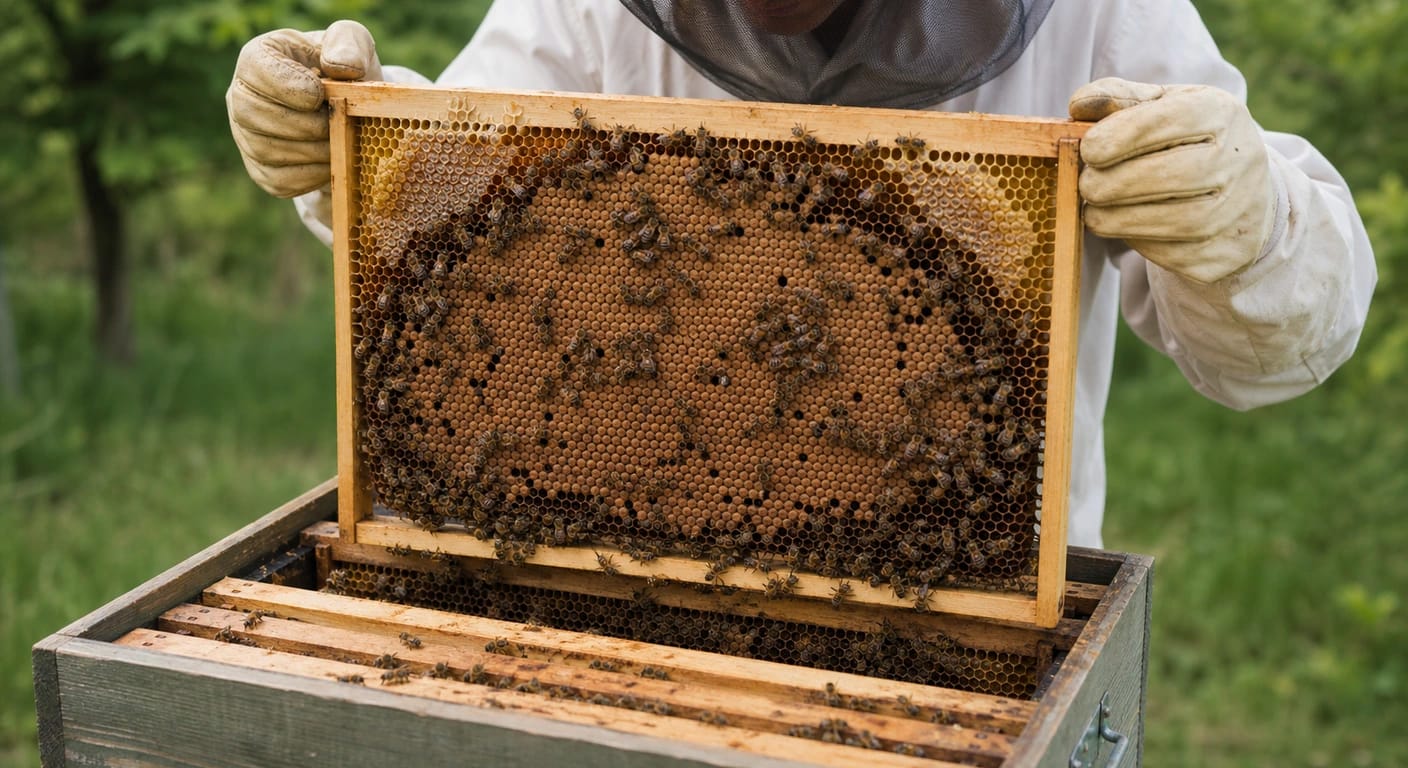
The Evaluation Form
Required Fields per Colony per Season
A/B/C Classification
- A colonies: above average in all criteria. Breed from these.
- B colonies: average. Stay at the apiary, no breeding.
- C colonies: below average. Queen is replaced.
Typical distribution: 20 % A colonies (breed), 60 % B colonies (keep), 20 % C colonies (requeen). Consistent selection in both directions -- breed from the best AND requeen the worst -- accelerates progress.
AGT Tolerance Breeding: The Practical Example
The AGT (Arbeitsgemeinschaft Toleranzzucht) is the largest German breeding programme focused on Varroa tolerance. Similar programmes exist in other countries. The principles described here -- systematic evaluation, performance testing, and controlled mating -- are universally applicable.
The AGT (Arbeitsgemeinschaft Toleranzzucht) is the largest German breeding programme focused on Varroa tolerance and demonstrates exemplary systematic breeding selection.
Participating beekeepers (over 300 operations in 10 regional groups) register test colonies evaluated according to a standardised scheme. In addition to standard criteria (honey yield, gentleness, swarming tendency), tolerance-specific traits are tested: natural mite drop, pin test and optional VSH testing. Results feed into the Beebreed breeding value estimation, and the best queens are selected for breeding.
Assessment and Mating Stations
An assessment is the official evaluation by trained assessors -- a prerequisite for breeding book registration. The assessor evaluates gentleness, calmness on comb, comb building, colony development and disease freedom.
Mating stations offer controlled drone genetics. Three types: island mating stations (most reliable isolation), mountain mating stations (alpine valleys) and lowland mating stations (flatland, less reliable). Alternative: instrumental insemination for complete mating control.
Controlled mating at mating stations or through instrumental insemination is the most powerful tool in bee breeding. Without controlling the paternal side, any selection is only half as effective.
Breeding Records and Beebreed
Beebreed (beebreed.eu) is the central European breeding value database with over 170,000 test results. Breeding values are expressed as deviations from the population mean (100 = average, 110 = above average).
Even without official participation, keep your own breeding record with: breeding book number, birth year, parent colony, mating type, mating station and performance data for each season.
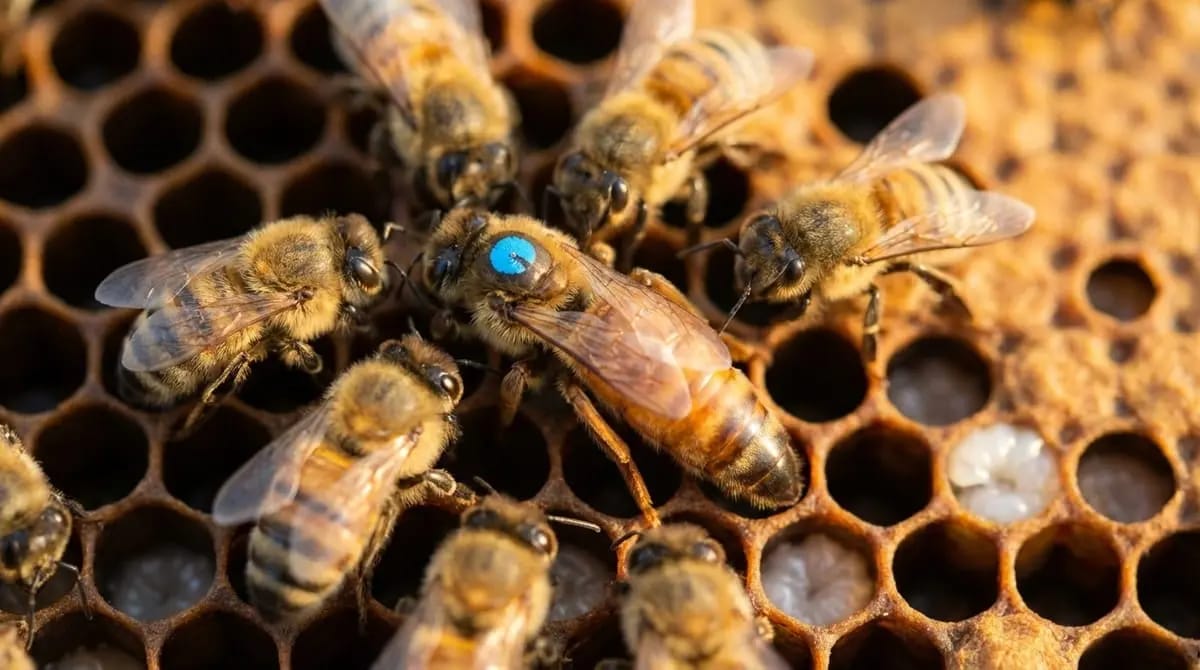
International Queen Colour Code
Queen marking follows an internationally standardised system determined by the last digit of the birth year:
| Final Digit | Colour | Example Years |
|---|---|---|
| 1 or 6 | White | 2021, 2026 |
| 2 or 7 | Yellow | 2022, 2027 |
| 3 or 8 | Red | 2023, 2028 |
| 4 or 9 | Green | 2024, 2029 |
| 5 or 0 | Blue | 2025, 2030 |
Marking is done with a paint pen (Opalith disc or lacquer pen) on the queen's thorax. It allows you to immediately recognise the age of each queen and detect supersedure (suddenly a queen with the "wrong" colour).
Population Genetics Fundamentals
Heterosis and Inbreeding
Heterosis (hybrid vigour): offspring from crossing genetically different lines are often more productive than either parent. Maximum effect in the F1 generation, declines in F2.
Inbreeding is especially harmful in honey bees because of the CSD gene: when homozygous, diploid drones are produced that are immediately consumed -- empty brood cells remain. Visible as a spotty brood pattern.
Never breed for multiple generations from the same parent colony without introducing fresh genetic material. Buy a queen from a different breeder every 2-3 years. Use different mating stations.
Calculating Breeding Progress
Breeding progress per generation: Heritability x Selection Differential
Example for gentleness (h2 = 0.4): Population mean 2.8, breeding stock mean 3.6 -> Selection differential 0.8 -> Expected progress: 0.4 x 0.8 = 0.32 points per generation. In practice the effect is halved by the uncontrolled drone side (with open mating).
Breeding Selection in Your Own Operation: Start Now
- Colony card/app (e.g. Hivekraft)
- Spring scale for honey harvest
- Powdered sugar kit for Varroa monitoring
- Queen marking pens
Step 1: Mark and number all queens.
Step 2: Document gentleness and calmness on comb at every inspection.
Step 3: Record swarming behaviour completely.
Step 4: Weigh honey yield per colony -- do not estimate!
Step 5: At season end, classify A/B/C. Breed from A, requeen C.
Step 6: Introduce fresh genetic material every 2-3 years (queen purchase, mating station).
Practical Tips for Your Operation
Even without a breeding station you can systematically improve your stock:
Tip 1: Do not breed from swarming colonies. If you make splits from colonies that are currently in swarming mood, you unconsciously select for swarming tendency. Make splits specifically from non-swarming A colonies.
Tip 2: Open mating is better than its reputation. Even without a mating station you achieve breeding progress if you consistently breed from the best colonies and requeen the worst. The effect is slower, but present.
Tip 3: Influence drone colonies at your apiary. Ensure that your A colonies raise drones in spring (deliberately insert drone frames in the best colonies). This increases the proportion of good genetics in the drone population at your site.
Tip 4: Compare at least 8-10 colonies. Breeding selection only works with a minimum number of colonies for comparison. With 3-4 colonies the data is not statistically meaningful. This is why collaboration within the association is so valuable.
Common Mistakes
Knowledge Check
In the next lesson we explore different hive systems -- from two-queen systems to Top Bar Hives.