Two-Queen Systems and Hive Types Compared
From standard hives to Dadant and Top Bar Hive: hive systems and management approaches in detail, including two-queen colonies and bee houses.
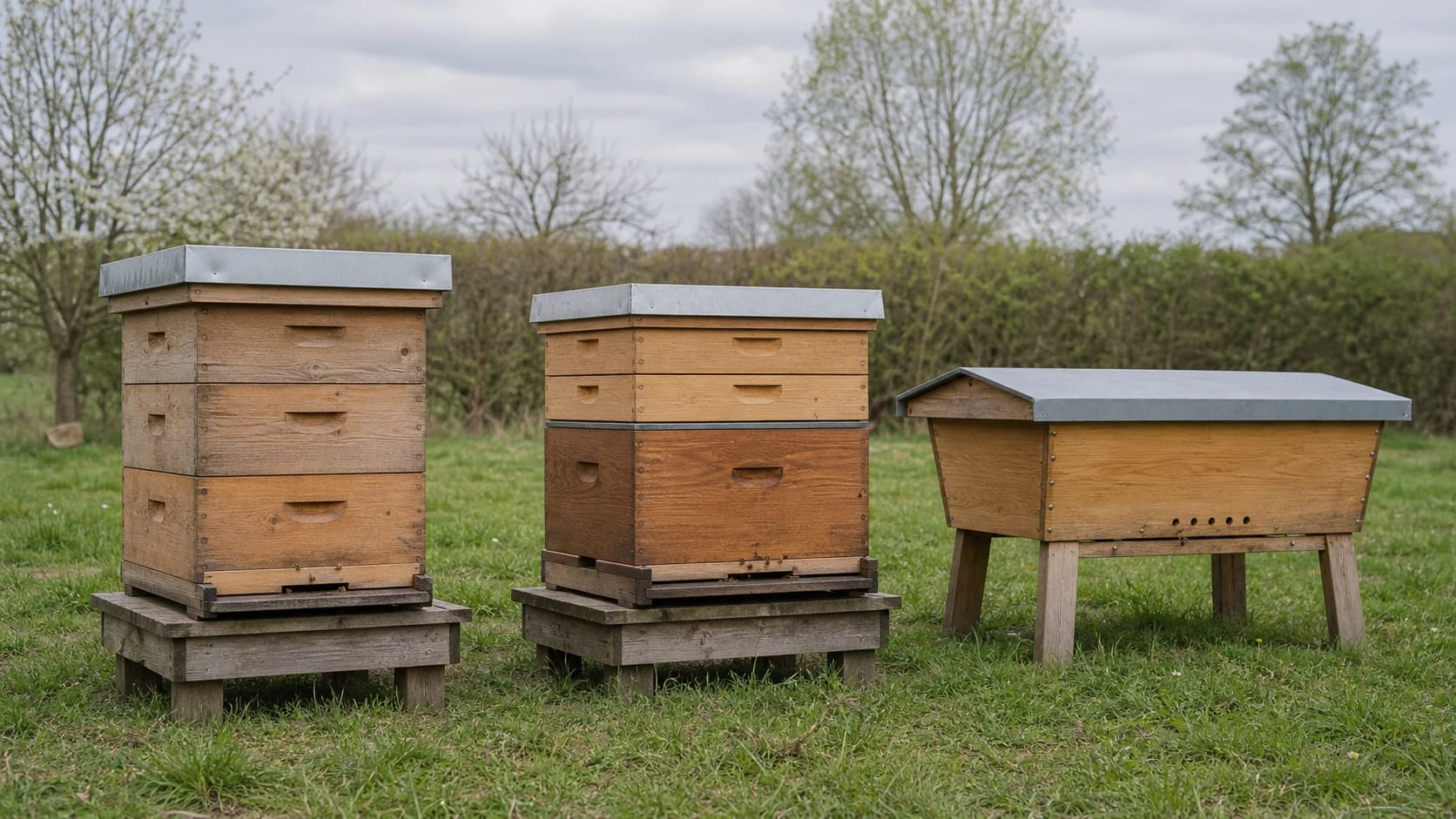 AI-generated
The choice of hive system influences honey yield, swarm management, physical strain and investment costs. In this lesson we analyse standard hive types, Dadant, alternative systems and advanced concepts such as two-queen management and the use of cell builder and cell finisher colonies.
Stacking Hives: The Standard
The basic principle: stackable boxes with removable frames. Brood chamber below, honey super above, separated by a queen excluder.
Single-Box vs. Two-Box Brood Chamber
| Feature | Single-box (1 brood box) | Two-box (2 brood boxes) |
|---|---|---|
| Frame type | Zander, Dadant | DN, Langstroth |
| Swarm control | Tilt check possible | Must check each frame |
| Weight per box | 20-35 kg | 15-20 kg per box |
| Finding the queen | Max. 10-11 frames | Up to 22 frames |
| Space shortage | Possible with strong colonies | Rarely a problem |
Dadant = single-box (brood chamber large enough). DN = two-box (one box too small). Zander = usually single-box (with a tendency to 1.5 in strong flow years).
The Dadant System in Detail
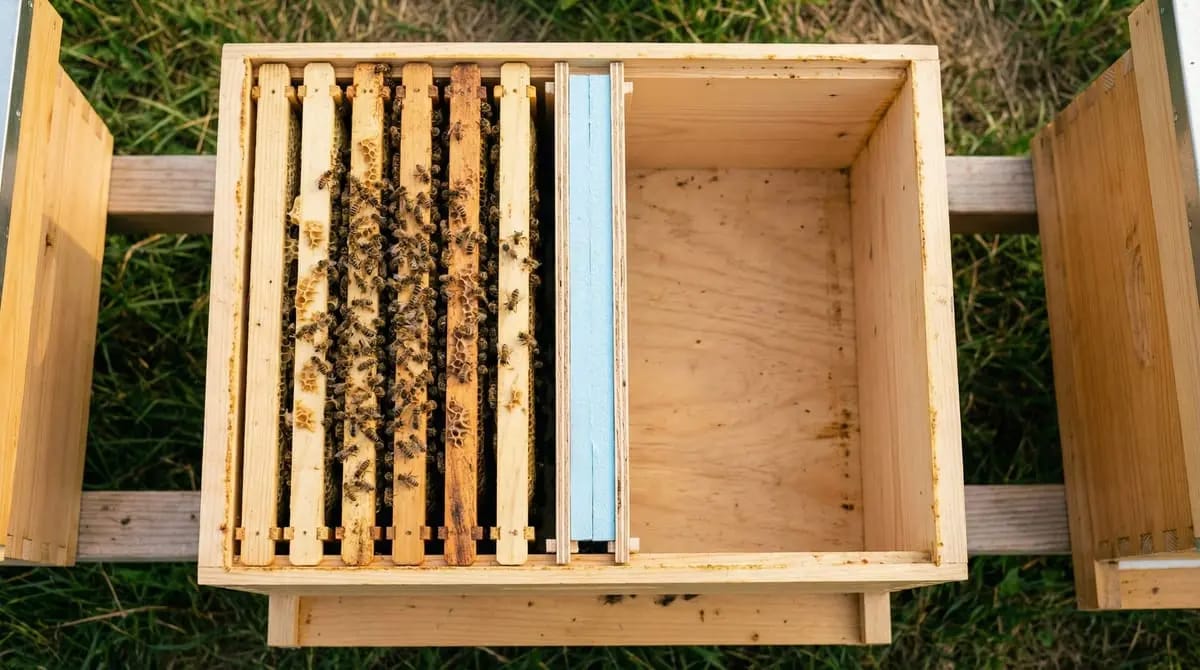
Dadant is rapidly gaining popularity in Germany and is the international standard. Construction: 1 large brood box (435 x 300 mm) + 2-4 medium supers for honey. The brood chamber is never expanded -- a central element is the follower board (divider board) that limits the brood nest to the required size.
- 1
Spring: set follower board tight (March)
Limit brood nest to 5-7 frames. The colony sits compactly and heats more efficiently -- earlier and stronger development.
- 2
Expansion: open follower board (April-May)
As the colony grows, move the follower board outward and insert empty foundation.
- 3
Add honey super (when flow begins)
Place first medium super with queen excluder. Medium supers are light (12-15 kg) -- quick harvesting.
Two-Queen Management
The two-queen management system uses two queens in a connected system for maximum forager strength during the main flow. Two colonies stand one on top of the other, separated by a double queen excluder. Both queens lay eggs; the forager bees work collectively.
| Aspect | Single Colony | Two-Queen Colony |
|---|---|---|
| Forager strength | Normal | Double |
| Honey yield potential | 20-40 kg | 40-80 kg |
| Swarming risk | Normal | Elevated |
| Total tower weight | 20-35 kg/box | 100+ kg total |
| Experience needed | Beginner to intermediate | Experts only |
Two-queen management only works with considerable experience and precise timing. Primarily worthwhile for migratory beekeeping into strong flow areas (oilseed rape, lime, fir).
Cell Starter and Cell Finisher
For queen rearing, specialised colonies are used:
Cell Starter Colony
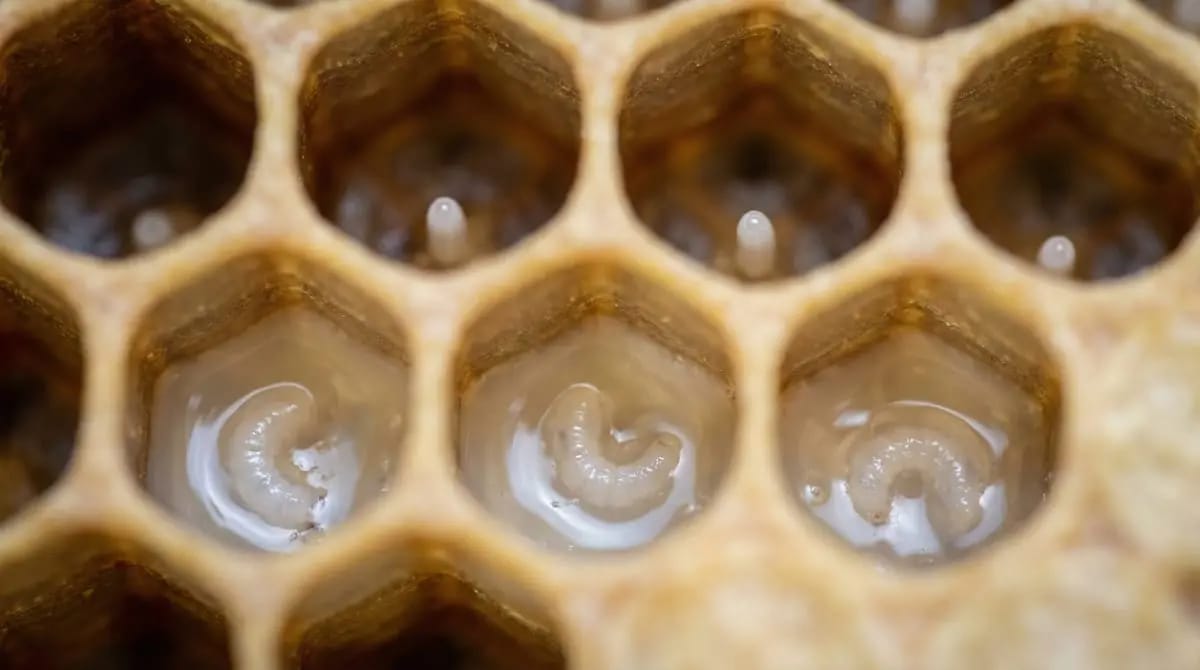
The cell starter accepts freshly grafted queen cups in the first 24 hours. Requirements: queenless, densely populated with young bees, well-fed. Usable for a maximum of 24-48 hours.
Cell Finisher Colony
The cell finisher takes over the started cells and feeds the larvae until capping. It can be queen-right (queen behind queen excluder) and accept new series every 5-7 days for weeks.
- 1
Day 0: Grafting
Transfer 1-2 day old larvae from the breeder colony into queen cups (15-30 pieces).
- 2
Day 0-1: Starting in the starter
Place cups in the queenless starter. Within 24 hours the larvae are accepted.
- 3
Day 1: Transfer to finisher
Move started cells into the finisher colony. Continued care until capping.
- 4
Day 5: Capping
Queen cells are capped and can be transferred to mating nucs.
- 5
Day 12: Emergence
Virgin queen emerges (Day 16 from egg-laying). After 5-10 days: mating flight.
Combined Systems: Brood-Honey Separation
A fundamental principle shared by all modern management systems is the strict separation of brood chamber and honey super through a queen excluder. The queen stays in the brood chamber; workers pass through the excluder and store nectar in the honey super.
Advantages of separation:
- Pure honey without brood (no discolouration, no pupal taste)
- Brood nest stays compact and well-tempered
- Honey harvest possible without disturbing the brood nest
- Clear structure: brood chamber = queen's domain, honey super = harvest area
Without queen excluder (as in Warre or Top Bar Hive), bees store honey and brood in the same space. This is more natural but makes clean honey harvest harder and spinning impossible.
Queen excluders are polarising: proponents value the clean honey, opponents argue they obstruct natural bee flow and can damage wings. Modern plastic excluders are more bee-friendly than old metal ones and are routinely used by most beekeepers.
Alternative Hive Systems
Warre Hive
Top Bar Hive
Bee House (rear-access hive)
| Aspect | Stacking Hive | Warre | Top Bar Hive |
|---|---|---|---|
| Frames | Yes (foundation) | Top bars only | Top bars only |
| Harvest method | Spinning/extracting | Pressing/draining | Pressing/draining |
| Honey yield/colony | 20-50 kg | 5-15 kg | 8-20 kg |
| Labour effort | Medium | Low | Medium |
| Cost | High (extractor etc.) | Low (DIY) | Low |
| Suited for | All beekeepers | Natural/hobby beekeepers | Natural/physically limited |
Bee House vs. Outdoor Apiary
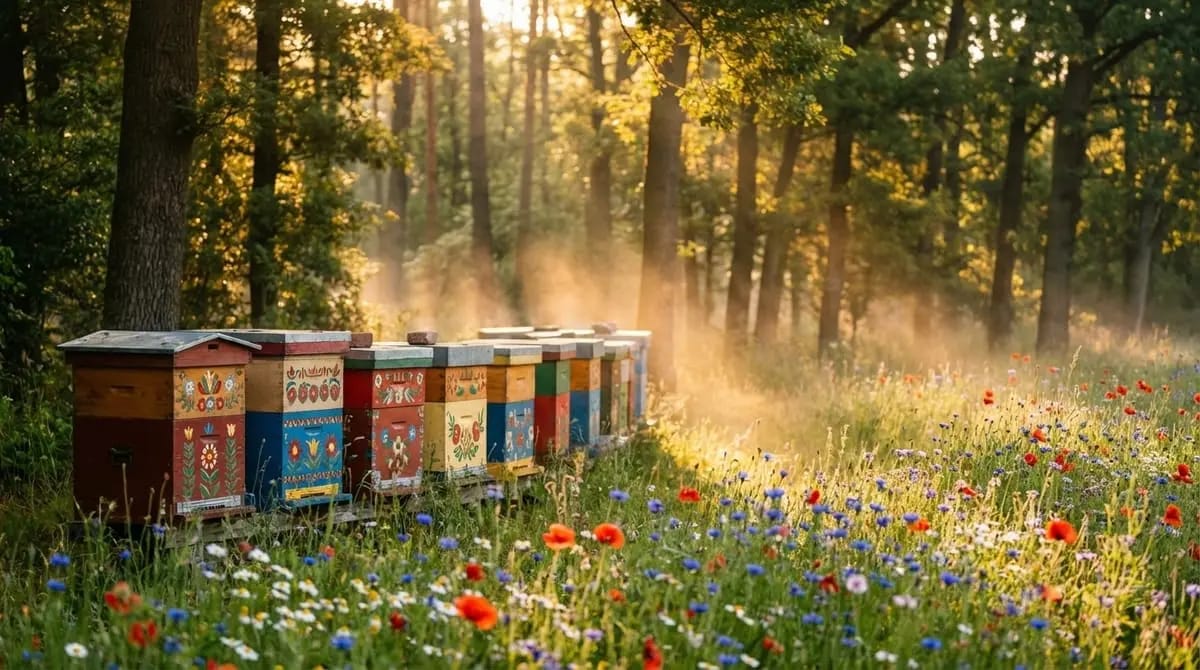
| Aspect | Bee House | Outdoor Apiary |
|---|---|---|
| Investment cost | 5,000-20,000 EUR | Low (hive stands) |
| Weather protection | Very good | Medium |
| Flexibility | None (fixed) | High (migration) |
| Scalability | Limited | Easily expandable |
| Physical strain | Low | Medium-High |
Migratory Beekeeping
- AprFruit BlossomHome apiary or orchard. First flow.
- MayOilseed RapeMove to rape fields. 2-3 weeks full flow.
- JunLime/Black LocustMove to lime or black locust areas.
- JulForest/FirHoneydew: Black Forest, Bavarian Forest. Premium flow.
- AugHeatherLueneburg Heath. Premium heather honey.
- SepHome ApiaryReturn. Feeding and wintering.
- Apr
Fruit Blossom
Home apiary or orchard. First flow.
- May
Oilseed Rape
Move to rape fields. 2-3 weeks full flow.
- Jun
Lime/Black Locust
Move to lime or black locust areas.
- Jul
Forest/Fir
Honeydew: Black Forest, Bavarian Forest. Premium flow.
- Aug
Heather
Lueneburg Heath. Premium heather honey.
- Sep
Home Apiary
Return. Feeding and wintering.

Anyone moving bees needs a health certificate (disease-free attestation, valid for up to 9 months in Germany) and the landowner's permission at the migratory site. Check your local regulations for specific requirements.
Requirements for Migratory Hives
Hives for migration must meet certain requirements:
- Stackable and transport-safe: standardised box size, stacking brackets, ratchet straps
- Ventilation: screened bottom boards or migratory screens for air circulation during transport
- Robust: hives must survive transport on the trailer
- Quick to work: at the migratory site every minute counts -- efficient management is essential
- Uniform size: all hives must be compatible (no mixed systems)
A compromise solution are mobile bee houses -- insulated trailers or containers housing hives. They combine weather protection with mobility. Common in Scandinavia and Eastern Europe, still rare in Germany.
Making the Right Choice: Decision Guide
Knowledge Check
In the next lesson we discover how data-driven decisions make beekeeping more precise.