Brood Diseases: Foulbrood, Chalkbrood, and Sacbrood
Reliably identify American and European Foulbrood, chalkbrood, and sacbrood. Pathogens, symptoms, diagnosis, reporting obligations, and control measures in detail.
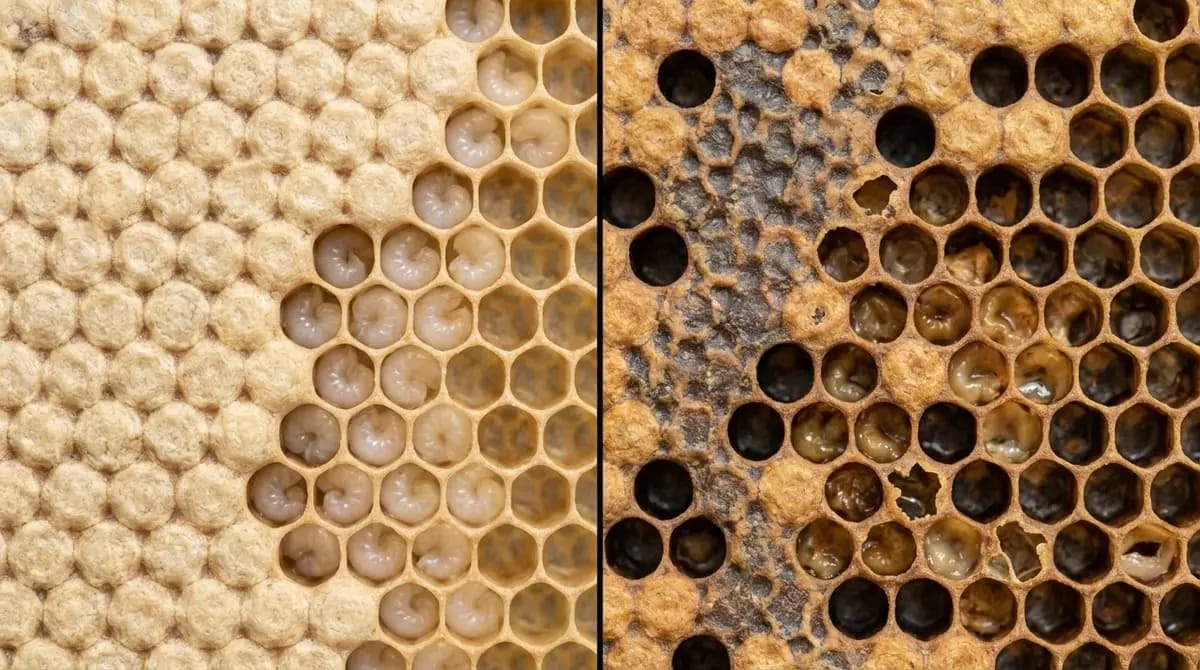
Brood diseases are among the most serious threats to bee colonies. While most adult bee diseases progress slowly, brood diseases can destroy a colony within weeks -- and spread to neighboring apiaries.
This lesson covers the four most important brood diseases: American Foulbrood (AFB), European Foulbrood (EFB), Chalkbrood, and Sacbrood. For each, you will learn about the pathogen, symptoms, diagnosis, and control measures.
AFB is a notifiable animal disease in most countries. In Germany, it falls under the Bienenseuchen-Verordnung (Bee Disease Regulation). Every suspicion must be immediately reported to the veterinary authority. Upon confirmation, a restricted zone (at least 1 km radius) is established. Failure to report is an offense with significant fines. This obligation applies to EVERY beekeeper -- including hobbyists! Check your country's specific reporting requirements.
American Foulbrood (AFB)
AFB is the most dangerous brood disease worldwide, caused by the spore-forming bacterium Paenibacillus larvae.
The Pathogen
Paenibacillus larvae forms extremely resistant endospores:
- Heat resistance: Survive 120 degrees Celsius for 30 minutes
- Lifespan: Infective for over 50 years in contaminated material
- Infective dose: As few as approximately 10 spores suffice to infect a larva
Imported honey can contain AFB spores -- harmless to humans but deadly to bee larvae. Never feed purchased honey to your bees! Also wash empty honey jars thoroughly before recycling -- robber bees can otherwise start an infection chain.
Disease Progression
- 1
Spore Ingestion (Day 1-2)
Larvae under 36 hours old ingest spores with the brood food. Older larvae and adult bees cannot develop the disease but can spread spores.
- 2
Multiplication (Day 2-7)
Spores germinate in the larval gut, bacteria multiply. The larva shows no symptoms yet. The infection progresses after capping.
- 3
Death of the Larva
The larva dies at the stretched larva stage. A viscous, brown, ropy mass with a characteristic foul smell develops.
- 4
Drying to Foulbrood Scale
Larval remains dry to a hard, dark scale that adheres firmly to the cell wall and contains billions of spores. Cannot be removed by cleaning bees, remains infective for decades.
- 5
Spread
Cleaning bees spread spores within the hive. Nurse bees carry them with food to healthy larvae. The infection spreads like an avalanche.
Recognizing Symptoms
Early symptoms: Slightly spotty brood pattern, occasional sunken or perforated cell caps, caps darker and greasier than normal.
Advanced symptoms: Clearly spotty brood pattern, foul smell (like fish glue), brown ropy larval mass, black hard foulbrood scale on the lower cell wall.
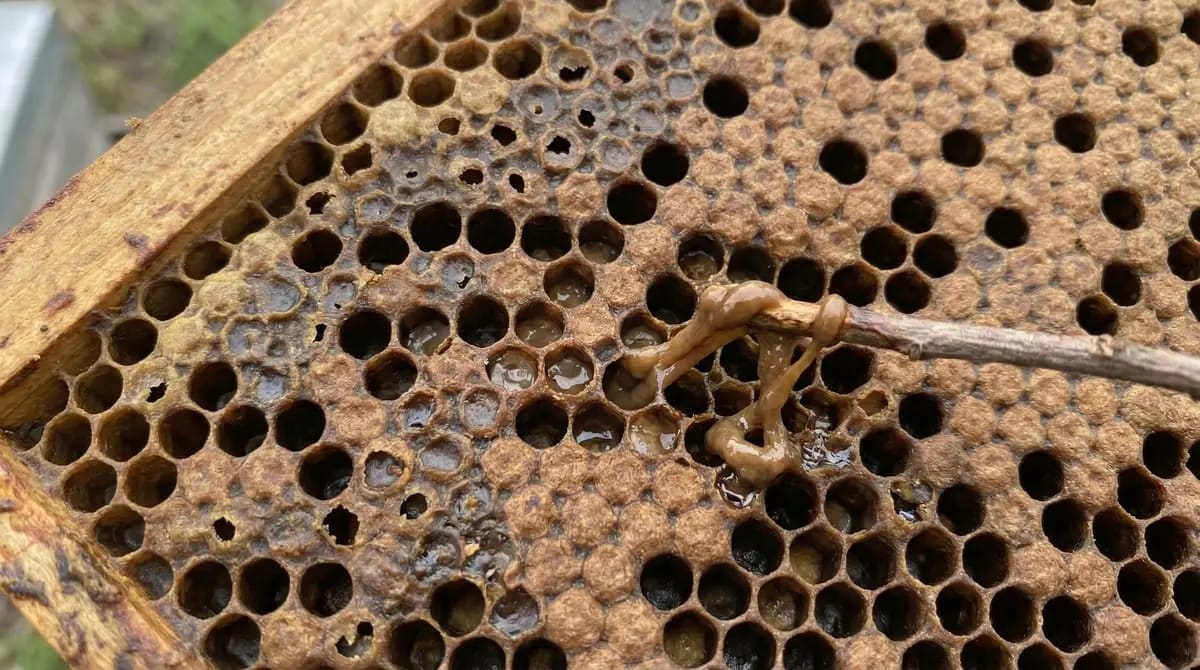
The Matchstick Test (Ropiness Test)
- Matchstick or toothpick
- Suspicious brood cell
- Identify a suspicious cell with sunken capping and brownish mass
- Open the cap with a hive tool or tweezers
- Insert the matchstick and rotate it in the mass
- Pull out slowly -- with AFB, the mass draws a viscous thread of 1-4 cm
- If positive: Close the hive immediately, disinfect tools, notify the veterinary authority without delay
Control Measures
- Restricted zone: At least 1 km radius, no colony movement, official examination of all colonies
- Shook swarm method: Bees shaken into spore-free hive on foundation, 3-day starvation period
- Destruction: In severe cases, colonies are killed with sulfur and burned
- Disinfection: Wooden parts scorched with a blowtorch or boiled in hot caustic soda (3%, 30 min boiling)
European Foulbrood (EFB)
Pathogen: Melissococcus plutonius -- a non-spore-forming bacterium that infects open coiled larvae.
Differences from AFB
| Feature | AFB | EFB |
|---|---|---|
| Pathogen | Paenibacillus larvae (spore-forming) | Melissococcus plutonius (non-spore-forming) |
| Affected stage | Capped stretched larvae | Open coiled larvae |
| Matchstick test | Highly ropy (1-4 cm) | Weakly ropy or pasty |
| Smell | Foul (fish glue) | Sour (vinegar-like) |
| Scale | Hard, black, firmly adhering | Rubbery, easily removable |
| Self-healing | Never | Possible in strong colonies |
| Notifiable | Yes (notifiable animal disease) | Varies by country (not notifiable in Germany) |
EFB Symptoms
- Twisted coiled larvae: Larvae twist unnaturally in the cell instead of lying curled in a C-shape. First yellowish, then brownish.
- Spotty brood pattern in the open brood (before capping)
- Sour smell (vinegar-like, not as penetrating as AFB)
- The mass is pasty-grainy rather than ropy
- Strong colonies partially clean out affected cells on their own
Controlling EFB
Since Melissococcus plutonius does not form persistent spores, the prognosis is significantly better than with AFB. Strong colonies can often overcome the infection on their own during a good nectar flow. For severe infestations: remove affected brood combs and replace with foundation, strengthen the colony through feeding and possibly brood frames from healthy colonies, and in extreme cases use the shook swarm method. When in doubt: always contact the veterinary authority -- even where EFB has no legal reporting obligation, they can advise and order measures in severe cases.
EFB reporting requirements vary by country. In Germany, EFB is not a legally notifiable disease (unlike AFB), though the veterinary authority can still order measures. In the UK, EFB is a notifiable disease. Check with your local beekeeping association for the rules in your area. EFB is promoted by stress, poor nectar flow, weak colonies, and damp locations.
Chalkbrood (Ascosphaerosis)
A fungal disease caused by Ascosphaera apis, widespread but usually less threatening.
Symptoms
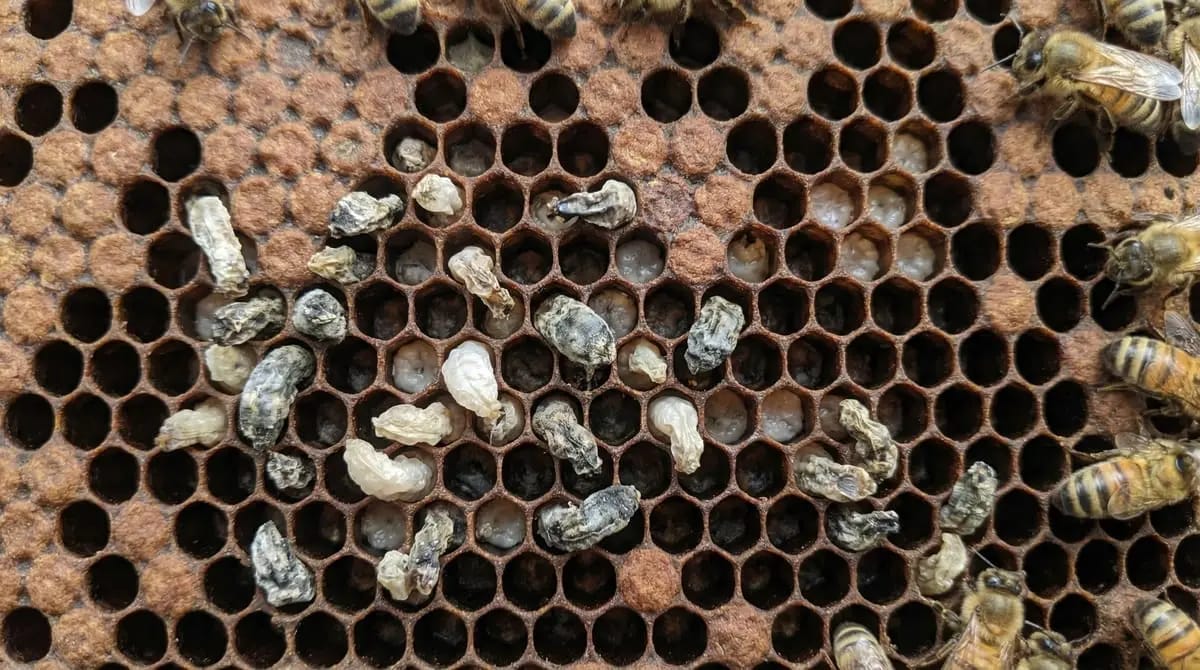
- Chalk-white or black mummies: Hard, chalk-like lumps. Black spots = spore balls (more infective)
- Rattling mummies: So hard they rattle when the frame is shaken
- Mummies at the entrance: Bees carry them out -- a very typical sight
- Spotty brood pattern: Unlike foulbrood (no sunken caps)
Risk Factors and Control
Chalkbrood is in most cases a management problem: moisture, cool hives, weak colonies, and genetic susceptibility favor the fungus. No approved medications are available.
- 1
Remove affected combs
Melt down heavily infested combs. Use wax only for technical purposes, not for new foundation.
- 2
Improve ventilation
Open screened bottom board, well-ventilated location. Moisture is the main risk factor.
- 3
Strengthen the colony
Reduce space (better temperature regulation) or unite with a healthy colony.
- 4
Requeen
For repeated occurrences: use a queen from a hygienically selected breeding line.
Sacbrood
A viral disease caused by the Sacbrood Virus (SBV), widespread but usually mild.
Symptoms
- Sac-like larvae: Larvae die at the pre-pupal stage. The outer skin remains intact, the contents liquefy. When pulled out, the larva hangs like a water-filled sac.
- Gondola/boat-shaped: Dead larvae lie curved with the head end pointing upward
- Color change: Pearly white -> yellowish -> gray-brown to black
- NO ropiness in the matchstick test (important distinction from AFB!)
| Feature | Sacbrood | AFB |
|---|---|---|
| Consistency | Watery in intact skin (sac-shaped) | Viscous, slimy, ropy |
| Matchstick test | NO thread | Highly ropy (1-4 cm) |
| Smell | Barely any or slightly sour | Strongly foul |
| Removal | Larva can be pulled out whole | Mass sticks to cell wall |
| Self-healing | Common | Never |
Measures: For mild infestations, wait and observe; remove affected combs; for chronic cases, requeen.
Overview of All Brood Diseases
| Property | AFB | EFB | Chalkbrood | Sacbrood |
|---|---|---|---|---|
| Pathogen | Bacterium | Bacterium | Fungus | Virus |
| Key symptom | Ropy mass | Twisted coiled larvae | White/black mummies | Sac-like larvae |
| Smell | Foul | Sour | Musty | Unremarkable |
| Notifiable | Yes | Varies by country | No | No |
| Self-healing | NEVER | Possible | Possible | Common |
| Severity | Very high | Medium | Low-medium | Low |
Diagnostics: Food Crown Sample
- Tablespoon
- Sealable sample container (50 ml)
- Labels
- Cool bag
- Timing: March-May, when colonies are brood-rearing and redistributing stores
- Take a brood frame from the brood nest area
- Pierce the food crown above and beside the brood at 5-6 points
- Take one tablespoon from each, totaling 50-100 g per colony
- Mix sub-samples, label (colony, apiary, date)
- Send chilled to the bee research institute or veterinary laboratory
Many bee research institutes offer free analyses through beekeeping associations. The food crown sample is the best early warning against AFB -- spores can be detected long before clinical symptoms appear. Recommended: at least every 2 years, annually in high-risk areas.
Prevention
Brood Disease Prevention Checklist
American Foulbrood is a preventable disease. Regular food crown samples, consistent comb hygiene, and open communication among beekeepers are the cornerstones of successful prevention.
Knowledge Check
In the next lesson, we will look at Nosema -- a widespread intestinal disease that can lead to weak colonies, especially in spring.