Nosema: Detection, Prevention, and Treatment
Nosema apis and Nosema ceranae: two pathogens, different courses. Recognize symptoms, perform microscopy, and prevent through good management.
Nosemosis is one of the most common diseases of adult honey bees worldwide. Microsporidia of the genus Nosema -- fungus-related, single-celled organisms -- infect the midgut and severely disrupt digestion and nutrient absorption. Two species are relevant: Nosema apis and Nosema ceranae.
Nosemosis can lead to weak spring development, reduced honey production, and increased winter losses. At the same time, it is a disease that can be most effectively prevented through good management.
Two Pathogens Compared
Until the 2000s, only Nosema apis was known. Then it was discovered that Nosema ceranae had jumped from the Asian honey bee to our Apis mellifera. Today, N. ceranae is the dominant pathogen in Central Europe (>90% of cases).
| Feature | Nosema apis | Nosema ceranae |
|---|---|---|
| Origin | Apis mellifera | Apis cerana (Asian) |
| Prevalence in Europe | Has become rare | Dominant (>90%) |
| Seasonality | Mainly spring | Year-round |
| Symptoms | Severe diarrhea, fecal spots | Often asymptomatic! Gradual weakening |
| Course | Acute, visible | Chronic, insidious |
| Lifespan reduction | 30-50% | Up to 70% |
| Spore size | Oblong-oval, 5-7 x 3-4 micrometers | Round-oval, 4-5 x 2-3 micrometers (smaller) |
| Environmental resistance | High (years) | Medium (more frost-sensitive) |
N. ceranae often shows no classic symptoms. No diarrhea, no fecal spots. Instead, the colony weakens for no apparent reason: slow development, declining bee population, less honey. Many beekeepers think of other causes without considering Nosema.
The Infection Cycle
- 1
Spore Ingestion
The bee ingests spores orally -- through contaminated food, water, or while cleaning soiled combs. Just a few thousand spores are sufficient.
- 2
Germination in the Midgut (30 Minutes)
In the alkaline environment, the polar filament shoots like a harpoon into a gut cell and injects the spore contents directly into it.
- 3
Multiplication (Day 1-7)
The parasite first multiplies vegetatively, then forms new spores. Each infected cell produces millions of spores. The gut cell is destroyed in the process.
- 4
Release (from Day 7-10)
Burst gut cells release spores. Some infect neighboring cells, the rest are excreted with feces and contaminate the environment.
- 5
Spread Within the Colony
Contaminated feces on combs is ingested by cleaning bees. Transmission is particularly efficient in the tightly packed winter cluster.
Damage to the Bee
The destruction of gut cells has far-reaching consequences:
- Disrupted nutrient absorption: The bee starves internally despite eating
- Reduced food gland activity: Nurse bees produce less royal jelly
- Shortened lifespan: Winter bees may die after 2-3 months instead of 5-6
- Immunosuppression: Increased susceptibility to secondary infections
- Premature foraging: Heavily infected bees become foragers too early and often do not return
The combination of both parasites increases mortality synergistically -- more than the sum of the individual effects. Consistent varroa control therefore also provides indirect protection against severe Nosema cases.
Recognizing Symptoms
Classical Nosemosis (predominantly N. apis)
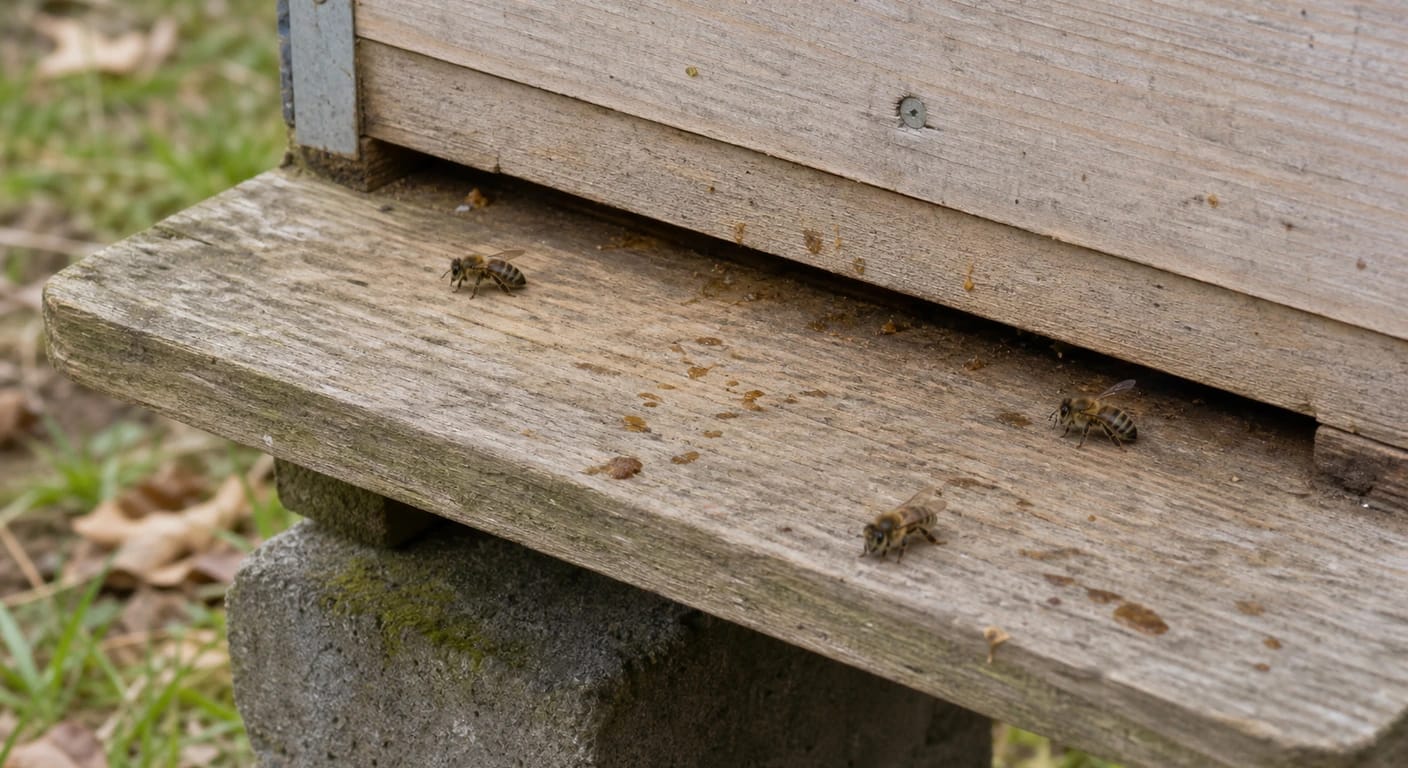
- Fecal spots: Brown-yellow stains on the hive front, landing board, and combs. Normally bees only defecate in flight -- fecal deposits in the hive are always an alarm signal.
- Crawlers at the entrance: Bees can no longer take flight
- Distended abdomens: Gut overloaded with spores
- Weak spring development: Colony fails to build up
Insidious Nosemosis (predominantly N. ceranae)
- Silent decline: Colony steadily shrinks, bees disappear on foraging flights
- No fecal spots -- bees die outside
- Poor honey yields without any other identifiable cause
- Queen problems: Infected queens show declining laying performance
Nosema ceranae is a silent killer. The classic diarrhea symptoms are often completely absent. When colonies weaken for no apparent reason, we should always consider Nosema and have a laboratory analysis performed.
Diagnosis: Microscopy and Spore Counting
Sample Collection
- 30-60 forager bees from the entrance
- Sample container or plastic bag
- Label
- Cool bag
- Collect forager bees: Catch 30-60 bees directly at the entrance (higher spore load than house bees)
- Timing: Late morning in flying weather, ideally March-April
- Label: Colony number, apiary, date
- Send: Chilled to the laboratory. For self-examination: freezing at -18 degrees Celsius is possible
Microscopic Examination
- 1
Collect abdomens
Separate the abdomens of 30 bees (Nosema resides in the midgut).
- 2
Macerate
Grind 30 abdomens with 30 ml water (1 ml/bee) in a mortar.
- 3
Filter
Filter the suspension through a coarse sieve. Spores pass through any filter.
- 4
Microscope examination
Place a drop on a slide at 400x magnification. Spores: oval, highly refractive bodies (rice-grain shaped for N. apis, more rounded for N. ceranae).
| Spore Count per Bee | Infestation Level | Action |
|---|---|---|
| <500,000 | None/very low | None needed |
| 500,000-1 million | Low | Monitor, prevent |
| 1-5 million | Medium | Comb replacement, strengthening |
| 5-10 million | Severe | Urgent measures, requeen |
| > 10 million | Very severe | Shook swarm or uniting |
Bee research institutes and veterinary laboratories offer Nosema analyses -- often free of charge. Beekeeping associations also frequently have a shared microscope and trained bee health advisors.
Risk Factors
Environmental Factors
- Moisture: The most important factor. Damp locations, shady spots, low-lying areas. Moisture in the hive promotes spore germination and prevents cleansing flights in bad weather.
- Long winters: The longer bees sit in the winter cluster without a cleansing flight, the more the spore load increases. Nosema is therefore a bigger problem in regions with long winters.
- Nectar dearths: Periods without nectar and pollen intake stress the bees and weaken their resistance.
Management Factors
- Old combs: Dark, multiply-brooded combs are true spore reservoirs. Cocoons and food residues in old cells are contaminated. Regular comb replacement is the single most important measure.
- Weak colonies: Higher per-capita spore load, fewer resources for immune defense
- Poor winter feed: Honeydew honey contains more indigestible substances and promotes diarrhea in the winter cluster -- which spreads spores.
- Stress: Transport, frequent inspections, varroa load, and food shortage weaken the immune system
Genetic Factors
Some bee lines show increased Nosema tolerance through better hygiene performance and more robust gut health. Selecting tolerant breeding lines can reduce the burden at the apiary in the long term.
Prevention and Treatment
In the EU, there are no approved medications against nosemosis. Fumagillin, used in North America, is not licensed as a veterinary medicine in the EU (insufficient data on maximum residue limits in honey). Control relies exclusively on management measures.
Comb Hygiene (Most Important Measure)
- 1
Annual comb replacement
Renew at least one third of all brood combs every year. Melt down the oldest combs.
- 2
Own wax cycle
Only use wax from your own or tested sources for foundation.
- 3
Acetic acid disinfection
Disinfect removed combs with 60% acetic acid by the vapor method: place 200 ml of 60% acetic acid in a shallow dish on the top bars per box, stack boxes tightly and seal with plastic wrap. Allow to act for at least 48 hours at above 15 degrees Celsius. Reliably kills Nosema spores. After treatment, air out combs for at least 24 hours before reusing them.
60% acetic acid is corrosive! Wear acid-resistant gloves and safety goggles. Work outdoors or in well-ventilated areas. In case of skin contact, rinse immediately with plenty of water.
Location and Hive Management
- Dry, sunny location: Morning sun dries out hives and encourages early foraging flights
- Open screened bottom board: Significantly reduces moisture
- Elevate hives: At least 30-40 cm above ground (against moisture and cold)
Additional Measures
- Maintain strong colonies: Unite or dissolve weak ones
- High-quality winter feed: Sugar syrup (3:2 sugar:water or commercial syrup) instead of honeydew honey. Honeydew contains high proportions of indigestible sugars (melezitose) that burden the gut and promote diarrhea in the winter cluster.
- Promote early cleansing flights: In spring, bees empty their spore-laden guts. In mild weather (from 10-12 degrees Celsius) briefly check the entrance -- an active cleansing flight is a good sign.
- No blanket stimulative feeding: It is not a Nosema treatment. Assess food stores and tailor measures to the Nosema species, season and colony condition.
Summary
Nosema Prevention: The Key Rules
Nosema is a management disease. The vast majority of cases can be traced back to suboptimal husbandry conditions -- locations that are too damp, old combs, weak colonies. Those who control these three factors will rarely have serious problems.
Knowledge Check
In the next lesson, we cover poisoning and pesticide damage: recognizing, documenting, and reporting -- and how to protect your bees preventively.