Weak Colonies: Finding Causes and Strengthening
Systematically diagnose weak bee colonies, strengthen them effectively, or safely unite them. The newspaper method explained step by step.
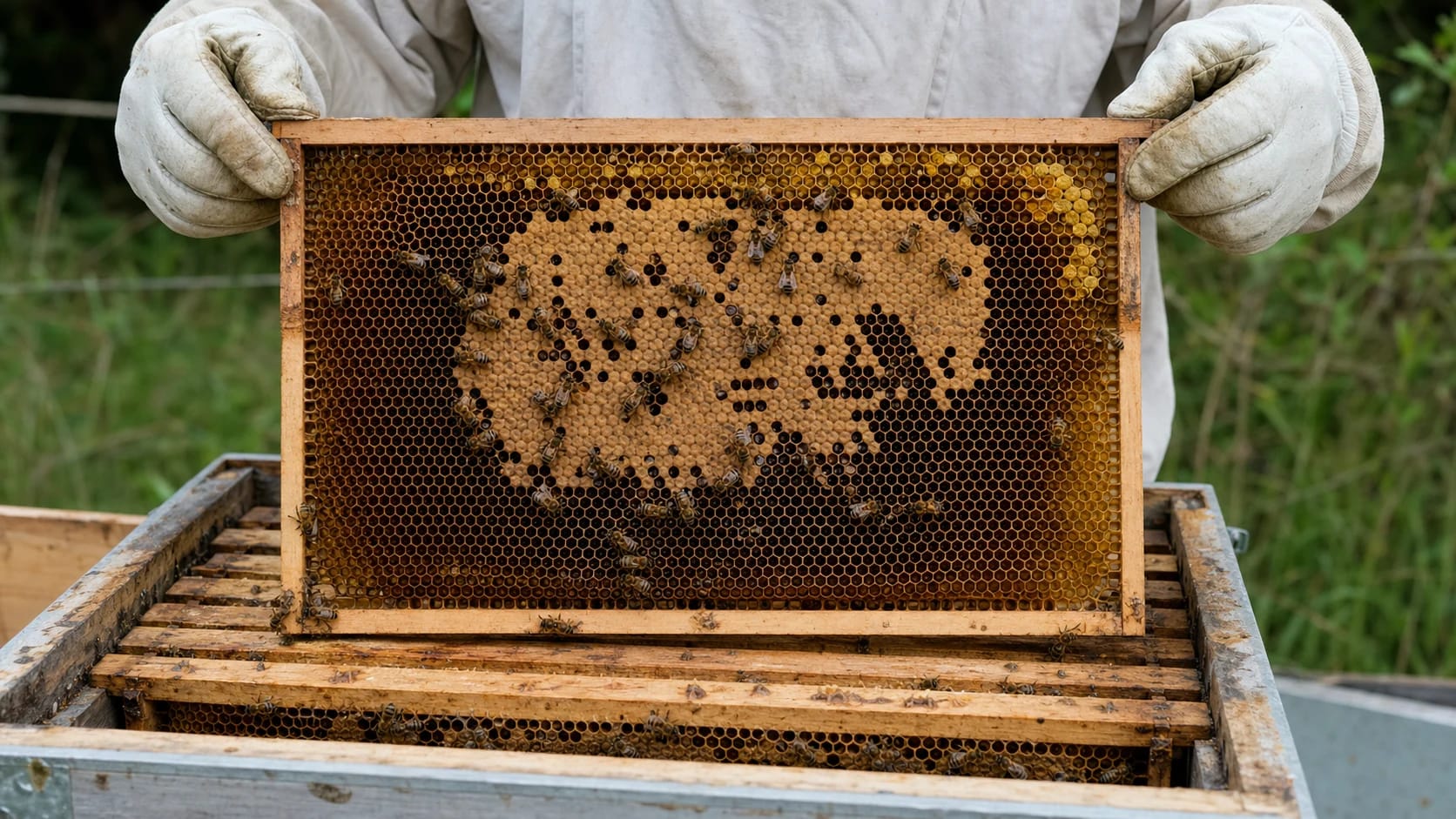 AI-generated
Weak colonies are a common problem -- and the temptation is great to simply "carry them along." But this strategy almost always fails: a weak colony is more susceptible to disease, gets robbed more easily, and as a source of disease also burdens neighboring colonies.
In this lesson, you will learn when a colony is considered weak, how to systematically narrow down the causes, what strengthening measures you can take -- and when the wisest decision is to unite or dissolve.
When Is a Colony "Weak"?
The classification depends on the time of year. A colony with 4 seams in March may be fine -- in June it would be critical.
| Season | Normal | Borderline | Critical |
|---|---|---|---|
| March (spring check) | 5-8 seams | 3-4 seams | <3 seams |
| May (spring) | 8-12 seams | 5-6 seams | <4 seams |
| July (summer) | 12-16+ seams | 6-8 seams | <5 seams |
| September (wintering) | 7-10 seams | 4-5 seams | <4 seams |
Why Weak Colonies Are Problematic
- Thermoregulation: Too few bees to heat -> less brood -> fewer young bees -> vicious cycle
- Defense: Wasps and robber bees enter unopposed
- Disease susceptibility: More parasites per bee (varroa, Nosema)
- Disease spread risk: Weak colonies get robbed out, spreading diseases (AFB!) in the process
Fewer bees -> less brood -> fewer young bees -> higher parasite load -> even more losses. Without active intervention, this spiral almost always ends in total loss.
Systematically Narrowing Down Causes
1. Queen Problem (Most Common Cause!)
- 1
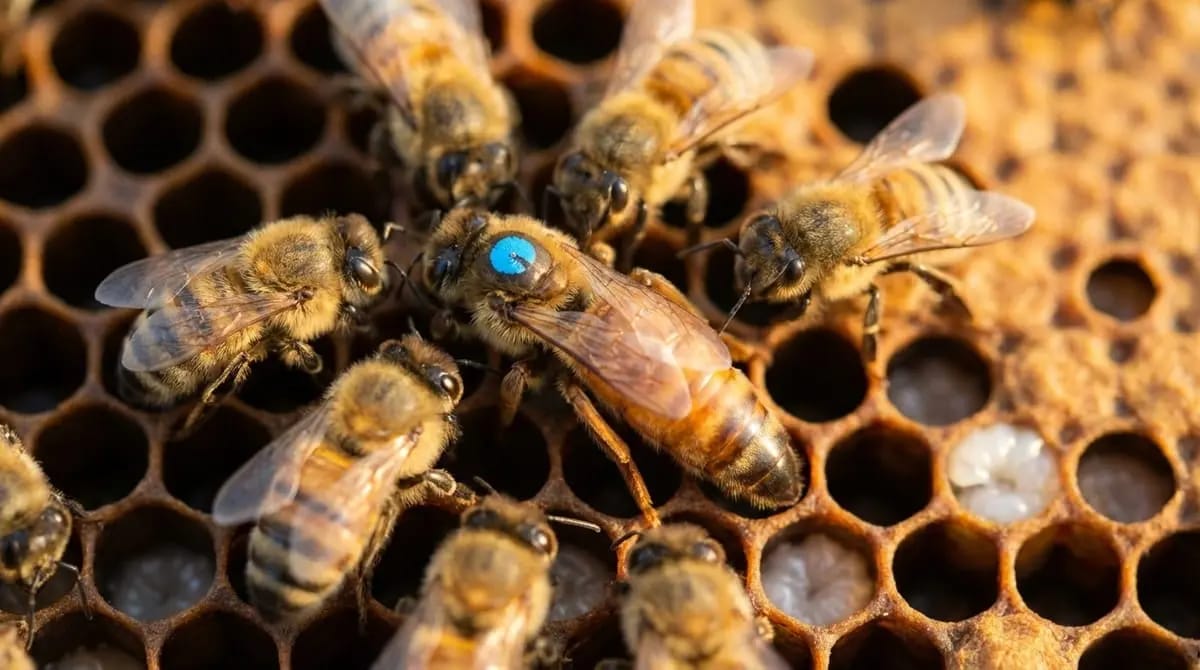
Check queenrightness
Look for eggs (freshly laid). No eggs + no young brood = possibly queenless. Are there emergency queen cells?
- 2
Assess brood pattern
Spotty (>20%)? Old or poorly mated queen. Bullet brood? Drone-laying.
- 3
Identify drone-laying
Multiple eggs per cell, placed haphazardly on cell walls, bullet brood: laying workers -- rescue is often not possible.
- 4
Estimate queen age
Over 2 years? Declining laying performance is possible. Marked queens (year color) help with assessment.
2. Disease and Parasites
| Cause | Identifying Features | Immediate Action |
|---|---|---|
| Varroa (high) | Mite drop >10/day, deformed wings | Treat immediately |
| Nosema | Fecal spots, poor spring development | Comb replacement, strengthen colony |
| AFB suspected | Foul smell, ropy mass | REPORT TO VETERINARY AUTHORITY! |
| Chalkbrood (severe) | White/black mummies | Remove combs, improve ventilation |
| Wax moths | Webbing, destroyed combs | Remove affected combs, reduce space |
Never add combs or bees from healthy colonies if foulbrood is suspected! You would spread the disease. Close the hive, disinfect tools, notify the veterinary authority.
3. Food Shortage
Light hive (heft test), no food reserves in outer combs, brood partially removed. Immediate action: Feed sugar syrup 3:2, for acute shortage place fondant directly on top bars.
4. Location and Beekeeper Errors
- Location: Too damp, too shady, too wind-exposed, forage-poor, pesticide exposure
- Too many colonies: No more than 10-15 per location in an average area
- Beekeeper errors: Too frequent inspections, expanded too early, incorrect treatment dosage
Decision Matrix: Strengthen, Unite, or Dissolve?
| Situation | Recommendation | Reasoning |
|---|---|---|
| Queenright, 4-6 seams, healthy, season is long | STRENGTHEN | Good prognosis with brood frame + feeding |
| Queenright, 3-4 seams, autumn | UNITE | Too few for independent overwintering |
| Queenless with emergency cells, >5 seams | WAIT (3 weeks) | Emergency queen rearing may succeed |
| Drone-laying (laying workers) | DISSOLVE | Laying workers block requeening |
| High varroa, under 3 seams | DISSOLVE | Recovery unrealistic, do not distribute mites |
| Healthy, but only 2 seams | UNITE | Under 3 seams hardly any chance |
Two strong colonies are better than one strong and one weak. A weak colony costs time and attention, produces no honey, and is a source of disease. Uniting is not failure.
Strengthening Measures
1. Adding Brood Frames (Most Effective Measure)
- Capped brood frame from a healthy colony
- Bee brush
- Hive tool
- Donor colony: Strong, healthy colony (at least 10 seams), free of brood diseases
- Choose frame: Lots of capped brood, ideally close to emergence
- Brush off bees: All bees back to the donor colony (only move the frame, not the bees!)
- Insert: In the center of the brood nest of the weak colony
- Repeat: After 7-10 days possibly another frame, do not overburden the donor
Only transfer frames from demonstrably healthy colonies. Brood diseases and high varroa loads are directly transmitted this way.
2. Reducing Space (Simple and Effective)
- 1
Remove empty combs
Take out all unoccupied frames. A colony with 4 seams does not need 10 frames!
- 2
Insert follower board
Place a divider board behind the last occupied frame. Less space = less heating required.
- 3
Reduce entrance
To 2-5 cm: Easier to defend, less heat loss.
3. Feeding
- Stimulative feeding: 200-300 ml sugar syrup 1:1 every 2-3 days -- simulates nectar flow, stimulates egg laying
- Build-up feeding: 1-2 liters sugar syrup 3:2 per week for reserves
- Protein feeding: If pollen is scarce, place pollen substitute on top bars
4. Requeening
If the weakness is due to the queen: Remove old queen, wait 2-4 hours, place new queen in introduction cage (fondant plug) between brood frames. Check after 7 days (eggs present?).
Uniting: The Newspaper Method
The most proven technique for combining two colonies gently and without fighting.
Principle
Two colonies are stacked on top of each other, separated by newspaper. As the bees chew through the newspaper over 12-24 hours, the hive scents mix. When the paper is gone, the bees accept each other as nestmates.
- 1 sheet of newspaper (NOT glossy paper)
- Nail for pre-punching holes
- Hive tool
- Smoker
- Choose the queen: The younger, better queen stays. Remove the unwanted queen the day before.
- Timing: Late afternoon/evening, when foragers are back.
- Prepare the weak colony: Keep only occupied frames, remove empty ones.
- Place newspaper: On top of the strong colony (with queen). Poke 5-10 holes with a nail.
- Stack the weak colony: Place the box (without bottom/lid) directly on the newspaper.
- Put the lid on. Done.
- After 2-3 days: Remove newspaper remnants, rearrange frames.
- After 7 days: Check -- queen active? Eggs present?
Without newspaper, the bees would recognize each other by hive scent as enemies and fierce fighting would begin -- hundreds could die, the queen would be in danger. The newspaper allows a gradual scent exchange over 12-24 hours.
When to Give Up and Dissolve?
Sometimes dissolving is the only sensible option:
- Drone-laying (laying workers): Laying workers will not accept a new queen
- Very high varroa with <3 seams: Recovery unrealistic, do not distribute mites to others
- AFB finding: Ordered by veterinary authority
- Chronic disease despite measures: Possibly genetic weakness
- 1
Remove bees
Sulfur (humane, immediate sedation) or shake off in front of a strong colony (only with demonstrably healthy bees!).
- 2
Sort combs
Healthy food combs can go to other colonies (only from healthy origins!). Melt down brood combs. If disease is suspected: destroy everything.
- 3
Clean the hive
Scorch wood (until uniformly brown). Plastic with caustic soda. For AFB: disinfection per official instructions.
- 4
Document
Note date, reason, and disposition of materials in hive record and colony record book.
Dissolving a weak colony is not failure -- it is responsible beekeeping. Those who drag along a hopelessly weak colony endanger their entire operation.
Prevention: Strong Colonies from the Start
Prevention: How to Keep Your Colonies Strong
Knowledge Check
In the next lesson, we cover queen problems: how to recognize queenless colonies, actively manage requeening, and safely introduce queens.