Queen Problems: Queenlessness and Drone-Laying
Recognize queenlessness, understand drone-laying, and initiate rescue measures. How to ensure the survival of your bee colonies.
The queen is the only fully fertile female bee in the colony. She is not the ruler but the mother of all bees -- and at the same time the most sensitive link in the chain. If the queen is lost, a countdown begins: the colony has only a few days to raise a successor. If that fails, a spiral threatens that leads from queenlessness to drone-laying and finally to the colony's demise.
In this lesson, you will learn to recognize the warning signs of a missing queen early, understand the causes, and initiate the right rescue measures -- before it is too late.
What the Queen Does for the Colony
To understand the gravity of queen loss, we first need to comprehend her role in the colony. The queen has two central functions:
1. Reproduction
The queen is the only bee that can lay fertilized eggs. From fertilized eggs, workers develop; from unfertilized eggs, drones. A good queen lays up to 2,000 eggs per day during the main season -- more than her own body weight. This enormous laying performance ensures the continuous supply of workers that the colony needs for brood care, foraging, and defense.
2. Colony Cohesion Through Pheromones
The queen produces the so-called Queen Mandibular Pheromone (QMP), a complex pheromone blend distributed throughout the colony via her retinue. These pheromones cause:
- Inhibition of ovary development in workers
- Suppression of the swarming impulse (in sufficient concentration)
- Orientation for the bees: "The queen is here, all is well"
- Cohesion of the colony as a social unit
The queen is constantly surrounded by 8-12 workers, her retinue. These bees feed the queen with royal jelly, lick off her pheromones, and distribute them through food exchange (trophallaxis) throughout the colony. Within 30-60 minutes, every bee in the hive knows whether the queen is still present.
Recognizing Queenlessness: The Warning Signs
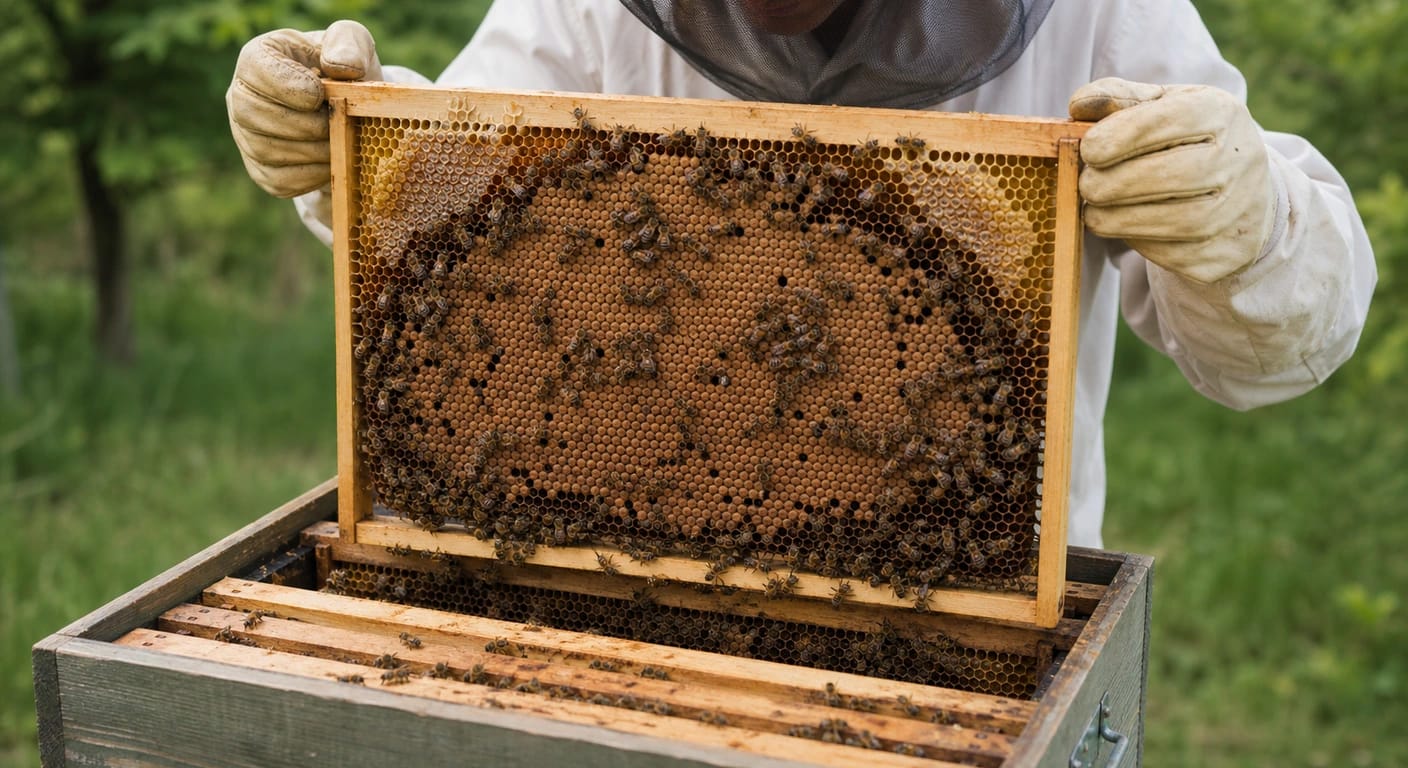
When the queen is lost -- whether through death, loss during a mating flight, or damage during inspection -- the behavior of the entire colony changes within hours. As a beekeeper, you must be able to read these signals.
Definite Signs of Queenlessness
- 1
No eggs and young larvae (Day 1-3)
The most reliable sign: during inspection you find no freshly laid eggs on the brood combs. Eggs are no longer recognizable as such after 3 days -- so if you see no eggs, the queen has not been laying for at least 3 days. Caution: During a laying break (e.g., after a swarm departure or in late autumn) eggs are also absent -- but the colony does not behave restlessly.
- 2
Restless behavior and fanning
Queenless colonies behave noticeably differently from queenright ones. The bees run searchingly across the combs, appear nervous and uncoordinated. At the entrance and on the top bars they fan intensively (abdomen raised, fanning with wings) -- they release the Nasanov gland to "call back" the queen. This behavior is particularly noticeable in the evening.
- 3
Roaring (queenless roar)
The queenless roar is an unmistakable acoustic signal. A queenless colony produces a penetrating, plaintive tone that clearly differs from normal humming. Experienced beekeepers can often identify queenlessness by sound before opening the hive. The roaring occurs because the bees enter a stress state without the queen substance.
- 4
Emergency queen cells (Day 1-3)
If the colony still has young brood (eggs or larvae up to 3 days old), the bees immediately begin building emergency queen cells. These are typically placed in the middle of the comb surface, built from normal worker cells, and directed downward. If emergency cells are found, this is simultaneously a good sign: the colony is actively trying to help itself.
- 5
Spotty brood nest (after weeks)
Without queen rearing, the brood nest will be completely empty after 21 days (one worker generation). Before that, an increasingly spotty brood pattern appears: the last capped cells emerge, but nothing new is coming. The colony visibly shrinks.
Not every queenlessness is an emergency. During supersedure, the colony raises a new queen on its own initiative while the old one is still laying. The old queen is replaced after the successor emerges. During the transition phase, a brief laying break may occur. Supersedure is recognizable by 1-2 queen cells at the comb edge with simultaneously still present, but often weak egg laying. Do not intervene -- the colony knows what it is doing!
Queenlessness Test with Open Brood
If you are unsure whether a colony is queenless, there is a simple and reliable method:
- A brood frame with fresh eggs and youngest larvae from a healthy colony
- Hive tool
- Bee brush
- From a strong, healthy colony, take a frame with freshly laid eggs and youngest larvae (maximum 1-2 days old).
- Brush off the adhering bees in front of the donor colony -- do not introduce foreign bees into the test colony.
- Hang the brood frame in the center of the suspected colony.
- Check after 3-5 days: Have the bees built queen cells (emergency cells) on the inserted frame?
- Queen cells present: The colony is queenless. The bees are trying to raise a new queen from the inserted larvae. You can leave the cells or choose a better solution (see rescue measures).
- No queen cells: The colony probably still has a queen -- she is just not laying at the moment (laying break, freshly mated virgin queen, or queen still developing egg-laying). Patience!
Causes of Queen Loss
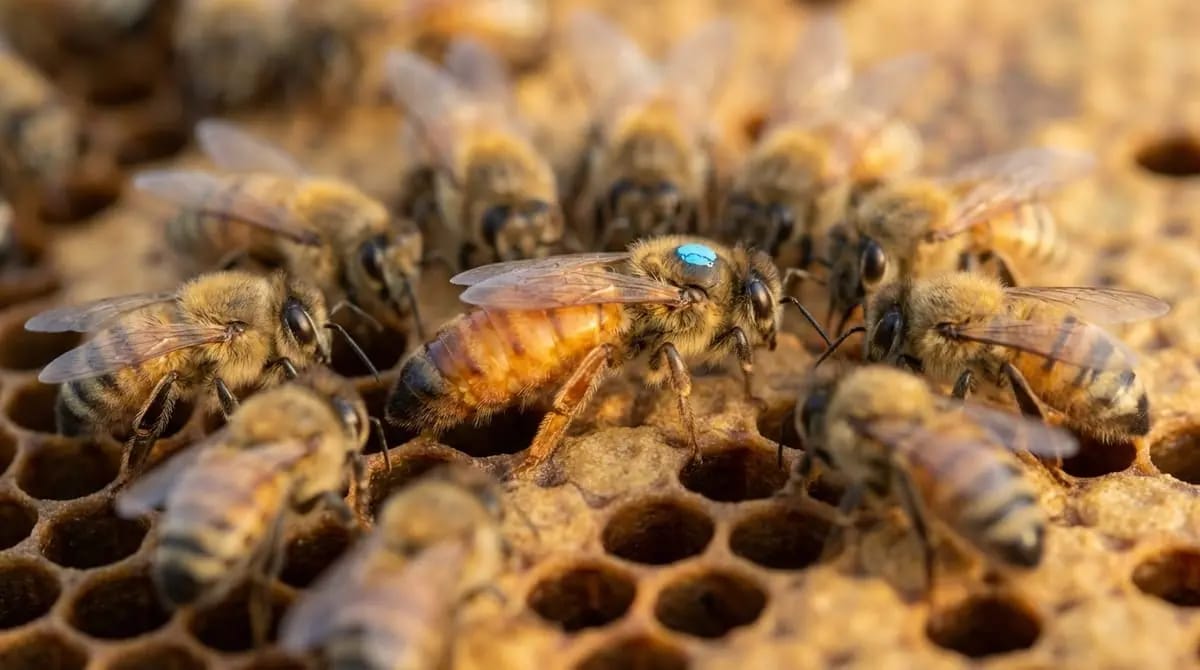
Queen loss rarely comes out of the blue. The most common causes can be divided into preventable and unavoidable factors.
Preventable Causes
| Cause | Frequency | Prevention |
|---|---|---|
| Crushed during inspection | Very common | Pull frames carefully, do not bump them together, locate queen before moving frames |
| Lost/fell during inspection | Common | Do not hold frames over grass, use queen excluder, do not inspect in wind |
| Stung during introduction | Occasional | Use introduction cage, do not disturb colony, 3-5 days cage confinement |
| Killed by robbing | Occasional | Keep entrance narrow, protect weak colonies, do not feed during dearth |
| Pesticide damage | Rare | Check location, communicate with farmers, observe spraying times |
Unavoidable Causes
- Failed mating flight: Young queens fly out for mating. They can be caught by birds, get lost, or fail to return in bad weather. The loss rate during mating flights is 10-30%.
- Age-related exhaustion: A queen exhausts her sperm supply after 2-4 years. Her laying performance declines, the brood nest becomes spotty, and the colony will supersede her or become weak.
- Diseases and parasites: Nosema, viruses (especially varroa-transmitted DWV), and the small hive beetle can directly damage the queen.
- Genetic problems: Inbreeding depression in small breeding populations leads to reduced viability.
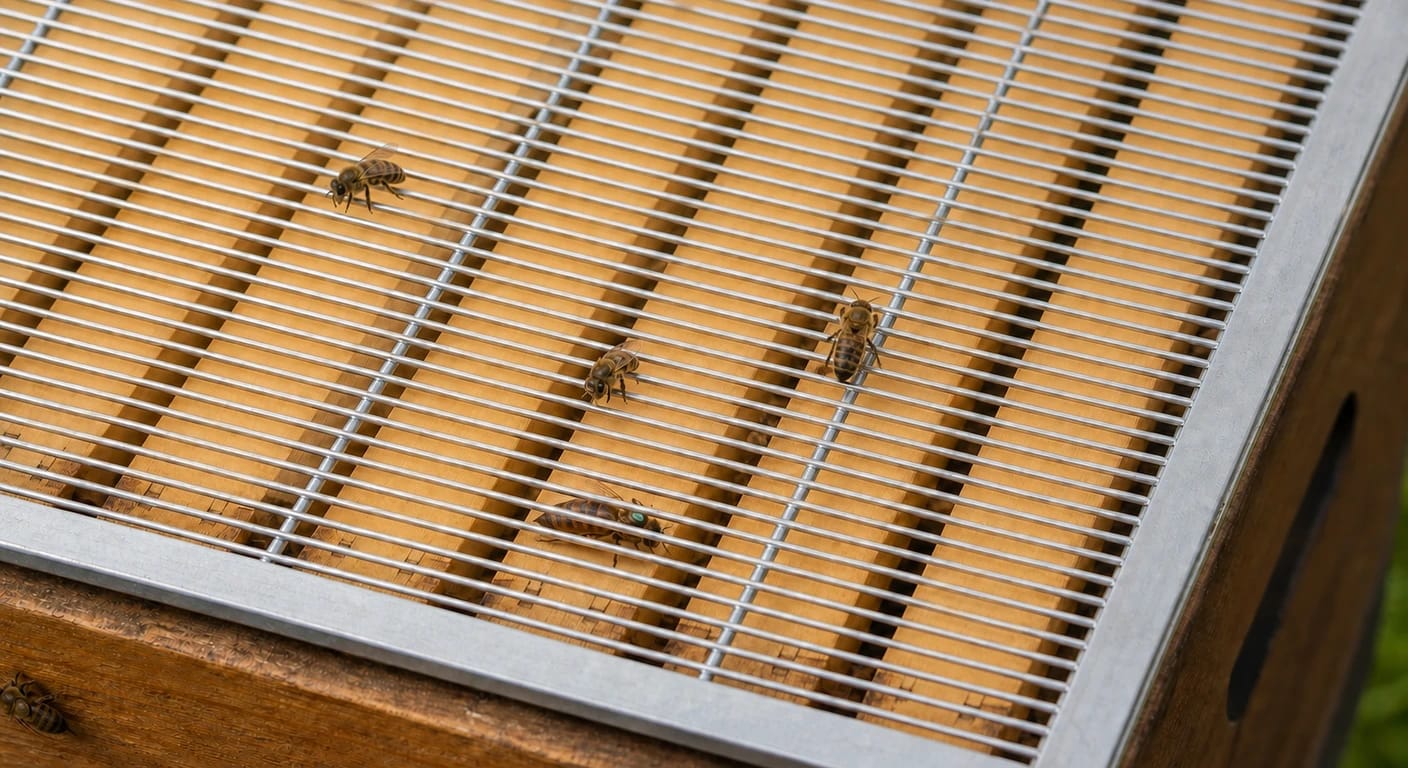
The most common cause of queen loss is accidental damage during inspection. Make it a habit: remove the first frame carefully from the edge (the queen is rarely there), never set frames on the ground, and with standard hives always use the empty edge first. A queen excluder between brood and honey supers ensures the queen is not lost when lifting the honey super.
Drone-Laying: The Beginning of the End
When a queenless colony fails to raise a new queen -- whether because no young brood was available or because all emergency queens were lost on mating flights -- a particularly problematic situation develops: drone-laying.
How Drone-Laying Develops
Drone-laying workersWithout the inhibiting effect of the queen substance, after 2-4 weeks of queenlessness the ovaries of some workers begin to mature. These so-called laying workers begin laying eggs. Since workers are not mated, they can only lay unfertilized eggs -- from which exclusively drones emerge.
Recognizing Signs of Drone-Laying
- 1
Bullet brood (most definitive sign)
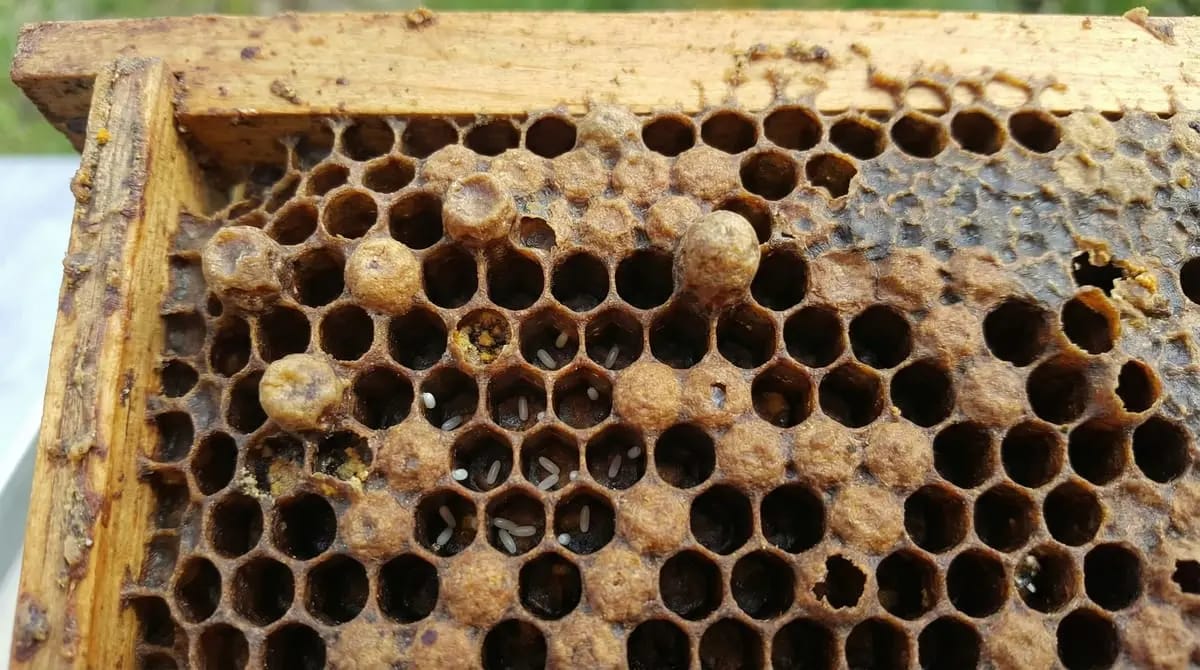
Drone-laying is recognized by bullet brood: drone eggs are laid in normal worker cells (the laying workers do not know the difference). But drone larvae are larger than worker larvae. The capping therefore bulges strongly upward -- the typical "bumpy" surface. In comparison, normal drone brood is found in the larger drone cells at the comb edges.
- 2
Multiple eggs per cell
Unlike the queen, who precisely places a single egg vertically on the cell floor, laying workers often place 2-5 eggs per cell, which moreover stick at angles to the cell walls rather than standing vertically on the floor. This pattern is a definitive sign of laying workers and not of a young, inexperienced queen.
- 3
Disorganized, spotty brood nest
The brood nest is completely unstructured: individual cells with brood are scattered randomly across multiple combs, without the typical concentric pattern of a queen's egg-laying. Empty cells, pollen cells, and brood cells alternate arbitrarily.
- 4
Aggressive behavior
Drone-laying colonies are often remarkably aggressive and stinging-prone. The bees are in a permanently agitated state due to the stress of queenlessness and the absence of calming pheromones.
- 5
Shrinking colony
Since no new workers are being produced, colony strength steadily declines. The old workers die off, and the emerging drones contribute nothing to colony maintenance. Without intervention, the colony dies within 6-10 weeks.
Why Rescue Is So Difficult
A drone-laying colony is one of the most difficult problems in beekeeping. The laying workers spread their own pheromones and behave like "pseudo-queens." The colony therefore often accepts neither open brood nor an introduced queen -- the bees sting the new queen because they consider the laying workers as their "queen." Rescue requires special methods (see below).
Rescue Measures: What to Do When Queenless?
The right measure depends on how far the queenlessness has progressed and what resources are available to you.
Stage 1: Adding Open Brood (Queenlessness Freshly Detected)
This is the simplest and most natural method. If the colony is not yet drone-laying (queenlessness maximum 2-3 weeks old), it can raise queens from young brood on its own.
- Brood frame with fresh eggs from a healthy colony
- Hive tool
- Bee brush
- From a strong colony, select a frame with the freshest possible eggs (day 1-2) and youngest larvae.
- Brush all bees off the frame in front of the donor colony -- do not introduce foreign bees.
- Hang the frame centrally in the brood nest of the queenless colony.
- The colony will begin building emergency queen cells within 24-48 hours.
- Check after 5 days: 3-8 queen cells should be visible.
- Leave the cells alone -- do not open, do not disturb.
- The first queen emerges after approximately 16 days (from egg laying). She will chew out the remaining queen cells.
- Mating flight of the virgin queen after another 5-10 days (weather-dependent).
- First egg-laying by the new queen approximately 2-3 weeks after emergence.
- Check no earlier than 4 weeks after inserting the brood frame for fresh eggs.
The colony often builds more queen cells than needed. This is not a problem -- on the contrary: it increases the chance that at least one queen successfully emerges and mates. The first queen to emerge eliminates the rivals herself. Do not break out the cells!
Stage 2: Introducing a Mated Queen
If no brood is available for queen rearing, the season is advanced, or you cannot risk a 4-6 week wait, introducing a mated queen is the most reliable solution.
- 1
Obtain a queen
Mated queens are available from queen breeders, through the beekeeping association, or from your own breeding. During the season (May-August), they are usually available within a few days.
- 2
Prepare the colony
Before introduction, remove all existing emergency queen cells -- otherwise the introduced queen will not be accepted. Check every frame carefully, especially comb edges and bottom edges.
- 3
Insert introduction cage (Day 0)
Place the queen in the introduction cage (Nicot cage or similar) between two brood frames in the seam. The bees can smell the queen through the mesh and get accustomed to her pheromones without being able to attack her.
- 4
Fondant method (Day 0-3)
The introduction cage has an opening sealed with fondant (sugar candy). The bees chew through the fondant within 2-4 days. During this time, the colony adjusts to the new queen. When the fondant is eaten through, the queen can leave the cage and is normally accepted peacefully.
- 5
Check (Day 5-7)
Check carefully after 5-7 days whether the queen has left the cage and whether you find fresh eggs on the combs. Open the colony very gently and without smoke -- the situation is still delicate.
The most common reasons for rejection of an introduced queen: (1) Queen cells are still present in the colony -- always remove all of them! (2) The colony is already drone-laying -- the laying workers interfere with acceptance. (3) The queen was released too quickly (fondant too soft/thin). (4) The colony was disturbed too much (too much smoke, too rough inspection). Patience and gentle handling are crucial.
Stage 3: Rescue with Drone-Laying
Rescuing a drone-laying colony is significantly harder, but not impossible. The laying workers must first be neutralized.
- Empty hive at the same location
- Mated queen in introduction cage
- 2-3 food frames
- Hive tool
- Bee brush
- Set up an empty hive with 2-3 food frames and the new queen (in introduction cage!) at the original location.
- Carry the drone-laying hive at least 50 meters away from the apiary.
- Shake all bees off in front of the old hive onto the ground. The bees must fly back.
- The forager bees return to the original location and find the new hive with the queen there. Foragers are almost never laying workers (drone-laying workers are typically house bees).
- The laying workers (non-flying house bees) remain disoriented and perish.
- Check after 5-7 days whether the queen has been accepted and is laying.
Stage 4: Uniting with a Queenright Colony
If a drone-laying colony is too weak to survive as an independent colony (fewer than approximately 3 seams of bees), uniting with a queenright colony is often the best solution.
Place a single layer of newspaper (with a few small pin holes) between the queenright colony below and the queenless colony to be placed on top. The bees chew through the newspaper in 1-2 days and unite slowly and peacefully. The queen's pheromones permeate the paper and accustom the queenless bees to the new ruler. Important: Remove all drone brood and laying worker combs from the queenless colony beforehand!
Distinguishing Cell Types: Emergency, Swarm, and Supersedure
Not every queen cell means the same thing. The ability to distinguish the different cell types is one of the most important skills of an advanced beekeeper.
| Feature | Emergency Cell | Swarm Cell | Supersedure Cell |
|---|---|---|---|
| Position on comb | Middle of comb surface, converted from normal worker cell | At comb edge, especially bottom edge, built as peanut-shaped cup | At comb edge or on surface, individual |
| Number | 3-20+ (often many) | 5-30+ (often very many, on multiple combs) | 1-3 (always very few) |
| Trigger | Sudden loss of queen | Space shortage, strong colony, high swarming impulse | Declining performance of old queen |
| Timing | Any time (emergency) | Swarm season (May-July) | Any time, often late summer |
| Old queen | Missing (lost/dead) | Still present, leaves with the swarm | Still present, still laying (reduced) |
| Queen quality | Variable (emergency solution from older larva possible) | Very good (natural impulse, best care) | Good (targeted replacement) |
| Beekeeper action | Leave alone or introduce a better queen | Depending on method: break or selectively use | Do not intervene -- the colony manages itself |
Quality of Emergency Queens
A critical point: emergency queens are not always of optimal quality. The reason lies in the biology:
- For an ideal queen, the larva should be fed exclusively with royal jelly from the 1st larval stage (up to 24 hours old).
- During emergency queen rearing, however, the bees often use larvae that are already 2-3 days old and were previously fed as worker larvae.
- Such queens may develop fewer egg tubules (ovarioles) and are often less productive.
When you insert a brood frame for emergency queen rearing, ensure that the freshest possible eggs (day 1) are present. This gives the bees the opportunity to select the youngest possible larvae, and the resulting queen will be of better quality than one from an older larva.
Prevention: Avoiding Queen Losses
Checklist: Protecting the Queen
A good queen is half the battle. Those who consistently mark and document their queens recognize problems early and can act in time. Queenlessness is not a catastrophe -- but only if you notice it early.
Experienced beekeepers with 10+ colonies always keep 1-2 reserve queens in small nucs (mini-plus or 3-frame nucs). This way you can react immediately to queen loss instead of waiting 4-6 weeks for emergency queen rearing. The cost of the nucs (feed, materials) is minimal compared to losing a production colony during the main flow. Also recommended for beginners from the second year onward!
Common Mistakes and How to Avoid Them
Digital Documentation with Hivekraft
Documenting queen status is one of the most important functions of a digital hive record. With Hivekraft you can:
- Record queen age and origin for each colony
- Document marking color and number
- Plan requeening dates and set reminders
- Log queenlessness as an inspection finding
- Record measures taken (brood frame added, queen introduced, uniting) with dates
Complete documentation helps you recognize patterns: Which colonies frequently lose their queen? Which breeding line shows the best longevity? Such insights only become possible through consistent record-keeping.
Knowledge Check
In the next lesson, we cover a topic that affects every beekeeper: winter losses -- how to analyze them, understand their causes, and prevent them in the future.