Notifiable Diseases: What to Do in an Emergency?
Distinguish between notifiable animal diseases and reportable animal illnesses in bees. Procedures in a disease outbreak and beekeeper obligations.
The specific legal framework described in this lesson (Bienenseuchen-Verordnung, Tiergesundheitsgesetz, notifiable disease classifications) applies primarily to Germany. Other countries have equivalent frameworks with similar principles -- notifiable bee diseases, restriction zones, and mandatory reporting exist in most jurisdictions. Check with your national veterinary authority and beekeeping association for local regulations and reporting procedures.
In Germany, three bee diseases are subject to mandatory reporting: any suspicion must be immediately reported to the veterinary authority. In addition, there are further diseases for which the Bee Disease Regulation (Bienenseuchen-Verordnung) mandates a treatment obligation. In this lesson, you will learn about the most important diseases, recognize the symptoms, and know what to do in an emergency.
Notifiable vs. Reportable: The Crucial Difference
The terms notifiable (anzeigepflichtig) and reportable (meldepflichtig) are often confused but have fundamentally different legal consequences. The correct classification determines which authorities must act and what measures are taken.
| Feature | Notifiable Animal Disease | Reportable Animal Illness |
|---|---|---|
| Legal basis | Animal Health Act (Tiergesundheitsgesetz) + Regulation on Notifiable Animal Diseases | Regulation on Reportable Animal Illnesses |
| Who must report? | EVERYONE who notices the outbreak or suspicion (animal keeper, veterinarian, any citizen) | The examining VETERINARIAN or LABORATORY |
| Report to whom? | Competent veterinary authority (district veterinary office) | Competent authority (via veterinarian/laboratory) |
| Official measures | Immediate investigation, restriction zone (min. 1 km radius), movement ban, possible culling/sanitation | Registration, statistical recording, possible recommendations -- NO compulsory control measures |
| Severity of consequences | Significant: restriction zone, trade ban, destruction obligation possible | Minor: statistical recording, monitoring, advice |
| Penalty for non-reporting | Administrative offense, fine up to 30,000 euros | Reporting obligation lies with veterinarian/laboratory, not the beekeeper |
Notifiable Animal Diseases in Bees
In Germany, there are three notifiable animal diseases affecting honey bees. Even mere suspicion must be reported.
1. American Foulbrood (AFB)
American Foulbrood (AFB) is the most significant notifiable bee disease. It is caused by the spore-forming bacterium Paenibacillus larvae and exclusively affects bee brood. The spores are extremely resistant and can survive in wax and honey for decades.
Pathogen: Paenibacillus larvae (spore-forming bacterium)
Transmission: Via contaminated feed (honey, fondant), contaminated combs and tools, robbing of infected colonies, drifting. Only 10 spores are sufficient to infect a larva.
Recognizing symptoms:
- 1
Spotty brood pattern
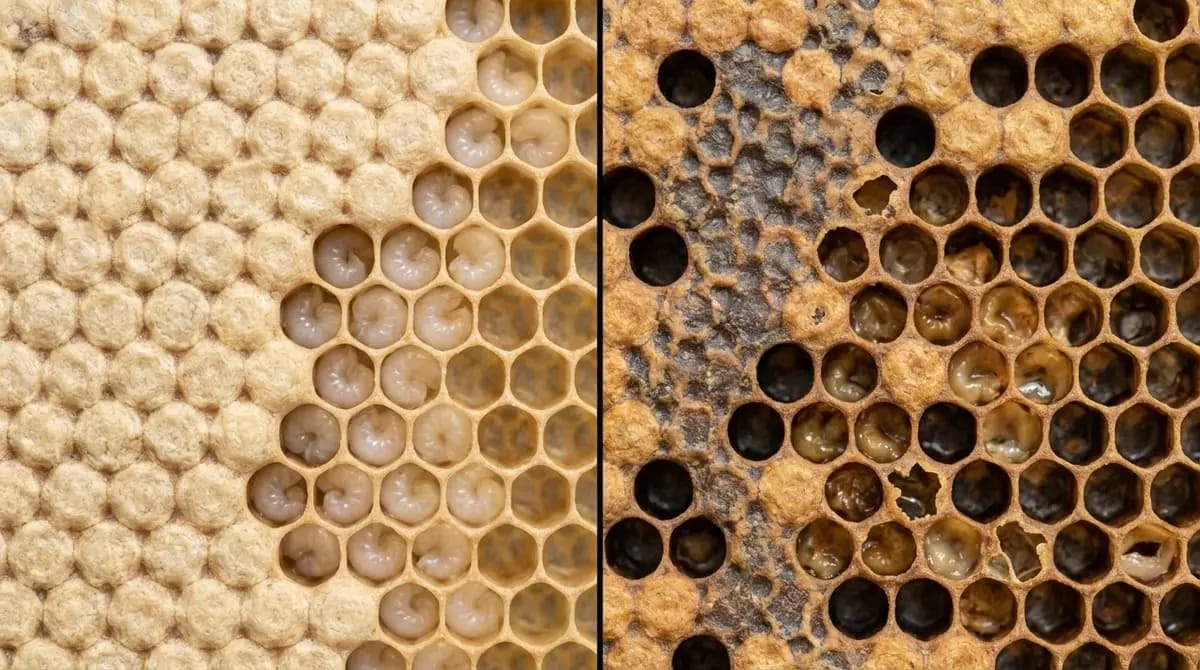
The first sign is an uneven, mosaic-like brood pattern -- capped and empty cells alternate without a recognizable pattern. Healthy colonies have a closed, compact brood pattern.
- 2
Sunken and perforated cell caps
The capping over affected cells sinks in, turns dark, and is partially gnawed by the bees. Small holes appear in the caps. (Note: Similar symptoms can also occur with chalkbrood.)
- 3
Matchstick test (rope test)
The most important quick test: insert a matchstick or thin wooden stick into a suspicious cell and pull out slowly. If the mass stretches into a brown, ropy thread (2-4 cm long), AFB is highly likely. Healthy larvae or other diseases do not show this ropy stretching.
- 4
Smell
Advanced AFB causes a characteristic foul smell resembling bone glue or spoiled animal glue. In early infection, the smell may still be absent.
- 5
Scale (final stage)
In the final stage, the ropy mass dries into a dark scale firmly adhering to the cell wall. This scale contains millions of spores and is the main reservoir for further spread. The bees cannot remove the scale.
2. Infestation with the Small Hive Beetle (Aethina tumida)
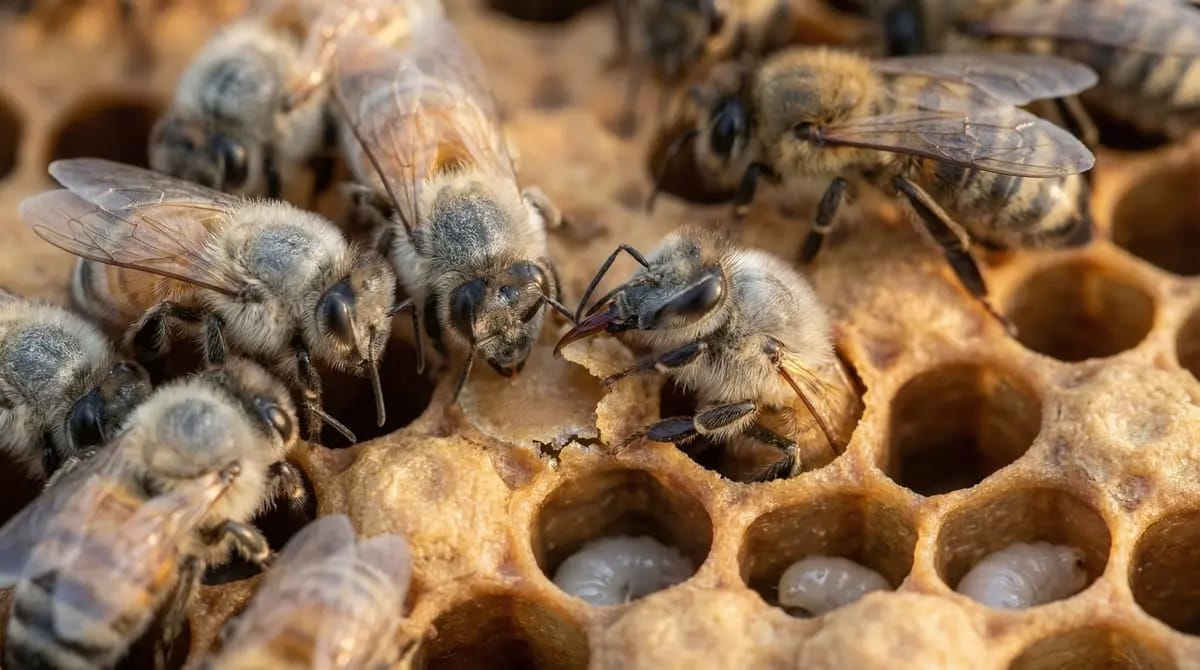
Small Hive Beetle (Aethina tumida)The Small Hive Beetle (SHB) originates from sub-Saharan Africa and was first detected in Europe in 2014 in southern Italy (Calabria). In Germany, it has not yet appeared as of 2026, but the risk of introduction remains. The SHB lays its eggs in the beehive, and the larvae feed on honey, pollen, and brood, destroying the combs.
Reporting obligation: Even the suspicion of an infestation must be immediately reported to the veterinary authority. The SHB is dark brown to black, approximately 5-7 mm long, and can be recognized with the naked eye.
3. Infestation with Tropilaelaps Mites
Tropilaelaps clareae and Tropilaelaps mercedesae are brood parasites of the giant honey bee (Apis dorsata) in Southeast Asia. They have not been detected in Europe as of 2026. Their damaging effect is similar to Varroa but with even faster reproduction. In case of suspicion, immediate notification is also required.
Other Bee Diseases (No Reporting or Notification Obligation)
Besides the three notifiable animal diseases, there are additional diseases relevant to beekeepers. In Germany, these are not subject to any statutory reporting or notification obligation but may require a treatment obligation under the Bee Disease Regulation.
The Bee Disease Regulation mandates a treatment obligation for Varroosis and tracheal mite infestation. This means: you are obligated to treat affected colonies -- but a report to the veterinary authority is not required. Do not confuse the treatment obligation with the notification obligation, which applies only to AFB, Small Hive Beetle, and Tropilaelaps.
1. European Foulbrood (EFB)
Pathogen: Melissococcus plutonius (bacterium, non-spore-forming)
Unlike AFB, European Foulbrood affects the open brood (still uncapped larvae). The larvae turn yellowish-brown and lie in an unnatural position in the cell (twisted instead of C-shape). There is no ropy slime as with AFB, and the mass dries into an easily removable scale (unlike the firmly adhering AFB scale).
EFB is not subject to any statutory reporting or notification obligation in Germany. In cases of severe infestation, the veterinary authority may order measures.
| Feature | American Foulbrood (AFB) | European Foulbrood (EFB) |
|---|---|---|
| Affected brood | Capped brood (stretched larvae, prepupae) | Open brood (curled larvae, 3-5 days old) |
| Matchstick test | Positive: long, brown thread (2-4 cm) | Negative: no thread formation, mass is mushy |
| Scale | Firmly adhering to cell wall, not removable | Loose, easily removable, no scale on wall |
| Spore formation | Yes -- spores survive decades | No -- pathogen less resistant |
| Smell | Foul, like bone glue | Sour, like vinegar |
| Legal status | Notifiable animal disease | No reporting or notification obligation |
| Control | Sanitation by veterinary authority, restriction zone | Colony strengthening, comb hygiene, possibly shook swarm method |
2. Varroosis (Treatment Obligation)
Infestation with Varroa destructor is subject to a statutory treatment obligation under the Bee Disease Regulation. However, Varroosis is not reportable -- since the mite is endemically present everywhere, a reporting obligation would serve no epidemiological purpose. Every beekeeper is nonetheless obligated to treat their colonies against Varroa.
3. Nosemosis
Nosemosis is caused by the microsporidia Nosema apis and Nosema ceranae. Both pathogens infect the gut cells of adult bees. Nosema apis causes the classic symptoms with fecal spots (dysentery) and crawling bees; Nosema ceranae often progresses without externally visible symptoms but significantly shortens bee lifespan. Nosemosis is not subject to any reporting or notification obligation in Germany.
4. Tracheal Mite (Acarapis woodi) (Treatment Obligation)
The tracheal mite infests the tracheae (respiratory tubes) of the bee, impeding oxygen supply. As with Varroosis, there is a treatment obligation under the Bee Disease Regulation, but no reporting obligation. The tracheal mite was a major problem in Great Britain in the 1920s (Isle of Wight Disease) but plays only a minor role in modern beekeeping.
Procedure in a Disease Outbreak: Step by Step
- 1
Recognize suspicion and report
If you notice symptoms during an inspection that suggest AFB (spotty brood pattern, sunken caps, positive matchstick test), contact the competent veterinary authority of your district immediately. Report even suspicion -- better once too often than once too few. At the same time, inform the bee health advisor of your beekeeping association.
- 2
Official sampling
The veterinary authority sends an official veterinarian or an authorized bee health advisor who takes official samples. The samples are sent to a recognized testing laboratory (e.g., a bee research institute or state testing laboratory). The examination typically takes 3-7 working days.
- 3
Preliminary protective measures
Until the examination result is available, the veterinary authority orders preliminary measures: the affected colony must not be moved, no material may leave the apiary, and you may not give combs or bees to other beekeepers.
- 4
Positive finding: Restriction zone
When AFB is confirmed, the veterinary authority establishes a restriction zone -- typically a radius of at least 1 km around the disease site. All bee colonies within the restriction zone must be examined (clinical examination and/or food ring sample). A movement ban applies: no bees, combs, hive equipment, or honey may leave the restriction zone.
- 5
Sanitation of the affected colony
The veterinary authority orders sanitation. The standard method is the shook swarm procedure: the bees are shaken into a new, clean hive with fresh foundation. All contaminated combs are destroyed (incineration or special disposal). The hive equipment is disinfected (wax dipping at a minimum of 160 degrees Celsius or scorching until the wood browns).
- 6
Follow-up examination and lifting
After sanitation, follow-up examinations (food ring samples) follow at set intervals (typically after 2-3 months). Only when all samples in the restriction zone are negative is the restriction zone lifted. This can take 3-12 months.
The costs of sanitation (new hive equipment, foundation, labor, destruction of contaminated material) are typically borne by the beekeeper. The animal disease compensation fund covers part of the compensation for destroyed colonies and material, depending on the region. Membership in the animal disease compensation fund is therefore mandatory for beekeepers in all German federal states -- and existentially important in a disease case. Check your country's equivalent compensation schemes.
The Role of the Bee Health Advisor
Bee Health AdvisorThe bee health advisor is a specially trained beekeeper appointed by the veterinary authority as an expert. Their responsibilities:
- Sampling: Take food ring samples and send them to the laboratory
- Clinical examination: Assess suspected cases on site
- Monitoring: Regular health checks in the restriction zone
- Advice: Counsel beekeepers on hygiene measures and disease control
- Reporting: Forward suspected cases to the veterinary authority
You can find the responsible bee health advisor through your beekeeping association, the veterinary authority of your district, or the regional beekeeping federation. It is advisable to establish contact before an emergency. Many bee health advisors also offer preventive apiary inspections -- take advantage of this service!
Prevention: Avoiding Disease Outbreaks
Emergency Plan: Bee Diseases
The Food Ring Sample
The food ring sample is the most reliable early detection test for AFB. Feed is taken from the cells surrounding the brood nest and tested for AFB spores in the laboratory.
- Clean screw-top jar (at least 50 ml)
- Tablespoon or hive tool
- Labeling stickers
- Address of the testing laboratory
- Open the colony and locate the brood combs with capped brood.
- Using a clean spoon or hive tool, extract feed (honey/food reserves) from the cells that directly border the brood nest (the so-called "food ring").
- Collect a total of at least 50-100 g of feed (approximately 2-3 tablespoons) from various brood combs.
- Fill the material into the clean screw-top jar and seal tightly.
- Label the jar with location, colony number, date, and your name.
- Send the sample to the competent testing laboratory (ask the veterinary authority or beekeeping association for the address). The examination is free or low-cost in many regions.
- The result is typically available after 1-2 weeks.
The food ring sample is the early warning system of beekeeping. AFB spores can be detected in the food supply long before clinical symptoms appear. Those who test regularly can prevent an outbreak before it causes damage.
The Bee Disease Regulation
The legal framework described here is specific to Germany (Bienenseuchen-Verordnung, Tiergesundheitsgesetz, EU Regulation 2016/429). While the EU Animal Health Law provides a common framework across EU member states, national implementations vary. Non-EU countries have their own equivalent legislation. Always consult your national veterinary authority for applicable rules.
The legal basis for disease control in bees is the Bee Disease Regulation in conjunction with the Animal Health Act (TierGesG) and the EU Animal Health Regulation (EU) 2016/429. Key provisions:
Documentation in a Disease Outbreak
Digital documentation of all disease cases and prevention measures is not only legally required (colony record book under EU 2019/6) but also essential for your own protection.
With Hivekraft, you can record:
- Food ring samples: Date, colony, laboratory, result
- Suspected cases: Symptom description, photos, measures taken
- Authority contacts: Veterinary authority, bee health advisor, animal disease compensation fund
- Sanitation measures: Measures taken, date, persons involved
- Health certificates: Validity period, issue date
Since January 28, 2022, all beekeepers (including hobbyists) across the EU must maintain a colony record book documenting veterinary medicine applications. This includes all varroa treatments with approved veterinary medicines. The retention obligation is 5 years. Hivekraft fulfills this requirement digitally and automatically.
Knowledge Check
In the next and final lesson of this module, we cover the beekeeper's medicine cabinet: what medications and treatment products are available, how to apply them correctly, and what the law says.