The Beekeeper's Medicine Cabinet: Medications and Treatment Products
Approved varroa treatment products, correct application, withdrawal periods, and documentation obligations. From formic acid to oxalic acid.
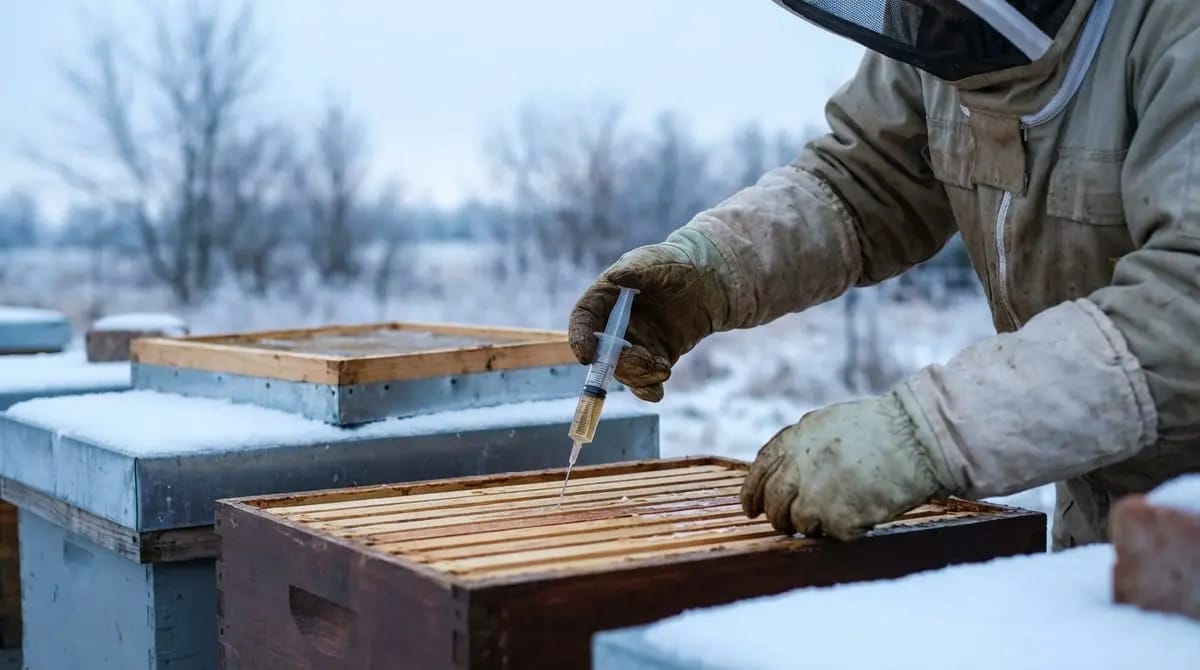
Treating bee colonies against the varroa mite is one of the unavoidable obligations of every beekeeper. Without regular treatment, colonies perish within 1-3 years. At the same time, the application of treatment products is subject to strict legal regulations: anyone treating bees is administering veterinary medicines and must document this correctly.
In this concluding lesson of the health module, we provide a complete overview of the approved treatment products, their correct application, the legal framework, and the obligation to document.
Legal Framework: Veterinary Medicines vs. Biocides
The regulatory framework described here (TAMG, BVL, EU 2019/6) applies primarily to Germany and the EU. Other countries have equivalent regulatory bodies and approval processes. The core principle is universal: only approved products may be used to treat bee colonies, and all treatments must be documented. Check with your national veterinary authority for locally approved products and regulations.
Not every product that works against varroa may actually be used. In Germany, only approved veterinary medicines may be used for varroa treatment. Using non-approved substances is an administrative offense and can make the honey unsaleable.
| Category | Veterinary Medicine (TAM) | Biocide / Plant Protection Product |
|---|---|---|
| Approval authority | Federal Office of Consumer Protection and Food Safety (BVL) | Federal Institute for Occupational Safety and Health (BAuA) / BVL |
| Legal basis | Veterinary Medicines Act (TAMG), EU 2019/6 | Biocidal Products Regulation (EU) 528/2012 / Plant Protection Act |
| Application on animals | Approved -- for direct application on the bee colony | NOT PERMITTED for application on the bee colony |
| Documentation | Colony record book obligation under EU 2019/6 | No record book obligation, but also not permitted |
| Examples for bees | MAQS, VarroMed, Api Life Var, Oxuvar, Dany's BienenWohl | Formic acid ad us. vet. vs. technical formic acid |
Technical formic acid (e.g., from the hardware store for descaling) is not an approved veterinary medicine and must not be used for varroa treatment. It may contain impurities that harm the bees and the honey. Use exclusively formic acid labeled "ad us. vet." (for veterinary use) or approved ready-made products like MAQS.
The Approved Active Substances: An Overview
1. Formic Acid (60% and 85%)
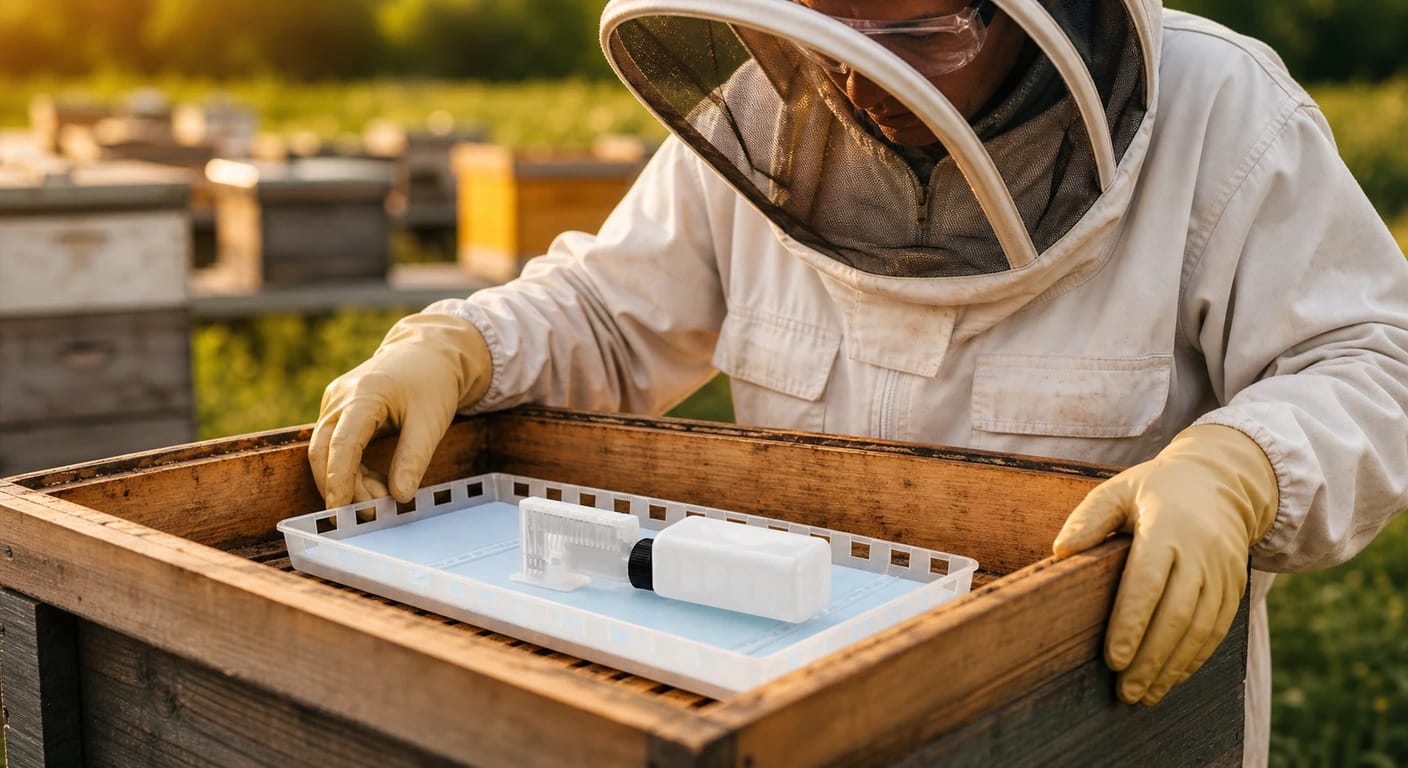
Formic acid is the most important active substance for summer treatment because it can penetrate into capped brood as a gas and kill mites there. No other approved active substance has this property.
Mode of action: Formic acid evaporates and fills the beehive as a gas. It penetrates through the wax cappings into the brood cells and kills mites in the phoretic phase (on the bees) as well as partially in the reproductive phase (in the brood).
Approved products (selection):
The evaporation rate of formic acid increases with temperature exponentially. Above 30 degrees Celsius, overdosing can occur, which can damage or even kill the queen (queen losses of 5-15% during heat treatments are documented). Therefore, only treat at moderate temperatures and avoid heat waves.
2. Oxalic Acid
Oxalic acid (Acidum oxalicum)Oxalic acid is the most important active substance for winter treatment during broodlessness. It acts exclusively on phoretic mites (on the bees) and cannot penetrate into capped brood. This is why broodlessness is the prerequisite for high efficacy.
Application methods:
| Method | Trickling Treatment | Sublimation (Vaporization) |
|---|---|---|
| Principle | Oxalic acid solution (3.5%) is trickled onto the bees between the frames | Oxalic acid crystals are heated and introduced into the hive as vapor |
| Dosage | 5 ml per occupied frame gap (max. 50 ml per colony) | 1-2 g per box (depending on device and instructions) |
| Efficacy (when broodless) | 90-95% | 95-99% |
| Bee tolerance | Good with correct dosing; overdosing harmful | Very good with correct application |
| Approved products | Oxuvar 5.7%, Dany's BienenWohl, Oxalic acid dihydrate ad us. vet. | Varroxal 0.71 g/g (approved in Germany since Sept. 2023; only with Varrox/Varrox Eddy vaporizers) |
| Repeatable? | NO -- only 1x per broodless phase | Possibly repeatable (product-dependent) |
| Withdrawal period | None | None |
- Oxalic acid solution (e.g., Oxuvar pre-mixed or Oxalic acid dihydrate ad us. vet. 3.5% with sugar)
- Squeeze bottle or dosing syringe (50-60 ml)
- Protective gloves and safety goggles
- Warm clothing (treatment in cold weather)
- Timing: When broodlessness is confirmed, typically late November to mid-December (at least 3 weeks after the last evidence of brood). Outside temperature should be above 0 degrees Celsius, ideally 3-8 degrees.
- Warm the oxalic acid solution to 35 degrees Celsius (water bath, not microwave). Warm solution is better accepted.
- Open the hive from the rear -- not from above, to avoid disturbing the winter cluster.
- Trickle 5 ml per occupied frame gap slowly onto the bees (use dosing syringe). Do not trickle on empty gaps!
- Maximum: 50 ml per colony -- overdosing is harmful.
- Close the hive immediately.
- The entire treatment should take under 2 minutes per colony.
- Apply only once per broodless phase -- a repeat harms the bees disproportionately.
Oxalic acid is corrosive and harmful to health. Always wear protective gloves (nitrile, not latex) and safety goggles during application. For sublimation, additionally wear a respiratory mask (FFP2 or better). Ingesting oxalic acid can cause severe kidney damage. Always store oxalic acid solution out of reach of children.
3. Thymol (Thymol Products)
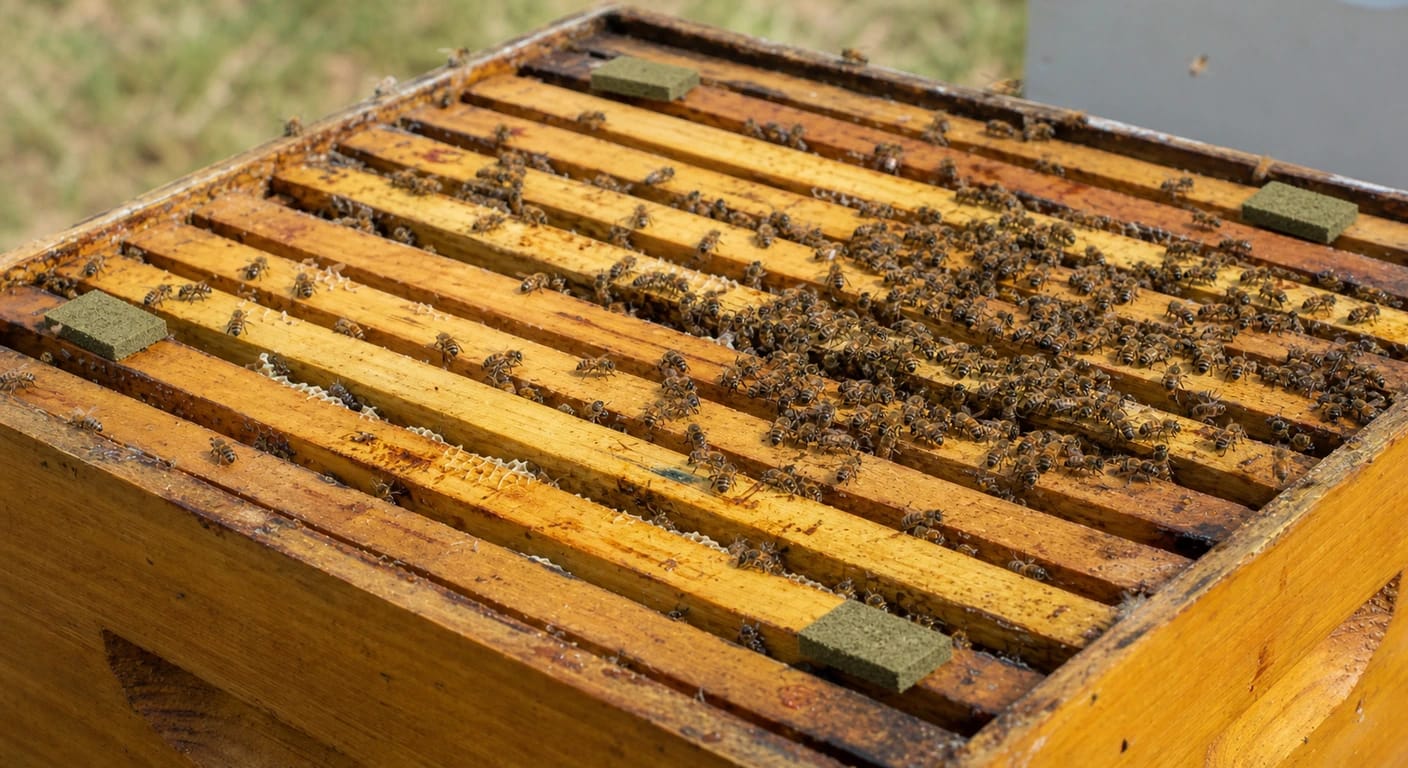
Thymol is a natural component of the essential oil of thyme and has acaricidal (mite-killing) properties. Thymol products are used as a summer treatment when formic acid is not tolerated or temperatures are too high.
Approved products:
4. Lactic Acid (15%)
Lactic acid (Acidum lacticum)Lactic acid is primarily used for treating artificial swarms and broodless nucs. It works by spraying the bees and only kills phoretic mites. It is less suitable for regular varroa treatment of established colonies because it does not penetrate into brood.
- Application: 15% lactic acid, spray bees on each comb side (approximately 7-8 ml per occupied comb side)
- Efficacy: 80-95% (when broodless)
- Advantage: Very bee-compatible, good for nucs and artificial swarms
- Disadvantage: Only effective when broodless, labor-intensive individual-comb treatment
5. VarroMed (Combination Product)
Comparison of Treatment Products
| Property | Formic Acid | Oxalic Acid | Thymol | Lactic Acid |
|---|---|---|---|---|
| Primary use | Summer treatment (July-Sept.) | Winter treatment (Nov.-Dec.) | Summer treatment (Aug.-Sept.) | Artificial swarms, broodless nucs |
| Effective in capped brood? | YES (only active substance!) | NO | NO (partially with long application) | NO |
| Broodlessness required? | No | Yes (for high efficacy) | No (but better with little brood) | Yes |
| Efficacy | 75-95% | 90-99% (when broodless) | 85-97% | 80-95% |
| Temperature-dependent? | Strongly (15-25 degrees ideal) | Slightly (> 0 degrees) | Moderately (15-30 degrees) | Slightly |
| Risk of queen loss? | 5-15% in heat | Minimal | Low | Minimal |
| Where to buy | Pharmacy, beekeeping supply | Pharmacy, beekeeping supply | Pharmacy, beekeeping supply | Pharmacy, beekeeping supply |
Storage and Shelf Life
- Lockable cabinet or container
- Cool, dry room (not above 25 degrees Celsius)
- Original containers with labeling
- Store all treatment products in the original container with intact labeling.
- Store cool and dry -- not in sunlight, not near heat sources.
- Store out of reach of children and inaccessible to unauthorized persons (lockable cabinet).
- Observe the expiration date -- expired products have reduced efficacy.
- Store formic acid in tightly sealed containers made of PE or glass (evaporates easily).
- Keep oxalic acid crystals dry -- they attract moisture (hygroscopic).
- Store thymol tablets (Api Life Var, Thymovar) in the original packaging in the refrigerator or cool room.
- Keep safety data sheets (SDS) for all products on hand and readily accessible.
Where to Buy
Approved varroa veterinary medicines can be obtained through three channels: (1) Pharmacy -- any pharmacy can order the products (formic acid 60% ad us. vet., oxalic acid dihydrate ad us. vet., ready-made products). (2) Beekeeping supply stores -- specialized retailers stock the common products. (3) Group orders through the beekeeping association -- many associations organize collective orders at better prices. A veterinary prescription is not required for common varroa veterinary medicines (available over the counter). Note: availability and prescription requirements may vary by country.
Documentation Obligation: The Colony Record Book
Since January 28, 2022, EU Regulation 2019/6 (Veterinary Medicines Regulation) requires all animal keepers -- including hobby beekeepers -- to maintain a colony record book. All applications of veterinary medicines must be documented therein.
Required Entries in the Colony Record Book
Required Information per Treatment
With Hivekraft, you fulfill the colony record book obligation digitally and automatically. Every documented treatment is automatically recorded in the colony record book with all required information. The EU-compliant colony record book can be exported as a PDF at any time -- for your own records or during inspections by the veterinary authority. The 5-year retention obligation is automatically maintained.
The Treatment Plan: The Integrated Varroa Concept
Effective varroa management does not consist of a single treatment but of an integrated concept throughout the entire beekeeping year:
- 1
Spring: Biotechnical Measures (April-June)
Drone comb removal (cutting out drone frames), trapping comb method, or complete brood removal in heavily infested colonies. These measures reduce the mite population without chemicals and delay reaching the damage threshold.
- 2
Summer: Formic Acid Treatment (July-August)
Immediately after the last honey harvest: formic acid long-term treatment (evaporator) or MAQS over 7-14 days. The summer treatment is the most important treatment timing because it reduces the mite load before the rearing of winter bees.
- 3
Late Summer: Efficacy Control (September)
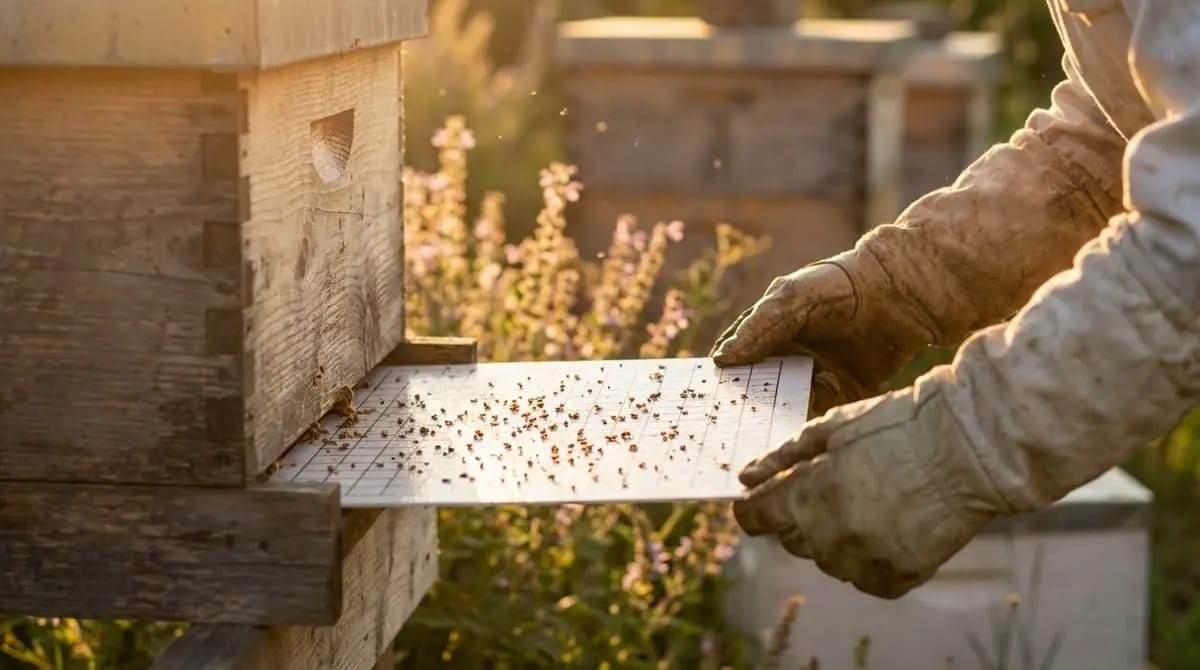
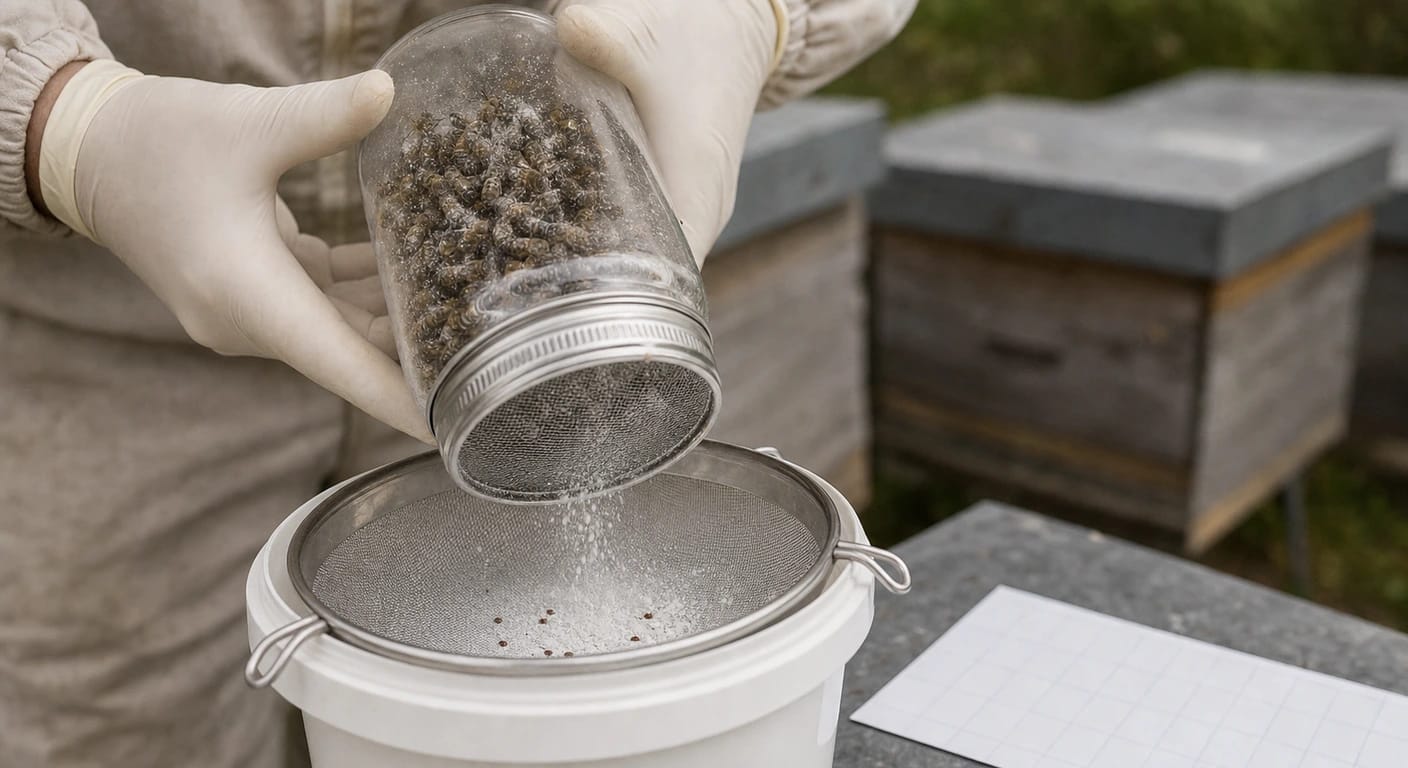
After treatment, monitor the natural mite drop (debris diagnosis over 3 days). If mite drop exceeds 0.5 mites/day, a follow-up treatment is needed (e.g., thymol or a second formic acid treatment).
- 4
Winter: Oxalic Acid Treatment (November-December)
When broodlessness is confirmed: oxalic acid trickling treatment or sublimation. This timing has the highest efficacy because all mites are on the bees and accessible. Do not forget!
Future of Varroa Control
Research is working on several promising approaches for the future:
The future of varroa control lies in the combination of new active substances, biotechnological methods, and breeding tolerant bees. None of these approaches alone will solve the problem, but together they can reduce dependence on organic acids and improve bee health in the long term.
Summary
The Beekeeper's Medicine Cabinet: Basic Equipment
Knowledge Check
This concludes the module Bee Health and Diseases. You have learned to recognize queen problems, analyze winter losses, consistently implement hygiene measures, identify notifiable diseases, and correctly apply the approved treatment products. This knowledge is the foundation for healthy, vital bee colonies -- and for successful, responsible beekeeping.