Understanding Honey Quality: Moisture Content, Enzymes and HMF
Learn the decisive quality parameters of honey: moisture content, enzyme activity and HMF value. With measurement methods, legal limits and practical tips.
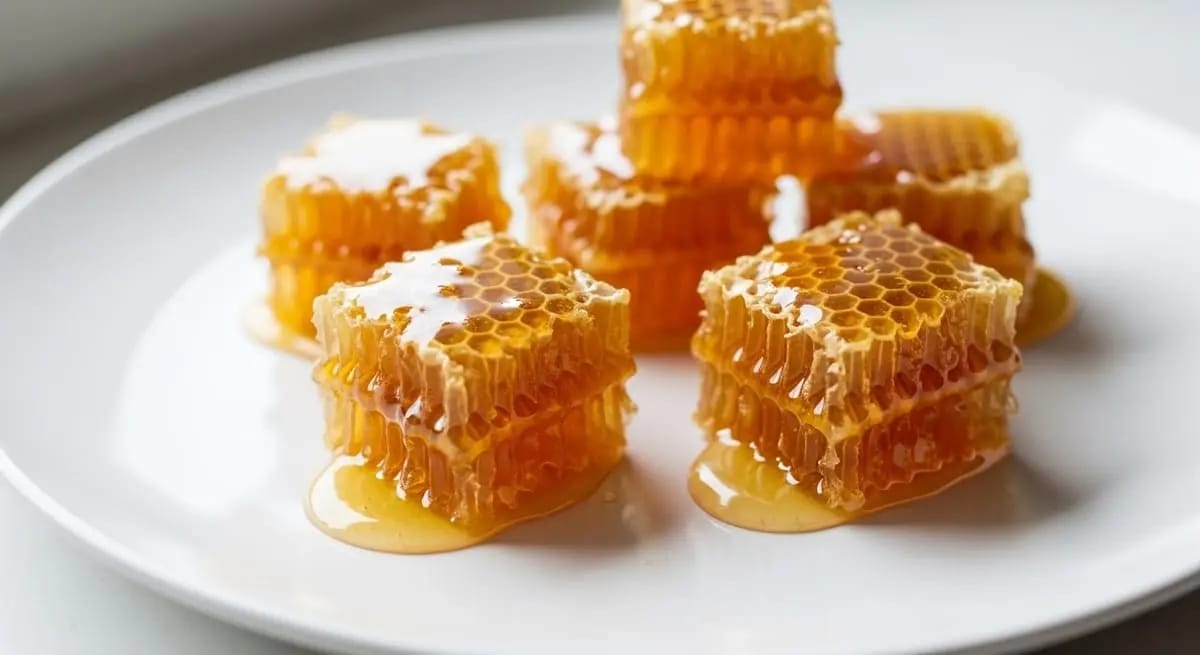
Honey contains over 200 different compounds -- sugars, enzymes, amino acids, vitamins and aromatic substances. But not all honey is equally good. Quality depends on factors that you as a beekeeper can actively influence.
In this lesson you will learn about the three most important quality parameters: moisture content, enzyme activity and HMF value. You will discover how to measure them, what legal limits apply and how to produce top-quality honey.
The specific legal standards and limits described in this lesson primarily apply to Germany (German Honey Ordinance / HonigV) and the EU. If you are based in another country, check your local food regulations -- the principles of honey quality are universal, but exact thresholds and labelling requirements may differ.
Why Quality Matters
Honey quality has direct economic consequences:
- Selling price: DIB honey (German Beekeepers Association standard) fetches 8-12 EUR per 500g jar, while discount honey sells for 3-5 EUR
- Shelf life: Honey with low moisture content keeps practically indefinitely; honey that is too moist can ferment
- Customer loyalty: Poor-quality honey means lost customers
- Legal compliance: The German Honey Ordinance (HonigV) sets binding minimum standards
Honey quality begins at the colony and ends with the consumer. The beekeeper decides whether the honey remains a premium natural product or loses value through mistakes.
Moisture Content: Quality Criterion No. 1
Moisture content determines shelf life, consistency and marketability. Honey is a supersaturated sugar solution -- the bees reduce the water content of nectar (40-80 %) through fanning and enzymatic breakdown to 15-20 %.
If the moisture content is too high, fermentation threatens: osmophilic yeasts become active at around 18-20 % and ferment sugars into alcohol and CO2. The honey tastes sour and is no longer sellable.
Once honey starts fermenting, it can no longer be sold as table honey. Therefore: always measure moisture content BEFORE extracting!
Legal Limits
| Standard | Max. Moisture Content | Note |
|---|---|---|
| German Honey Ordinance (HonigV) | 20 % | Legal maximum |
| EU Directive 2001/110/EC (amended by Directive 2024/1438) | 20 % | Heather honey up to 23 % |
| DIB Quality Standard | 18 % | Stricter than the legal requirement |
| Recommended by quality beekeepers | 16-17 % | Optimal shelf life |
Measuring Moisture Content: The Refractometer
- 1
Calibrate
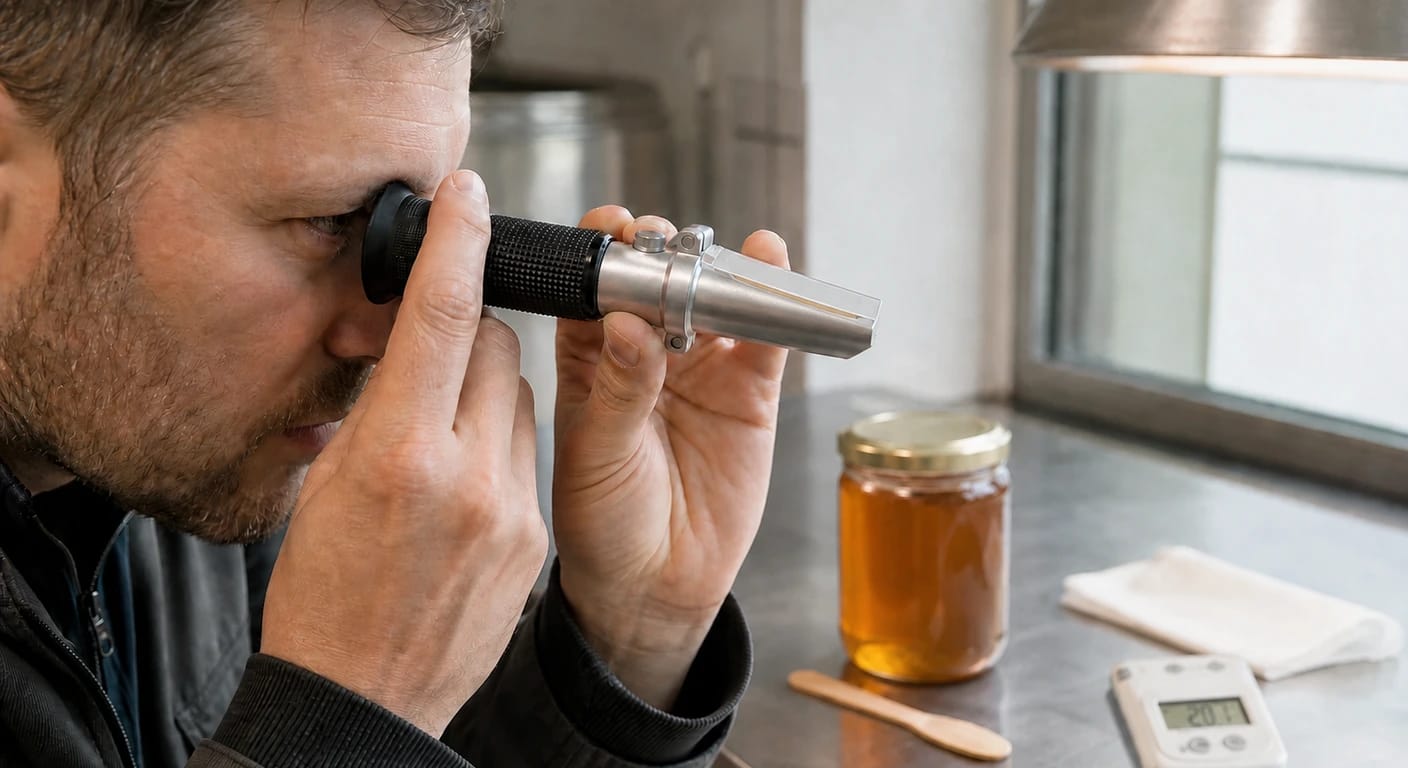
Before measuring, calibrate the refractometer with distilled water or calibration solution. Place 2-3 drops on the prism, close the flap, adjust the calibration screw.
- 2
Prepare the sample
Take a representative sample and stir briefly. The sample should be at room temperature (20 degrees C).
- 3
Apply and read
Place 1-2 drops of honey on the prism, close the flap (no air bubbles!). Hold against a light source and read the boundary line on the scale.
- 4
Evaluate
Under 18 % -- excellent, extract immediately. 18-20 % -- acceptable under the Honey Ordinance. Over 20 % -- do NOT extract, return frames to the hive!
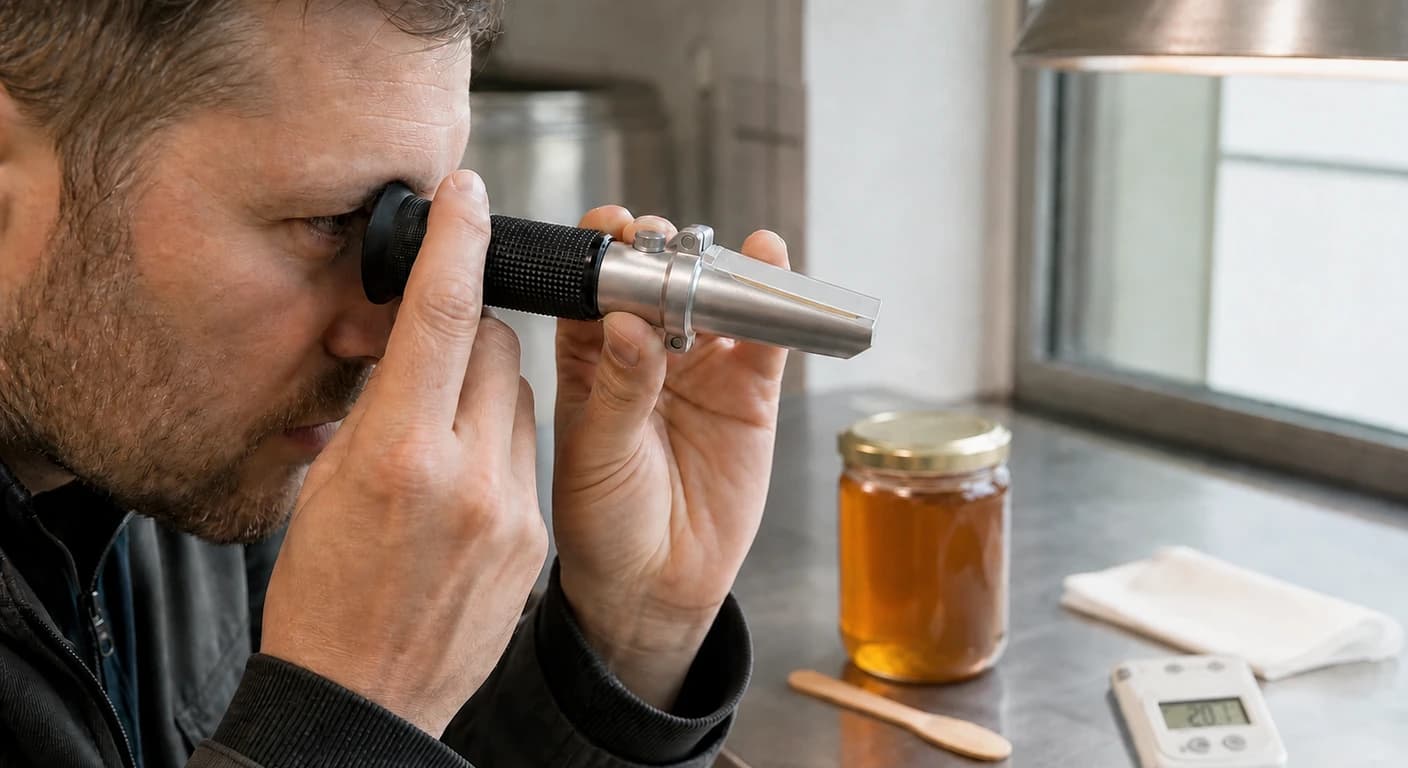
Analogue refractometer with ATC (automatic temperature compensation), measuring range 12-27 % water. Look for a model with a honey scale, not just a Brix scale.
Hold a capped honeycomb horizontally and strike it firmly downwards. No honey sprays: Under 18 %. Drops appear: Measure again. Honey flies out: Too moist.
Reducing Moisture Content
At the hive: Only extract frames when at least 2/3 are capped. Use smaller supers. Improve ventilation.
In the extraction room: Use a dehumidifier (below 50 % humidity), store frames for 24-48 hours. Maximum 30 degrees, no direct sunlight.
Enzyme Activity: The Sign of Naturalness
Enzymes originate from the honey bee's glands and are a direct measure of gentle processing.
| Enzyme | Function | Measurement Parameter |
|---|---|---|
| Invertase (Saccharase) | Splits sucrose into glucose + fructose | Invertase number (IN) in Units/kg |
| Diastase (Amylase) | Breaks down starch | Diastase number (DN) according to Schade |
| Glucose oxidase | Produces H2O2 (antibacterial) | Not routinely measured |
Invertase Number
The invertase is the most heat-sensitive enzyme in honey. Degradation begins above 40 degrees Celsius.
- Over 150: Excellent -- fresh quality honey
- 64-150: Very good -- DIB top quality
- Under 15: Poor -- probably heated or very old
Diastase Number
The diastase is the legally required parameter: at least 8 DN according to Schade. Exception: for honey that is naturally low in enzymes (e.g. acacia), DN 3 is sufficient if HMF is below 15 mg/kg.
Acacia honey has naturally lower enzyme values due to its variety -- this is not a quality deficiency. The Honey Ordinance accounts for this with an exception clause.
Protecting Enzymes
Enzyme Protection in Practice
The HMF Value: Ageing and Heating Indicator
HMF (Hydroxymethylfurfural) is formed during the breakdown of fructose under the influence of acid and heat. Fresh honey has only 1-10 mg/kg, but the value rises rapidly through heating or prolonged storage.
Influencing factors: Temperature (most important factor), acidity, fructose content, storage time, light exposure.
| Standard | Max. HMF | Note |
|---|---|---|
| HonigV / EU | 40 mg/kg | Legal maximum |
| DIB Standard | 15 mg/kg | Less than half the legal limit |
| Recommended | under 10 mg/kg | Fresh and gently processed |
Honey stored at room temperature for one year can already exceed the DIB limit. Cool storage (10-15 degrees) is decisive.
You cannot measure HMF yourself -- the determination is carried out in a laboratory (HPLC or photometrically according to Winkler).
Where to have it tested?
- Bee institutes: State bee research institutes (in Germany: Hohenheim, Celle, Mayen, Veitshochheim) offer analyses partly free or at reduced rates for association members
- Accredited laboratories: QSI Bremen, Intertek, Eurofins -- costs approx. 30-80 EUR per sample
- DIB quality control: In cases of complaints, samples are automatically analysed
The German Honey Ordinance (HonigV): Overview
The German Honey Ordinance of 16 January 2004 (last amended 2025) transposes the EU Honey Directive into German law. It defines what may be sold as "honey."
DIB vs. Honey Ordinance: The Quality Comparison
| Parameter | Honey Ordinance (legal) | DIB Standard |
|---|---|---|
| Moisture content | max. 20 % | max. 18 % |
| HMF content | max. 40 mg/kg | max. 15 mg/kg |
| Diastase number | min. 8 (Schade) | min. 8 (Schade) |
| Invertase number | not required | min. 64 Units/kg |
| Origin | Country of origin required | 100 % German honey |
| Processing | No heating | max. 40 degrees |
Varietal Honey vs. Mixed Blossom Honey
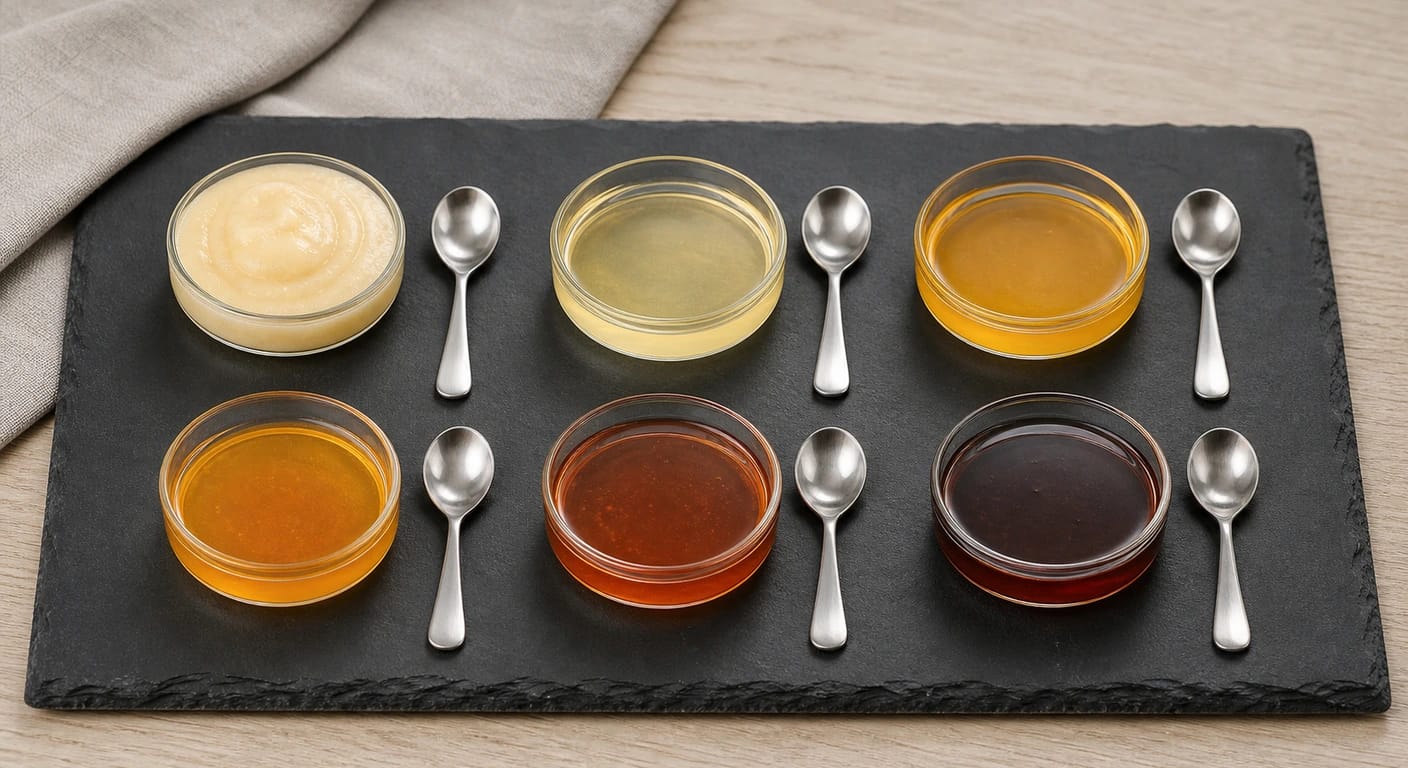
A honey may carry a varietal designation if it predominantly originates from that forage source. Verification is carried out through pollen analysis, sensory testing and physico-chemical parameters (conductivity, sugar spectrum).
| Variety | Typical Moisture Content | Crystallisation | Distinctive Feature |
|---|---|---|---|
| Rapeseed honey | 15-17 % | Very fast | Must be stirred immediately |
| Acacia (Robinia) honey | 16-18 % | Very slow | Naturally low enzyme values |
| Forest honey | 15-17 % | Slow | High conductivity > 0.8 mS/cm |
| Heather honey | 17-21 % | Gel-like | Up to 23 % moisture allowed |
Mixed blossom honey reflects the forage diversity of a region and often has a particularly complex aroma profile. The designation "blossom honey" or "summer blossom" is popular with consumers.
Storage: Preserving Quality
Storing Honey Correctly
- 10 degrees: HMF +1 mg/kg per year -- optimal
- 20 degrees: HMF +2-3 mg/kg per year -- acceptable
- 30 degrees: HMF +10-15 mg/kg per year -- critical, DIB limit exceeded in approx. 1 year
Quality Workflow
- 1
Before Harvesting
Check capping level (min. 2/3), shake test, refractometer measurement. Only extract if below 18 % (DIB).
- 2
During Harvesting
Clean, dry room, 20-25 degrees. No sunlight. Stainless steel or food-grade containers.
- 3
After Extracting
Double sieve, document moisture content, create batch record.
- 4
Ripening and Bottling
Let rest for 48-72 hours, skim foam. For fast-crystallising varieties, begin stirring immediately (Lesson 4). Fill cleanly, apply label (Lesson 5).
- 5
Storage
Cool, dark, dry. Check sensory quality regularly. Observe best-before date (typically 2 years).
Knowledge Check
In the next lesson, we follow the honey from hive to jar: the perfect harvest workflow with all steps and tools.