Honey Varieties: Discovering Regional Flavours
The most important honey varieties in profile: rapeseed honey, linden honey, forest honey and more. Colour, flavour, crystallisation, origin and prices compared.
Germany produces around 25,000 tonnes of honey annually -- with consumption of 80,000-90,000 tonnes. The quality and variety of German honeys are among the best in the world. In this lesson you will learn about the most important varieties: how they taste, where they come from and what makes them special.
This lesson focuses primarily on German and Central European honey varieties, as many are tied to specific landscapes and climates. The principles of varietal honey production and sensory evaluation, however, apply universally. Your local forage sources will produce their own unique honeys.
What Makes a Varietal Honey?
The Honey Ordinance permits a varietal designation when the honey predominantly originates from the named plant. Verification involves:
- 1
Pollen Analysis (Melissopalynology)
Microscopic examination of the pollen spectrum. The indicator pollen must be present in sufficient quantity -- the percentages vary by variety (rapeseed: ~60 %, robinia: ~20-30 %).
- 2
Sensory Testing
Colour, aroma, taste and consistency must match the typical varietal profile.
- 3
Physico-Chemical Parameters
Electrical conductivity, sugar spectrum and colour must fall within variety-specific ranges. Forest honey, for example, has a conductivity > 0.8 mS/cm.
Anyone who declares varietal honey must be able to prove it. False designations violate the Honey Ordinance. When in doubt, label as "blossom honey" or "summer blossom."
The Most Important Honey Varieties
1. Rapeseed Honey -- The Classic
| Characteristic | Rapeseed Honey |
|---|---|
| Colour | White to pale yellow, crystallises almost white |
| Flavour | Mild, delicately sweet, buttery |
| Crystallisation | Extremely fast (days to 2 weeks) |
| Glucose/Fructose | High glucose content (> 40 %) |
| Region | Northern Germany, Brandenburg, Saxony-Anhalt |
| Harvest | May -- IMMEDIATELY after the flow ends! |
| Price | 6-9 EUR / 500g |
Rapeseed honey crystallises so quickly that it can solidify in the combs. Harvest no later than 3-5 days after the flow ends and begin stirring immediately (Lesson 4).
2. Acacia Honey (Robinia Honey)
| Characteristic | Acacia Honey |
|---|---|
| Colour | Almost water-clear to delicate golden yellow |
| Flavour | Very mild, finely sweet, floral |
| Crystallisation | Very slow (stays liquid for months to years) |
| Glucose/Fructose | High fructose content (> 50 %) |
| Region | Brandenburg, Saxony, Thuringia, parks and avenues |
| Harvest | Late May / early June (blooms only 10-14 days) |
| Price | 8-12 EUR / 500g |
Acacia honey has naturally lower diastase and invertase values. The Honey Ordinance therefore allows DN 3 (instead of 8) if HMF is below 15 mg/kg.
3. Linden Honey
| Characteristic | Linden Honey |
|---|---|
| Colour | Light yellow to greenish-yellow |
| Flavour | Fresh, mentholated, bittersweet, unmistakable |
| Crystallisation | Medium-fast |
| Conductivity | 0.40-0.80 mS/cm (higher with honeydew content) |
| Region | Brandenburg, Berlin, Saxony, linden avenues everywhere |
| Harvest | Late June / early July |
| Price | 7-11 EUR / 500g |
Linden honey is one of the finest varieties. Its mentholated aroma is so distinctive that even laypeople can identify it blind.
4. Forest Honey (Honeydew Honey)
Forest honey is not made from nectar but from honeydew -- the sugary excretions of aphids and bark lice.
| Characteristic | Forest Honey |
|---|---|
| Colour | Dark brown to almost black |
| Flavour | Robust, malty, spicy, less sweet |
| Crystallisation | Slow (months) |
| Conductivity | > 0.8 mS/cm (key parameter!) |
| Region | Black Forest, Swabian Alps, Bavarian Forest, Harz |
| Harvest | July-August (highly weather-dependent) |
| Price | 9-14 EUR / 500g |
Certain honeydew sources produce honey with a high melezitose content. This crystallises extremely rapidly in the combs ("cement honey") and can no longer be extracted. Hive scales help with timely harvesting.
5. Heather Honey
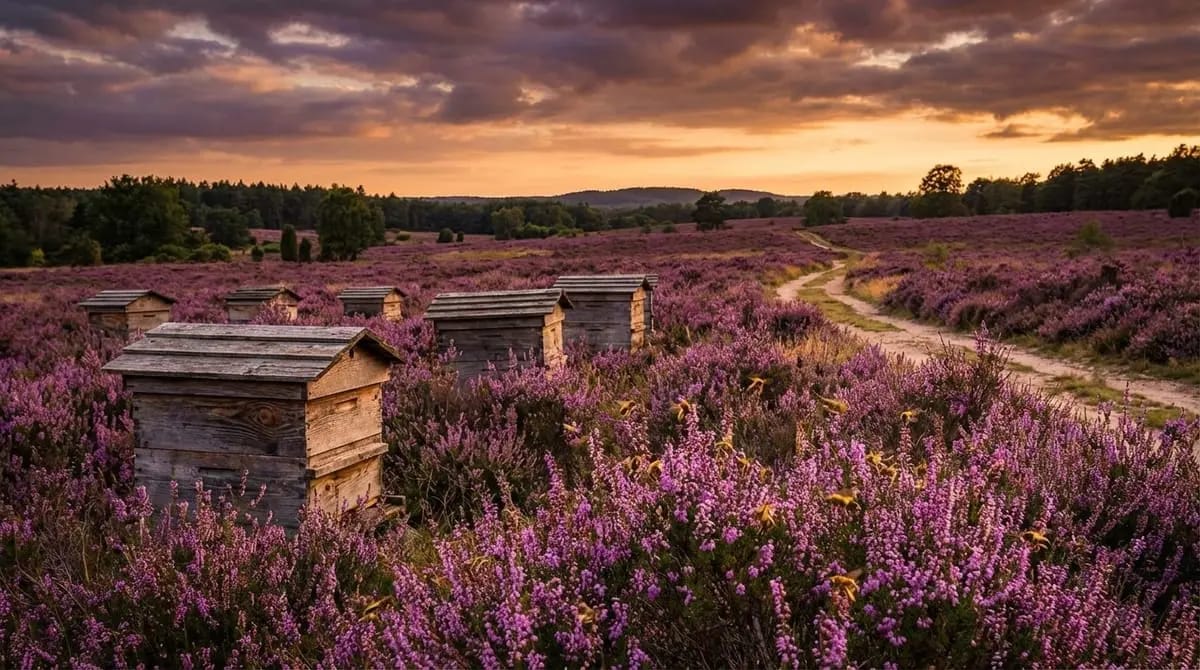
| Characteristic | Heather Honey |
|---|---|
| Colour | Amber to dark reddish-brown |
| Flavour | Bittersweet, spicy, caramel-like |
| Consistency | Thixotropic (gel-like) -- unique! |
| Distinctive Feature | CANNOT be extracted (pressing required) |
| Region | Lueneburg Heath, Senne, Rhoen |
| Harvest | September |
| Price | 12-20 EUR / 500g (Premium) |
Thixotropy means: gel-like at rest, becomes fluid when stirred. Heather honey is the only common honey with this property.
6. Fir Honey
| Characteristic | Fir Honey |
|---|---|
| Colour | Greenish-black with reddish shimmer |
| Flavour | Resinous, balsamic, complex, not very sweet |
| Crystallisation | Very slow to none |
| Conductivity | > 1.0 mS/cm |
| Region | Black Forest, Swabian Alps, Alpine foothills |
| Price | 12-18 EUR / 500g (Premium) |
7-9: Other Varieties
| Variety | Colour | Flavour | Crystallisation | Price/500g |
|---|---|---|---|---|
| Buckwheat honey | Dark brown-black | Very robust, bitter, malty | Medium | 10-15 EUR |
| Chestnut honey | Amber-dark brown | Bitter, herbaceous, nutty | Slow | 10-16 EUR |
| Phacelia honey | White-pale yellow | Very mild, neutral | Medium-fast | 7-10 EUR |
Buckwheat honey has a particularly high antioxidant content and is traditionally used as a cough remedy. Its robust flavour pairs well with dark bread and cheese.
The Grand Variety Comparison
| Variety | Colour | Flavour | Crystallisation | Price | Rarity |
|---|---|---|---|---|---|
| Rapeseed honey | White-light yellow | Mild, creamy | Very fast | 6-9 EUR | Common |
| Acacia honey | Water-clear | Very mild | Very slow | 8-12 EUR | Common |
| Linden honey | Greenish-yellow | Mentholated | Medium | 7-11 EUR | Medium |
| Forest honey | Dark brown | Malty, robust | Slow | 9-14 EUR | Medium |
| Heather honey | Amber | Bittersweet | Gel-like | 12-20 EUR | Rare |
| Fir honey | Greenish-black | Resinous | Hardly any | 12-18 EUR | Rare |
Varieties and Location: What Grows Where?
Mixed Blossom Honey: Underrated and Diverse
Not every honey needs to be a varietal honey. Mixed blossom honey accounts for a significant portion of production and has its own strengths.
Popular Designations
- Early flow / spring blossom: Fruit, dandelion, rapeseed and wildflower nectar (April-May)
- Summer blossom / summer flow: Linden, clover, blackberry, phacelia (June-July)
- Urban honey: From urban environments -- often surprisingly diverse thanks to parks and gardens
- Blossom honey: General designation, always correct
Mixed blossom honey is unique -- no other beekeeper has the same forage mix. Market this as a unique selling point: "Summer blossom from the city park" or "Spring harvest from the Weser hills." Customers love the local story.
Economic Variety Strategy
| Strategy | Advantages | Disadvantages | Recommended For |
|---|---|---|---|
| Only mixed blossom | Simple, no varietal proof needed | Lower prices | Beginners |
| 1-2 varieties + mixed blossom | Good range, good prices | Harvest timing critical | Hobby with good location |
| Migratory beekeeping | Max. variety | High logistics effort | Sideline / commercial |
| Premium varieties (heather/fir) | Highest prices | Uncertain harvest | Experienced specialists |
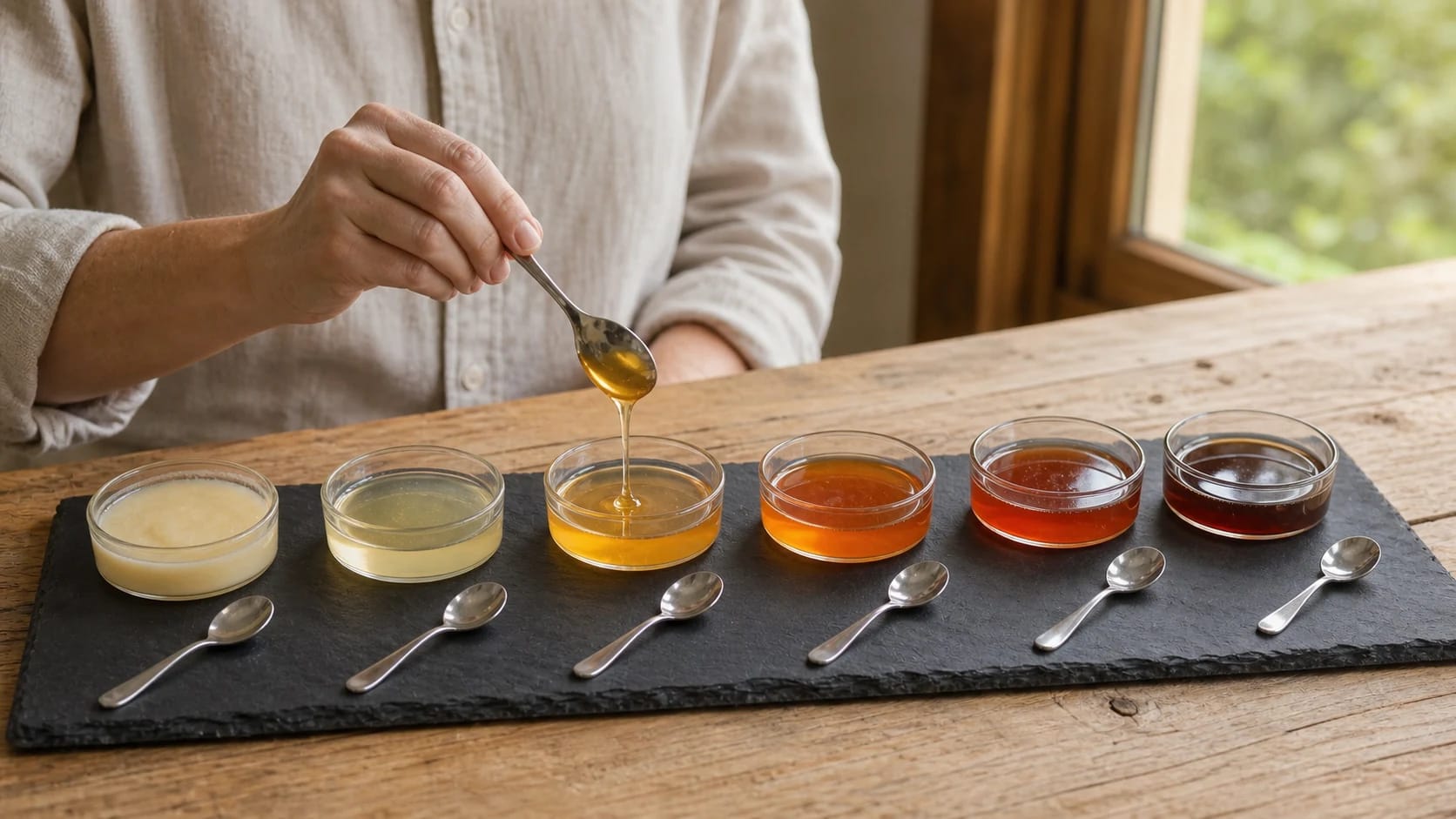
Systematic Honey Tasting
- 1
Visual assessment
Examine colour, clarity, consistency in the jar against light.
- 2
Check aroma
Intensity and character (floral, woody, mentholated, malty). Gently warm to release aromas.
- 3
Taste test
Assess sweetness, acidity, bitterness, aroma and aftertaste.
- 4
Feel texture
Creamy, grainy, liquid, gel-like? The texture reveals the variety and processing quality.
 AI-generated
Producing Varietal Honey
Prerequisites
The diversity of honeys is a treasure. Every beekeeper who carefully produces regional honey contributes to consumers appreciating the value of real honey.
Knowledge Check
In the next lesson we delve into processing techniques: extraction room, uncapping and the art of making creamed honey.