Labelling Under the Honey Ordinance: What Goes on the Label
All mandatory information for honey labels under HonigV and LMIV: trade description, best-before date, origin, nutrition. Plus DIB rules, organic labelling and QR code integration.
The specific laws and labelling requirements described in this lesson primarily apply to Germany (HonigV, LMIV, FPackV) and the EU. If you are based in another country, check your local food labelling regulations. The principles of transparent, accurate labelling are universal, but exact requirements may differ.
Labelling is one of the most legally sensitive steps. An incorrect label can lead to fines, product recalls and loss of customer trust. At the same time, the label is your most important marketing space.
In this lesson you will learn about all mandatory information under HonigV, LMIV and FPackV, the DIB specifics, voluntary enhancements and QR code integration.
The Legal Framework
| Legal source | Regulates | Relevant for honey |
|---|---|---|
| LMIV (EU 1169/2011) | General food labelling | Mandatory information, font size, nutrition |
| Honey Ordinance (HonigV) | Specific honey requirements | Trade descriptions, origin |
| Pre-packaging Regulation (FPackV) | Fill quantity and tolerances | Fill quantity declaration, font size |
| Lot Marking Regulation | Traceability | Batch identification |
Food inspectors can check at farmers' markets, farm shops or online sales. Fines for incorrect labelling: several hundred euros. False origin claims can even have criminal consequences.
The 7 Mandatory Items
Mandatory information on the honey label
1. Trade Description
The Honey Ordinance strictly defines permitted descriptions:
| Description | Meaning | Application |
|---|---|---|
| Honey / Blossom honey | From flower nectar | Standard for mixed blossom |
| Honeydew honey / Forest honey | Predominantly from honeydew | Forest / fir honey |
| Varietal honey (e.g. Rapeseed honey) | Predominantly from the named plant | Only if verifiable |
| Pressed honey | Obtained by pressing | Mandatory for pressed honey |
| Comb honey | In capped combs | For comb honey products |
- "Natural honey" / "Pure natural" -- misleading, as all honey must be a natural product
- "Cold-extracted" -- implies there is "hot extraction" (there is not)
- Health claims without authorisation ("helps with colds")
- Fantasy names without a correct trade description
2. Net Fill Quantity
Stated in grams or kilograms. Minimum digit height under FPackV:
| Fill quantity | Minimum digit height |
|---|---|
| up to 50 g | 2 mm |
| 50-200 g | 3 mm |
| 200-1,000 g | 4 mm |
| over 1,000 g | 6 mm |
Common sizes: 250 g (sample size), 500 g (standard), 1,000 g (regular customers). DIB jar: Only 250 g and 500 g.
The declared fill quantity must be met on average. For 500g: max. -15g tolerance per jar. Use a calibrated scale and fill slightly generously.
3. Best-Before Date (BBD)
The BBD is not an expiry date -- honey stored correctly is practically indefinitely shelf-stable. You set the BBD yourself and are liable for it.
Format: "Best before: 06/2028" or "Best before end: June 2028" (for shelf life over 3 months, month/year is sufficient).
4. Country of Origin
Mandatory for honey:
- German honey: "Country of origin: Germany" or "German honey" in the trade description
- EU blend: "Blend of honeys from EU countries"
- Non-EU blend: "Blend of honeys from EU and non-EU countries"
"German honey" or regional statements ("Honey from the Taunus") are strong selling points. Consumers pay more for regional honey -- but the claim must be truthful.
The new EU Honey Directive 2024/1438 tightens origin labelling: for honey blends, from 14 June 2026 the individual countries of origin with percentage shares must be listed in descending order on the label. The previous collective description "Blend of honeys from EU and non-EU countries" will no longer suffice.
5. Lot Number
Serves traceability. Format freely chosen, e.g.: "L 2026-S2" (Lot 2026, extraction 2). Tip: If the BBD includes day and month, it can simultaneously serve as the lot number.
6. Name and Address
Complete: First/last name, street, house number, postcode, city. Yes, you must provide your home address if you do not have a business address. A PO box is not sufficient.
7. Nutrition Declaration
Mandatory since 2016 for pre-packaged foods. Important exception: Under Annex V No. 19 LMIV, foods supplied in small quantities directly from the producer to consumers or local retail shops are exempt from the nutrition declaration (radius approx. 50 km). This exemption applies to many hobby beekeepers selling directly. For online sales, however, the exemption does not apply.
The "Big 7" per 100 g:
| Nutrient | Typical value |
|---|---|
| Energy | 1,340 kJ / 320 kcal |
| Fat | 0 g |
| of which saturated fatty acids | 0 g |
| Carbohydrates | 80 g |
| of which sugars | 78 g |
| Protein | 0.3 g |
| Salt | 0.01 g |
Recommendation: Even if you are exempt, include the nutrition table anyway -- the values are similar for all honeys and can be taken from standard food composition databases. It looks professional and builds trust.
Font Size
LMIV: All mandatory information at least 1.2 mm x-height (approx. 6-7 pt). For packaging under 80 cm2 surface area: 0.9 mm. Make a test print and check legibility!
The DIB Honey Jar
- 1
Use only original jars
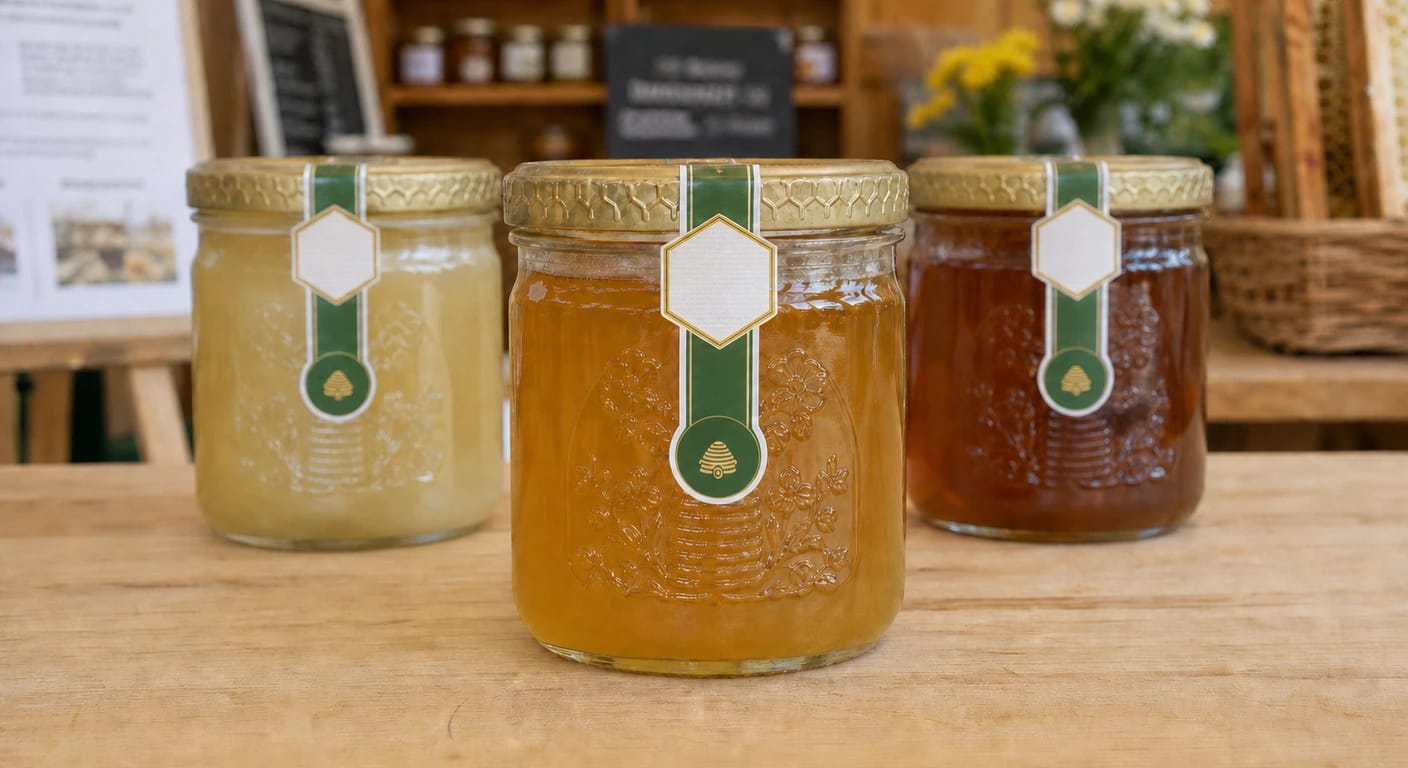
Exclusively DIB jars with the guarantee seal (green-gold banderole). Only 250 g and 500 g. Obtained from the regional association.
- 2
Apply the guarantee seal intact
The banderole must be stuck intact around the lid rim -- it guarantees DIB quality.
- 3
Back label with mandatory information
Your own label on the back with: name, address, BBD, lot number, nutrition table, variety if applicable.
- 4
Meet DIB quality standards
Max. 18 % moisture content, max. 15 mg/kg HMF, min. 64 Units/kg invertase, 100 % German honey.
DIB: High recognition value, trust signal, but limited design freedom (0.80-1.20 EUR/jar). Own jar: Maximum brand freedom, cheaper (0.30-0.60 EUR), but no quality seal. Many beekeepers use both: DIB for the classic range, own jars for premium lines.
Voluntary Information
| Information | Example | Effect |
|---|---|---|
| Regional origin | From the Taunus | Emotional connection, buying argument |
| Harvest year | Harvest 2026 | Signals freshness |
| Flavour description | Mild, creamy, floral | Helps with selection |
| Beekeeper portrait | Photo + short text | Personal connection |
| QR code | Link to apiary/story | Modern, transparent |
| Storage advice | Store cool and dark | Competence, extends quality |
Allergen Labelling
Honey itself is not an allergen (not on the LMIV list). Only relevant for mixed products:
- Honey with nuts: "Contains: tree nuts"
- Honey with milk: "Contains: milk"
- Pure honey: No ingredient list required (single-ingredient product)
Organic Labelling
- 1
Register with an organic control body
Choose an approved control body (e.g. DE-OKO-006). Costs: approx. 200-500 EUR/year.
- 2
Implement organic requirements
EU Organic Regulation 2018/848: Within the 3 km foraging radius, predominantly organic land or wild flora, approved hive materials, approved Varroa treatments (organic acids), organic feed.
- 3
Use the EU organic logo
Green leaf with stars. Mandatory alongside the logo: control body code number + origin statement.
Terms like "organic", "eco" or the EU organic logo without certification are illegal. Even "biologically valuable" or "natural like organic" are problematic.
Packaging Act (VerpackG) and LUCID
The following applies specifically to Germany. Other countries have their own packaging waste regulations -- check with your national authority.
Since 1 July 2022, everyone who first places filled packaging on the market -- including beekeepers who fill honey into jars -- must be registered in the LUCID Packaging Register and participate in a dual system.
Selling packaged food without LUCID registration risks fines up to 200,000 EUR and a sales ban. Registration at lucid.verpackungsregister.org is free; participation in a dual system (e.g. Der Gruene Punkt, Interseroh+) costs approximately 15-50 EUR/year for small quantities.
QR Code Integration
What to Link?
| Target | Customer benefit |
|---|---|
| Apiary map with photos | Transparency, regional connection |
| Batch info (harvest date, analysis values) | Verifiable quality |
| Beekeeper portrait and story | Personal connection |
| Recipes using the honey | Added value, usage ideas |
| Reorder option | Easy repeat purchase |
With Hivekraft you generate QR codes directly from the app -- linked to a public page with batch info, apiary photos and beekeeper portrait. No coding required.
Technical details: Print QR code at least 15 x 15 mm. Use a permanent URL (not a free dynamic provider). Short accompanying text: "Learn more" or "Meet our bees."
Label Design
Design Checklist
Common Mistakes
Sample Label
The label is the legal business card of your honey. A professional, complete label signals: this person knows their craft.
Knowledge Check
With this you have laid the foundation for a successful honey business: quality control, harvest workflow, variety knowledge, processing and labelling. In the remaining lessons we delve deeper into pricing, marketing and brand building.