Calculating Prices: Fair Pricing for Quality Honey
Learn full cost accounting for beekeeping products: materials, labour, depreciation and packaging. With break-even analysis and pricing strategies for maximum returns.
One of the most common questions beekeepers face: What should my honey cost? Many hobby beekeepers give away their honey or sell it well below its true value -- often out of uncertainty because they do not know their actual costs. At the same time, beekeepers who want to work more professionally face the challenge of finding prices that are fair to customers yet still cover their own costs.
In this lesson you will learn how to compile a solid full cost calculation, what market prices are typical, and how to use psychologically savvy pricing to market your honey successfully. By the end, you will be able to calculate a well-founded price for each of your products.
The specific market prices, tax rules and cost examples in this lesson are based on Germany (2025/2026). If you are based elsewhere, adapt the figures to your local market, but the principles of full cost accounting and pricing strategy apply universally.
Why Proper Pricing Matters
Before we dive into the numbers, let us clarify why professional pricing is relevant for every beekeeper -- even if you only have 5 colonies:
- Valuing your work: A realistic price reflects the hundreds of hours you invest annually
- Sustainability: Only those who cover their costs can practise high-quality beekeeping long-term
- Quality signal: A price that is too low makes customers doubt the quality
- Fairness: If you sell your honey too cheaply, you also undermine the prices of your fellow beekeepers
- Business foundation: Anyone wanting to scale up needs reliable calculations
Many beekeepers only account for the obvious costs like jars and labels. Yet these packaging costs represent only 10-15 % of actual total costs. The real cost drivers are labour time, equipment depreciation and ongoing operating costs -- and these are systematically underestimated.
Fundamentals of Full Cost Accounting
Full cost accounting captures all costs arising in honey production -- direct and indirect. Only this way do you get a realistic picture of your actual production costs.
The Four Cost Blocks
- 1
Block 1: Material costs (variable costs)
These are costs directly related to the quantity produced. The more honey you produce, the more jars, labels and lids you need.
Typical items:
- Honey jars (DIB 500g: approx. 0.55-0.70 EUR/piece, neutral jar: 0.35-0.55 EUR)
- Lids (0.10-0.25 EUR/piece, depending on quality)
- Labels (DIB guarantee seal: approx. 0.12 EUR, own label: 0.08-0.25 EUR)
- Foundation sheets (approx. 1.20-1.80 EUR/piece)
- Feed (sugar/syrup: approx. 15-20 EUR per colony per year)
- Varroa treatment products (approx. 5-10 EUR per colony per year)
- Packaging materials (cartons, tape, padding for shipping)
- 2
Block 2: Labour costs (calculated)
Even if you do not pay yourself a wage, your working time has value. For the calculation, you should apply a notional hourly rate.
Benchmarks:
- Hobby beekeeper: 15-20 EUR/hour (minimum wage orientation)
- Sideline beekeeper: 20-30 EUR/hour (skilled work)
- Professional beekeeper: 25-40 EUR/hour (skilled worker level)
Time spent per colony per year:
- Inspections and care: approx. 15-20 hours
- Honey harvest and processing: approx. 5-8 hours
- Varroa treatment: approx. 3-5 hours
- Winter feeding: approx. 2-3 hours
- Marketing and sales: approx. 3-5 hours
- Administration and documentation: approx. 2-4 hours
- Total: approx. 30-45 hours per colony per year
- 3
Block 3: Depreciation (equipment and hives)
Equipment and hives have a limited useful life. Acquisition costs are spread over this useful life.
Typical depreciation periods:
- Honey extractor: 15-20 years (cost: 300-2,000 EUR)
- Hives (wood): 10-15 years (cost: 80-150 EUR/piece)
- Smoker: 5-8 years (cost: 25-50 EUR)
- Uncapping equipment: 10-15 years (cost: 50-200 EUR)
- Protective clothing: 3-5 years (cost: 60-120 EUR)
- Bottling equipment: 10-15 years (cost: 50-300 EUR)
- 4
Block 4: Ongoing operating costs (fixed costs)
These costs arise regardless of production volume.
Items:
- Association membership + insurance: 40-80 EUR/year
- Animal disease fund: 0-15 EUR/year (varies by region)
- Travel costs to apiaries: highly variable (0.30 EUR/km flat rate)
- Electricity (extraction room, heating plate): approx. 50-100 EUR/year
- Water supply and cleaning: approx. 20-40 EUR/year
- Training and specialist literature: approx. 50-150 EUR/year
- Processing room (rent/proportionate): 0-600 EUR/year
Sample Calculation: 500g Jar of Blossom Honey
Let us look at a concrete calculation. We assume a small hobby operation with 10 colonies harvesting an average of 25 kg of honey per colony per year -- 250 kg total harvest.
| Cost item | Cost/year | Cost per 500g jar |
|---|---|---|
| Jar + lid | 350 EUR (500 jars) | 0.70 EUR |
| Labels + guarantee seal | 100 EUR | 0.20 EUR |
| Foundation sheets | 120 EUR | 0.24 EUR |
| Feed + treatment | 250 EUR | 0.50 EUR |
| Equipment depreciation | 200 EUR | 0.40 EUR |
| Ongoing operating costs | 300 EUR | 0.60 EUR |
| Labour (350 hrs x 20 EUR) | 7,000 EUR | 14.00 EUR |
| TOTAL (with labour) | 8,320 EUR | 16.64 EUR |
| TOTAL (without labour) | 1,320 EUR | 2.64 EUR |
The figures show clearly: labour time accounts for over 80 % of total costs. At a selling price of 8 EUR per 500g jar, the calculated hourly rate is only about 3-4 EUR. This is not a criticism -- it shows that beekeeping as a pure business model is challenging for small operations. All the more reason not to sell your honey below even the bare material costs.
Realistic Price Finding
The honest answer is: as a hobby beekeeper with 10 colonies, you will struggle to fully recoup labour costs through the honey price. That is perfectly fine -- for most people, beekeeping is a hobby with side income, not a full-time business. Nevertheless, your price should at minimum cover material costs, depreciation and operating costs and make a reasonable contribution to your working time.
Formula for the Minimum Price
The absolute minimum price below which you should never sell:
Minimum price = Material costs + Depreciation + Operating costs + Profit margin
For our example:
2.64 EUR + 20 % margin = 3.17 EUR per 500g jar
That is the bare floor. A fair price that also honours part of your working time lies considerably higher -- in the range of 7-12 EUR per 500g.
Market Prices: The Big Comparison
To position your price realistically, you need to know what honey costs across different sales channels.
| Sales channel | Price per 500g | Quality | Note |
|---|---|---|---|
| Discounter | 2.49-3.99 EUR | Blended, often imported | EU/non-EU blends, industrial |
| Supermarket | 3.99-6.99 EUR | Mixed | Broad spectrum, including brand honey |
| DIB beekeeper honey (association jar) | 6.50-9.00 EUR | Controlled, regional | German honey, DIB quality standards |
| Direct sales (farm shop) | 7.00-12.00 EUR | High, regional | Personal contact, trust |
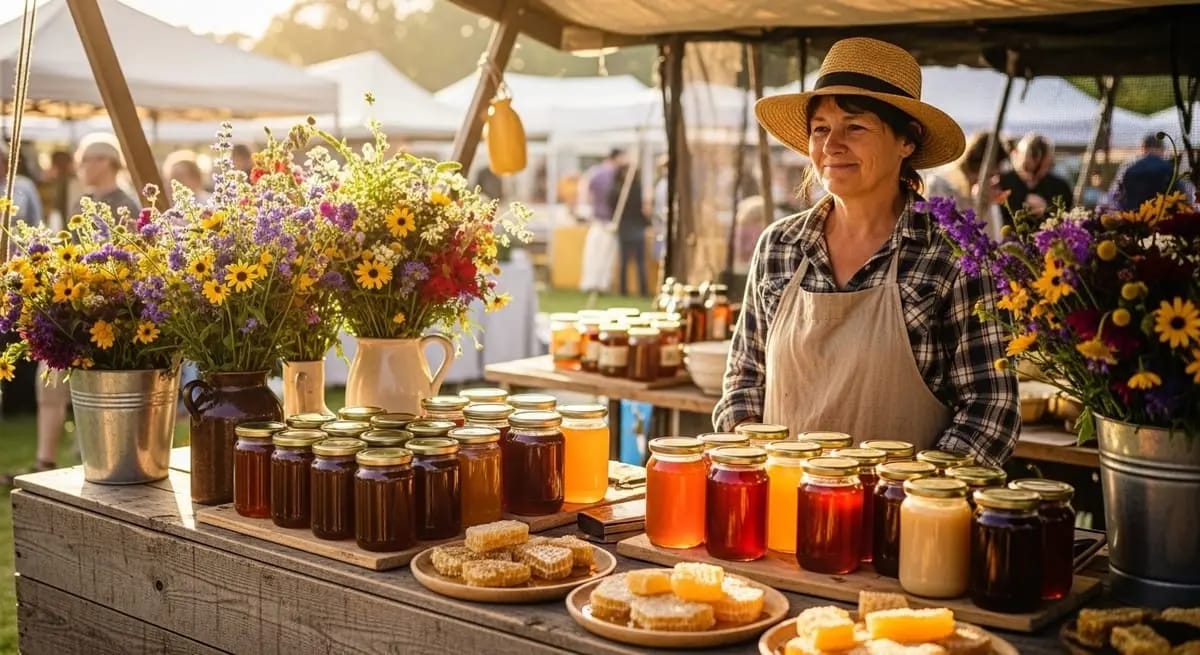
| Farmers' market | 8.00-14.00 EUR | High, varietal | Premium segment, advice included |
| Organic honey (certified) | 9.00-16.00 EUR | Organic certified | 20-40 % premium over conventional |
| Speciality (heather/forest) | 10.00-20.00 EUR | Premium, varietal | Rare varieties, limited availability |
| Online shop (own) | 8.00-15.00 EUR | High | Plus shipping, larger radius |
The German Beekeepers' Association (DIB) publishes annual price recommendations. For 2025/2026, the recommendation is 6.50-8.50 EUR for 500g (depending on region and variety). This serves as a guideline and minimum price for DIB jar marketers. Direct marketers with a good story and quality can and should price significantly higher.
Price Differences by Region
Customers' willingness to pay varies considerably by region:
- Major cities (Munich, Hamburg, Berlin): 10-15 EUR/500g achievable, especially in urban organic shops
- Affluent suburbs: 8-12 EUR/500g, high appreciation for regionality
- Rural areas: 6-9 EUR/500g, people often know beekeepers personally
- Tourist regions: 10-14 EUR/500g, honey as a souvenir and gift
Price Differentiation: Different Prices for Different Products
A uniform price for all honey varieties leaves money on the table. Smart price differentiation allows you to appropriately reflect the value of each variety.
Differentiation by Variety
Not all honey varieties are equally expensive to produce or equally rare:
| Honey variety | Recommended price (500g) | Justification |
|---|---|---|
| Early flow / blossom honey | 7.00-9.00 EUR | Standard variety, relatively high yield |
| Summer blossom | 7.50-9.50 EUR | Complex aroma, medium yield |
| Rapeseed honey | 7.00-8.50 EUR | High yield, but strong demand |
| Linden honey | 8.50-11.00 EUR | Popular variety, location-dependent |
| Forest / fir honey | 9.00-14.00 EUR | Honeydew honey, lower yield, sought-after |
| Acacia honey | 9.00-13.00 EUR | Stays liquid long, popular |
| Heather honey | 12.00-20.00 EUR | Very laborious harvest (pressing), rare |
| Comb honey | 14.00-25.00 EUR | Unprocessed premium product |
Differentiation by Packaging and Size
| Container size | Effective price/kg | Strategy |
|---|---|---|
| 50g sample jar | 30-40 EUR/kg | Gift, tasting sets, wedding favours |
| 250g jar | 20-28 EUR/kg | Entry product, gift |
| 500g jar | 14-24 EUR/kg | Standard size, best-seller |
| 1,000g jar | 12-18 EUR/kg | Regular customers, volume discount |
| 2.5-5 kg bucket | 8-12 EUR/kg | Bulk buyers, restaurants |
The 250g jar is often underestimated but makes an excellent gift and sample format. The effective price per kilo is significantly higher than for the 500g jar, and customers perceive the absolute price (4-6 EUR) as low-threshold. Particularly suitable for assortment boxes (3 x 250g different varieties).
Price Psychology: How People Perceive Prices
Prices are not just numbers -- they send messages. Here are the most important psychological principles you can use in pricing:
1. Threshold Prices (Price Anchors)
People do not perceive prices linearly. The jump from 7.90 EUR to 8.10 EUR feels larger than from 8.10 EUR to 8.30 EUR because the 8-euro threshold is crossed. Use this:
- 7.90 EUR instead of 8.00 EUR (stay below the psychological threshold)
- 9.80 EUR instead of 10.00 EUR (avoid the 10-EUR barrier)
- Alternatively: deliberately round prices (8.00 EUR, 10.00 EUR) for a premium signal
2. Anchoring Effect
Show the most expensive honey first. When customers first see heather honey at 18 EUR, the blossom honey at 8.50 EUR looks like a bargain afterwards. This works at the market stand just as well as in an online shop.
3. Decoy Effect
Offer three sizes where the middle one has the best value for money:
- 250g for 5.50 EUR (22 EUR/kg)
- 500g for 8.50 EUR (17 EUR/kg) -- best deal
- 1,000g for 15.00 EUR (15 EUR/kg)
Most customers choose the 500g jar because it is significantly cheaper per kilo than the small jar, yet requires less commitment than the kilo jar.
4. Quality Signal Through Price
A price that is too low for food products can have the opposite of the intended effect: instead of selling more, trust in quality drops. For artisan products like beekeeper honey, the price signals care and value.
Contribution Margin Analysis: What Remains?
The contribution margin analysis shows you how much each jar sold contributes to covering your fixed costs.
The contribution margin is the difference between the selling price and the variable costs (material costs) per unit. It shows how much money remains after deducting directly attributable costs to cover fixed costs and generate profit.Formula
Contribution margin (CM) = Selling price - Variable costs per unit
Sample Calculation for Various Products
| Product | Selling price | Variable costs | Contribution margin | CM in % |
|---|---|---|---|---|
| 500g blossom honey (DIB jar) | 8.50 EUR | 1.20 EUR | 7.30 EUR | 85.9 % |
| 250g blossom honey | 5.50 EUR | 0.85 EUR | 4.65 EUR | 84.5 % |
| 500g forest honey | 11.00 EUR | 1.20 EUR | 9.80 EUR | 89.1 % |
| Comb honey (250g) | 12.00 EUR | 1.50 EUR | 10.50 EUR | 87.5 % |
| Tasting set (3x250g) | 18.00 EUR | 3.50 EUR | 14.50 EUR | 80.6 % |
| Candles (pair) | 8.00 EUR | 2.50 EUR | 5.50 EUR | 68.8 % |
| Propolis tincture (30ml) | 9.50 EUR | 1.80 EUR | 7.70 EUR | 81.1 % |
Forest honey and comb honey have the highest contribution margin per unit. This means: each jar sold contributes the most to covering your fixed costs. If you have a choice of which product to promote more, premium products are more attractive from a business perspective -- provided the demand is there.
Break-Even Analysis: When Does It Pay Off?
The break-even analysis answers the question: How many jars must I sell to cover my fixed costs?
The break-even point is where revenue exactly covers total costs. Beyond this point, the operation generates profit.Formula
Break-even quantity = Fixed costs / Contribution margin per unit
Example: 10 Colonies, 250 kg Harvest
Assuming your annual fixed costs (depreciation + operating costs, excluding labour) are 500 EUR and your average contribution margin is 7.30 EUR per 500g jar:
500 EUR / 7.30 EUR = 69 jars
You need to sell at least 69 jars of 500g (= 34.5 kg honey) to cover your fixed costs. With a total harvest of 250 kg (= 500 jars), this is easily achievable.
Extended Break-Even Analysis Including Labour
If you also factor in part of your labour time (e.g. 10 EUR/hour instead of the full 20 EUR):
Fixed costs: 500 EUR + (350 hours x 10 EUR) = 4,000 EUR 4,000 EUR / 7.30 EUR = 548 jars (= 274 kg)
This exceeds the 250 kg harvest! With 10 colonies and moderate labour valuation, you do not reach break-even. Only from approximately 15-20 colonies or at higher selling prices does the calculation turn positive.
Three adjustments to reach break-even faster:
- Higher prices (premium varieties, direct sales, storytelling)
- More yield (better locations, optimised management)
- By-products (wax, propolis, courses -- additional revenue without additional colonies)
Pricing for By-Products
Besides honey, beekeeping products offer interesting additional revenue. Here is an overview of typical market prices:
| Product | Typical price | Effort | Revenue potential |
|---|---|---|---|
| Beeswax candles (pair) | 6-12 EUR | Medium | Good (Christmas season) |
| Beeswax wraps (set of 3) | 12-18 EUR | Medium | Good (sustainability trend) |
| Propolis tincture (30ml) | 8-15 EUR | Low | Very good |
| Bee pollen (250g) | 8-14 EUR | Medium | Good |
| Lip balm (5ml) | 3-6 EUR | Low | Good (gift item) |
| Honey gift set | 20-45 EUR | Low | Very good (Christmas, Easter) |
| Mead (0.5l) | 8-15 EUR | High | Medium |
Calculation Tool: Your Personal Computation
Here is a step-by-step guide to calculate your individual honey price:
- Calculator or spreadsheet
- Last year's accounts/receipts
- Overview of harvest quantities
- List of all equipment with year of purchase
Step 1: Note all variable costs per jar (jar, lid, label, proportionate foundation sheets, feed, treatment)
Step 2: Sum all fixed costs from the past year (association, insurance, travel, electricity, rent)
Step 3: Calculate the annual depreciation of all equipment (purchase price / useful years)
Step 4: Estimate your annual working hours and multiply by your notional hourly rate
Step 5: Add everything together and divide by the number of jars produced
Step 6: Add a profit margin of 15-25 %
Step 7: Compare with market prices and adjust if necessary
Common Pricing Mistakes
Pricing Strategies for Different Situations
Strategy 1: The Beginner (1-5 colonies)
You have little honey and sell mainly to friends and acquaintances.
- Price: Association price recommendation as minimum (approx. 7-8 EUR/500g)
- Focus: Learn fair pricing, do not give away
- Tip: Better to sell less and use the rest yourself than to sell too cheaply
Strategy 2: The Ambitious Hobbyist (5-15 colonies)
You market actively and want to cover your costs.
- Price: 8-12 EUR/500g depending on variety and region
- Focus: Price differentiation by variety, offer 2-3 container sizes
- Tip: Gift sets and by-products for higher contribution margins
Strategy 3: The Sideline Beekeeper (15-50 colonies)
You want to generate a meaningful contribution to income.
- Price: 9-15 EUR/500g for premium varieties, differentiated price list
- Focus: Professional packaging, brand building, diverse sales channels
- Tip: Update break-even analysis monthly, compare contribution margins
Checklist: Your Price Calculation
Pricing Checklist
Knowledge Check
Test your pricing knowledge:
In the next lesson we explore marketing strategies -- from the farm shop to the farmers' market to your own online shop. You will learn which sales channel suits you and how to win and retain customers.