Nectar and Pollen: What Bees Really Need
Understanding nectar, pollen, and honeydew: composition, nectar secretion, foraging behavior, and forage evaluation for successful beekeeping.
Nectar, pollen, and honeydew are the three pillars of bee nutrition -- each with an entirely different significance for the colony. Understanding these fundamentals allows you to evaluate forage offerings and manage your colonies optimally.
What Is Nectar?
Nectar is a sugar-rich fluid secreted by special glands of the plant -- called Nectaries -- and excreted to attract pollinators. It is the central lure plants use for their pollinators and simultaneously the most important energy source for honey bees.
Composition of Nectar
| Component | Proportion | Function for the Bee |
|---|---|---|
| Water | 40-80% | Carrier medium, reduced to 16-18% in honey |
| Sucrose | 5-40% | Main energy source, split into glucose + fructose |
| Glucose | 3-25% | Quick energy, promotes crystallization |
| Fructose | 3-25% | Slow energy, keeps honey liquid |
| Amino acids | Traces | Flavor development |
| Minerals, aromatic compounds | Traces | Enzyme function, variety-specific aroma |
Plants differ fundamentally in the sugar ratio of their nectar. Sucrose-dominant nectars (e.g., black locust, white clover) contain predominantly table sugar and are particularly attractive to bees. Hexose-dominant nectars (e.g., rapeseed, dandelion) contain more glucose and fructose -- honey made from them crystallizes faster. Some plants like linden offer a balanced ratio.
Sugar Concentration and Attractiveness
Below 15% sugar content, the foraging effort is not worthwhile; above 70%, the nectar is too viscous. The optimal range is 30-50% -- here the ratio of energy density to ease of uptake is ideal.
What Is Honeydew?
Honeydew is the excretion product of plant-sucking insects (aphids, bark lice, scale insects, leafhoppers) -- an often underestimated second sugar source alongside blossom nectar.
How Honeydew Is Produced
- 1
Plant sap is absorbed
Aphids and bark lice insert their proboscis into the sieve tubes (phloem) of trees and shrubs. They extract the sugar-rich plant sap, which is under pressure.
- 2
Amino acids are filtered
The aphids primarily need the amino acids in the plant sap. Since the sap consists of about 90% sugar, they must process large volumes to obtain enough protein.
- 3
Excess sugar is excreted
The excess, enzyme-modified sugar is excreted as sticky droplets -- this is honeydew. It drips onto leaves, needles, and other surfaces below.
- 4
Bees collect the honeydew
Honey bees recognize honeydew droplets and deliberately collect them. In good honeydew years, the forest forage can be more productive than any blossom forage.
Nectar vs. Honeydew: A Comparison
| Property | Blossom Nectar | Honeydew |
|---|---|---|
| Origin | Nectaries of blossoms | Excretion of plant-sucking insects (aphids, leafhoppers) |
| Sugar content | 15-75% (usually 20-50%) | 5-60% (usually 10-30%) |
| Sugar types | Sucrose, glucose, fructose | Additionally melezitose, erlose, trehalose |
| Mineral content | Low | Significantly higher (up to 10x) |
| Honey color | Light to medium (variety-dependent) | Dark to very dark |
| Taste | Mild to aromatic | Bold, malty, often spicy |
| Special features | Monofloral honey possible (e.g., rapeseed honey) | Melezitose can lead to cement honey problems |
| Availability | Depends on bloom calendar | Depends on aphid populations and weather |
Some types of honeydew contain high proportions of melezitose, a trisaccharide that crystallizes extremely rapidly in honey -- so firmly that the honey solidifies in the combs and can no longer be extracted. This so-called cement honey or concrete honey is found particularly when foraging from the spruce bark louse (Cinara pilicornis). Beekeepers in forested areas should regularly check honey consistency.
Pollen: The Protein Source for Bees
While nectar represents the energy source (carbohydrates), pollen is the protein source of the colony. Without sufficient pollen, a colony cannot raise brood, feed young bees, or produce winter bees with adequate fat body reserves.
Composition of Pollen
Pollen is a remarkably nutrient-rich natural product:
- Protein: 10-35% (average about 20%) -- more than in most grain varieties
- Amino acids: All 10 amino acids essential for bees (arginine, histidine, isoleucine, leucine, lysine, methionine, phenylalanine, threonine, tryptophan, valine)
- Fats (lipids): 1-14% -- important for fat body formation in winter bees
- Vitamins: A, B complex (B1, B2, B6, niacin, folic acid, pantothenic acid), C, D, E
- Minerals: Potassium, calcium, magnesium, iron, zinc, copper, manganese
- Carbohydrates: 15-40% (starch and sugars)
- Water: 7-16% (fresh pollen up to 30%)
Pollen Quality: Not All Pollen Is Equal
Pollen quality varies enormously between different plant species. For bee health, it is not just the quantity but above all the protein content and the amino acid profile that matter:
| Plant | Protein Content (%) | Rating for Bees |
|---|---|---|
| White clover (Trifolium repens) | 23-30 | Excellent -- high protein content, broad amino acid profile, easily accessible |
| Fruit trees (Malus, Prunus) | 20-28 | Very good -- important spring forage |
| Rapeseed (Brassica napus) | 22-27 | Very good -- mass forage with good protein |
| Willow (Salix sp.) | 18-25 | Good -- most important early forage |
| Dandelion (Taraxacum) | 14-18 | Moderate -- abundant pollen but lower protein content |
| Corn (Zea mays) | 15-20 | Moderate -- wind-pollinated but collected by bees when scarce |
| Pine (Pinus sp.) | 5-10 | Poor -- very low protein content, nearly worthless |
Bees with pollen from diverse plant species are healthier and live longer than those on a monofloral pollen diet. Landscapes with high plant diversity promote bee health.
How Bees Collect Pollen
The forager lands on the blossom, where electrostatic charge draws pollen grains onto her fur. Using special brushes, she combs out the pollen, moistens it with nectar, and presses it into the pollen baskets (corbiculae) on her hind legs. Back in the hive, the pollen loads are scraped off into cells near the brood and fermented by house bees into bee bread (perga).
Nectar Secretion: Why Not Every Day Is the Same
The amount and quality of nectar secreted depends on numerous factors. Knowing these is essential for beekeepers to properly assess forage periods:
Temperature Factor
Temperature is the most important factor influencing nectar secretion:
- Below 10°C: Barely any nectar secretion in most plants
- 15-25°C: Optimal range for most Central European forage plants
- Above 30°C: Nectar secretion often decreases (drought stress); some plants stop entirely
- Night temperature: Warm nights (above 15°C) particularly promote next-day nectar secretion
Experienced beekeepers know the formula: Warm days (20-28°C) + warm nights (above 14°C) + sufficient soil moisture = strong nectar secretion. In Germany and Central Europe, these conditions typically occur in May/June and often again in July. Dry periods with hot days and cool nights dramatically slow down the forage flow.
Humidity
- High humidity (60-80%): Promotes nectar secretion, as the plant loses less water
- Low humidity (below 40%): Reduces nectar quantity but increases sugar concentration
- After rain: Often a brief nectar surge when soil moisture increases
Soil and Plant Factors
Nutrient-rich, deep soils with good water-holding capacity promote nectar production (especially potassium and phosphorus). Waterlogged soils inhibit it despite high moisture. As for the plants themselves: young blossoms produce more nectar, heritage fruit varieties are often more productive than modern ones, and sun-exposed blossoms yield more than shaded ones.
Forage Evaluation: Nectar Value and Pollen Value
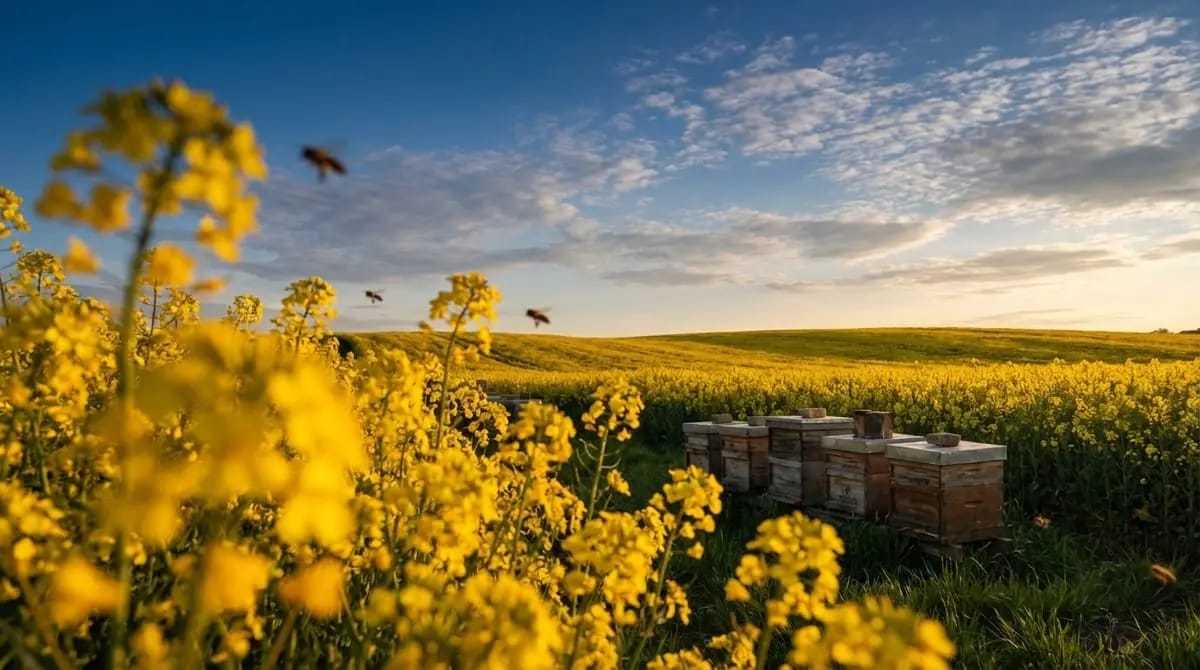
In beekeeping literature, forage plants are standardly rated with a nectar value and a pollen value. This scale helps quickly assess the forage benefit of different plants:
The Rating Scale (1-4)
| Value | Nectar Yield | Pollen Yield | Example - Nectar | Example - Pollen |
|---|---|---|---|---|
| 1 (low) | Little to insignificant | Little to insignificant | Dogwood, oak | Corn, pine |
| 2 (moderate) | Noticeable, supplements other forage | Decent amounts | Apple, cherry | Dandelion, birch |
| 3 (good) | Good forage, honey surplus possible | Abundant, supports brood rearing | Sweet chestnut, hawthorn | Willow, rapeseed |
| 4 (very good) | Mass forage, high honey yield | Overabundant | Rapeseed, linden, black locust | Hazel, white clover |
Some plants are outstanding nectar providers but offer little pollen (e.g., buckwheat). Others are pure pollen donors without significant nectar (e.g., hazel, corn). For good bee nutrition, both are needed -- ideally simultaneously or in close succession.
What Does "Mass Forage" Mean?
The term Mass Forage refers to a forage period where a colony records a daily weight gain of 3-10 kg -- sometimes even more. Typical mass forage events in Germany and Central Europe:
- Rapeseed (April-June): Up to 8-10 kg/day under optimal conditions
- Black locust (May-June): Up to 6-8 kg/day, but often only 10-14 days long
- Linden (June-July): Up to 5-8 kg/day, varies greatly by region
- Heather (August-September): 2-5 kg/day, long-lasting
Trickle Flow: The Underestimated Supply
In contrast to mass forage, there is the Trickle Flow -- a continuous but low nectar supply from many different sources. Weight gain ranges from 0.2-1.5 kg per day. Typical trickle flow situations:
- Mixed forests with various wildflowers
- Home gardens and parks with perennials
- Field margins and roadsides with wildflowers
- Urban areas with diverse bloom offerings
For bee health, trickle flow is enormously valuable: continuous supply, stable brood, high pollen diversity. Locations with good trickle flow often have the lowest colony losses.
Honey Bee Foraging Behavior
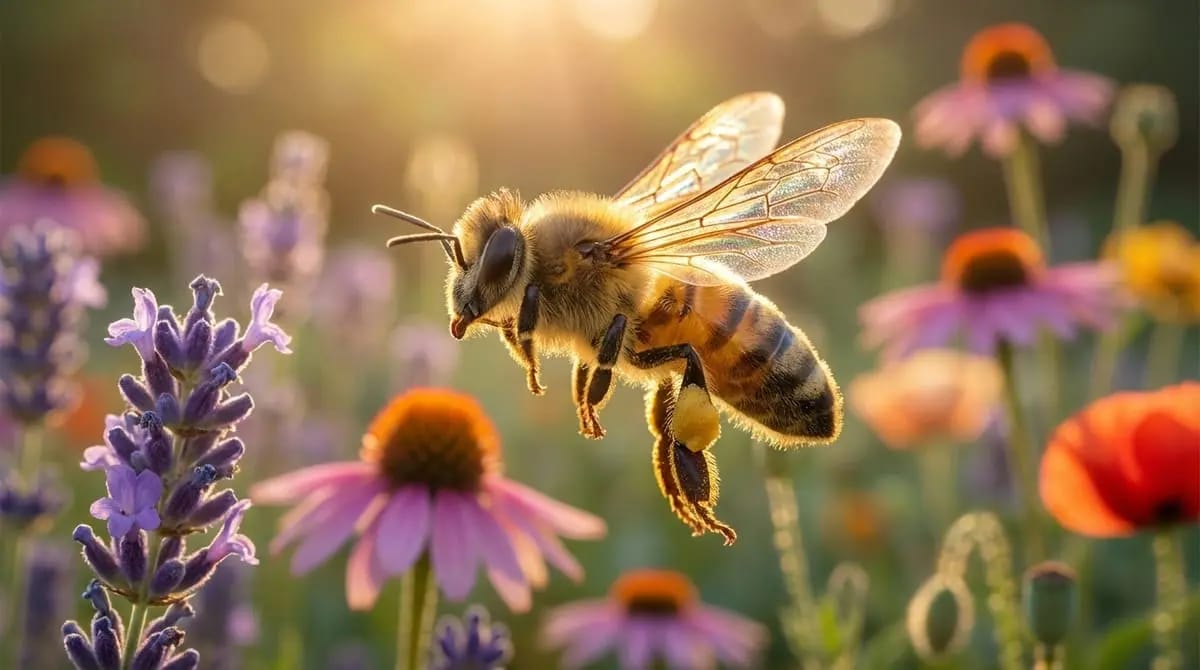
Foraging Radius: The Forage Network
The typical foraging radius is 1-3 km (maximum 5 km, in extreme cases 10 km). The preferred range is 1.5 km. At a 3 km radius, the foraging area covers approximately 2,800 hectares.
Division of Labor in Foraging
Bees specialize: Nectar foragers carry 40-80 mg per trip in the honey stomach, pollen foragers carry 15-30 mg in their baskets, water foragers (up to 25% of foragers during heat) cool the hive, and propolis foragers (1-5%) seal it.
Flower Fidelity
Individual foragers remain loyal to a single plant species during a foraging cycle (Flower Fidelity). This ensures effective cross-pollination and enables monofloral honeys when mass forage from a single source dominates.
Annual Forage Overview
- Jan-FebEarly Spring BloomersHazel and snowdrops provide first pollen sources. No significant nectar flow yet. Bees use hazel pollen on mild days (from 10°C) to start brood rearing.
- Mar-AprSpring ForageWillow (Salix) as the first mass forage! Plus fruit blossom (cherry, plum, apple), dandelion, maple. Crucial phase for colony development. Nectar value 2-4.
- May-JunMain ForageRapeseed, black locust (acacia), early honeydew. The most productive phase of the year. Daily gain of 3-10 kg possible. Linden bloom begins late June.
- Jul-AugSummer Forage / Forage GapLinden (early July), sweet chestnut, phacelia, forest forage (honeydew). In many regions a forage gap from mid-July! Sunflower, buckwheat, and balsam in some areas.
- Sep-OctLate ForageHeather (important in the north!), ivy (last pollen provider), autumn aster, Himalayan balsam. Important for winter stores. Decreasing day length signals the colony: brood reduction.
- Nov-DecForage-Free PeriodNo more forage. The colony lives on its stores (honey and pollen). The winter cluster forms. Feed reserves must be sufficient -- this is why correct autumn feeding is so important.
- Jan-Feb
Early Spring Bloomers
Hazel and snowdrops provide first pollen sources. No significant nectar flow yet. Bees use hazel pollen on mild days (from 10°C) to start brood rearing.
- Mar-Apr
Spring Forage
Willow (Salix) as the first mass forage! Plus fruit blossom (cherry, plum, apple), dandelion, maple. Crucial phase for colony development. Nectar value 2-4.
- May-Jun
Main Forage
Rapeseed, black locust (acacia), early honeydew. The most productive phase of the year. Daily gain of 3-10 kg possible. Linden bloom begins late June.
- Jul-Aug
Summer Forage / Forage Gap
Linden (early July), sweet chestnut, phacelia, forest forage (honeydew). In many regions a forage gap from mid-July! Sunflower, buckwheat, and balsam in some areas.
- Sep-Oct
Late Forage
Heather (important in the north!), ivy (last pollen provider), autumn aster, Himalayan balsam. Important for winter stores. Decreasing day length signals the colony: brood reduction.
- Nov-Dec
Forage-Free Period
No more forage. The colony lives on its stores (honey and pollen). The winter cluster forms. Feed reserves must be sufficient -- this is why correct autumn feeding is so important.
Summary: The Most Important Fundamentals
Core Knowledge: Nectar and Pollen
Knowledge Check
The differences between mass forage and trickle flow become tangible with a hive scale: 8 kg gain on a rapeseed day versus 0.5 kg on a quiet summer day tells the whole story. In the course Using Hivekraft Effectively (Lesson 9: IoT Sensors), you will learn how to set up a hive scale and correctly interpret weight curves.
In the next lesson, we will dive into spring forage -- from hazel as the first pollen provider through willow blossom to the great rapeseed flow.