Lesson 3 of 8
Summer Forage: Linden, Black Locust, and Phacelia
20 min
Summer forage in detail: black locust, linden, phacelia, sweet chestnut, and forest forage. Honey yield, honeydew formation, and beekeeping practice for the most productive phase.
After the spring forage from willow, fruit blossom, and rapeseed, summer forage begins -- for many beekeepers the most productive phase of the year. Black locust, linden, phacelia, and forest forage (honeydew) deliver the large honey harvests that carry the beekeeping year economically. At the same time, in many regions from mid-July onward, the dreaded summer forage gap begins, presenting challenges for both bees and beekeepers.
June-Julyis the most productive period of summer forage -- this is when the annual harvest is decided
Black Locust (Robinia pseudoacacia) -- The "Acacia Honey"
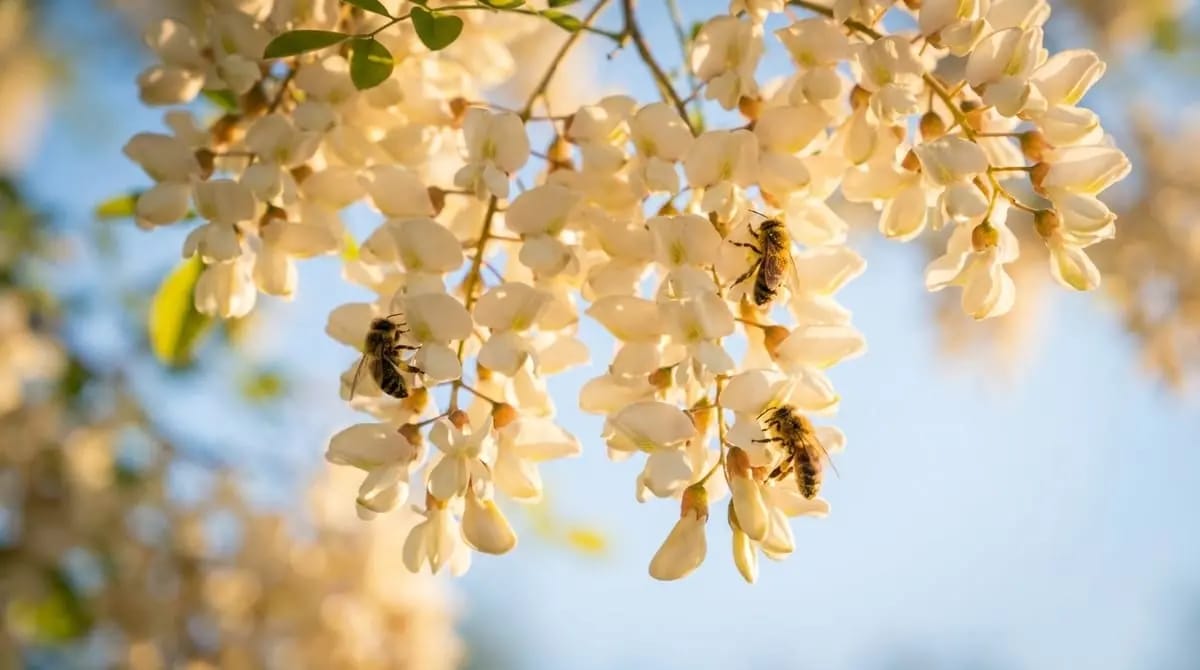
The black locust -- colloquially often incorrectly called "acacia" -- produces one of the most popular and expensive honeys worldwide. The tree originally comes from North America and was introduced to Europe in the 17th century.
Black Locust Profile
| Characteristic | Data |
|---|---|
| Scientific name | Robinia pseudoacacia (Black locust / False acacia) |
| Bloom period | May to June (approx. 10-14 days, varies regionally) |
| Nectar value | 4 (very good -- short-term mass forage) |
| Pollen value | 2 (moderate) |
| Sugar content of nectar | 35-55% (high, fructose-dominant) |
| Honey yield per tree | 8-20 kg in good weather |
| Honey yield per colony | 10-30 kg when migrating |
| Distribution | Warm regions, city parks, railway embankments, industrial brownfields, riverbanks |
| Honey type | "Acacia honey" -- water-clear, mild, stays liquid for a long time |
Acacia Honey: A Premium Product
Black locust honey (sold as "acacia honey") is one of the most valuable monofloral honeys:
- Color: Water-clear to straw-yellow -- the lightest of all honeys
- Taste: Very mild, delicately floral, finely sweet, without any bitterness
- Crystallization: Stays liquid for an extremely long time (high fructose content, low glucose content) -- can remain liquid for years
- Market price: 12-20 EUR/500g in retail (premium)
- Special feature: Most popular honey for tea and cooking, as it sweetens without altering flavor
The Pitfalls of Black Locust Forage
The black locust bloom is highly productive but risky for migratory beekeepers:
- Short bloom duration: Only 10-14 days -- those who migrate too late miss the forage
- Weather-dependent: Rain and wind during bloom destroy the delicate blossoms
- Late frost risk: A late frost in May can destroy all flower buds
- Regionally limited: Black locusts grow mainly in warmer areas (river valleys, urban areas, continental climate zones)
Black locust is the queen of migratory forages -- and the most capricious. In good years, you can harvest 30 kg per colony in two weeks. In bad years, you stand with 100 colonies before a black locust forest and get nothing. Those who migrate to black locust need experience, contacts, and a bit of luck.
Linden (Tilia sp.) -- The Queen of Summer Forage
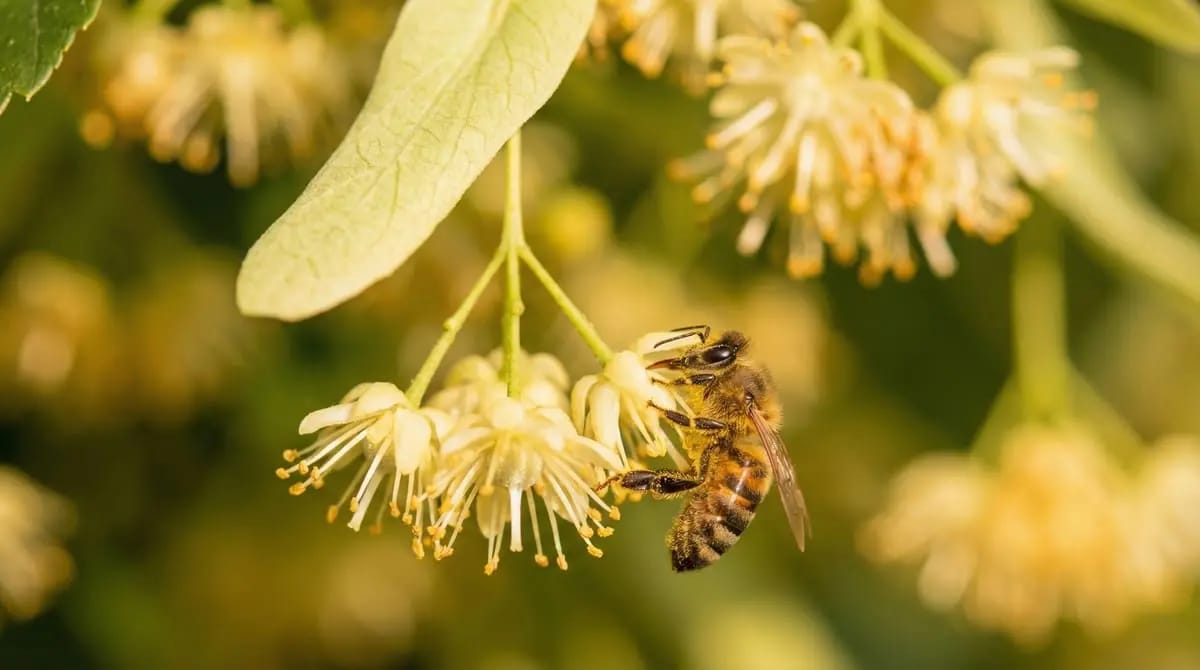
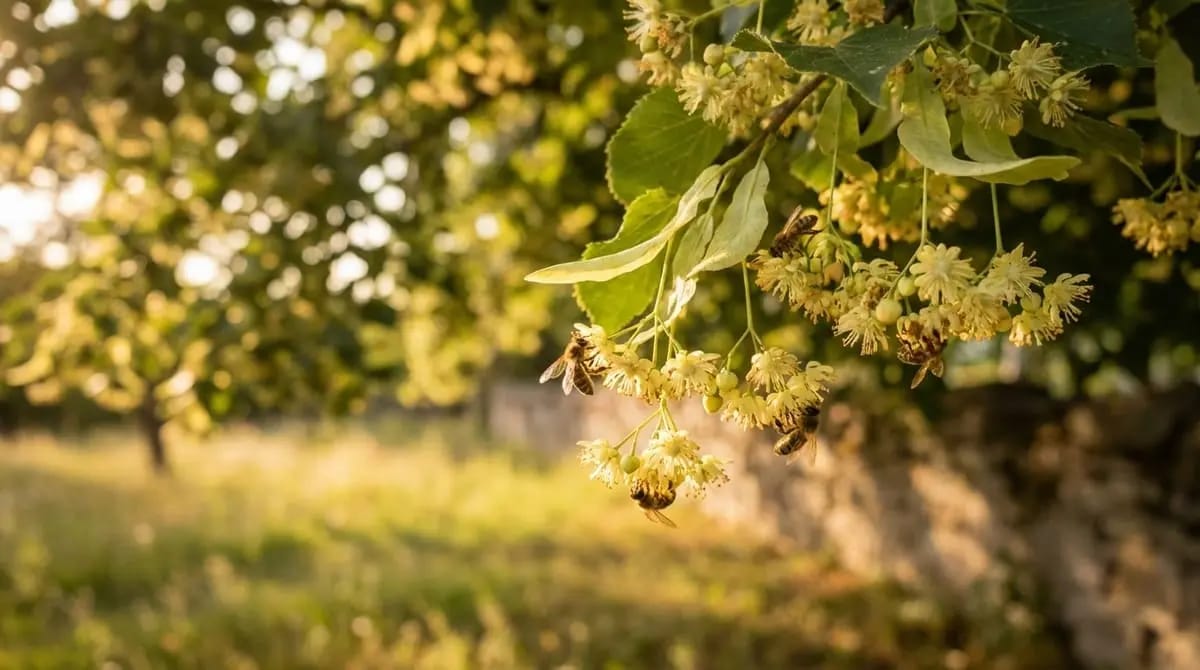
In many regions of Central Europe, the linden is the single most productive forage source of all. A large linden tree can bear several hundred thousand to over a million blossoms and produces enormous quantities of nectar.
Linden Species Comparison
| Species | Bloom Period | Nectar Value | Pollen Value | Nectar Properties |
|---|---|---|---|---|
| Small-leaved linden (T. cordata) | Late June - mid-July | 4 | 2 | Fertile, nectar-rich, reliable |
| Large-leaved linden (T. platyphyllos) | Mid-June - early July | 4 | 2 | Somewhat earlier, similarly productive |
| Silver linden (T. tomentosa) | July - August | 3-4 | 2 | Late-blooming, urban tree, controversial due to bumblebee deaths |
| Common linden (T. x europaea) | Late June - July | 4 | 2 | Cross between small- and large-leaved linden, common avenue tree |
up to 60 kgof nectar can a single large linden tree produce in good years
Linden Honey: Character and Distinctiveness
Linden honey is one of the most characterful monofloral honeys:
- Color: Yellowish to greenish-yellow (fresh), darkening over time
- Taste: Intense, typically "linden blossom," slightly menthol-fresh with a spicy note
- Crystallization: Medium-fast, coarse-grained
- Aroma: Unmistakable -- anyone who has once tasted genuine linden honey will recognize it immediately
Linden and Honeydew: The Double Forage
The special thing about linden is that it can often provide blossom nectar and honeydew simultaneously. Linden aphids (especially Eucallipterus tiliae) produce honeydew on the leaves while the blossoms secrete nectar. In such "double forage years," yields are spectacular.
Phacelia (Phacelia tanacetifolia) -- The Bee Friend
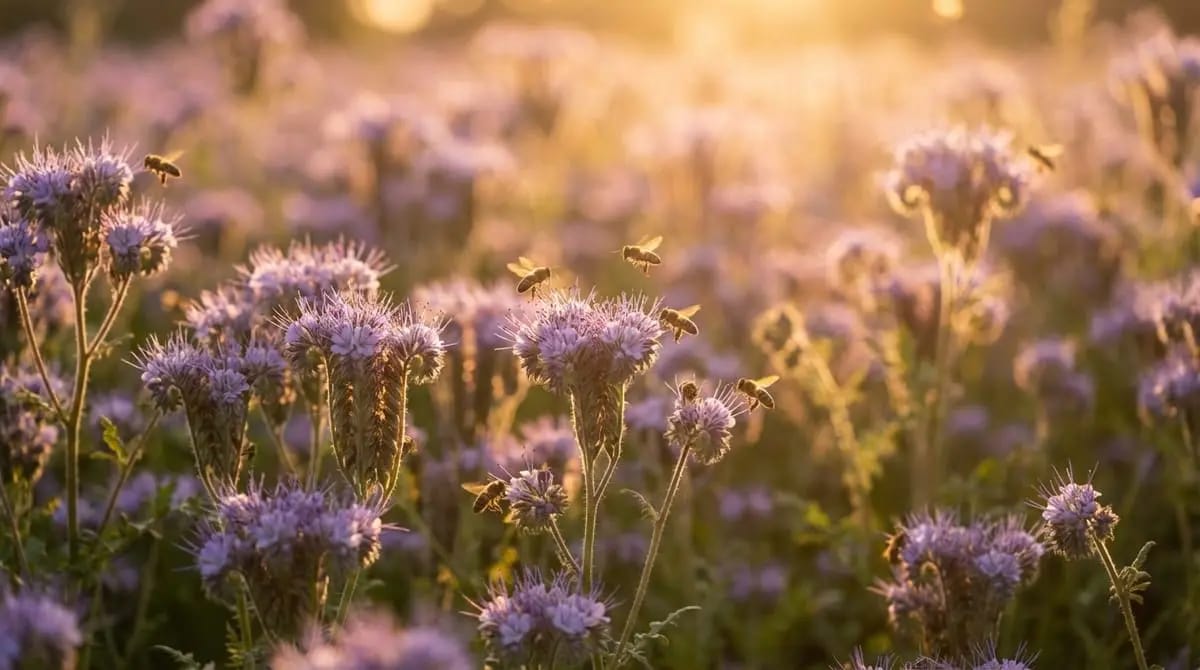
Phacelia, also called "bee friend" or "lacy phacelia," is one of the best bee pasture plants of all and is increasingly grown as a cover crop in agriculture.
Phacelia Profile
| Characteristic | Data |
|---|---|
| Scientific name | Phacelia tanacetifolia (Lacy phacelia) |
| Bloom period | June to September (depending on sowing date) |
| Bloom duration | 6-8 weeks (long!) |
| Nectar value | 3-4 (good to very good) |
| Pollen value | 3 (good) |
| Sugar content of nectar | 25-45% |
| Honey yield per hectare | 200-500 kg (depending on stand and weather) |
| Special feature | Long bloom duration, ideal as cover crop, green manure |
Sweet Chestnut (Castanea sativa) -- The Spicy Loner
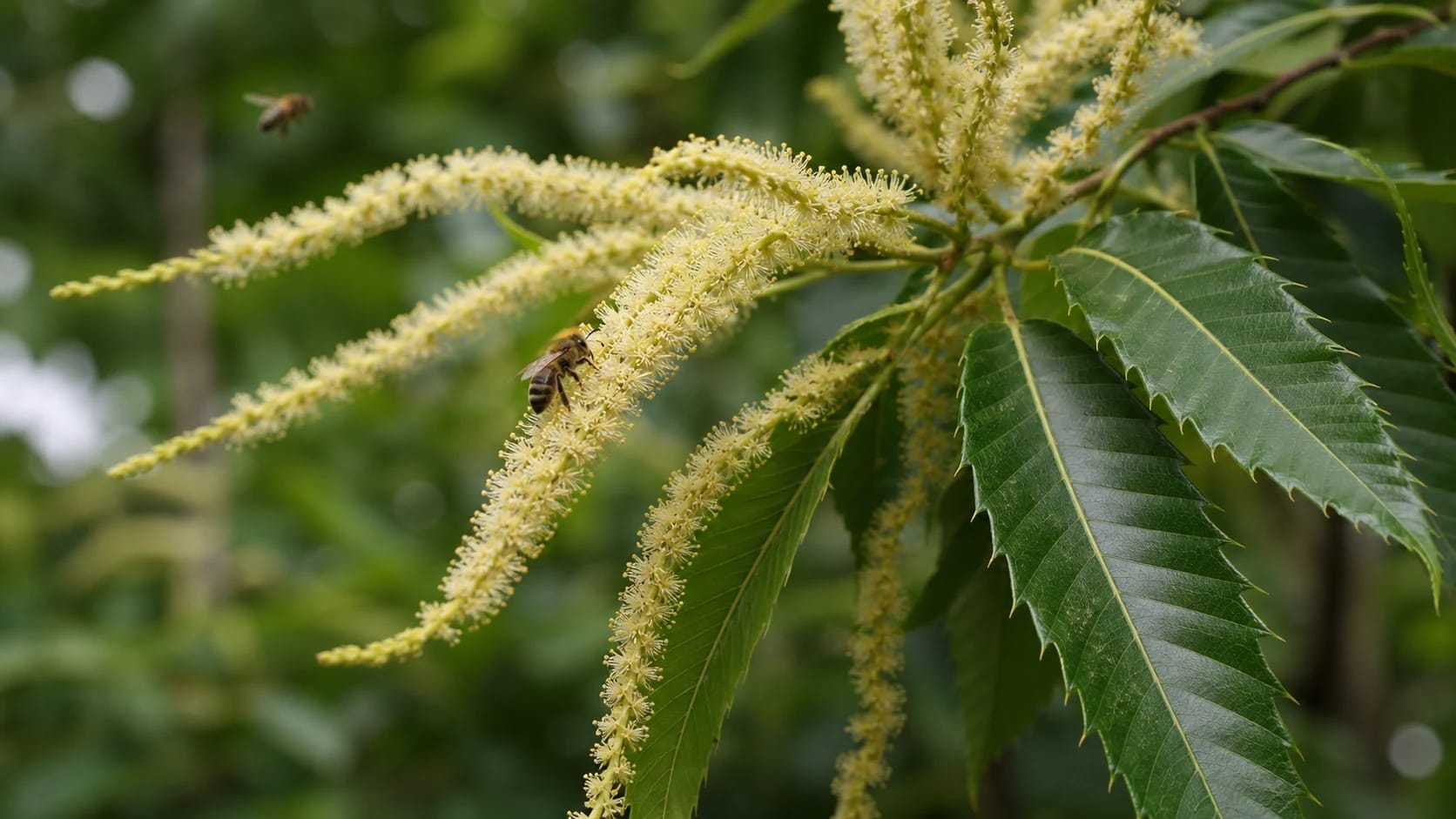 AI-generated. This image was created with AI. It does not show a real apiary.
Sweet Chestnut Profile
| Characteristic | Data |
|---|---|
| Scientific name | Castanea sativa (Sweet chestnut) |
| Bloom period | June to July |
| Nectar value | 3 (good) |
| Pollen value | 3 (good) |
| Honey type | Sweet chestnut honey -- dark, bold, bitter-aromatic |
| Distribution | Wine-growing climates: Palatinate, Rhineland, Black Forest foothills, Southern Europe |
| Special feature | Honey stays liquid for a long time, high mineral content, bitter taste |
Sweet chestnut honey is a connoisseur's honey: dark, bold, slightly bitter-herbal with malty notes. Not everyone likes it, but connoisseurs value it highly -- and it commands premium prices (12-18 EUR/500g).
Additional Summer Forage Plants
Cornflower (Centaurea cyanus)
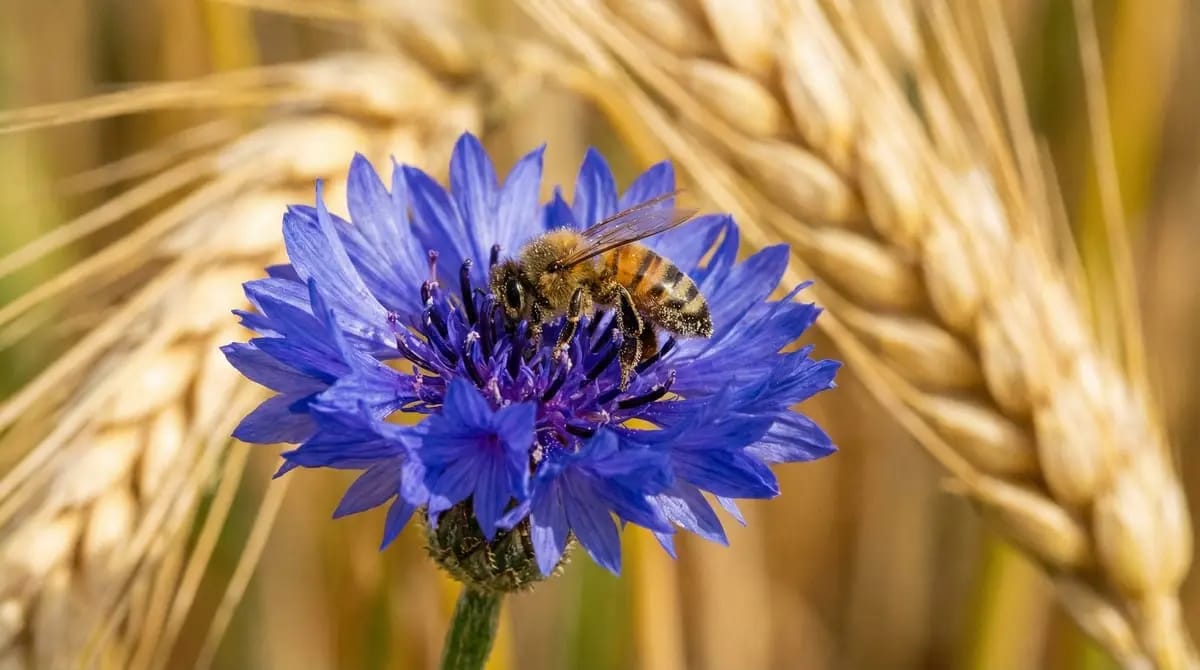
- Bloom period: June-August
- Nectar value: 2-3, Pollen value: 2
- Special feature: Severely declined due to herbicide use; today mainly found in wildflower strips and organic fields
White Clover (Trifolium repens)
- Bloom period: June-September
- Nectar value: 3, Pollen value: 2
- Special feature: Important trickle flow in meadows and pastures, requires sufficient moisture. White clover honey is mild and popular.
Red Clover (Trifolium pratense)
- Bloom period: June-August
- Nectar value: 1-2 (barely usable for honey bees), Pollen value: 2 (limited accessibility for honey bees)
- Special feature: The corolla tubes (9-10 mm) are too long for the honey bee's proboscis (6-6.5 mm) -- red clover is therefore primarily a bumblebee forage, not suitable for honey bees. After the second cut (shorter tubes) or with short-tubed varieties, honey bees can partially benefit.
Sunflower (Helianthus annuus)
- Bloom period: July-August
- Nectar value: 2-3, Pollen value: 3
- Sugar content of nectar: 25-40%
- Special feature: Nectar secretion strongly variety-dependent -- heritage varieties are more productive than modern hybrids. Sunflower honey crystallizes quickly.
Forest Forage: Honeydew from Spruce, Fir, and Oak
Forest Honey: Character and Characteristics
| Property | Forest Honey (Honeydew) | Blossom Honey (for comparison) |
|---|---|---|
| Color | Dark brown to nearly black | Light to medium brown |
| Taste | Bold, malty, spicy, caramelly | Mild to aromatic, floral |
| Crystallization | Slow (high fructose content) | Fast to medium |
| Mineral content | High (up to 1%) | Low (approx. 0.1-0.3%) |
| Enzyme activity | High (diastase number often above 20) | Low to medium |
| Electrical conductivity | Above 0.8 mS/cm (analytical criterion!) | Below 0.8 mS/cm |
| Price (500g, direct from beekeeper) | 10-15 EUR | 8-12 EUR |
0.8 mS/cmelectrical conductivity is the threshold -- above this, honey qualifies as honeydew honey or forest honey
Important Forest Forage Regions
The following examples are from Germany, but similar honeydew forages occur across Central European mountain and forest regions:
| Region | Main Tree Species | Honeydew Producer | Honey Quality |
|---|---|---|---|
| Black Forest | Silver fir, spruce | Green fir honeydew louse | Excellent (Black Forest fir honey, sought-after specialty) |
| Swabian Jura | Spruce, beech | Various bark lice | Good, sometimes melezitose problems |
| Bavarian Forest | Spruce, fir | Spruce bark lice | Good to very good |
| Spessart | Oak, beech | Oak scale insect | Spicy, dark, mild |
| Thuringian Forest | Spruce | Spruce bark lice | Regional, melezitose possible |
The Summer Forage Gap: Problem and Solutions
From mid-July, a forage gap occurs in many regions: spring and early summer forage is over, late summer forage has not yet begun. This phase is critical for bee colonies and beekeepers alike.
Causes of the Forage Gap
- Intensive agriculture: Large monocultures (grain) offer no food after harvest
- Meadow mowing: Blooming meadows are mowed before seed maturity
- Drought: In hot summers, many blossoms dry out and cease nectar production
- Limited bloom offerings: Between linden (end) and heather/late bloomers, a gap of 3-6 weeks often opens
Consequences for the Bees
Summary
Knowledge Check
In the next lesson, we explore late summer forage: heather honey, buckwheat, and the last pollen source of the year -- ivy.