Late Summer and Autumn: Heather, Sunflower, and Buckwheat
Late summer forage for bees: common heather and press honey, sunflower, buckwheat, Himalayan balsam, and ivy as the last pollen source before winter.
Late summer forage (July to October) holds dual significance for bee colonies: it provides the last major honey harvests of the year and -- even more importantly -- it supplies the colonies during the rearing of winter bees. The quality of late forage directly determines a colony's ability to overwinter.
In this lesson, you will learn about the most important late summer forage plants, including the legendary heather with its unique press honey.
Common Heather (Calluna vulgaris) -- The Honey You Have to Press
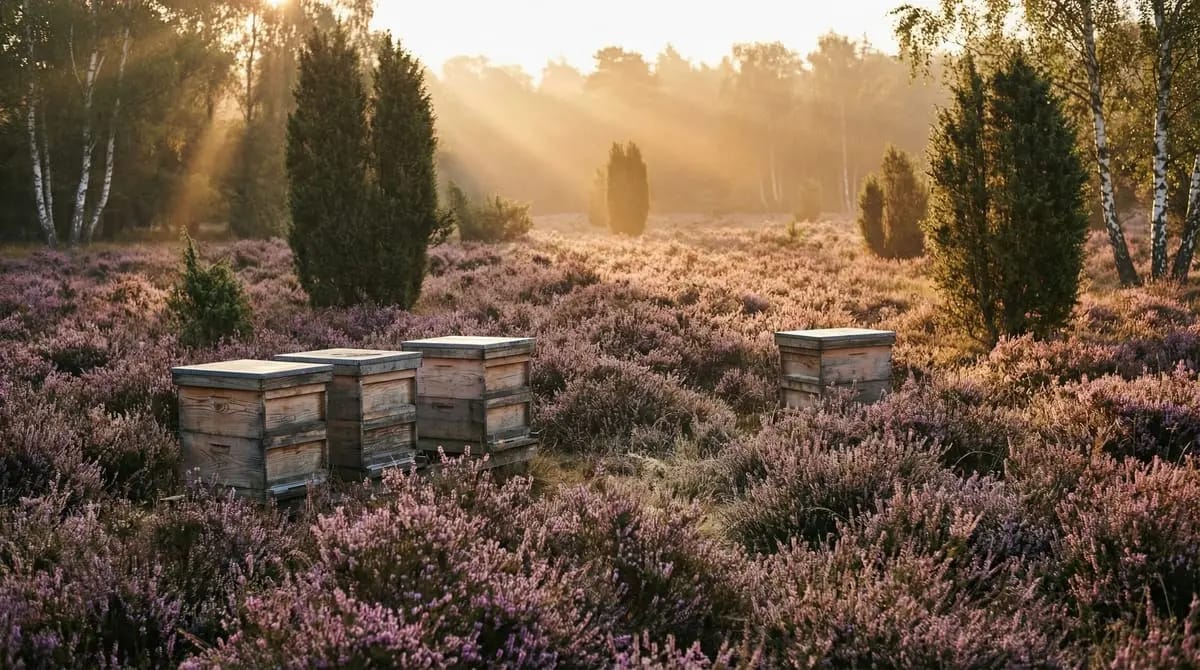
Common heather is one of the most fascinating forage plants in European beekeeping. Its honey has properties that fundamentally distinguish it from all other honeys -- and that require a completely different harvesting method.
Heather Profile
| Characteristic | Data |
|---|---|
| Scientific name | Calluna vulgaris (Common heather / Ling) |
| Bloom period | August to September (4-6 weeks) |
| Nectar value | 3-4 (good to very good) |
| Pollen value | 2 (moderate) |
| Sugar content of nectar | 25-45% |
| Honey yield per colony | 5-20 kg (highly weather-dependent) |
| Main regions | Lueneburg Heath, Northern European heathlands, moorlands |
| Special feature | Thixotropic honey -- gels at rest, becomes liquid when stirred |
The Unique Feature: Thixotropic Honey
Heather honey has a unique physical property: it is thixotropic. This means:
- At rest: The honey is gel-like firm -- like pudding
- When stirred/shaken: It temporarily becomes liquid
- After stirring: It slowly returns to the gel state
This property makes normal extraction by spinning impossible. The gel-like honey is not flung from the cells by centrifugal force. Therefore, heather honey must be harvested in one of the following ways:
- 1
Method 1: Press honey (traditional)
The honey-filled combs are crushed and pressed in a honey press (spindle press or basket press). Press honey contains slightly more wax and pollen components than spun honey. Labeling note: Must be labeled as "press honey" (EU honey regulations).
- 2
Method 2: Stippling + spinning
The capped combs are perforated with a special device (heather honey stippler / pricking tool) -- hundreds of small holes break through the gel structure. The honey can then be extracted in the spinner, though only at high speed.
- 3
Method 3: Dissolving and spinning
The combs are briefly warmed to approx. 35-40°C to temporarily dissolve the thixotropy. Then spin quickly. This method is controversial, as the warming can damage enzymes.
The gel structure of heather honey is caused by an unusually high content of protein substances (approx. 1-2% protein). These proteins form a three-dimensional network that gels the honey at rest. Other honeys contain only about 0.1-0.4% protein. Additionally, heather honey contains many air bubbles that contribute to its creamy-gelatinous consistency.
Heather Honey: Character and Value
- Color: Amber to reddish-brown, often cloudy from air inclusions
- Taste: Bold-aromatic, spicy, slightly bitter note, intense aftertaste
- Consistency: Gelled (thixotropic), spreadable in the jar
- Price: 15-25 EUR/500g (one of the most expensive monofloral honeys)
- Tradition: Heather honey from the Lueneburg Heath is a tradition-rich premium product
Migration to the heather is no guaranteed success. It needs warm days above 20°C, cool nights, and no drought. In good years we get 20 kg per colony, in bad years we drive home empty-handed. But the taste of genuine heather honey -- it is worth it.
Heather Migration: Practical Tips
Checklist for Heather Migration
Sunflower (Helianthus annuus)
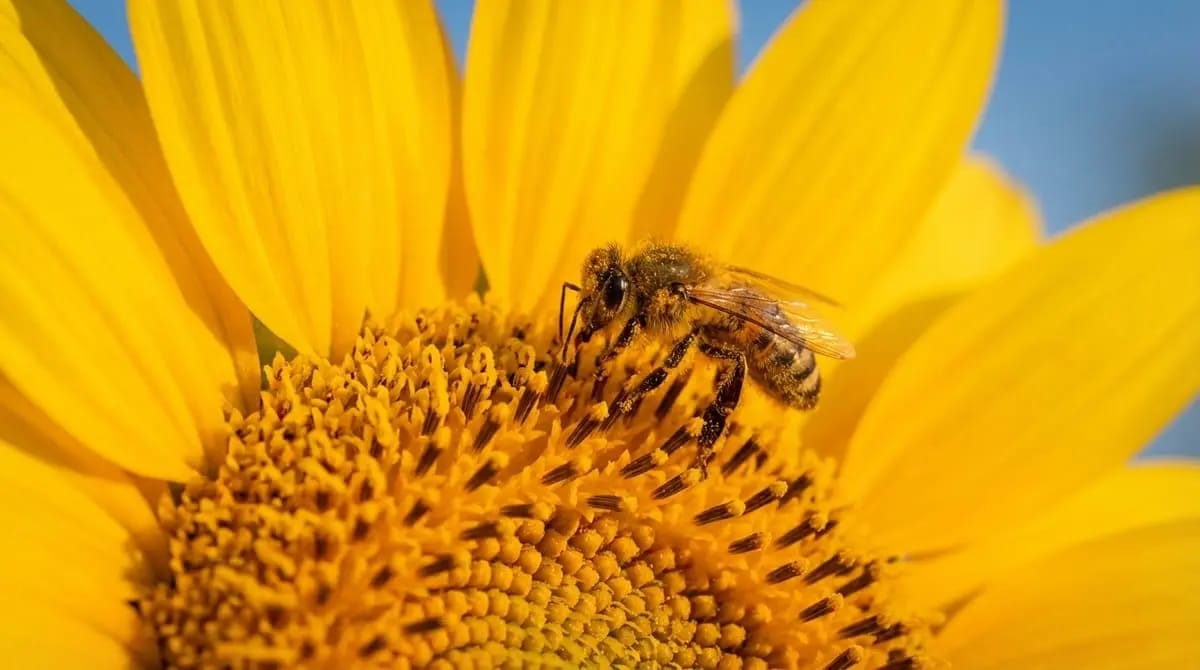
Sunflower Profile
| Characteristic | Data |
|---|---|
| Scientific name | Helianthus annuus (Common sunflower) |
| Bloom period | July to August |
| Nectar value | 2-3 (strongly variety-dependent!) |
| Pollen value | 3 (good) |
| Sugar content of nectar | 30-50% |
| Honey yield per hectare | 30-80 kg (with nectar-rich varieties) |
| Cultivation area (Germany) | approx. 50,000-65,000 hectares (rising sharply since 2022) |
| Special feature | Modern hybrid varieties often nectar-poor -- heritage varieties better for bees |
Not every sunflower provides good bee forage. Modern hybrid varieties bred for maximum oil yield often produce significantly less nectar than older, bee-friendly varieties. Pollenless varieties (for cut flowers) are completely worthless for bees. When working with farmers, it is worth recommending bee-friendly varieties.
Sunflower Honey
- Color: Bright yellow to golden yellow
- Taste: Mild, fruity, slightly sour
- Crystallization: Fast and coarse-grained (high glucose content)
- Special feature: Typical late summer honey, rarely monofloral
Buckwheat (Fagopyrum esculentum) -- The Dark Exotic
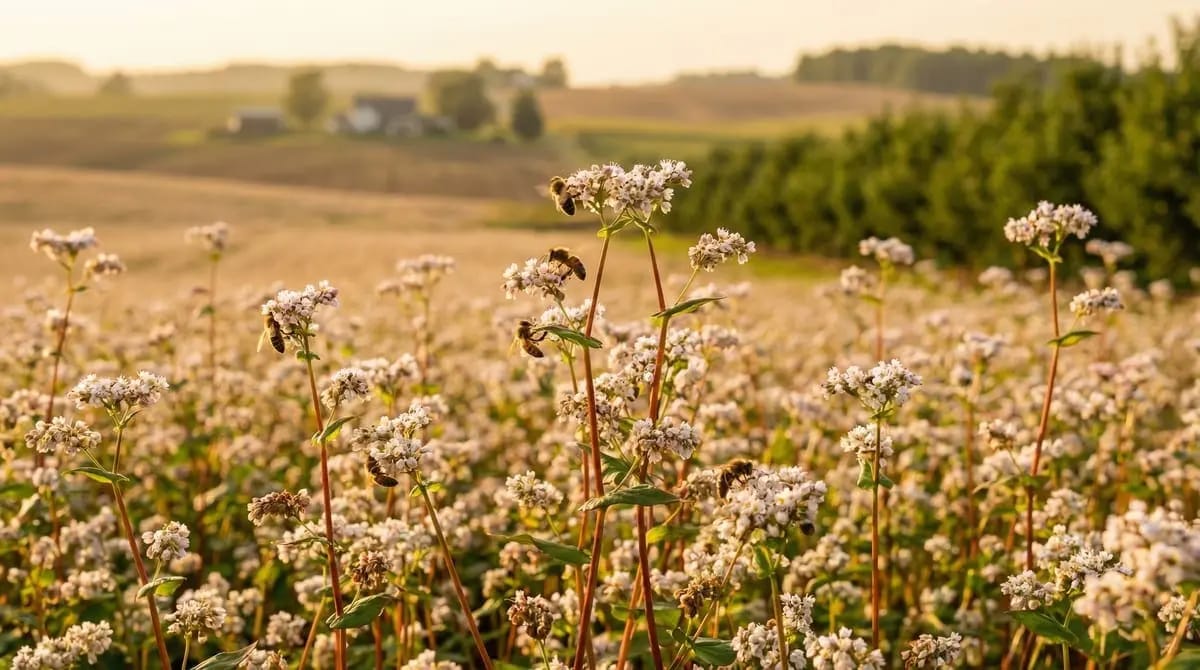
Buckwheat is botanically not a cereal (but belongs to the knotweed family), yet is used similarly. For beekeeping, it is a valuable late summer forage.
Buckwheat Profile
| Characteristic | Data |
|---|---|
| Scientific name | Fagopyrum esculentum (Common buckwheat) |
| Bloom period | July to September (6-8 weeks) |
| Nectar value | 3-4 (good to very good) |
| Pollen value | 1-2 (low) |
| Sugar content of nectar | 30-50% |
| Honey yield per hectare | 50-150 kg |
| Cultivation area (Germany) | approx. 5,000-8,000 hectares (increasing) |
| Special feature | Nectar secretion only in the morning (6 AM - noon!), dark, bold honey |
Buckwheat Honey: The Insider Tip
Buckwheat honey is still relatively unknown in Germany but is a valued monofloral honey in Eastern Europe (Poland, Russia) and North America:
- Color: Dark brown to nearly black -- one of the darkest honeys of all
- Taste: Very bold, malty, slightly bitter, reminiscent of caramel and molasses
- Crystallization: Medium-fast
- Health: Scientific studies (e.g., University of Illinois, 2004) show that dark honeys like buckwheat honey have a particularly high antioxidant content
Buckwheat is an excellent plant for bee pasture projects: it germinates quickly (5-7 days), blooms after 4-6 weeks, and is agriculturally useful as a cover crop (soil improvement, weed suppression). Sowing in June provides bloom from July to September -- exactly in the forage gap!
Himalayan Balsam (Impatiens glandulifera) -- The Controversial Late Forage
Himalayan balsam (also called Indian balsam or "policeman's helmet") is one of the most controversial forage plants in Europe.
Himalayan Balsam Profile
| Characteristic | Data |
|---|---|
| Scientific name | Impatiens glandulifera (Himalayan balsam) |
| Bloom period | July to October (very long!) |
| Nectar value | 3-4 (very good!) |
| Pollen value | 2 (moderate) |
| Sugar content of nectar | 40-60% (high!) |
| Nectar quantity per flower | Up to 5 mg (very much for a herbaceous plant) |
| Origin | Himalayas -- introduced from Kashmir to England in 1839, since then an invasive neophyte in Europe |
| Habitat | Riverbanks, moist sites, forest edges, wasteland |
The Controversy: Invasive Neophyte vs. Valuable Bee Forage
| Pro (Forage Plant) | Contra (Nature Conservation) |
|---|---|
| Outstanding nectar provider during the forage gap | Displaces native riparian plants through mass occurrence |
| Very long bloom duration (July-October) | Forms dense monoculture stands along waterways |
| Intensively visited by honey bees AND wild bees | Die-back in autumn leaves bare riverbanks (erosion risk) |
| No care or sowing needed (grows on its own) | Classified as invasive neophyte, EU regulation calls for control |
| Mild aromatic honey, marketable | Competes with native plants for pollinators |
In practice, Himalayan balsam can no longer be eradicated in many areas. Where it grows, it provides valuable late forage. However, one should not actively sow or promote it -- instead, plant native alternatives. Most nature conservation authorities take a similar view: control where sensible, but not at any cost.
Ivy (Hedera helix) -- The Last Pollen Source
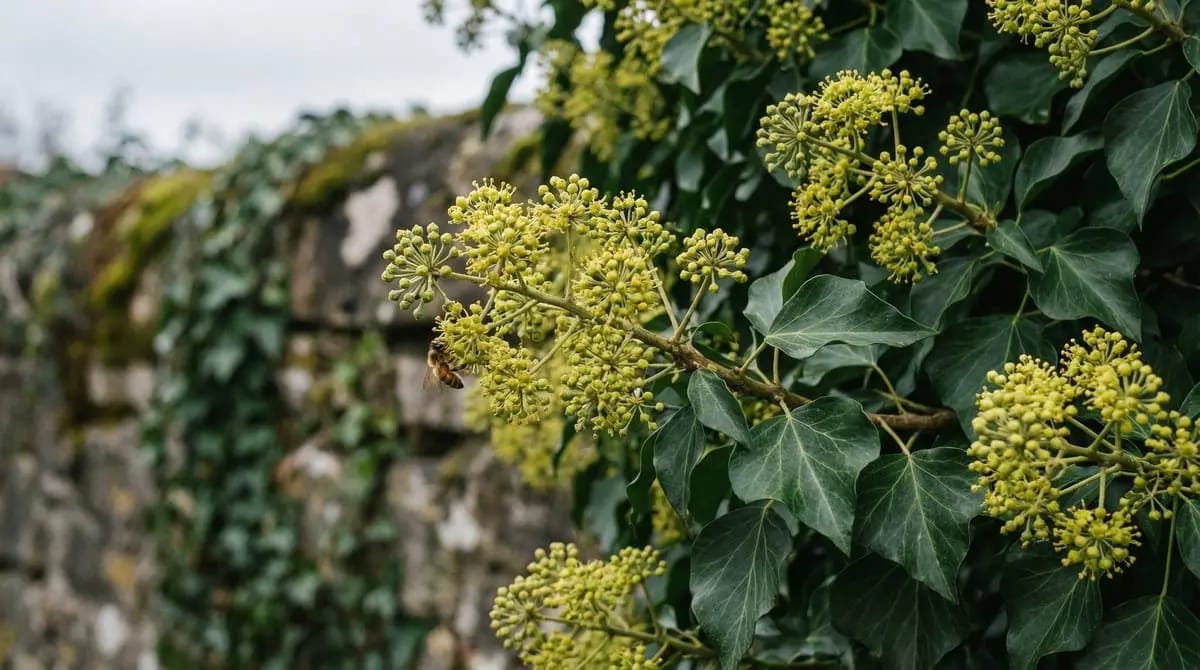
Ivy is one of the most important autumn forage plants and is underestimated in its significance by many beekeepers. As the last major nectar and pollen source of the year, it has a key function for overwintering.
Ivy Profile
| Characteristic | Data |
|---|---|
| Scientific name | Hedera helix (Common ivy) |
| Bloom period | September to October (sometimes into November) |
| Nectar value | 2-3 (moderate to good) |
| Pollen value | 3 (good -- important as the last major pollen source!) |
| Pollen color | Gray-green to gray-yellow |
| Special feature | Only old, bloom-capable plants (adult form from approx. 8-10 years) develop flowers |
| Distribution | Throughout Europe, walls, trees, hedgerows, forest edges |
Ivy nectar has a very high glucose content and crystallizes extremely quickly -- similar to rapeseed honey, but even faster. If bees store ivy honey as winter provisions, it can solidify in the combs and is difficult for bees to dissolve in winter. In ivy-rich areas, you should therefore feed the colonies early after the ivy flow and ensure that sufficient sugar syrup is available as easily accessible winter provisions.
Significance of Ivy for Overwintering
The ivy flow has a special strategic significance:
- Last pollen: Ivy often provides the last high-quality pollen before winter. This pollen is important for completing winter bee rearing.
- Fat body: Ivy pollen contributes to the final charging of the winter bees' fat body (vitellogenin production).
- Brood impulse: The late flow can trigger a final brood impulse -- this can be positive (more winter bees) or negative (too-late brood, varroa problem).
Additional Late Summer Forage Plants
Autumn Aster (Aster sp.)
- Bloom period: September-October
- Nectar value: 2, Pollen value: 2
- Special feature: In gardens and parks, one of the last nectar sources; especially smooth aster (A. novi-belgii) and New England aster (A. novae-angliae)
Goldenrod (Solidago sp.)
- Bloom period: August-October
- Nectar value: 2-3, Pollen value: 2
- Special feature: Invasive neophyte (like Himalayan balsam) but valuable late forage on wasteland
Stonecrop (Sedum sp.)
- Bloom period: August-October
- Nectar value: 2-3, Pollen value: 1
- Special feature: Particularly in gardens and on green roofs, a reliable late nectar source
Bee Tree / Korean Evodia (Tetradium daniellii)
- Bloom period: July-August
- Nectar value: 4 (excellent!), Pollen value: 3
- Special feature: East Asian ornamental tree considered the "perfect bee pasture." Intense nectar production, long bloom duration, hardy to approx. -20°C. Increasingly planted by beekeepers and in public plantings.
Late Summer from the Beekeeper's Perspective
- JulyForage Gap BeginsAfter the end of linden bloom, a forage gap occurs in many regions. Sunflowers and buckwheat can bridge the gap. Summer varroa treatment begins!
- AugustHeather and Last HarvestHeather migration for specialists. Last honey harvest of the year. Begin feeding! Winter bee rearing in full swing.
- SeptemberIvy and OverwinteringIvy as the last major forage. Complete feeding (target: 15-20 kg winter stores). Queen check -- queenless colonies should be united now.
- OctoberSeason EndsLast ivy flow in mild weather. Install mouse guards. Leave colonies in peace. Prepare for winter treatment (wait for broodless period).
- July
Forage Gap Begins
After the end of linden bloom, a forage gap occurs in many regions. Sunflowers and buckwheat can bridge the gap. Summer varroa treatment begins!
- August
Heather and Last Harvest
Heather migration for specialists. Last honey harvest of the year. Begin feeding! Winter bee rearing in full swing.
- September
Ivy and Overwintering
Ivy as the last major forage. Complete feeding (target: 15-20 kg winter stores). Queen check -- queenless colonies should be united now.
- October
Season Ends
Last ivy flow in mild weather. Install mouse guards. Leave colonies in peace. Prepare for winter treatment (wait for broodless period).
After the last harvest, feeding must begin immediately -- ideally completed by the end of August. Reason: the bees need to process the sugar while the weather is still warm (invert, dry, store). Feeding too late means winter bees must perform feed processing work, wearing them out. This shortens their lifespan and endangers overwintering.
Summary
Core Knowledge: Late Summer Forage
Knowledge Check
Late summer is the time for varroa treatment. In the course Using Hivekraft Effectively (Lesson 4: Varroa Dashboard and Lesson 6: Colony Record Book), you will learn how to track infestation levels, interpret thresholds, and have EU-compliant documentation handled automatically.
In the next lesson, you will learn how to create your own bee pasture -- with the right seed mixtures, planting plans, and practical tips for every budget.