Trees for Bees: Planting for the Long Term
The most important bee trees: willow, linden, maple, black locust, chestnut, and fruit trees. Planting guide, site requirements, and honey yield per tree.
While a flower meadow shows results within a single season and needs renewal after a few years, planting bee trees is an investment in the future. A linden tree planted today will become a forage source in 10-15 years -- and then reliably deliver nectar and pollen for 80-100 years. No other intervention in the forage landscape has a better long-term cost-benefit ratio.
In this lesson, you will learn about the most important bee trees, their site requirements, planting instructions, and expected forage value.
The Top 10 Bee Trees Compared
| Tree Species | Bloom Period | Nectar Value | Pollen Value | Height (m) | Honey per Tree (kg/year) |
|---|---|---|---|---|---|
| Goat willow (Salix caprea) | Mar-Apr | 3-4 | 4 | 6-10 | 1-3 |
| Norway maple (Acer platanoides) | Mar-Apr | 3 | 2 | 20-30 | 3-8 |
| Sycamore maple (Acer pseudoplatanus) | Apr-May | 3-4 | 2 | 25-35 | 5-12 |
| Apple (Malus domestica) | Apr-May | 2-3 | 2-3 | 5-10 | 1-3 |
| Black locust (Robinia pseudoacacia) | May-Jun | 4 | 2 | 15-25 | 8-20 |
| Horse chestnut (Aesculus hippocastanum) | May | 2-3 | 3 | 20-30 | 2-5 |
| Sweet chestnut (Castanea sativa) | Jun-Jul | 3 | 3 | 15-25 | 5-15 |
| Large-leaved linden (Tilia platyphyllos) | Jun-Jul | 4 | 2 | 25-35 | 10-30 |
| Small-leaved linden (Tilia cordata) | Jun-Jul | 4 | 2 | 20-30 | 10-25 |
| Bee tree (Tetradium daniellii) | Jul-Aug | 4 | 3 | 8-12 | 5-15 |
Willow (Salix sp.) -- The Early Starter
Why Plant Willows?
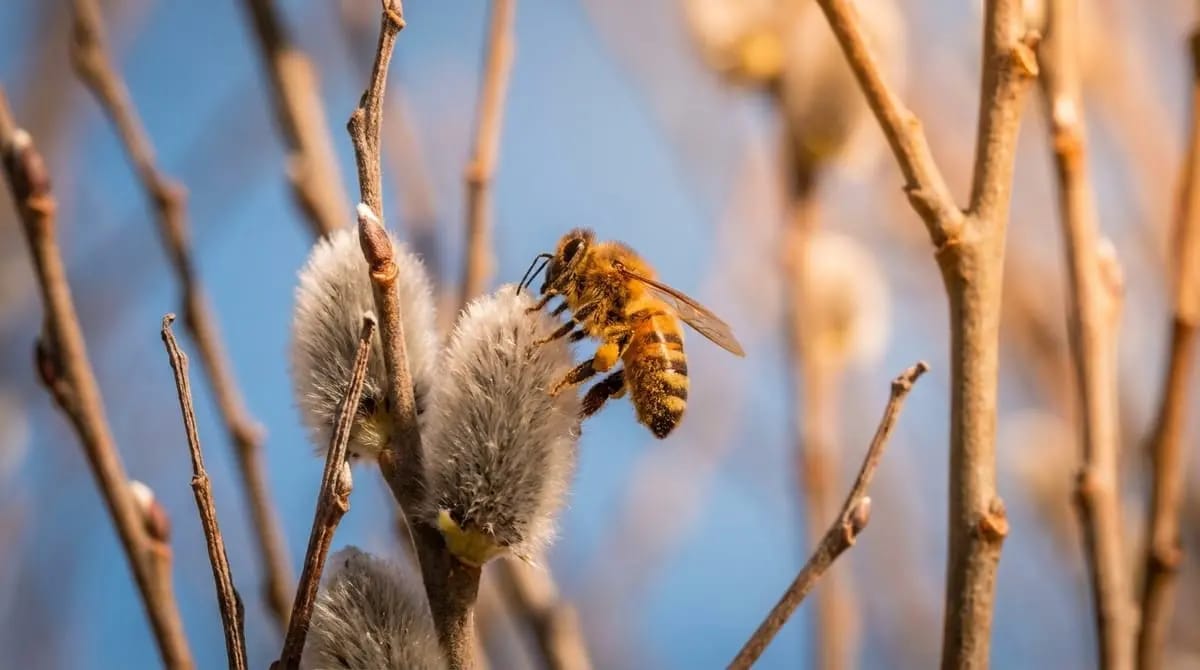
Willows are the fastest-growing native woody plants and provide notable forage after just 3-5 years. They are the first major nectar and pollen source of the year and thus indispensable for the spring development of colonies.
Recommended Willow Species for Beekeepers
| Species | Growth Form | Height (m) | Bloom Period | Site | Special Feature |
|---|---|---|---|---|---|
| Goat willow (S. caprea) | Large shrub / small tree | 6-10 | Mar-Apr | Everywhere, including drier sites | The most important bee forage in spring! |
| White willow (S. alba) | Large tree | 15-25 | Apr-May | Moist sites, riverbanks | Impressive tree, very nectar-rich |
| Purple willow (S. purpurea) | Shrub | 2-5 | Mar-Apr | Riverbanks, moist soils | Compact growth, ideal for small properties |
| Violet willow (S. daphnoides) | Large shrub / small tree | 5-10 | March | Fresh to moist soils | Very early blooming, decorative blue bloom |
| Eared willow (S. aurita) | Shrub | 2-3 | Apr-May | Moorland, acidic sites | Suitable for special habitats |
Willows are among the easiest woody plants to propagate. A cutting (20-30 cm long, finger-thick shoot) stuck into moist soil in spring or autumn will almost certainly take root. No root development needed, no expensive plant stock -- just cut a branch, stick it in the ground, keep moist, done.
Willows are dioecious: there are male and female plants. Only male plants provide the important pollen. Female plants also offer nectar, but significantly less. When buying or propagating, ensure you choose male specimens (recognizable by the stamens in the flower catkins).
Linden (Tilia sp.) -- The Queen of Forage Trees
If there were one single tree every beekeeper should plant, it would be the linden. No other native tree provides so much nectar per footprint over so many decades.
Small-Leaved vs. Large-Leaved Linden
| Property | Small-leaved Linden (T. cordata) | Large-leaved Linden (T. platyphyllos) |
|---|---|---|
| Bloom period | Late June to mid-July | Mid-June to early July |
| Bloom duration | 2-3 weeks | 2-3 weeks |
| Nectar value | 4 (very good) | 4 (very good) |
| Growth height | 20-30 m | 25-35 m |
| Crown diameter | 12-18 m | 15-20 m |
| Leaf size | Small (3-6 cm) | Large (8-15 cm) |
| Drought tolerance | Good (better adapted to drought) | Moderate (needs more moisture) |
| Urban climate suitability | Very good | Good |
| Age | Up to 1,000 years | Up to 1,000 years |
| Recommendation | Best choice for most sites | Good for moist, nutrient-rich sites |
The linden is the perfect bee tree. During the short bloom period of a large tree, a single colony can bring in 15-30 kg of honey. Anyone who plants a linden today creates a forage monument for generations.
Linden Planting Guide
- Linden tree (container or root-ball stock, trunk circumference 8-10 cm)
- Planting hole tools (spade)
- 3 tree stakes + tree ties
- Compost (10-20 liters)
- Form a watering rim from soil
- Bark mulch (optional)
Timing: October-March (dormant season), ideally October-November (roots still grow before winter).
1. Choose location
- Minimum distance to buildings: 10-15 m (lindens grow large!)
- Full sun to light shade
- Not directly over utilities or next to parking areas (honeydew drips on cars!)
2. Dig planting hole
- Twice as wide and 1.5x as deep as the root ball
- Loosen the bottom (break up compacted layers)
- Mix excavated soil with compost (1:3)
3. Place tree
- Top of root ball level with ground surface
- Fill in soil, tamp down in layers (no air pockets!)
- Form watering rim (soil wall 10 cm high, 50 cm radius)
4. Stake and water
- Set 3 tree stakes in a triangle, secure tree with ties
- Water thoroughly immediately (50-80 liters)
- Water regularly during the first 2-3 summers (20-30 L per week during drought)
Maple (Acer sp.) -- The Versatile Companion
Recommended Maple Species
| Species | Height (m) | Bloom Period | Nectar Value | Drought Tolerance | Special Feature |
|---|---|---|---|---|---|
| Norway maple (A. platanoides) | 20-30 | Mar-Apr | 3 | Good | Blooms BEFORE leaf emergence -- bright yellow, spectacular |
| Sycamore maple (A. pseudoplatanus) | 25-35 | Apr-May | 3-4 | Moderate | One of the best nectar trees of all, 'honey drips' |
| Field maple (A. campestre) | 8-15 | May | 2-3 | Very good | Ideal for hedges, stays small, robust |
| Italian maple (A. opalus) | 8-15 | Mar-Apr | 3 | Very good | Southern European, very early blooming, climate change tree |
The field maple (Acer campestre) is the perfect bee tree for small properties: at 8-15 m it stays significantly smaller than Norway or sycamore maple, can be pruned as a hedge or specimen tree, is extremely robust (drought-tolerant, urban-climate-proof, wind-resistant), and reliably provides nectar and pollen. As a hedge plant, it can even stand on narrow property edges.
Black Locust (Robinia pseudoacacia) -- The Honey Tree
The black locust provides valuable "acacia honey" and is one of the most productive forage trees of all. However, it is not uncontroversial.
Pros and Cons of Black Locust
| Pro | Contra |
|---|---|
| Highest nectar yield of all native trees (8-20 kg/tree) | Invasive neophyte: displaces native plants on nutrient-poor sites |
| Valuable, hard wood (naturally durable) | Nitrogen fixer: alters nutrient balance of lean soils |
| Fast-growing, blooms as early as 6-8 years | Thorns and root suckers can be problematic |
| Drought-tolerant, ideal for climate change | Prohibited / controlled in nature reserves |
| Premium honey with high market price | Late frost sensitive (bloom loss) |
The black locust is on the invasive species list in many regions. Near nutrient-poor grassland, dry grassland, and heathland, it should NOT be planted, as through nitrogen fixation it alters the nutrient-poor soil and displaces native plants. On already nutrient-rich sites (gardens, settlement edges, industrial brownfields), planting is unproblematic.
Chestnuts -- Two Trees, Two Worlds
Horse chestnut (Aesculus hippocastanum): May, nectar value 2-3, pollen value 3, 20-30 m, urban tree. The nectar guides change color (yellow = fresh, red = empty) as a signal for bees.
Sweet chestnut (Castanea sativa): June-July, nectar value 3, pollen value 3, 15-25 m, wine-growing climate. Edible fruits, bold monofloral honey.
The sweet chestnut benefits from climate change: as a warmth-loving tree, it is expanding its range northward. Where previously only wine-growing climates sufficed, it now grows in milder areas across Central Europe. For beekeepers in these regions, the sweet chestnut is a future-proof investment.
Fruit Trees -- Diversity in a Small Space
Recommended Fruit Trees for Beekeepers
| Fruit Type | Bloom Period | Nectar Value | Pollen Value | Special Feature for Beekeepers |
|---|---|---|---|---|
| Sweet cherry (Prunus avium) | Apr | 2-3 | 2-3 | Early, abundant bloom; wild cherry ideal as wild form |
| Apple (Malus domestica) | Apr-May | 2-3 | 2-3 | Longest fruit bloom; heritage varieties often more nectar-rich |
| Plum (Prunus domestica) | Apr | 2 | 2 | Early bloom, complements cherry blossom |
| Quince (Cydonia oblonga) | May-Jun | 2-3 | 2 | Late fruit bloom, bridges the gap |
| Medlar (Mespilus germanica) | May-Jun | 2 | 2 | Rare wild tree, late blooming, decorative |
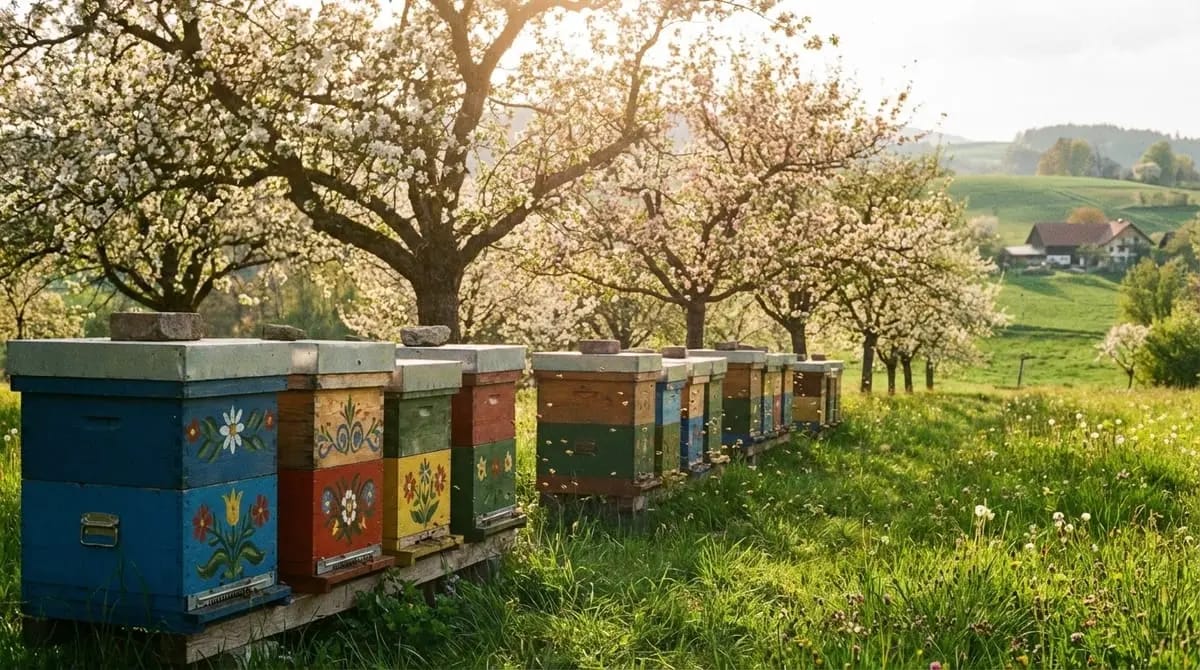
A traditional orchard with standard fruit trees of various species is one of the most valuable biotopes for bees and other insects. The combination of fruit blossom (April-May), meadow flowers in the understory (May-September), and deadwood in old trees (nesting sites for wild bees) creates an ideal habitat. Heritage varieties like Cox Orange, Bramley, or local cultivars are often more nectar-rich than modern varieties.
Exotics and Future Trees
Bee Tree / Korean Evodia (Tetradium daniellii)
The bee tree is the discovery of recent decades for beekeeping:
- Origin: East Asia (China, Korea)
- Bloom period: July-August -- right in the forage gap!
- Nectar value: 4 (excellent)
- Pollen value: 3 (good)
- Height: 8-12 m
- Growth: Fast (30-60 cm/year), blooms from the 3rd-5th year
- Winter hardiness: To approx. -20°C (fully hardy in most of Central Europe)
- Site: Full sun, well-drained soil, urban-climate-proof
Tree of Heaven (Ailanthus altissima) -- The Controversial One
- Origin: China
- Bloom period: June-July
- Nectar value: 3-4, Pollen value: 2
- Status: Invasive neophyte! Listed on the EU list of invasive alien species
- Recommendation: Do NOT actively plant! Where it already stands, however, it provides valuable forage (especially in cities)
However tempting the forage value of some exotics may be: invasive species must not be actively introduced into the landscape. The tree of heaven (Ailanthus altissima) is on the EU list and may not be planted near nature reserves. The same applies to black cherry (Prunus serotina). Instead, use the bee tree (Tetradium daniellii), which is NOT currently considered invasive.
Japanese Pagoda Tree (Styphnolobium japonicum)
- Origin: East Asia
- Bloom period: August-September (very late!)
- Nectar value: 3-4, Pollen value: 2
- Height: 15-25 m
- Special feature: One of the latest-blooming trees of all, ideal for late summer supply. Urban-climate-proof, drought-tolerant. Not invasive.
Practical Recommendations: What to Plant Where?
| Site Situation | Recommended Trees | Rationale |
|---|---|---|
| Small garden (under 300 m2) | Field maple, goat willow, crab apple | Stays small, quick effect |
| Medium garden (300-1,000 m2) | Bee tree, wild cherry, apple tree | Medium size, diverse forage |
| Large garden / meadow | Small-leaved linden + sycamore maple + goat willow | The 'holy trinity' of bee trees |
| Riverbank / moist site | White willow, alder (pollen!), bird cherry | Moisture-loving species |
| Dry / sandy soil | Black locust (away from conservation areas), field maple, wild cherry | Drought-tolerant species |
| Urban area / street tree | Small-leaved linden, Norway maple, pagoda tree | Urban-climate-proof, heat-tolerant |
| Climate change preparedness | Sweet chestnut, bee tree, pagoda tree | Warmth-loving, drought-tolerant |
Summary
Core Knowledge: Bee Trees
Knowledge Check
In the next lesson, you will discover the surprising forage sources of the city -- and why urban beekeeping often produces better honey than rural beekeeping.