Beekeeping in Bavaria: Forage, Traditions and Regional Specialties
Bavarian beekeeping from the Alps to Franconia: Forest honey, mountain forage, beekeeping associations and what makes beekeeping in the Free State so special.
Bavaria is not only the largest federal state in Germany by area, but also one of the most important centers of German beekeeping. With over 40,000 beekeepers and more than 200,000 bee colonies, the Free State is the beekeeping heart of Germany. The landscape ranges from the Alps through the Alpine foothills and the Danube plain to the low mountain ranges of Franconia — and each region offers unique forage opportunities.
The regulations, organizations and geographic details described in this article apply specifically to Bavaria, Germany. Rules and structures may differ in other countries and regions.
Bavaria's Beekeeping Landscape: An Overview
Bavaria has a beekeeping tradition stretching back centuries. As early as the Middle Ages, Zeidlerei — forest beekeeping — was a protected trade. The famous Nuremberg Imperial Forest — once known as the "bee garden of the Holy Roman Empire" — is perhaps the best-known testament to this tradition. Today Bavaria is home to the Landesverband Bayerischer Imker e.V. (LVBI), one of the largest beekeeping associations in Europe, as well as the Institut fuer Bienenkunde und Imkerei (IBI) at the Bavarian State Institute for Viticulture and Horticulture (LWG) in Veitshöchheim — the successor to Germany's first bee research institute, founded in Erlangen in 1907.
What Makes Bavaria Special for Beekeepers
- Diverse landscape: Alps, Alpine foothills, Danube plain, Franconian low mountain ranges
- Strong association structure: Over 650 local beekeeping associations in 74 county associations, organized under the LVBI
- Research: Institut fuer Bienenkunde und Imkerei (IBI) at the LWG Veitshöchheim
- Funding programs: Bavarian State Ministry supports young beekeeper development
- Tradition: From the Zeidler tradition to the modern bee house
Bavaria's Forage Regions
Bavaria can be divided into four major forage regions for beekeeping purposes, each fundamentally different in its floral offerings and resulting honey varieties.
1. Alps and Alpine Foothills
The Alpine region and foothills are the heart of Bavarian forest beekeeping. In the coniferous forests, spruce and fir trees dominate, producing the famous forest honey and fir honey through honeydew. These honeys are among the highest-quality and most expensive German honey varieties.
Typical forage sources:
- Fir honey (Silver fir): Dark, spicy-malty, barely crystallizes — the queen of Bavarian honeys
- Spruce honey: Similar to fir honey, somewhat more robust, very mineral-rich
- Alpine blossom honey: A blend of mountain herbs, gentian, clover and wildflowers
- Dandelion honey: Spring forage, bright yellow, intensely sweet
Forest honey does not occur every year. Honeydew production by bark lice (especially Cinara pilicornis on spruce and Physokermes spp.) fluctuates greatly from year to year. In good "forest honey years," Bavarian beekeepers in the Alpine foothills can harvest 30 to 50 kg per colony. In bad years, nothing at all.
The distinctive feature of Alpine beekeeping also lies in the elevations: apiaries at 800 to 1,200 m altitude have a significantly shorter season, but the honeys develop an incomparable aroma from the alpine flora. The growing season here often does not begin until mid-May and ends by late August.
2. Upper Bavaria and Swabia: The Alpine Foothills
The hilly Alpine foothills between Munich, Augsburg and the Alps offer a mixed landscape of grassland, fruit cultivation and forest. Here bees find a diverse range of forage:
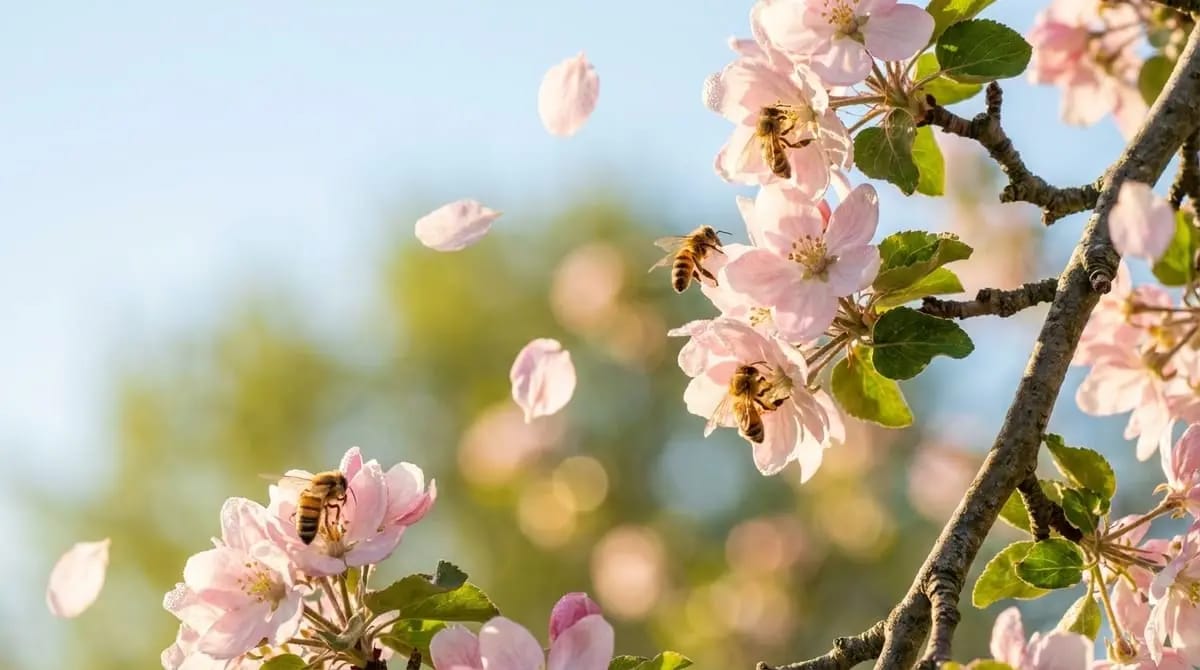
- Fruit blossom (April–May): Apple, pear, cherry — especially in the Lake Constance area
- Dandelion (April–May): The large meadows of the Alpine foothills glow yellow
- Linden (June–July): In parks and avenues, especially in urban areas
- Forest (June–August): Transitions to the coniferous forests of the foothills
3. Franconia: Low Mountain Ranges and Viticulture
Franconia is Bavaria's most diverse forage region. The landscape ranges from the vineyards along the Main River through the Franconian Switzerland region to the Fichtelgebirge and Spessart.
Franconian specialties:
- Acacia honey (Black locust): Especially along the Main valley, light and mild
- Sweet chestnut honey: In the Spessart, spicy-robust with a slight bitter note
- Rapeseed honey: In the cultivation areas of Lower Franconia, creamy-mild
- Linden honey: In the cities of Wuerzburg, Bamberg, Nuremberg
Franconia also has special historical significance: The Nuremberg Imperial Forest has been the center of Zeidlerei since the Middle Ages. The Zeidler had their own rights and their own court — a privilege that underscores the importance of beekeeping in this region.
4. Lower Bavaria and Upper Palatinate
The eastern regions of Bavaria, bordering the Czech Republic and Austria, are characterized by mixed forest and agriculture. The Bavarian Forest offers forest honey opportunities similar to the Alpine foothills, while the plains along the Danube yield classic blossom honeys.
Bavarian Beekeeping Traditions
The Bee House: A Bavarian Institution
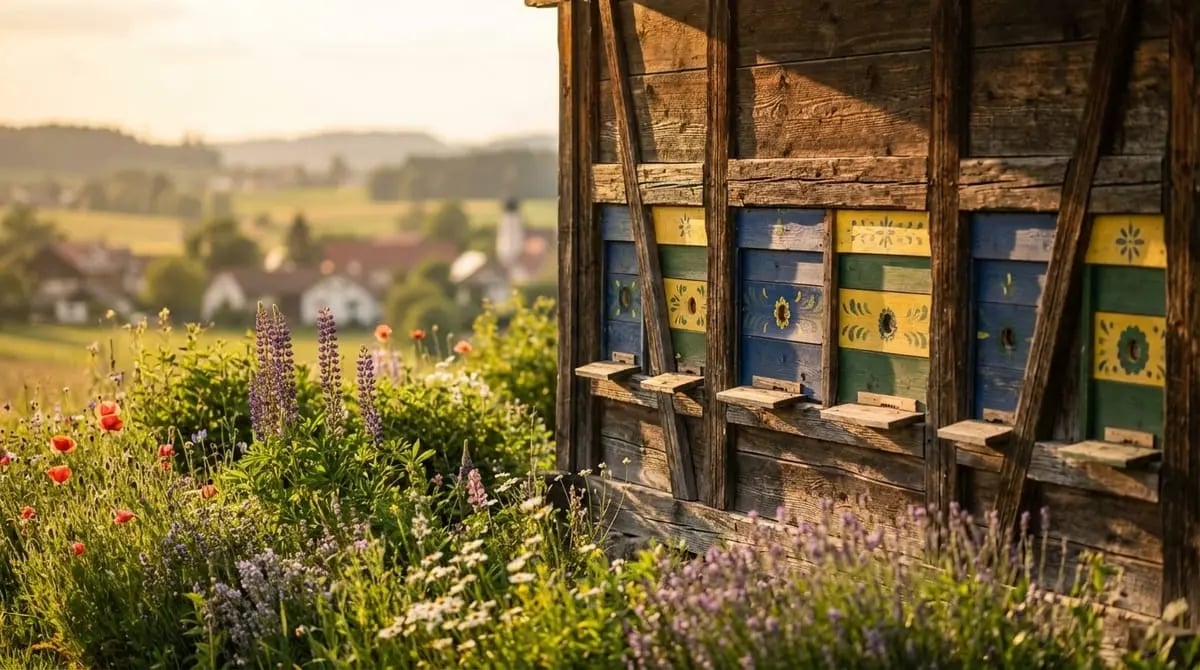
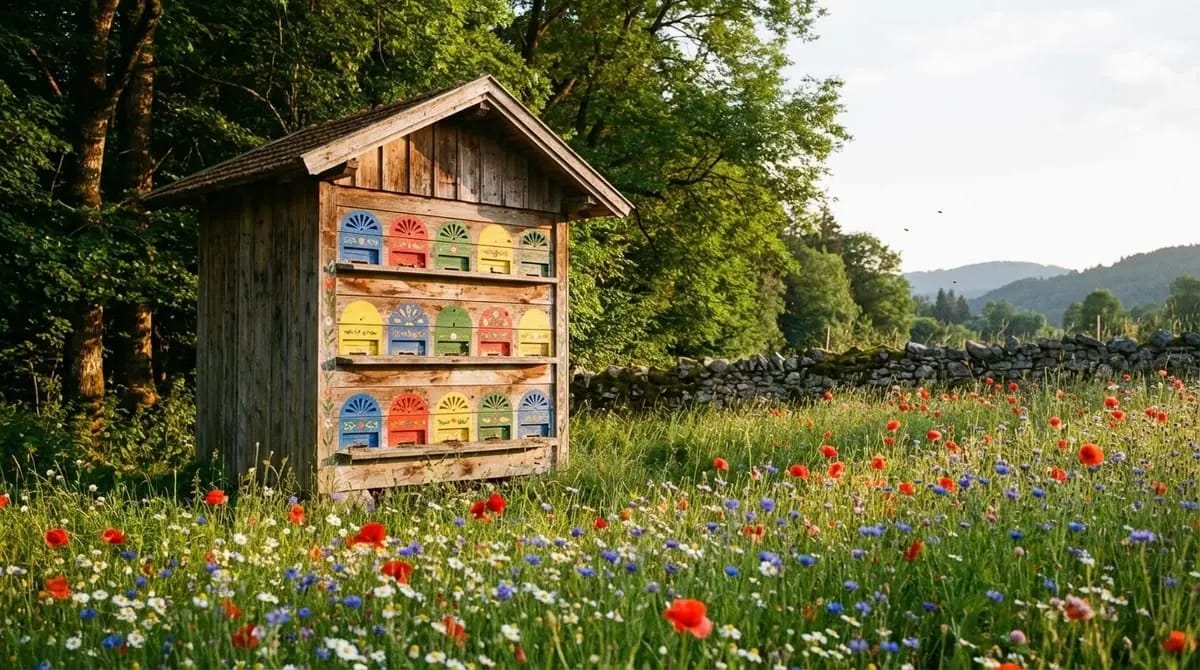
While in northern Germany magazine beekeeping with free-standing hives dominates, in Bavaria the traditional bee house (Bienenhuette, Bienenstand) is still widespread. In these wooden shelters, the hives stand in rows, protected from rain and wind, and can be worked from the rear.
| Feature | Bee House | Free-Standing |
|---|---|---|
| Weather protection | Excellent, year-round | Exposed to wind and rain |
| Working comfort | Dry and wind-sheltered | Weather-dependent |
| Investment | High (construction costs) | Low (hives only) |
| Flexibility | Fixed location | Easily relocatable |
| Migratory potential | Not possible | Easy with trailer |
| Prevalence | Southern Germany, Alps | Northern Germany, modern |
| Tradition | Centuries old | Widespread since approx. 1950 |
Many Bavarian bee houses are lovingly painted — a tradition that is not merely decorative but also helps bees with orientation. Different colors and patterns on the landing boards help them find the correct entrance.
Beekeeping Associations: The Backbone of Bavarian Beekeeping
Bavaria has the densest network of beekeeping associations in all of Germany. Over 650 local associations in 74 county associations are organized under the Landesverband Bayerischer Imker. These associations offer:
- Beginner courses: Usually one year with practical exercises at the hive
- Honey courses: Preparation for the DIB honey certification
- Breeding groups: Collaborative queen rearing and mating station operation
- Regular meetings: Monthly gatherings for exchanging experience
- Teaching apiaries: Association-owned apiary locations for training
The LVBI offers a convenient association search by postal code on its website. For beginners, joining a local association is the best entry into beekeeping — here you will find a mentor and learn the regional specifics.
Mating Stations and Breeding
Bavaria operates numerous state-recognized mating stations for controlled queen breeding. These are often located in isolated Alpine valleys or at high elevations where controlled mating is possible. Bavarian breeding focuses almost exclusively on the Carnica bee (Apis mellifera carnica), which has its natural homeland in the Alpine regions.
Key Bavarian breeding organizations:
- Verband Bayerischer Carnicazuechter (VBC): Promotes pure Carnica breeding in Bavaria
- LVBI Breeding Department: Coordinates mating stations and breeding value estimation via beebreed.eu
- Gemeinschaft der europaeischen Buckfastimker (GdeB): Also active in Bavaria, but in the minority
Forest Honey: Bavaria's Liquid Gold
Forest honey is the pride of Bavarian beekeeping. It is not made from nectar but from honeydew — the sugar-rich excretion of bark lice on coniferous trees. Bavarian forest honey, particularly the Silver fir honey from the Allgaeu and Upper Allgaeu, is among the most sought-after honeys in Europe.
- 1
Understanding Honeydew Formation
Bark lice (Lachnidae) feed on sap from coniferous trees. They excrete excess sugar as sticky honeydew that drips onto needles and branches. Bees collect this honeydew and process it into honey.
- 2
Forest Honey Monitoring
Experienced Bavarian beekeepers observe the development of bark lice populations in spring. The "lice forecast" determines whether migrating to the forest is worthwhile. Particular attention is paid to the spruce scale insect (Physokermes spp.).
- 3
Migration to the Forest
When the forecast is favorable, Bavarian beekeepers often migrate with 20 to 50 colonies to productive forest locations. In the Alpine foothills, there are frequently agreed-upon migration sites with forest owners.
- 4
Harvest and Processing
Forest honey crystallizes much more slowly than blossom honey and often remains liquid for months. It is gently extracted and should be bottled promptly to preserve its intense aroma.
Forest Honey Quality Characteristics
Bavarian forest honey is distinguished by:
- Color: Dark brown to almost black
- Taste: Spicy-malty, slightly resinous, barely sweet
- Consistency: Remains liquid for a long time
- Conductivity: Over 0.8 mS/cm (honeydew indicator)
- Mineral content: Significantly higher than blossom honey
Challenges for Bavarian Beekeeping
Climate Change in the Alps
Climate change particularly affects Bavarian beekeeping: Growing seasons are shifting, late frosts endanger fruit blossom, and honeydew production is becoming more unpredictable. At the same time, some regions benefit from longer warm periods.
Agriculture and Plant Protection
In the large arable farming regions of Franconia and Lower Bavaria, pesticides are a concern. Bavaria set a strong signal with the citizens' initiative "Biodiversity and Natural Beauty in Bavaria — Save the Bees!" (2019) — the most successful citizens' initiative in Bavarian history with 1.74 million signatures. The resulting biodiversity law brought concrete improvements:
- Expansion of flower strip programs
- Reduction of pesticides in nature reserves
- Promotion of organic agriculture
- Stronger protection of traditional orchards
Hive Beetle and New Parasites
As a southern federal state, Bavaria is geographically closer to the introduction routes of the Small Hive Beetle (Aethina tumida) from Italy, where it has been documented in Calabria since 2014. The IBI at the LWG Veitshöchheim coordinates the early warning system "Bee Warned" with around 200 monitoring beekeepers at 220 locations throughout Bavaria.
American Foulbrood (AFB) is also a regular concern in Bavaria. Especially in regions with high bee density, restriction zones can be established. Always follow disease prevention protocols and report suspected cases immediately to the responsible veterinary office.
Bavarian Specifics for Practice
Migratory Beekeeping
Bavaria is a paradise for migratory beekeeping due to its topographic diversity. A typical migratory beekeeper in the Alpine foothills might plan their annual schedule as follows:
- Spring (April): Fruit blossom in the Alpine foothills
- Early summer (May–June): Rapeseed in Franconia or dandelion on alpine meadows
- Summer (June–August): Forest honey in the Alpine foothills
- Late summer (August): Late forage from linden or sweet chestnut
Direct Marketing
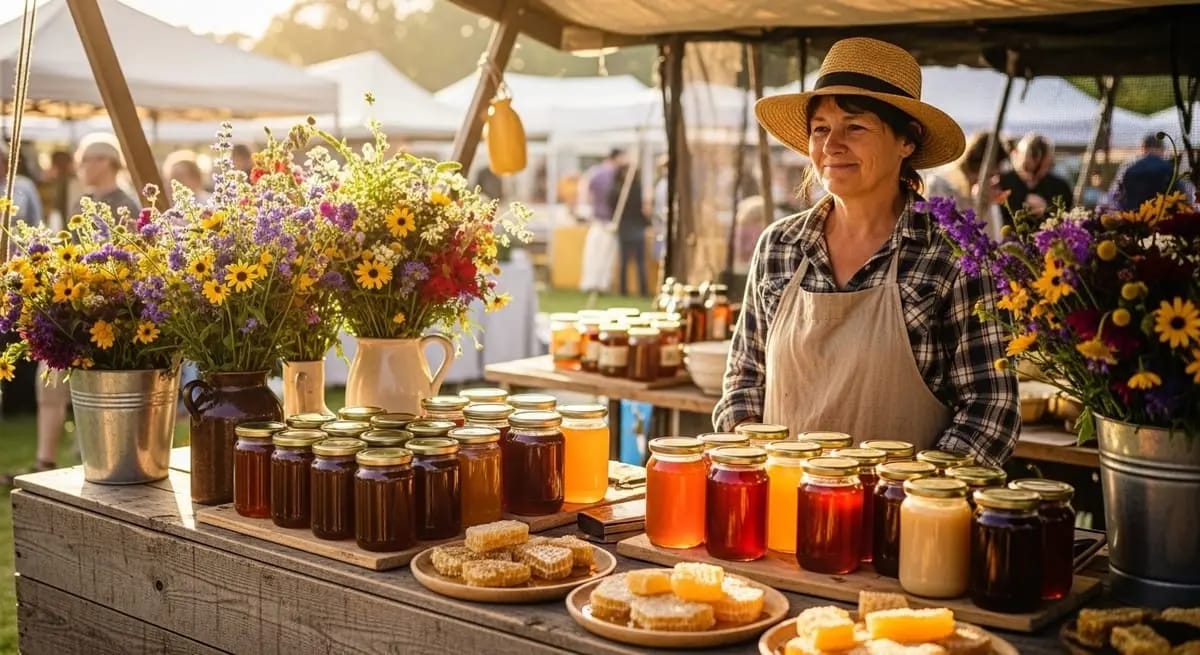
Bavaria's strong regional identity benefits beekeepers in direct marketing. Terms like "Alpine Blossom Honey," "Bavarian Forest Honey" or "Franconian Acacia Honey" have high brand recognition. Regional markets, farm shops and on-site sales are important distribution channels.
Digital Tools
Bavarian beekeeping is also becoming increasingly digital. Hive scales, digital hive records and apps like Hivekraft help beekeepers manage their colonies more efficiently — especially for migratory beekeeping and monitoring forest honey flows.
Conclusion: Bavaria — a Beekeeping Paradise with Responsibility
Bavaria offers beekeepers unique opportunities: from Alpine forage sources to legendary forest honey to a rich association culture. At the same time, climate change, agricultural intensification and new parasites present challenges. Those who keep bees in Bavaria benefit from a strong community, first-class research and a landscape that ranks among the most diverse bee regions in Europe.
Beekeeping in NRW: Urban Beekeeping in the Industrial Heartland Beekeeping in Baden-Wuerttemberg: Fruit Blossom and Black Forest Germany's Honey Varieties: A Taste Journey Through the Regions- Forage Plants and Bee Pasture -- Understanding Regional Forage
- Honey Business -- Lesson 3: Germany's Honey Varieties
Less paperwork. More time with your bees.
Hivekraft is free for up to 5 hives. Register in 30 seconds.