Beekeeping in the North: Heather, Rapeseed and Coastal Climate
Beekeeping in Northern Germany: From the Lueneburg Heath to rapeseed fields and the coast. Forage, wind and the specifics of northern German beekeeping.
Northern Germany — this is the vast landscape between the North Sea and Baltic Sea, the endless rapeseed fields of Schleswig-Holstein, the mystical Lueneburg Heath and the windswept dikes of East Frisia. For beekeepers, this region offers unique opportunities and equally specific challenges. Anyone who wants to keep bees successfully here needs knowledge about the coastal climate, northern German forage sources and the right strategy for wind and weather.
The regulations, organizations and geographic details described in this article apply specifically to Northern Germany. Rules and structures may differ in other countries and regions.
The Northern German Beekeeping Landscape
Northern Germany encompasses the federal states of Schleswig-Holstein, Lower Saxony, Mecklenburg-Western Pomerania, Hamburg and Bremen as well as parts of Brandenburg. The landscape is predominantly flat, shaped by agriculture and offers a maritime to moderate continental climate.
What Makes the North Special for Beekeepers
- Rapeseed: By far the most important single forage source in Germany — and the North is the center
- Heather: The Lueneburg Heath offers one of the most exclusive honey varieties of all
- Coastal climate: Mild but windy — bees and beekeepers need special strategies
- Migratory beekeeping tradition: Northern German beekeepers have been migrating with their colonies for centuries
- Large operations: The North has a disproportionate number of commercial beekeepers with 100+ colonies
The Great Forage Sources of the North
Rapeseed: The Yellow Gold
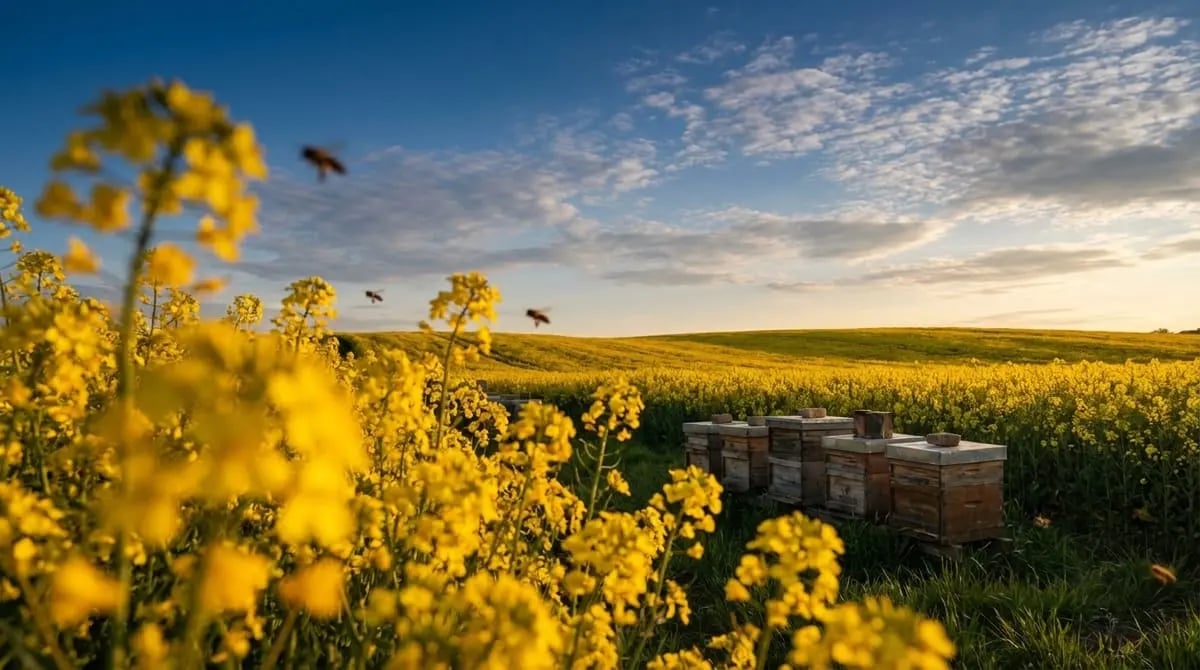
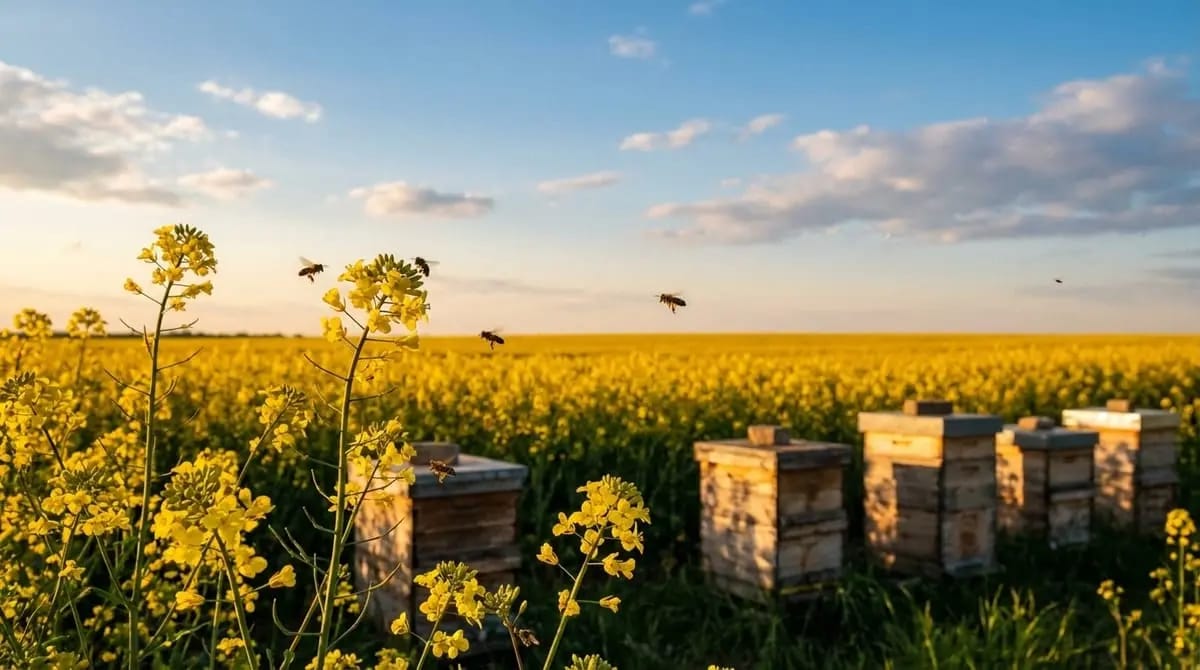
Rapeseed (Brassica napus) is the signature forage of Northern Germany. Especially in Schleswig-Holstein, Mecklenburg-Western Pomerania and northern Lower Saxony, the fields bloom in brilliant yellow in April and May. For beekeepers, this means:
Advantages of the rapeseed flow:
- Extremely productive: 20 to 40 kg of honey per colony in a good season
- Reliable: Rapeseed blooms abundantly almost every year
- Early harvest: Can be extracted as early as late May
Challenges:
- Rapid crystallization: Rapeseed honey has a high glucose content and crystallizes within days to weeks. Anyone who does not extract in time risks solid honey in the combs.
- Pesticides: Rapeseed is intensively treated — coordination with farmers is essential
- Mono-forage: Pure rapeseed honey can be somewhat monotonous in flavor
Rapeseed honey should be extracted as soon as possible after the end of the rapeseed flow — ideally within one to two weeks. Due to the high glucose content, crystallization begins significantly faster than with other honey varieties and can cause the honey to solidify in the combs. Check the water content regularly with a refractometer — below 18% is ideal.
Lueneburg Heath: Heather Honey — the Crown of Northern German Beekeeping
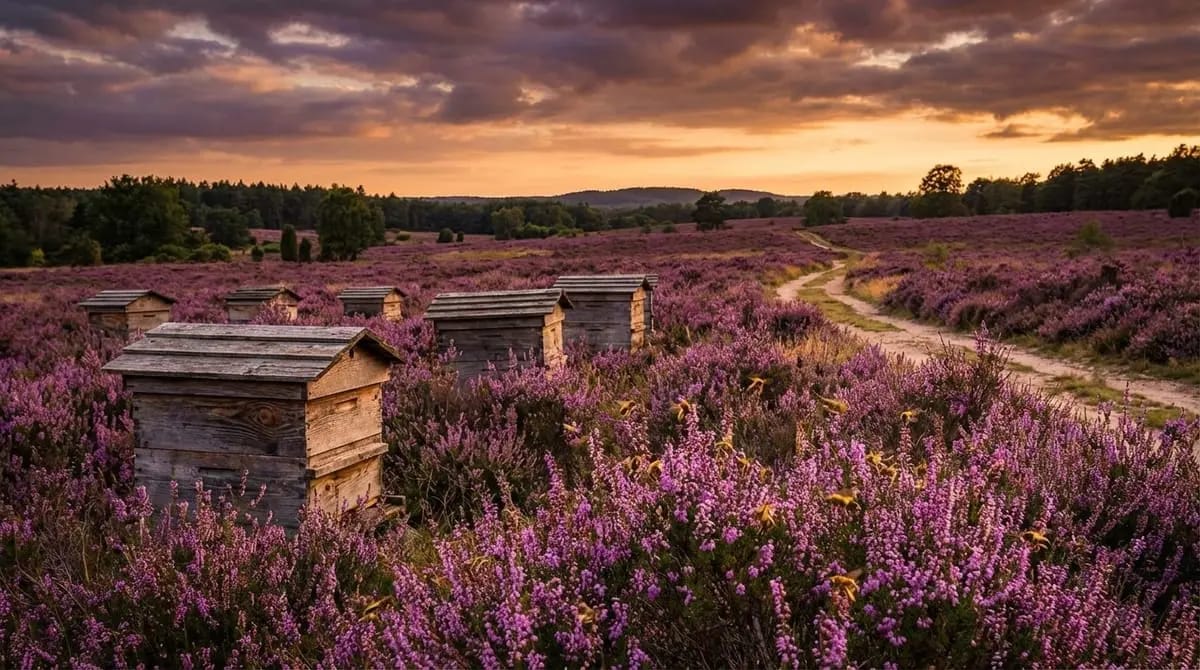
The common heather (Calluna vulgaris) blooms in August and September in the Lueneburg Heath, transforming the landscape into a purple sea. Heather honey is one of the most exclusive and expensive honey varieties in Germany.
What makes heather honey so special:
- Consistency: Jelly-like, thixotropic — becomes liquid when stirred, sets again
- Taste: Robust-spicy, slightly bitter, malty
- Color: Amber to dark brown
- Price: 10 to 18 EUR per 500g jar — significantly above average
- Harvest: Cannot be extracted by centrifuge, but is obtained using a heather honey press (stipper) or stippled
- 1
Preparing the Migration (July)
Contact the heathland owners or local beekeeping association well in advance. Migration spots in the heath are in demand and often must be reserved months ahead. The Lueneburg Heath is protected as a nature park — inform yourself about permits.
- 2
Preparing the Colonies
Only strong colonies with at least 30,000 bees are suitable for the heather flow. Weak colonies starve because heather provides nectar but barely any pollen. Feed protein-rich food (pollen combs) beforehand and ensure the colonies are actively brooding.
- 3
Migration (Mid-August)
Transport the colonies in the evening when all bees are inside. The heather typically blooms from mid-August to mid-September — the exact bloom time depends on temperature and precipitation.
- 4
Harvest (September)
Heather honey is thixotropic and cannot be extracted by conventional centrifuge. Use a stipper — a device with spring-loaded pins that penetrate the honeycomb cells and loosen the honey. Afterward, the honey is centrifuged or obtained by pressing (heather press honey).
Other Important Forage Sources
Fruit blossom (April–May): The Altes Land near Hamburg is Europe's largest contiguous fruit-growing region. Cherries, apples and pears provide reliable early forage.
Linden (June–July): In the cities of Hamburg, Luebeck, Hanover and Rostock there are large linden populations. Linden honey from the North is light, fresh-minty and highly sought after.
Phacelia and Mustard (Summer): As cover crops in agriculture, these plants offer a welcome summer forage, especially in Mecklenburg-Western Pomerania.
Buckwheat (July–August): In some regions of Lower Saxony, buckwheat is grown. The resulting honey is dark, robust and has a characteristic, slightly tart aroma.
The Coastal Climate: Blessing and Curse
Wind — the Constant Companion
Along the North Sea and Baltic Sea coasts, wind is the dominant climatic factor. For bees and beekeepers, this means:
| Factor | Impact on Bees | Solution |
|---|---|---|
| Strong wind | Bees fly less, foraging performance decreases | Windbreak plantings, sheltered locations |
| Salt air | No direct damage, but salt-containing dew | Provide fresh water source |
| Cool summers | Slower colony development | Stronger overwintering, later season start |
| Mild winters | Fewer winter losses | But: Late-brooding colonies, Varroa problem |
| Early rapeseed flow | Fast colony buildup in spring | Add honey supers on time |
Site Selection on the Coast
Site selection is particularly important in Northern Germany. A good coastal location offers:
- Wind protection: Hedges, Knicks (typical Schleswig-Holstein hedge banks), buildings
- South orientation: Entrances facing south or southeast
- Drainage: Northern German soils can be waterlogged — elevated placement protects
- Diverse forage: Mix of fruit trees, wildflowers and agricultural crops
The typical Schleswig-Holstein Knicks (hedge banks) are true treasure troves for bees. Within just a few meters you find hawthorn, blackthorn, elderberry, hazel and blackberry — a bloom buffet from February to September. Position your hives near such Knicks whenever possible.
The Migratory Beekeeping Tradition of the North
Northern Germany has a long migratory beekeeping tradition closely linked to heather beekeeping. For centuries, beekeepers have transported their bees to the heath in late summer — once on carts, today on trailers.
Typical Migration Plan of a Northern German Beekeeper
- March–April: Home apiary — fruit blossom and early bloomers
- May–June: Migration to rapeseed (Schleswig-Holstein or Mecklenburg-Western Pomerania)
- June–July: Return to home apiary or linden flow
- August–September: Migration to the Lueneburg Heath
- October: Feeding and winter preparation at the home apiary
Migratory Beekeeping: Legal Requirements
In Lower Saxony and Schleswig-Holstein, special rules apply for migratory beekeeping:
- Migration fee: Some municipalities charge a small fee
- Health certificate (Seuchenfreiheitsbescheinigung): Required when moving colonies across county borders, certifying freedom from American Foulbrood (under Section 5 of the Bee Disease Ordinance)
- Nature reserves: Permit from the nature park authority required (especially in the heath)
Northern German Beekeeping Associations and Organizations
Northern German beekeeping is well organized. Key contact points:
- Landesverband Schleswig-Holsteinischer und Hamburger Imker e.V.: One of the most tradition-rich associations
- Landesverband Hannoverscher Imker e.V.: One of the two Lower Saxony associations (over 9,800 members)
- Landesverband der Imker Weser-Ems e.V.: Second Lower Saxony association (approx. 2,900 members)
- Landesverband der Imker Mecklenburg und Vorpommern e.V.: Grown strongly since reunification
- LAVES Institut fuer Bienenkunde Celle: One of Germany's most important bee research institutes
- Celle Professional Beekeepers' Conference: Largest northern German professional conference, held annually in late January in Celle

The Celle Bee Institute
The LAVES Institut fuer Bienenkunde Celle in Lower Saxony is a central institution for northern German beekeeping. It offers:
- Bee health examinations (Foulbrood, Nosema, Varroa)
- Honey analyses and quality testing
- Research on bee health and plant protection
- Training and continuing education for beekeepers
- Consultation on bee diseases
Challenges in the North
Summer Forage Gaps
After the rapeseed flow (late May) and before the heather flow (mid-August), the North often has a forage gap of 8 to 10 weeks. During this time, bees find barely any food in the intensively used agricultural landscape. Countermeasures:
- Choose locations with flower strips and extensive grassland
- Seek contact with farmers who plant cover crops
- Emergency feeding during extreme forage scarcity
Varroa in the Mild Coastal Climate
The mild coastal climate has a downside: bee colonies often continue brooding into November or December. This extends the Varroa reproduction phase and complicates the brood-free winter treatment.
In the mild coastal climate, a combined Varroa strategy is recommended: drone brood removal in May, formic acid treatment after harvest (August) and oxalic acid trickling treatment only when brood-free conditions are confirmed — in the North often not until late December or early January.
Intensive Agriculture
The northern German lowland is one of Europe's most productive agricultural regions. Intensive arable farming brings rapeseed forage but also:
- Monotonous crop rotations with little floral diversity
- Use of pesticides
- Large areas without edge structures
- Compacted soils with fewer wildflowers
Tips for Aspiring Northern Beekeepers
- 1
Prioritize Wind Protection
Look for a location behind a hedge, a building or a Knick. In the northern German lowland, even moderate wind protection can increase your bees' foraging performance by 20 to 30%.
- 2
Utilize Rapeseed Flow but Plan Ahead
Learn which rapeseed fields are in your area. Talk to farmers about spraying schedules and plan the harvest early. A refractometer is a must — rapeseed honey needs to be extracted quickly.
- 3
Try the Heather Migration
Even hobby beekeepers can try the heather migration. Start with just a few colonies and join an experienced migratory beekeeper. The heather honey yield can enhance the entire season.
- 4
Adapt Winter Treatment
In the mild coastal climate, colonies often brood for a long time. Adapt your Varroa strategy and be patient with the winter treatment. A brood-free phase in mid-January is more realistic than in inland areas.
Conclusion: The North — Rapeseed, Heather and Lots of Wind
Northern Germany offers beekeepers a contrasting experience: the productive rapeseed flow in spring, the exclusive heather flow in late summer and the challenges of the coastal climate form a unique beekeeping character. Those who understand the specifics of the North and adapt their management practices can produce excellent honeys here — from creamy-mild rapeseed honey to spicy-thixotropic heather honey.
Beekeeping in NRW: Urban Beekeeping in the Industrial Heartland May: Managing Swarming Season — Techniques, Timing and Control Germany's Honey Varieties: A Taste Journey Through the Regions- Forage Plants and Bee Pasture -- Lesson 4: Late Summer and Heather
- Honey Business -- Regional Marketing
Less paperwork. More time with your bees.
Hivekraft is free for up to 5 hives. Register in 30 seconds.