Explaining Bees to Children: Tips and Activities for Parents
Explaining bees to children in an age-appropriate way: explanations, activities, experiments, and book recommendations for curious kids.
"Mom, why do bees buzz?" — "Dad, will they hurt me?" — "Why do we need bees?" Children are naturally curious about the world of insects, and bees are among the most fascinating animals you can introduce to them. At the same time, many children (and honestly, many adults too) are afraid of bees. In this article, we show you how to explain bees to children in an age-appropriate way, transform their fear into fascination, and experience exciting activities together around the topic of bees.
Why Bees Are a Great Topic for Children
Bees are the perfect nature topic for children because they:
- Are everywhere — every child has already seen a bee
- Have a fascinating social structure (queen, workers, drones)
- Make honey — a tangible, delicious product
- Clearly show the connection between nature and food (pollination)
- Offer opportunities to talk about environmental protection
- Teach how to overcome fear — through knowledge, fear becomes respect
Explaining Bees by Age Group
Not every explanation suits every age. Here's a guide:
For Children Ages 3 to 5
At this age, simple, visual explanations are sufficient:
"Bees are little creatures that fly from flower to flower and carry pollen with them. It's like they help flowers make seeds. And from the sweet juice of flowers, they make honey — the kind we eat on bread!"
Important messages for this age group:
- Bees are busy helpers that need flowers
- Bees make honey — and it's delicious
- Bees only sting when you bother them — if we stay calm, nothing happens
- Bees are afraid of us, not the other way around
For Children Ages 6 to 9 (Primary School)
Now children can understand more complex concepts:
The three bee jobs:
- The Queen: The only one who lays eggs. She's the "mother" of the whole colony. Up to 2,000 eggs a day!
- The Workers: All female! They clean, feed the babies, build combs, collect nectar, and guard the hive. Throughout their lives, they change jobs.
- The Drones: The boys. Their only task: find a queen and mate. After that, they die.
Pollination explained for children: "Imagine the bee visits a flower and gets yellow pollen on her legs and fur — like powder. When she flies to the next flower, some of it falls off. The flower needs that to make fruits and seeds. Without bees, there would be no apples, no cherries, and no strawberries!"
For Children Ages 10 and Up
Here you can really go into depth:
| Topic | Fascinating Facts |
|---|---|
| Communication | Bees dance to show others the way to flowers (waggle dance) |
| Navigation | They orient themselves by the sun's position and Earth's magnetic field |
| Architecture | The hexagonal comb is the most efficient shape — maximum space with minimum material |
| Mathematics | A colony consists of up to 50,000 bees and functions as a superorganism |
| Temperature control | They keep the brood nest at a constant 35°C — through muscle vibration and fanning |
| Democracy | When swarming, bees vote on the best nesting site |
The Waggle Dance: When a forager bee finds a rich flower source, she dances a figure-eight in the hive: the direction indicates the angle to the sun, the duration of the straight part reveals the distance, and the intensity of the dance shows how good the source is. Other bees "read" the dance and fly directly there. Karl von Frisch decoded this dance and received the Nobel Prize for it in 1973.
10 Activities About Bees
Activity 1: Observing Bees in the Garden
The simplest activity: sit together in front of a blooming plant and watch the bees. Which flowers do they prefer? How long do they stay on one flower? Can you spot the pollen baskets on their hind legs?
Tip: A magnifying glass makes the observation even more exciting.
Activity 2: Building a Bee Hotel
- Empty tin can
- Bamboo tubes or reed stalks
- Garden shears
- Sandpaper
- String for hanging
- Clean and dry the tin can. Cover sharp edges with tape.
- Cut bamboo tubes to the length of the can.
- Smooth open ends with sandpaper.
- Pack tubes tightly into the can (closed end facing back).
- Hang the can horizontally in a sunny, rain-protected spot.
- Watch which bees move in!
Activity 3: Simulating Pollination
An experiment that shows children how pollination works:
- Take two paper flowers and sprinkle some flour or powdered sugar in the center (that's the "pollen")
- Have your child touch the pollen of the first flower with a cotton ball (that's the "bee")
- Now touch the second flower — the pollen is transferred
- Explain: This is exactly how pollination works with real bees!
Activity 4: Keeping a Bee Journal
Create a small journal together where you record your bee observations:
- Date, time, weather
- Which flowers were visited?
- How many bees did you count?
- Drawings of the observed bees
- Observations: Pollen baskets? Waggle dance? Other insects?
Activity 5: Honey Tasting
Get 3–4 different types of honey and do a blind tasting:

- Close or blindfold eyes
- Try a small spoonful of each
- Describe: Sweet? Floral? Spicy? Light or dark?
- Reveal: Which honey was that?
Children are often surprised at how different honey can taste!
Activity 6: Rolling Beeswax Candles
- Beeswax foundation sheet (available online or from a beekeeper)
- Candle wick
- Scissors
- Optional: Hair dryer for warming
- Warm the foundation sheet at room temperature (briefly warm with a hair dryer if it's crumbly).
- Place the wick along one edge, leaving about 2 cm sticking out.
- Roll the wax sheet firmly around the wick — tight but careful.
- Press the end down so the candle holds.
- Trim the wick to 1 cm. Done!
Activity 7: Making Seed Bombs
Bee-friendly seed bombs are a great crafting project:
- Mix 5 parts clay, 3 parts compost soil, and 1 part wildflower seeds
- Add some water until you have a moldable mixture
- Roll into small balls and let dry
- Throw them into the garden in spring or give them to friends
Activity 8: Visiting a Beekeeper
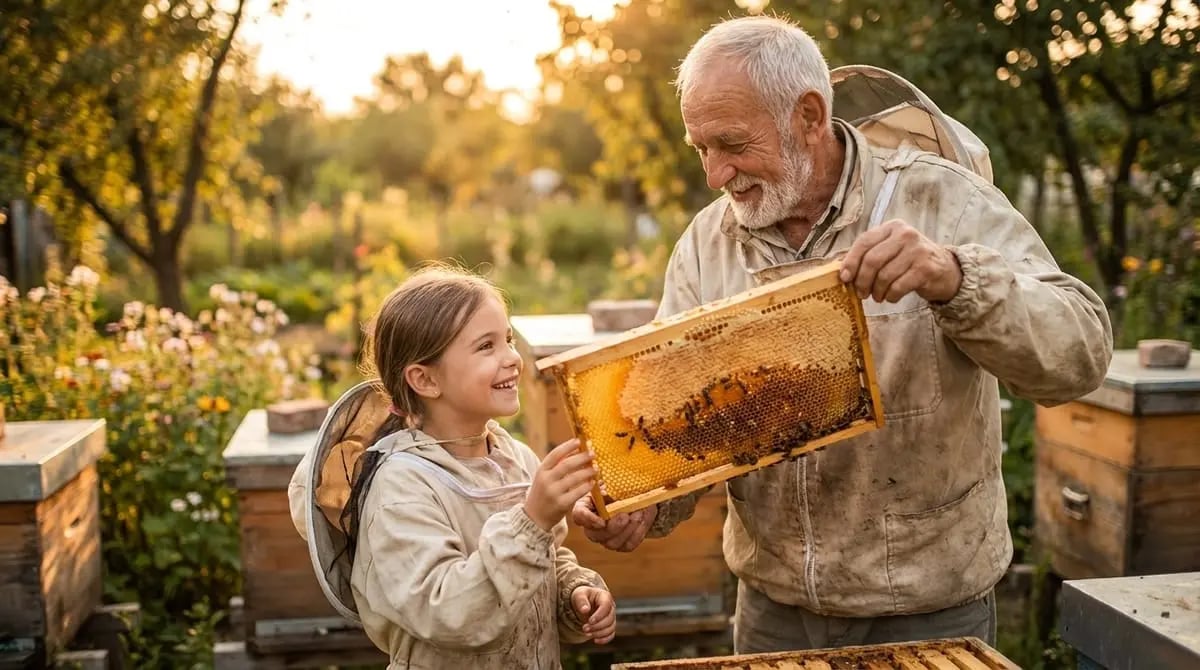
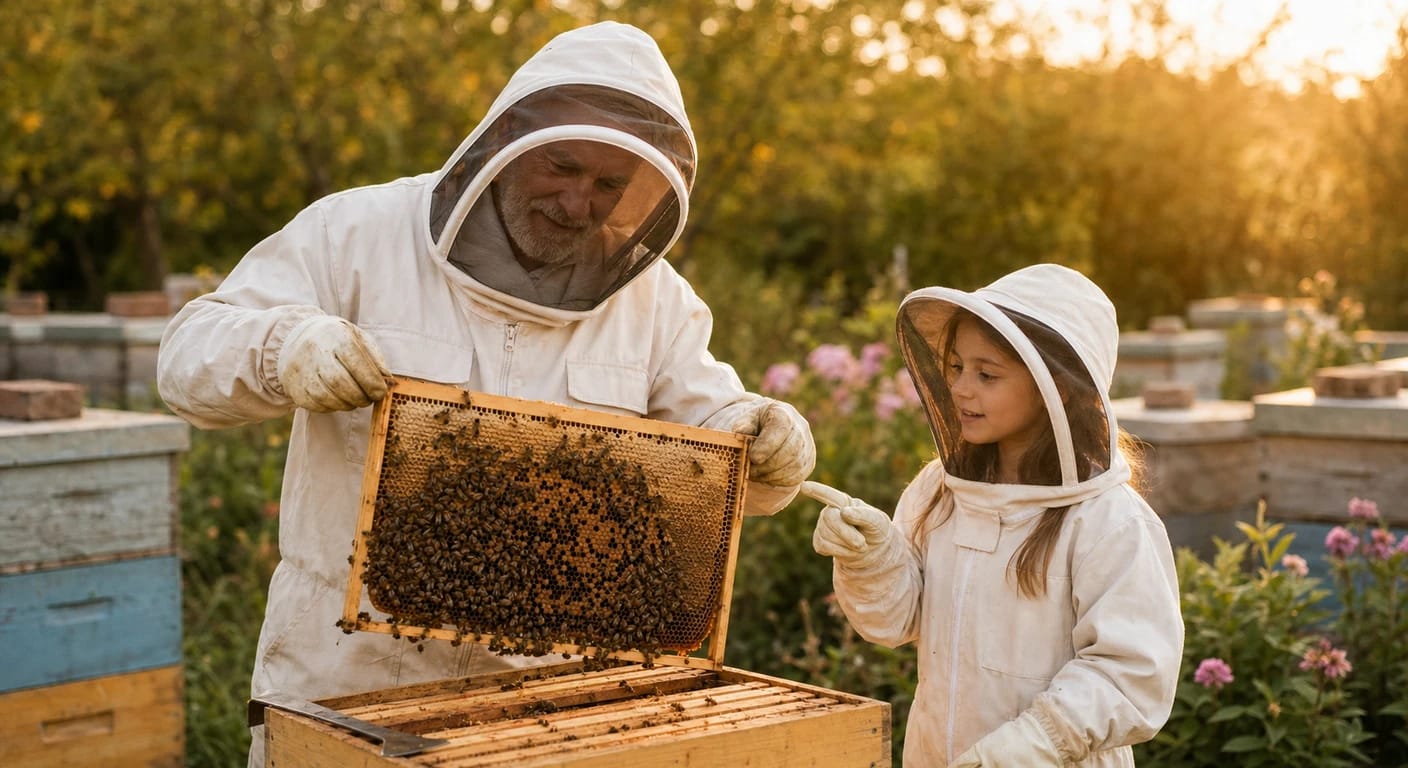
Many local beekeepers and beekeeping associations offer tours for children. A visit to the apiary — with veil and smoker — is an unforgettable experience. Some beekeepers offer special children's birthday parties.
Activity 9: Reenacting the Waggle Dance
Explain the waggle dance and reenact it on the playground or in the garden:
- One child is the "scout" and has hidden a "treasure" (flower)
- Through dancing (indicating direction, duration = distance), the other children must find the treasure
- Variation: Blindfold and follow only the buzzing sound
Activity 10: Bee Quiz
Overcoming Fear of Bees
Many children (and adults) are afraid of bees. Here's how you can help transform that fear into respect:
- 1
Knowledge provides security
Explain why bees sting (only in self-defense) and that they die in the process. Bees don't want to hurt us — they're afraid of us themselves. This knowledge takes away a lot of fear.
- 2
Practice correct behavior
Practice the three golden rules playfully: (1) Stay calm, (2) move slowly, (3) don't swat at the bee. Make a role-play out of it: "What do you do when a bee wants to drink from your juice?"
- 3
Collect positive experiences
Observe bees together from a safe distance. Show how you yourself stay calm when a bee is nearby. Children learn behavior primarily through example.
- 4
Gradually get closer
First observe, then visit a beekeeper (with veil!), then maybe hold a frame yourself. Every step at their own pace — no pressure.
Before children come close to beehives, it should be clarified whether there is a bee venom allergy. If unsure: get tested at the pediatrician or allergist. When in doubt, have an emergency kit on hand.
Bees in School
The topic of bees is excellent for cross-curricular teaching:
| Subject | Topic |
|---|---|
| Science / Biology | Life cycle, pollination, ecosystem |
| Mathematics | Comb structure (hexagons), quantity comparisons |
| Art | Painting bees, making wax candles |
| Language Arts | Writing stories about bees, composing factual texts |
| Physical Education | Waggle dance, movement games |
| Ethics | Environmental protection, responsibility for nature |
Many beekeeping associations offer school visits and bring an observation hive (a glass-enclosed mini bee colony) into the classroom. This is incredibly exciting for children — searching for the queen is like a treasure hunt.
Book Recommendations for Bee-Enthusiastic Children
| Book | Age | Highlight |
|---|---|---|
| Maya the Bee (Waldemar Bonsels / Picture Book) | 3–6 | Classic, beautiful illustrations |
| The Bee Book (Charlotte Milner) | 4–7 | Beautifully illustrated introduction to bees |
| Bees: A Honeyed History (Piotr Socha) | 5–99 | Large-format reference book, wonderfully illustrated |
| The History of Bees (Maja Lunde) | 12+ | Novel about bees and humans across three eras |
| The Bee Book (DK) | 8–12 | Comprehensive reference, child-friendly |
| National Geographic Kids: Bees | 4–7 | Fun facts and great photos |
The Most Important Bee Facts for Children
To conclude, a collection of facts that will amaze children:
- A bee flies about 800 km in its lifetime — that's as far as from London to Edinburgh and back
- Bees can recognize faces and remember them
- In summer, a bee colony has up to 50,000 residents — more than a small town
- A bee weighs only 0.1 grams — you'd need 10,000 bees for one kilogram
- Bees actually sleep — in many short naps throughout the day
- A bee's honey stomach holds only 0.05 ml of nectar — a single drop
- Bees keep their brood nest at exactly 35°C — warmer than your living room
- There are bees on every continent — except Antarctica
Conclusion: Bees Fascinate Children
Children have a natural interest in animals and nature. Bees offer endless conversation topics, exciting activities, and the opportunity to learn together about ecosystems, responsibility, and conservation. The most important thing: lead with enthusiasm — if you talk about bees with fascination, the excitement will be contagious.
And who knows — maybe someday there'll be a beehive in the garden, because a child once asked on the playground: "Mom, why do bees buzz?"
Bee Sponsorship: Give the Gift of Conservation and Support Beekeepers Helping Wild Bees: Building Insect Hotels and Nesting Aids Correctly Bee-Friendly Plants: The Best Flowers for Your Garden- Beekeeping for Beginners -- Lesson 2: Bee biology explained clearly
- Forage Plants and Bee Pastures -- Lesson 1: What bees really need
Less paperwork. More time with your bees.
Hivekraft is free for up to 10 hives. Register in 30 seconds.