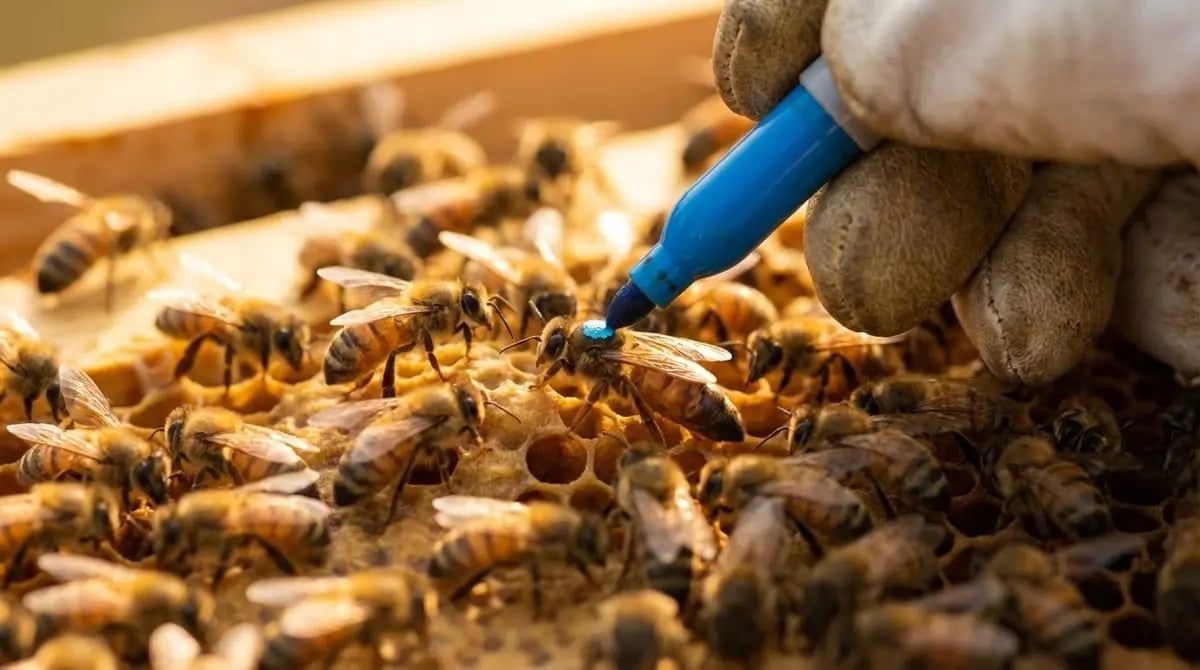
Queen Rearing for Beginners - Step by Step
Raising your own queens is easier than you think. From selecting the breeding colony to a mated queen - a guide for beginners.
Every beekeeper sooner or later faces the question: buy queens or raise your own? Raising your own queens gives you control over the genetics of your colonies, saves money, and makes you independent. And it is easier than many think.
Why Raise Your Own Queens?
Advantages of Own Queen Rearing
- Adaptation: Queens from your own colonies are adapted to your climate and forage
- Selection: You select specifically for gentleness, low swarming tendency, and honey yield
- Independence: No waiting for breeders, no shipping risk
- Cost: A purchased queen costs 25-50 EUR, self-raised ones cost almost nothing
- Colony multiplication: Every new queen creates a new colony
When to Start?
Queen rearing takes place between May and July - during the natural swarming season, when drones are available for mating.
Understanding the Basics
The Life Cycle of a Queen
| Phase | Day | What Happens |
|---|---|---|
| Egg | 1-3 | Fertilized egg in queen cell |
| Larva | 4-8 | Fed with royal jelly |
| Capping | 9 | Cell is sealed |
| Pupa | 9-16 | Metamorphosis in the cell |
| Emergence | 16 | Young queen emerges |
| Mating flight | 21-24 | Multiple mating flights |
| Egg laying | 26-30 | First eggs are laid |
What You Need
- Breeding colony: Your best, gentlest, most productive colony
- Starter/Finisher: A strong, queenless nurse colony
- Mating nucs: Mini-Plus, Kieler mating nuc or Apidea
- Grafting tools: Chinese grafting needles (approx. 5 EUR)
- Cell bar frame with queen cups
Method 1: Simple Emergency Queen Rearing
The simplest method - ideal for getting started:
- Select breeding colony: Your gentlest, strongest colony
- Remove a frame with youngest larvae (under 24 hours old)
- De-queen the nurse colony: Move queen to a nucleus or mating nuc
- The bees will raise emergency queen cells from the youngest larvae
- After 10-11 days: Harvest ripe queen cells and distribute
Disadvantage: You have little control over which larvae the bees select.
Method 2: Grafting (Standard Breeding Method)
The gold standard of queen rearing - precise and effective:
Step 1: Obtain Breeding Material
- Remove a frame with eggs and youngest larvae from the breeding colony
- Larvae should be maximum 24 hours old - ideally under 12 hours (barely visible, swimming in royal jelly)
Step 2: Grafting
- Lightly moisten queen cups with diluted honey
- Slide grafting needle under the larva (lying in C-shape)
- Gently place larva in the cup - do not rotate!
- Place 10-15 cups per cell bar
Step 3: Starting
- Hang cell bar frame in the queenless nurse colony
- Place between capped brood frames (warmth + bee contact)
- After 24 hours check: Accepted cells have raised edges
Step 4: Care and Maturation
- Leave accepted cells in the nurse colony
- Day 5 after grafting: Queen cells are capped
- Day 10-11 after grafting: Cells are ripe for transfer
- Carefully place cells in protective cages (protection from mutual destruction)
Step 5: Mating
- Hang ripe cells in mating nucs
- Place nucs at a quiet location near a drone congregation area
- After 2-3 weeks check: Laying queen = success!
Making the Right Selection
Selection Criteria
Choose your breeding colony according to these criteria (in this order):
- Gentleness: Calm behavior during inspections
- Low swarming tendency: Little inclination to swarm
- Vitality: Healthy, no disease signs, good Varroa count
- Honey yield: Above-average harvest
- Comb behavior: Calm sitting on the comb
Tip: Document the traits of your colonies with the queen management in Hivekraft. This way you quickly find the best breeding colony and can track development over the years.
Breeding Schedule
| Week | Action |
|---|---|
| Week 1 | Select breeding colony, prepare nurse colony |
| Week 2 (Mon) | Graft, hang cell bar frame |
| Week 2 (Tue) | Check acceptance |
| Week 3 (Thu) | Harvest ripe cells, place in mating nucs |
| Week 5-6 | Mating check: Eggs present? |
| Week 7 | Introduce mated queen or form nucleus |
Common Mistakes
- Grafting larvae that are too old: Only use larvae under 24 hours (ideally under 12 hours)
- Nurse colony too weak: At least 8-10 occupied frame spaces
- Starting too early in the year: Only start when enough drones are flying (from May)
- No selection: Do not breed from just any colony
- Dropping queen cells: Always transport carefully and vertically
Summary
Queen rearing is one of the most rewarding skills in beekeeping. Start with simple emergency queen rearing and work your way up to grafting. The key points:
- Select a good breeding colony (gentleness + performance)
- Use young larvae (maximum 24 hours, ideally under 12 hours)
- Provide a strong nurse colony
- Be patient - not every cell will be accepted
- Document — the digital hive record helps you track every breeding result — and learn from experience
With each season you will improve, and your colonies will reward you with gentleness and productivity.
Read also: May - Managing Swarm Season Properly Basics: Beekeeping for Beginners - Your Start into BeekeepingQueen rearing is a fascinating topic with great depth:
- Advanced Beekeeping Practice -- Lesson 2: Queen rearing for advanced beekeepers
- Bee Health Complete Course -- Recognizing and solving queen problems
Less paperwork. More time with your bees.
Hivekraft is free for up to 10 hives. Register in 30 seconds.