Wax Moth Control: Prevention and Treatment for Beekeepers
Wax moths can destroy stored comb and devastate weak colonies. Learn to identify, prevent, and treat both Greater and Lesser wax moth infestations with proven methods that protect your equipment.
Wax moths are among the most frustrating problems a beekeeper faces — not because they threaten healthy colonies (they generally do not), but because they can silently destroy months of hard-won drawn comb stored in your barn or garage. Understanding the wax moth lifecycle, recognizing the damage early, and knowing which control methods actually work can save your equipment and your sanity.

Two Species: Greater and Lesser Wax Moth
Most beekeepers encounter two species, and it is worth knowing which you are dealing with.
Greater Wax Moth (Galleria mellonella)
The Greater wax moth is the primary pest and the more destructive of the two. The adult is a grey-brown moth about 3/4 inch (20 mm) long with wings that fold flat over the body at rest. Females can lay 300–600 eggs per lifetime.
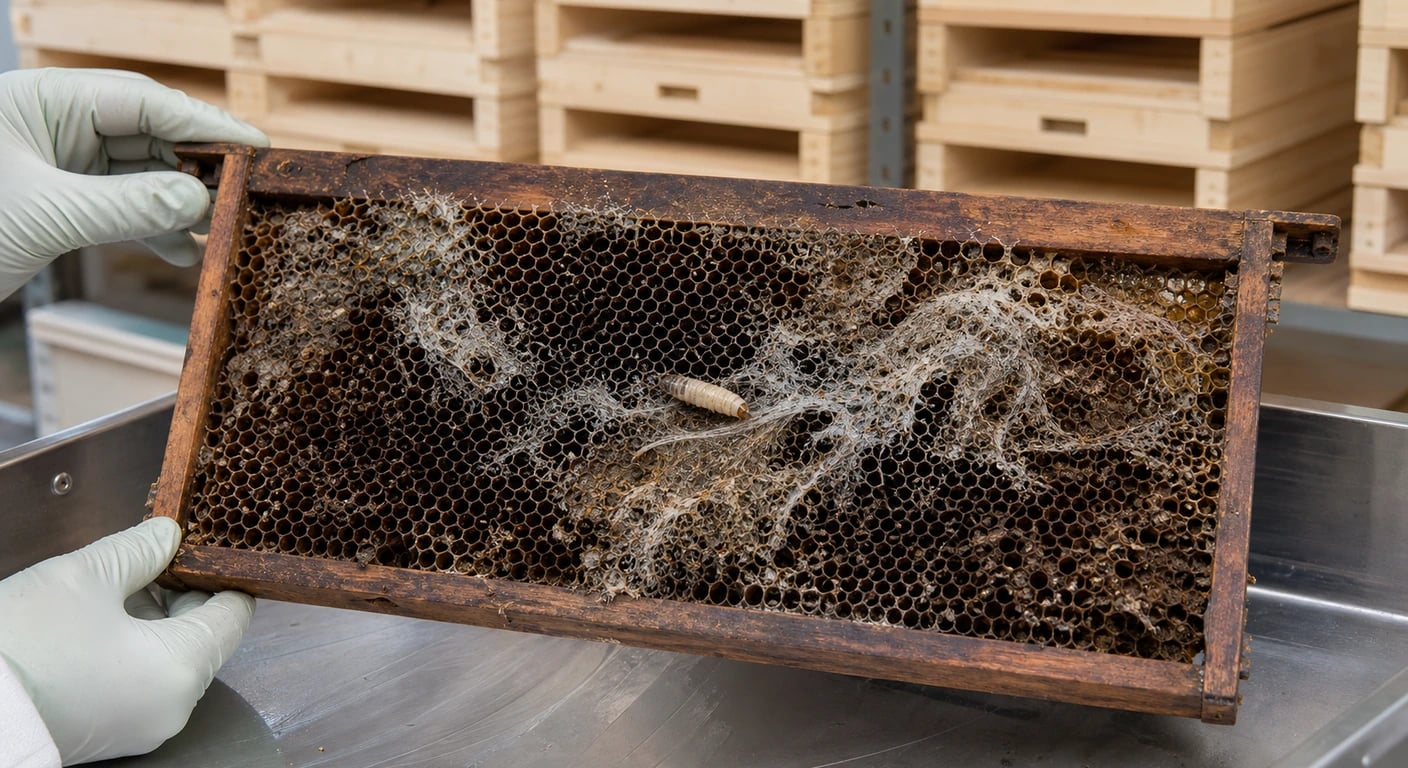
The larvae — creamy white caterpillars up to 1 inch (25 mm) long — cause all the damage. They tunnel through comb, consuming beeswax, pollen, cocoons, and anything else they find. They spin silken tunnels as they go, making removal very difficult without destroying the comb.
Lesser Wax Moth (Achroia grisella)
Smaller and less destructive than Galleria, the Lesser wax moth adult is a silver-grey moth about 1/2 inch (13 mm) long. It prefers the periphery of the brood nest and older, darker comb. While the damage is less severe, infestations can still ruin stored equipment.
In North America, Galleria mellonella is the species causing the vast majority of serious infestations. Both species are found across the United States, Canada, and most of Europe.
The Wax Moth Lifecycle
Understanding the lifecycle helps you time your control measures correctly.
| Stage | Duration | Notes |
|---|---|---|
| Egg | 3–35 days | Shorter in warm temperatures (80°F+); eggs are tiny, nearly invisible |
| Larva | 6–7 weeks (warm) up to 5 months (cool) | All damage occurs at this stage |
| Pupa | 8–60 days | Cocoons are extremely hard — nearly impossible to remove without damaging wood |
| Adult moth | 7–12 days | Adults do not eat; they only mate and lay eggs |
Key insight: Temperature controls everything. Above 85°F (29°C), a larva can complete its entire development in 6 weeks. Below 50°F (10°C), development stops. Near freezing, all stages die within days. This is the basis of the most reliable control method: cold treatment.
Identifying Wax Moth Damage
Early detection prevents the total loss of equipment. Inspect stored comb regularly for:
- Silken tunnels or webbing across the surface of comb — the first visible sign
- Cocoons attached to the wooden frame or the inside walls of the hive body
- Frass (feces): Small brown granules that accumulate on the bottom board or floor
- "Bald brood" in an active colony: larvae tunneling just beneath capped brood cells, causing workers to uncap cells to remove them (the cell cappings look sunken or chewed away)
- Full destruction: Heavily infested frames are completely webbed over, with comb partially or entirely consumed and a characteristic unpleasant smell
In an active, healthy colony, workers will eject wax moth eggs and small larvae before they can establish. Wax moth infestations within the hive almost always indicate a weak or queenless colony that cannot adequately defend itself.
Prevention: Keep Colonies Strong
The most important wax moth prevention strategy requires no chemicals: maintain strong colonies. A healthy colony with a laying queen and a full population of bees will patrol every inch of comb and remove wax moth eggs and larvae before they can establish.
Practical prevention steps within the hive:
- Never give a colony more comb than it can cover. Bees can only defend what they can reach.
- Remove empty supers promptly after the nectar flow.
- Replace old, dark comb every 3–5 years. Old comb is more attractive to wax moths and more likely to harbor diseases.
- Requeen struggling colonies — a failing queen means a declining population that cannot defend itself.
Comb Storage: The Critical Challenge
Stored drawn comb is the most vulnerable period. Wax moth adults can enter through the smallest gaps — cracks in hive bodies, poorly fitting lids, stack joints.
Storage Best Practices
- Stack boxes tightly: Alternate the direction of each box when stacking so entrance notches are offset, reducing gaps.
- Do not seal airtight: Paradoxically, some airflow is helpful because moths prefer still, stale air. A crossed stack with screen on top allows ventilation.
- Freeze before storage: Before stacking boxes for the season, freeze all combs at 20°F (-7°C) or below for at least 48 hours. This kills all stages of wax moth, including the cocoons and eggs that may already be present.
- Inspect regularly: Even "treated" storage needs checking every 4–6 weeks in warm weather.
- Keep storage cool: A cool basement or unheated garage slows larval development dramatically.
Control Methods for Stored Comb
1. Freezing (Most Reliable)
Freezing is the gold standard because it kills all life stages — eggs, larvae, pupae, and adults — without chemicals, residues, or risk to the comb.
Protocol:
- Place frames (or full boxes) in large plastic bags to exclude moisture
- Freeze at 0°F (-18°C) or lower for 24–48 hours (or 20°F/-7°C for 72+ hours)
- Remove and allow to thaw completely before returning to storage or to hives
- Comb can be frozen repeatedly without damage
Limitation: Requires sufficient freezer space. A standard chest freezer holds about 2 deep boxes or 3 medium supers at a time.
2. Bacillus thuringiensis var. kurstaki (Bt)
Bacillus thuringiensis var. kurstaki (Bt-k) is a naturally occurring soil bacterium that is toxic specifically to caterpillars (Lepidoptera larvae) when ingested. It is the active ingredient in products marketed for wax moth control, such as Certan (in Europe) and formerly B401 (discontinued in the US).
Bt-k works by producing crystal proteins that disrupt the gut lining of larvae, causing them to stop feeding and die within days. It is safe for bees, other insects, mammals, and the environment.
Protocol (where available):
- Apply a diluted solution to both sides of frames before storage
- Store treated frames in a well-ventilated area (Bt is less effective in airtight storage)
- Re-treat if frames are stored beyond 6 months
Note: Regulatory availability varies by country. In the United States, Bt-k products specifically registered for wax moth control have had limited commercial availability in recent years. Check with your local extension service for currently registered products.
3. Paradichlorobenzene (PDB) — Use With Caution
Paradichlorobenzene crystals (sold as moth crystals or "Paramoth") were historically the go-to chemical treatment for stored comb. They work as a fumigant — the vapors suffocate larvae and deter adult moths.
Critical warning: Paradichlorobenzene must be allowed to completely off-gas before comb is returned to hives. Residues can contaminate honey and are harmful to bees. At minimum, air out treated frames for 2 weeks in good ventilation before use.
PDB is NOT the same as naphthalene (old-fashioned mothballs). Never use naphthalene around beekeeping equipment — it cannot be safely removed and will ruin comb permanently.
Due to the contamination risk and the availability of safer alternatives (freezing, Bt), many beekeepers have moved away from PDB entirely.
4. Carbon Dioxide (CO₂) Treatment
Exposing stored comb to high concentrations of CO₂ (>98%) for 4 hours kills all stages of wax moth. This is used primarily by commercial operations with access to CO₂ tanks. It leaves no residue and does not harm comb or stored pollen.
5. Heat Treatment
Wax moths cannot survive temperatures above 115°F (46°C) for more than a few minutes. Some beekeepers have experimented with heat chambers (essentially modified ovens or hot boxes), but temperature control is critical — beeswax melts at approximately 145°F (63°C), leaving almost no margin for error.
Not recommended for hobbyists without purpose-built equipment.
Control Method Comparison
| Method | Effectiveness | Chemical Residue | Equipment Needed | Best For |
|---|---|---|---|---|
| Freezing | Excellent (all stages) | None | Freezer | Home beekeepers |
| Bt-k (Certan) | Good (larvae) | None | Sprayer | Organic beekeeping |
| PDB crystals | Good | Yes — must off-gas | None | Large storage, use with caution |
| CO₂ treatment | Excellent (all stages) | None | CO₂ tank + chamber | Commercial operations |
| Strong colonies | Best prevention | N/A | N/A | All beekeepers |
When to Destroy Comb
Sometimes comb cannot be saved and must be destroyed. Discard frames when:
- The comb is completely webbed through and structurally compromised
- Cocoons are embedded in the wood of the frame — they cannot be effectively removed and will harbor the next generation
- The comb has a strong, foul smell indicating heavy contamination
- Old, dark comb has been heavily infested multiple times — it is simply not worth the risk of reintroducing it to the apiary
Render usable wax from rejected frames using a solar wax melter. The webbing and debris sink to the bottom or remain on a filter, and the clean wax can be used for candles, lip balm, or traded to a foundation supplier.
Wax Moths in Observation Hives and Nucs
Observation hives and small nucleus colonies are particularly vulnerable. Their small populations cannot patrol all surfaces, and the glass or plexiglass sides of observation hives often have enough gaps for moth entry. Inspect weekly during warm months and be prepared to intervene quickly.
Conclusion: Stay Ahead with Hivekraft
Wax moth management is easier when you track your stored equipment alongside your active colonies. In Hivekraft, you can log storage events for each box — when comb was frozen, when it was placed in storage, and when it was last inspected. Setting a reminder to check stored supers every 4–6 weeks during warm weather takes the guesswork out of a problem that beekeepers often discover too late.
Wax moths win through neglect. Consistent monitoring, strong colonies, and a freezer full of treated comb before summer's end will keep them from costing you a full season of drawn comb.
Less paperwork. More time with your bees.
Hivekraft is free for up to 10 hives. Register in 30 seconds.