Heat Protection: Protecting Bees in Midsummer
Extreme heat threatens bee colonies - learn how to protect your bees with shade, water supply, and ventilation when temperatures exceed 35 degrees Celsius.
The summer of 2025 demonstrated it once again: heat waves with temperatures above 35 degrees Celsius are no longer rare in Germany. For bee colonies, extreme heat means stress, energy consumption, and in the worst case, comb collapse. As a beekeeper, you can do a lot to help your colonies through the hottest weeks of the year. This article shows you what happens inside the beehive during heat and which measures truly help.
What Happens Inside the Beehive During Heat?
Bees are masterful climate engineers. They maintain the temperature in the brood nest at a constant 35 degrees Celsius - with variations of only 1 to 2 degrees - regardless of whether it is minus 20 or plus 40 degrees outside. But while heating in winter is relatively energy-efficient, cooling in summer is extremely demanding.
The Cooling Mechanisms of Bees
- 1
Water intake
Foragers become water carriers. They fly to water sources, fill their honey stomachs with water, and bring it into the hive. There they distribute the water in thin films on the combs and on the cell edges.
- 2
Evaporative cooling
Fanning bees create a targeted airflow over the moist surfaces. The water evaporates and draws heat from the surroundings - the same principle as sweating. A strong colony can reduce the interior temperature by up to 10 degrees this way.
- 3
Fanning chains
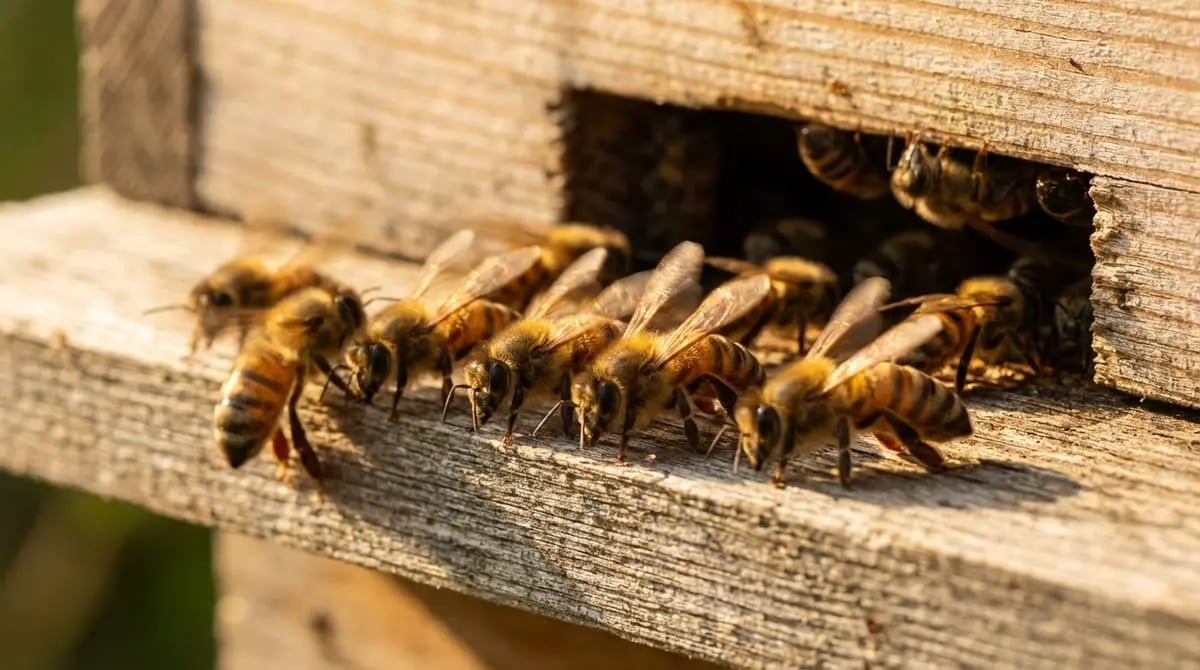
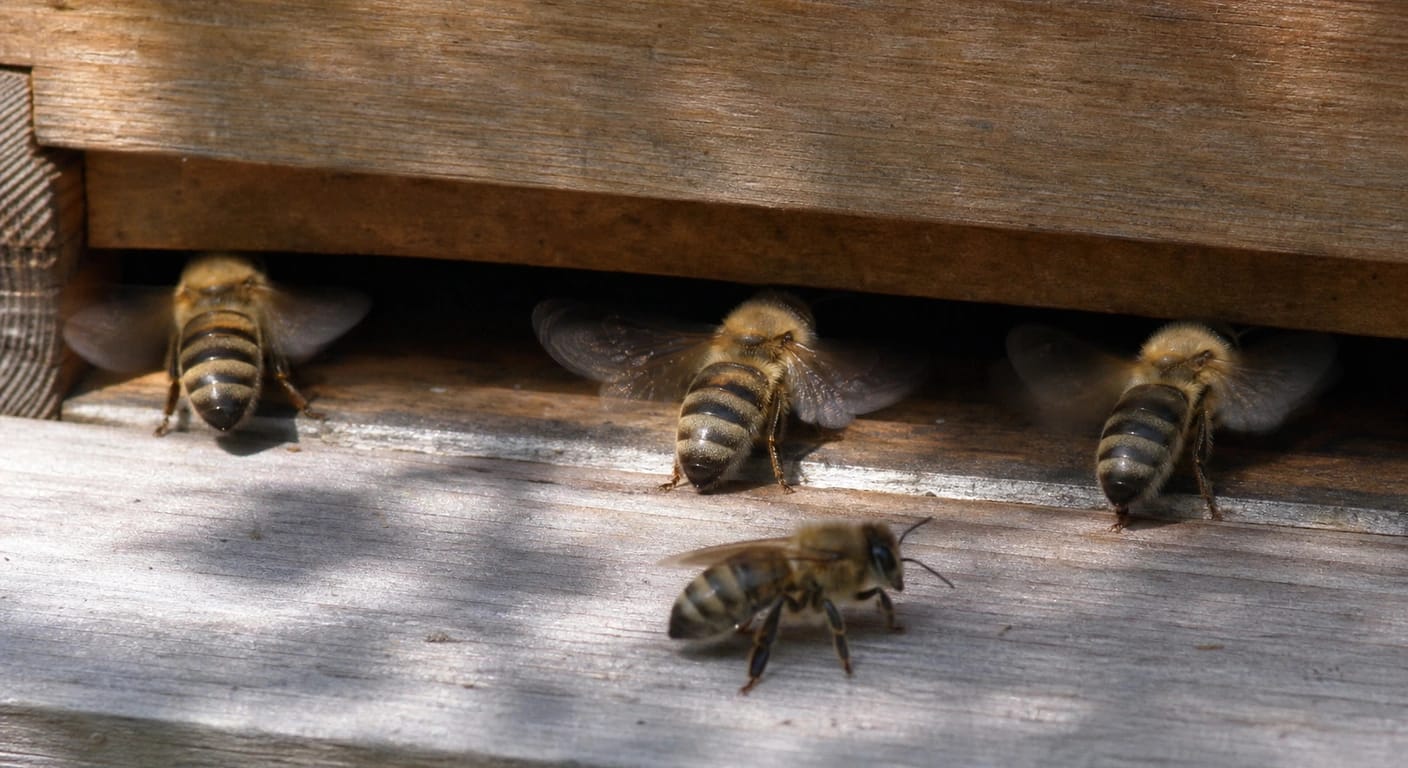
At the entrance, veritable fanning chains form: rows of bees that synchronously fan with their wings, creating an airflow through the entire hive. The warm, humid air is blown outward, cool air flows in.
- 4
Bee beard
When it becomes too warm and too crowded inside the hive, bees move outside. They hang as a dense cluster - the so-called bee beard - below the entrance or on the front of the hive. This reduces body heat inside and relieves the cooling system.
On hot days, a single colony can consume up to 2 liters of water per day - just for cooling. With 10 colonies, that is 20 liters daily. A reliable water source near the apiary is therefore essential.
Critical Temperature Thresholds
Not every warm summer day is a problem. But beyond certain thresholds, it becomes critical:
| Temperature | Situation in the Hive | Action Required |
|---|---|---|
| Below 30°C | Normal cooling, no stress | No action needed |
| 30-35°C | Increased cooling activity, more water flights | Ensure water supply |
| 35-38°C | Heavy stress, bee beard, massive fanning activity | Provide shade, improve ventilation |
| 38-40°C | Critical range, wax softening begins | Immediate measures needed |
| Above 40°C | Comb collapse possible, brood damage | Emergency measures, possibly relocate colonies |
Comb Collapse: The Greatest Danger
Beeswax becomes soft and loses stability already at 25 to 40 degrees Celsius. It becomes liquid at about 62 to 65 degrees Celsius. That sounds far from summer temperatures - but in an unprotected, dark-painted beehive in direct sun, the combs can become significantly warmer than the outside air. Newly built combs without wire support and heavy, honey-laden combs are especially at risk.
A comb collapse means:
- Loss of brood and honey
- Crushing and drowning of bees in flowing honey
- Massive disruption of the colony that lasts for weeks
- In the worst case, loss of the entire colony
Effective Heat Protection Measures
1. Shade
The most effective single measure against heat is shading the hives. Direct sun exposure, especially in the afternoon hours, heats hives enormously.
Natural shade:
- Place apiaries under deciduous trees (not under conifers - they drip resin)
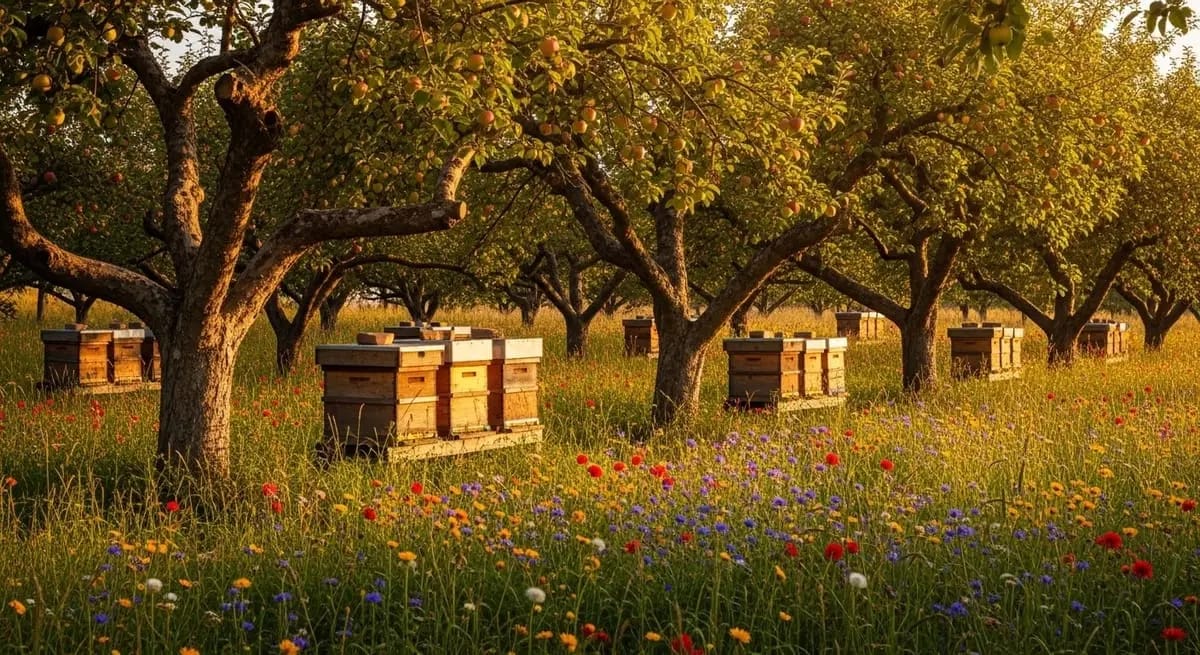
- Fruit trees provide ideal conditions: shade in summer, sun in winter after leaf fall
- Hedges as windbreaks and partial shade
Artificial shade:
- Shade sails or awnings over the hives
- Wooden pallets placed at an angle on the hives (with space for air circulation)
- Reflective foil on the metal lid (silver side up)
- Straw mats on the lids - insulate and reflect
Morning sun (east) is welcome for bees - it wakes the colony and dries the dew. Afternoon sun (west), however, is the greatest heat burden in midsummer. Ideal is a location with morning sun and afternoon shade.
2. Water Supply
Without sufficient water, bees cannot cool. A bee waterer near the apiary is essential in summer.
Checklist: Setting up a bee waterer
Tip for neighborhood peace: If you do not provide your own waterer, the bees find their own sources - the neighbor's pool, rain barrels, dripping faucets. This almost always leads to conflicts. A well-placed bee waterer prevents this.
3. Improving Ventilation
Bees need optimal air circulation during heat. You can help:
Enlarge the entrance:
- In summer, open the entrance completely (no entrance reducer)
- In stacking hives: remove the bottom board slider for ventilation from below
Use mesh floor:
- An open mesh floor significantly improves ventilation
- Rising warm air can escape upward
- Remove bottom board slider during heat
Lid ventilation:
- Create an air gap between inner cover and metal lid
- Small spacers (wooden strips or corks) between lid and box
4. Hive Color and Material
The color and material of the hive significantly affect the interior temperature:
| Hive Color/Material | Temperature Comparison | Recommendation |
|---|---|---|
| White or light gray | Reference (lowest heating) | Optimal for sunny locations |
| Natural wood (untreated) | +2-3°C | Good, natural insulation |
| Green or brown | +4-6°C | Acceptable with shade |
| Dark brown or black | +8-12°C | Avoid at sunny locations |
| Polystyrene | Better insulation than wood | Very good, blocks both heat AND cold |
An unprotected, dark metal lid can heat up to over 70°C in direct sun and transfer this heat directly to the inner cover and upper combs. Always place an insulating layer (polystyrene board, straw cover, burlap sack) between the metal lid and the bee colony.
5. Location Optimization
Sometimes only a location change helps:
- Forest edge locations offer natural partial shade and cooler temperatures
- Higher elevations are about 0.5 to 1 degree cooler per 100 meters of elevation difference
- North-facing slopes receive less direct sunlight
- Open locations without wind protection benefit from cooling air movement
Emergency Measures During Extreme Heat
During heat waves with temperatures above 38 degrees on several consecutive days, you should take additional measures:
- 1
Bring water directly to the hives
Place shallow dishes with water directly in front of each hive. Place wet cloths on the metal lids - evaporative cooling significantly reduces lid temperature.
- 2
Additional shade
If necessary, stretch a light bedsheet or tarp over the hives. Ensure adequate distance (at least 20 cm) for air circulation.
- 3
Check honey supers
Heavy, full honey supers are especially at risk for comb collapse during heat. Better to harvest one day early than take risks. Check whether combs are sitting stably.
- 4
Watch for bee beard
A bee beard at the entrance is normal during heat and no reason for panic. It shows the bees are actively cooling. Only intervene if you see additional stress signs (combs sagging, bees are lethargic, honey running out).
The Impact of Climate Change
The increasing frequency and intensity of heat waves is a direct consequence of climate change. For beekeeping, this means:
- More hot days: The number of hot days (above 30°C) in Germany has roughly tripled since the 1950s from about 3 to 9 per year (DWD)
- Longer dry periods: Less nectar, less water, more stress
- New pests: Warmer winters favor the spread of Varroa and potentially new parasites like the Asian hornet
- Shifted nectar flow times: Rapeseed blooms earlier, linden flow shifts, nectar dearths become longer
In the long term, beekeepers must adapt their practices: choose heat-resistant locations, expand water supply, and possibly turn to better-adapted bee lines.
Heat Protection Measures at a Glance
| Measure | Effectiveness | Effort | Cost |
|---|---|---|---|
| Shade (natural) | Very high | One-time (location choice) | Low |
| Shade sail / awning | High | Setup + takedown | Medium |
| Set up bee waterer | High | Daily refilling | Low |
| Open entrance completely | Medium | Minimal | None |
| Remove bottom board slider | Medium | Minimal | None |
| Light hive color | High | One-time (painting) | Low |
| Wet cloths on lid | Medium-high | Daily renewal | None |
| Reflective foil | High | One-time | Low |
| Change location | Very high | High (transport) | Medium |
The honeybee's ability to thermoregulate is one of the most impressive achievements in the animal kingdom. But it too has limits - and those limits are increasingly being tested by climate change.
Conclusion
Heat protection in modern beekeeping is no longer a side issue but a core task. With the right measures - shade, water supply, and good ventilation - you bring your colonies safely through midsummer. The weather data in Hivekraft shows you temperatures at your apiaries, and with an IoT hive scale you can detect heat stress from changes in the weight curve. Plan heat protection already when choosing your apiary location and respond quickly during heat waves.
Read also: Bees in Summer - Nectar Flow, Care and Heat Protection Long-term thinking: Climate Change and Beekeeping - Adaptation Strategies for Beekeepers Harvest time: Extracting Honey Properly - Tips for Best Quality- Beekeeping for Beginners -- Lesson 9: Summer work and honey super
- Beekeeping for Beginners -- Lesson 5: Finding the perfect location
Less paperwork. More time with your bees.
Hivekraft is free for up to 10 hives. Register in 30 seconds.