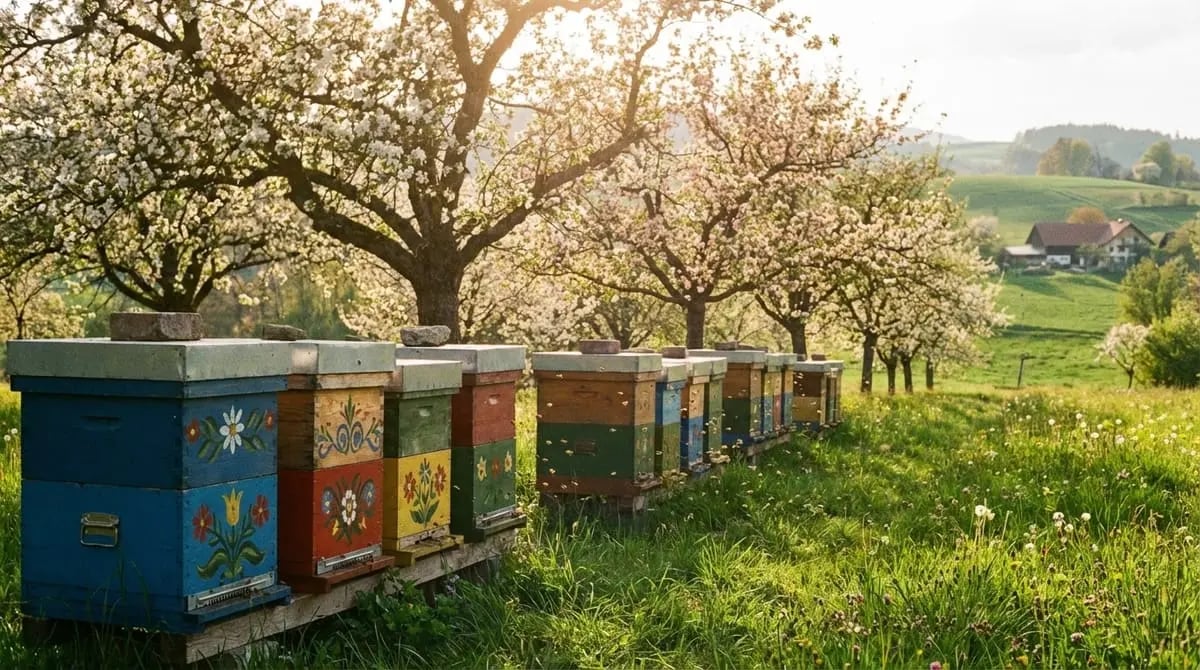
Annual Beekeeping Plan: How to Plan Your Bee Year
Plan your beekeeping year strategically: Month-by-month calendar, material lists, goal setting and never missing the right timing again.
The beekeeping year follows a fixed rhythm — yet it is different every year. Weather conditions, nectar flow and the development of your colonies determine when each task is due. Those who plan ahead keep the overview and never miss critical time windows. In this article you get a complete monthly calendar, practical material lists and tips for strategic planning of your bee year.
Why Annual Planning?
Beekeeping is not a hobby you can do spontaneously. Many tasks have tight time windows, and missing one means harvest losses, colony losses or double the work. Good annual planning helps you:
- Never forget critical dates (swarm control, Varroa treatment)
- Order and prepare materials on time
- Estimate working hours realistically
- Set and track goals for the season
- Learn from mistakes of previous years
The Monthly Calendar: Month by Month Through the Bee Year
January: Rest and Preparation
The new beekeeping year starts at the desk. The bees are in their winter cluster and don't need you — but you can make good use of the time.
Tasks at the apiary:
- Check entrance openings (clear of snow and ice?)
- Check storm protection (lid secure?)
- Check mouse guards
Tasks in the workshop:
- Build and wire frames
- Install foundation sheets
- Repair and paint hive boxes
- Order materials
Tasks at the desk:
- Review the past season
- Define goals for the new year
- Close the previous year's colony records
- Continuing education (courses, books, webinars)
February: Tension Rises
Days grow longer and the first mild days bring activity at the apiary. Queens begin laying eggs.
Tasks:
- Observe cleansing flight (from 8-10°C)
- Entrance observation: Pollen being brought in?
- Check food reserves (by hefting)
- Emergency feeding if needed (fondant)
- Finish workshop work
The highest food consumption occurs in early spring when brood rearing increases sharply. Check food reserves regularly by hefting the hive. When in doubt, place fondant on top rather than risking a colony starving.
March: Season Start
The real season start. Willow blossom provides massive amounts of pollen, colonies grow rapidly.
Tasks:
- First spring inspection (from stable 15°C)
- Check colony strength and queen-rightness
- Assess food reserves
- Mark old combs (for later exchange)
- Unite weak colonies
- Clean bottom boards
April: Build-Up Phase
Colonies grow explosively. Fruit blossom brings the first major nectar flow.
Tasks:
- Add honey supers (when 7/10 frames are occupied)
- Place queen excluders
- Hang drone frames
- Begin swarm control (end of April)
- Start comb renewal (old combs for new foundation)
- 1
Add honey supers on time
When 7 of 10 brood frames are occupied and fruit blossom begins, it is time. One day too early is better than one week too late. Place a queen excluder between brood box and honey super so the queen does not lay above.
- 2
Drone frames as Varroa trap
Hang an empty building frame at position 2 or 9 in the brood box. The bees build drone comb, in which Varroa preferentially reproduces. Cut out the capped drone brood every 3 weeks — this removes Varroa mites naturally.
- 3
Start swarm control
From end of April, check weekly for queen cells. Tip each brood comb and inspect the bottom edge for queen cells. The 7-day rhythm is now mandatory.
May: Swarming Season and Spring Harvest
The most intense month of the beekeeping year. Swarm control, making splits and utilizing the spring nectar flow — all at once.
Tasks:
- Swarm control every 7 days (mandatory!)
- Cut out drone frames
- Make splits (swarm prevention)
- Check honey supers and expand if needed
- Rapeseed honey harvest (end of May, when rapeseed finishes blooming)
June: Summer Nectar Flow
Swarming season subsides, the summer nectar flow (linden, black locust, sweet chestnut) begins.
Tasks:
- Continue swarm control until summer solstice
- Utilize summer nectar flow (expand honey supers)
- Care for and check splits
- Ensure water supply
July: Harvest
The harvest month. The summer honey is harvested, and the course is set for autumn.
Tasks:
- Extract summer honey (capped combs, <18% water content)
- Monitor end of nectar flow
- Remove honey supers
- Prepare Varroa treatment
- Begin feeding (if nectar flow ends early)
August: The Turning Point
August is the most important month for winter preparation. Varroa treatment and feeding start simultaneously.
Tasks:
- Start Varroa treatment with formic acid
- Begin feeding (3:2 sugar solution)
- Evaluate colony strength
- Mark weak colonies (for uniting in September)
September: Complete Feeding
Feeding is finished, treatment success is checked.
Tasks:
- Complete feeding by mid-September
- Check Varroa treatment success (mite drop <1/day)
- Re-treat if necessary
- Unite weak colonies (newspaper method)
- Queen check: all colonies queen-right?
- Check food reserves (15-20 kg)
October: Winter Preparations
Colonies go into winter rest. Final checks and mechanical preparations.
Tasks:
- Attach mouse guards
- Narrow entrance (5-8 cm)
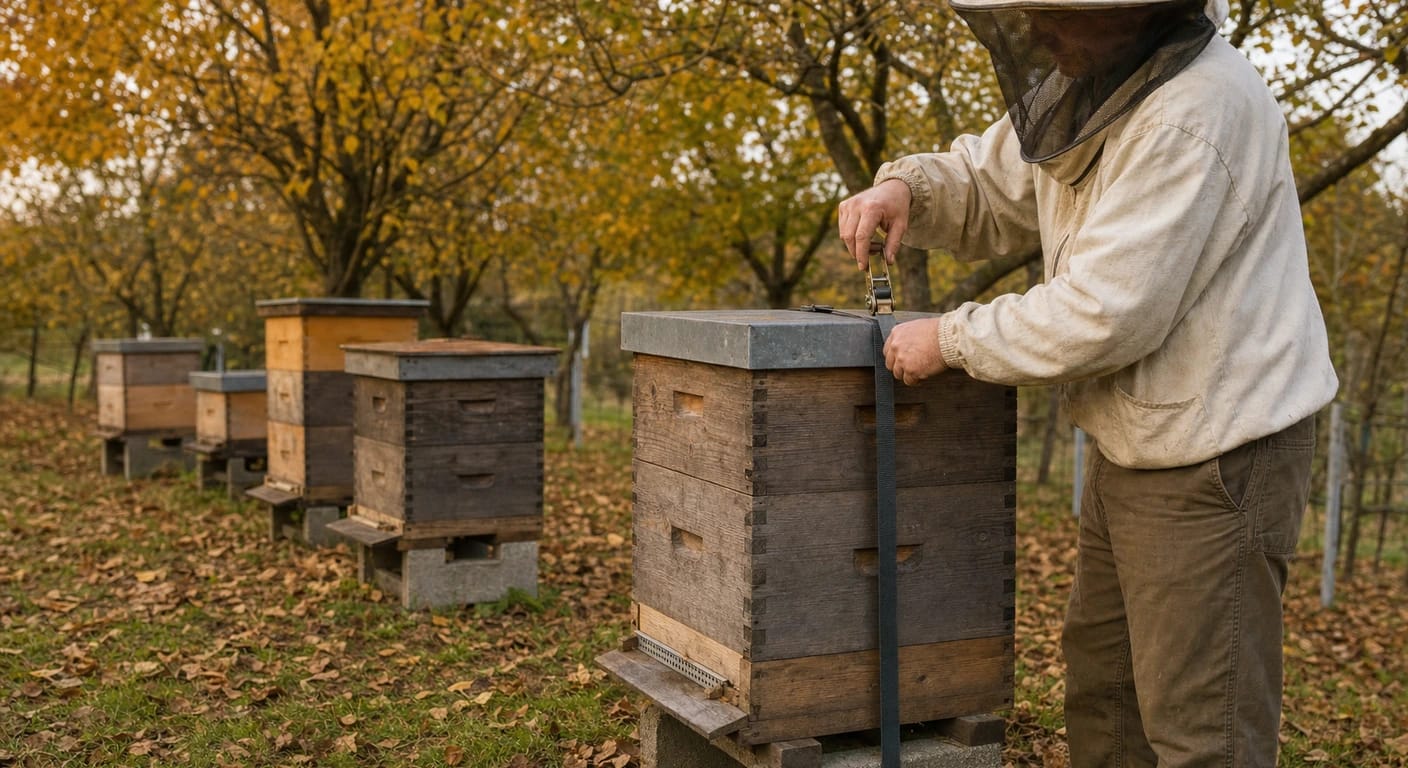
- Weigh down lids (storm protection)
- Store empty combs (cool, wax moth proof)
- Check hive tilt (slightly forward)
- Remove bottom board inserts (open mesh floor promotes ventilation and brood-free periods)
November: Transition
The bees sit in the winter cluster. Peace at the apiary.
Tasks:
- Occasional checks (storm protection, mouse guards)
- Begin workshop time
- Order materials for next season
- Melt down old combs
- Jar and label honey
December: Winter Treatment
The last major task of the year: the oxalic acid treatment during the brood-free period.
Tasks:
- Oxalic acid winter treatment (brood-free period, 3-4 weeks after first frost)
- Winter checks (entrance, storm protection)
- Year-end review: document stock levels, losses, harvest quantities
- Workshop work
Setting Strategic Goals
Beyond operational tasks, you should set strategic goals for the season. What do you want to achieve?
Possible Annual Goals
| Goal | Metric | Realistic for 10 Colonies |
|---|---|---|
| Increase honey yield | kg honey / colony | 20-30 kg/colony |
| Minimize winter losses | % losses | Under 10% |
| Build colony numbers | Number of colonies | +3-5 splits |
| Raise own queens | Number of queens | 5-10 queens |
| Comb renewal | % renewed combs | 30% (1/3 of brood combs) |
| Access new nectar sources | Migratory beekeeping | 1-2 migrations |
| Harvest varietal honey | Varieties | 2-3 varieties (rapeseed, linden, forest) |
Material List for the Season
So you don't forget anything, here is the complete material list. Print it out or save it digitally:
Season Materials (for 10 colonies)
Planning Working Hours Realistically
Many beginners underestimate the time involved. Here is a realistic estimate:
| Month | Hours (for 10 colonies) | Main Task |
|---|---|---|
| Jan-Feb | 10-15 | Workshop, planning |
| March | 5-8 | Spring inspection |
| April | 8-12 | Expanding, swarm control starts |
| May | 15-20 | Swarm control, splits, harvest preparation |
| June | 10-15 | Swarm control, honey supers |
| July | 15-20 | Harvest, extraction |
| August | 12-15 | Treatment, feeding |
| September | 8-10 | Feeding, checks |
| October | 5-8 | Winter preparation |
| Nov-Dec | 8-12 | Oxalic acid, workshop |
| TOTAL | ~100-140 hours |
As a rule of thumb, expect 10 to 15 hours per colony per year for ongoing management. Add workshop work, extraction and marketing. With 10 colonies, that is 2 to 3 hours per week on annual average — but very unevenly distributed.
Digital Planning
A digital hive management tool makes planning much easier. Instead of paper chaos, you have all data in one place:
- Inspection history: What was done when for which colony?
- Treatment tracking: When was treatment done? What is still pending?
- Reminders: Automatic alerts for swarm control, treatment, feeding
- Weight data: Hive scale shows nectar flow start and end in real-time
- Season comparison: How did the colony develop compared to last year?
Season Review: The Most Important Planning
The best foundation for planning next year is an honest review of the past season:
Successful beekeepers have one thing in common: They plan ahead and learn from each year. The best investment in your beekeeping is half an hour of reflection at the end of the year.
Conclusion: Planning is Half the Success
The beekeeping year is a marathon, not a sprint. Those who plan ahead, prepare materials on time and have critical dates in the calendar, beekeep more relaxed and more successfully. Set realistic goals, document your work and take time at the end of the year for an honest review. This way you improve from season to season — and your bees benefit from it.
Workshop Time: Preparing Frames and Materials Feeding: Amount, Timing and the Right Method Swarming Season: Detecting, Preventing and Using Swarms- Advanced Beekeeping Practice -- Lesson 10: Professional Season Planning
- Forage Plants and Bee Pasture -- Lesson 8: Phenology as Calendar
Less paperwork. More time with your bees.
Hivekraft is free for up to 10 hives. Register in 30 seconds.