
Practice
Piping, quacking and roaring: what you can hear, what instruments detect and where research has limits. With 15 sources.
- Bee sounds
Source status: 23 October 2026, from the canvas. Expert review: reviewer and review date still pending.
What do piping, quacking and roaring mean?
Three signs can be heard by ear. None is a diagnosis; each is a reason to inspect.
Piping
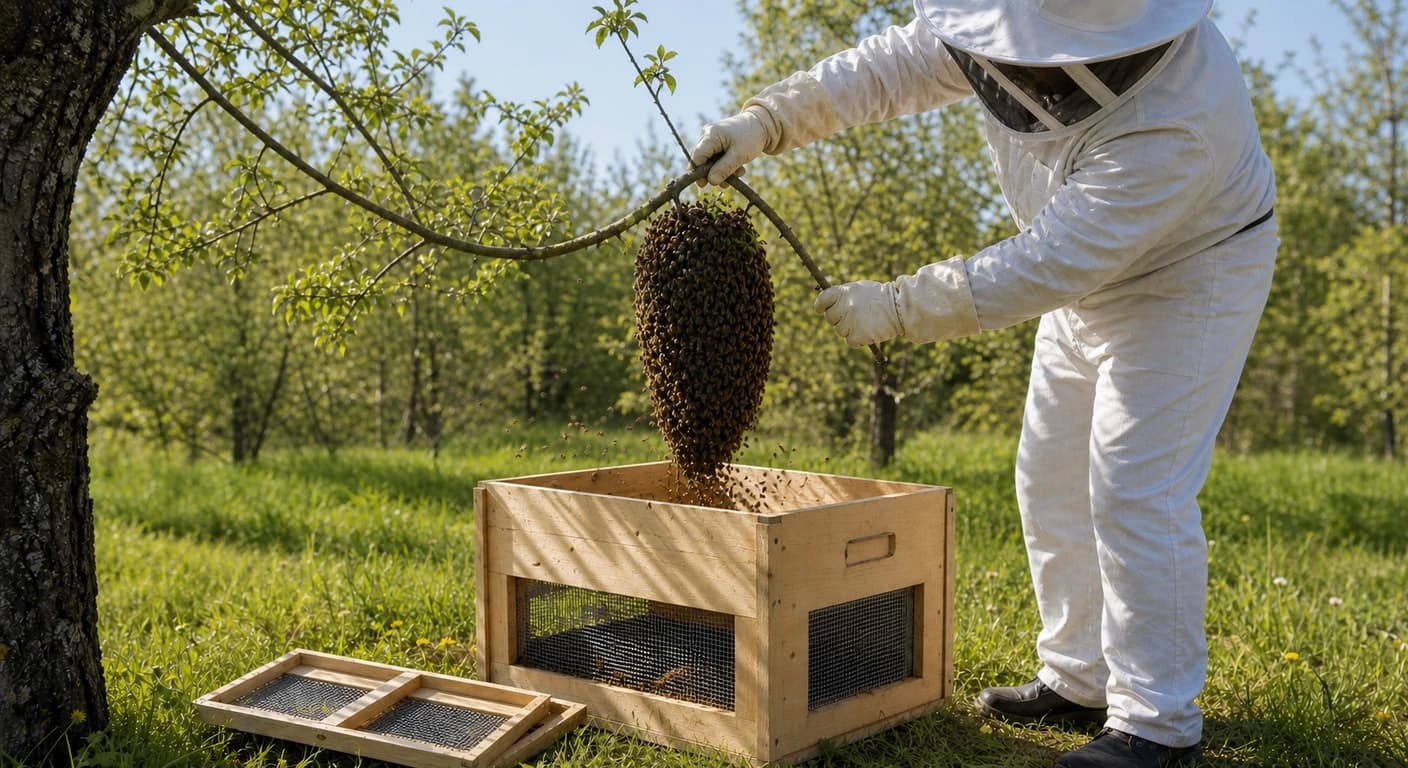
A tone of about one second followed by short pulses around 400 Hz: a young queen has emerged. During swarm preparation an afterswarm is possible. The first swarm is usually followed by 4 to 7 days without piping. Look for emerged and further sealed queen cells. 1
Quacking
Shorter, lower tones around 300 to 350 Hz, always after piping: more queens are still in their cells. Look for queen cells. 1 2
Roaring on opening
The colony becomes much louder and sounds lower when opened. This can mean queenlessness, but also disturbance or weather. Queenless colonies measure louder, especially below 150 Hz. Look for eggs, open brood and emergency queen cells. 3 4
Bees also hiss when defending themselves, for example against hornets at the entrance. 2 Look for hornets or wasps hunting at the entrance.
Audio examples are still pending cleared licences.
Can apps and sensors analyse colony sound?
Researchers put vibration sensors in brood combs in 24 to 25 colonies in France and England. The faster method alerted an average of 22 days before swarming, in 91% of cases according to the authors. This requires cutting a chamber into the comb and installing a cable; false alarms become more frequent after the first swarm. 1 5
Programs in studies recognise queenlessness with 93 to 99% accuracy when training and testing use the same colonies. 6 With unfamiliar colonies accuracy falls to 34 to 84%, sometimes chance level: programs learn the colony, apiary and microphone rather than the queen. 7
The largest collection, 5,129 handheld recordings from 3,285 colonies, performed barely better than a coin toss at unfamiliar apiaries. This is insufficient for an apiary decision. 4
Apps claiming to read colony condition from a phone recording have not been independently validated. In 2017, Hiveeyes community beekeepers tested an analysis on 11 known queenright colonies and concluded: “Nearly all classifications are wrong”. 8 Colony strength is also difficult to estimate acoustically: on unfamiliar colonies, a model was off by an average of 3.97 frames, compared with 4.48 for guessing. 9
Can you hear foulbrood or Varroa?
You cannot hear diseases. A quiet colony can be sick. Disease assessment requires looking at brood; Varroa requires counting.
No study shows that American or European foulbrood or Nosema can be recognised by sound; there is only a patent claim. 10 Electronic noses and dogs have been investigated for foulbrood, rather than sound. 11 For Varroa there is an individual study and laboratory work, but no method for apiary use. 12 13
What distorts the sound?
- Foraging: daytime flight masks colony sounds; one study therefore analysed night hours only. 1
- Rain and noise: heavy rain increased one measurement system’s error by up to 355%. 14
- Open hives and smoke: inspections disturb the colony; roaring was observed under those conditions. 3
- The phone: phone microphones offer the fewest guarantees below 150 Hz, where queenless colonies differ most. 15 4
What HiveKraft does
Record observations in the notes of an inspection. Record Varroa measurements with method, value, unit and counting days. The Varroa calculator helps with the calculation; you review and save the measurement in the app.
Sources
- Ramsey u. a. (2020): The prediction of swarming in honeybee colonies using vibrational spectra. Scientific Reports. Source
- Terenzi, Cecchi, Spinsante (2020): On the Importance of the Sound Emitted by Honey Bee Hives. Veterinary Sciences 7(4):168. Source
- Kanelis u. a. (2023): Decoding the Behavior of a Queenless Colony Using Sound Signals. Biology 12(11):1392. Source
- Abdollahi, Coallier, Fraser Franco, Falk (2026): Acoustic Honeybee Queen-State Detection Under Unseen Conditions. arXiv 2609.37845. Source
- Evans, The Apiarist (2020): Listening to bees – swarm prediction. Source
- Šabić, Perković, Šolić, Šerić (2025): Buzzing with Intelligence: A Systematic Review of Smart Beehive Technologies. Sensors 25(17):5359. Source
- Bricout u. a. (2024): Bee Together: Joining Bee Audio Datasets for Hive Extrapolation in AI-Based Monitoring. Sensors 24(18):6067. Source
- Hiveeyes Community (2017): Analyze recordings from queen vs. queenless hives using „audiohealth“. Source
- Abdollahi u. a. (2024/2025): UrBAN: Urban Beehive Acoustics and PheNotyping Dataset. Source
- US-Patent 7,549,907 (Bromenshenk u. a.): Honey bee acoustic recording and analysis system (Patentanspruch, keine Validierung). Source
- In-Field Detection of American Foulbrood (AFB) by Electric Nose (2022). Source
- Yıldız, Karabağ (2026): When the hive speaks: detecting Varroa destructor infestation through acoustic biomarkers. Experimental and Applied Acarology 97(3). Source
- Hall, Bencsik, Newton (2023): Automated, non-invasive Varroa mite detection by vibrational measurements of gait. Scientific Reports 13:10202. Source
- Abdollahi u. a. (2022): The Importance of Context Awareness in Acoustics-Based Automated Beehive Monitoring. Applied Sciences 13(1):195. Source
- Android Compatibility Definition, 5.11 Unprocessed Audio. Source