Swarm Season: Recognizing, Preventing and Using Swarms
Swarm season in bees: Recognize signs early, prevent swarming, and properly assess queen cells.
Swarm season is the most demanding phase of the beekeeping year for many beekeepers. Between mid-April and late June, any strong colony can develop swarming mood. Those who recognize the signs early and respond correctly can prevent the swarm or use it deliberately for colony multiplication. Swarm control is one of the fundamental skills of every beekeeper.
Why Do Bees Swarm?
Swarming is the natural reproductive drive of the bee colony. It is not the beekeeper's mistake and not a sign of poor management - it is biology. A strong, healthy colony wants to divide, just as a plant wants to bloom.
The triggers for swarming mood are varied:
- Lack of space: The colony has too little room for brood and honey
- Age of the queen: Older queens (2+ years) swarm more readily
- Large colony size: Very strong colonies are more prone to swarming
- Genetics: Some lines are more swarm-prone than others
- Warmth and forage: Good conditions promote the swarming drive
When Is Swarm Season?
Swarm season varies by region and weather but follows a predictable pattern.
| Month | Swarm Risk | Typical Situation |
|---|---|---|
| March / April | Low | Colonies are building up, still too weak to swarm |
| May | High | Peak swarm season, strong colonies at full development |
| June | High | Continued high swarming tendency, afterswarms possible |
| July | Declining | Nectar flow ends, colonies enter summer pause |
| August to February | Minimal | No natural swarming behavior |
Important: In warm springs, swarm season can begin as early as late April. In cold years, everything shifts two to three weeks later.
The 8 Signs of Swarming Mood
Not every single sign means swarming mood. But when several occur together, you must act.
| Sign | Reliability | Description |
|---|---|---|
| Queen cells (queen cups with eggs) | Very high | Queen cups with eggs or larvae on the comb undersides |
| Drone comb greatly expanded | High | Bees are raising drones in increased numbers |
| Bee beard at the entrance | Medium | Bees hang outside as a cluster and do not fly |
| Building activity stops | Medium | Foundation sheets are no longer built out |
| Foraging activity decreases | Medium | Less flight activity despite good nectar flow |
| Fanning bees at the entrance | Low | Can have other causes |
| Restlessness when opening | Low | Colony seems nervous and defensive |
| Queen appears slimmer | High | Bees feed queen less so she becomes flight-capable |
The most certain sign is queen cups containing eggs or larvae. Empty queen cups (play cups) alone are not cause for concern - many colonies build them as a precaution.
Swarm Control: How to Proceed
During swarm season you should conduct a swarm check every 7 days. This is non-negotiable - 9 or 10 days is not enough, because queen cells can already be capped after 8 days.
Swarm Check Procedure
- Open hive and briefly assess colony strength
- Pull each frame individually and check the undersides
- Search for queen cells: especially on comb bottom edges and margins
- Check queen cups: Do they contain eggs or larvae?
- Document finding: Record swarming mood yes or no
Tip: Never tilt frames so that you cannot see the underside. Queen cells are often in spots that are missed at a quick glance.
Methods for Swarm Prevention
There are various strategies for preventing swarming. Each has its advantages and disadvantages.
| Method | Effort | Effectiveness | Suited For |
|---|---|---|---|
| Give space (add honey super) | Low | Medium | Preventive, before swarming mood sets in |
| Break queen cells | Low | Low to medium | Only short-term effective, must be repeated weekly |
| Nucleus formation (split) | Medium | High | Experienced beekeepers who want to multiply colonies |
| Artificial swarm (flying bees split) | Medium | Very high | Swarming mood is immediately broken |
| Queen replacement | High | High | When the queen is older than 2 years |
| Total brood removal | High | Very high | Also usable as a Varroa measure |
Giving Space
The simplest and most important measure: Add the honey super in time. A colony with enough space is less likely to develop swarming mood. Add the honey super as soon as colonies are well occupying the boxes and the fruit tree bloom begins.
Breaking Queen Cells
Breaking out queen cells is the most common but not the best method. You gain at most one week. If you miss a single cell, the colony swarms anyway.
When breaking queen cells makes sense:
- As a bridge until you can form a nucleus
- With isolated play cups without true swarming mood
When not:
- When capped queen cells are already present (too late)
- When you are not sure you found them all
Nucleus Formation (Preemptive Swarm)
The most elegant solution: You preempt the swarm by forming a nucleus. This simulates natural swarming and satisfies the swarming drive.
Simple nucleus:
- Remove 2-3 brood frames with adhering bees and a queen cell
- Place in a new hive with feed supply
- Position the nucleus at a different location (at least 3 km distance) or use an artificial swarm method
This way you gain a new colony and the mother colony abandons its swarming plans.
Artificial Swarm (Flying Bees Split)
The most reliable method for breaking acute swarming mood:
- Place an empty hive with foundation sheets at the location of the mother colony
- Move the mother colony with the queen to a new location (at least half a meter away)
- All flying bees return to the old location and form the artificial swarm
- Hang a frame with open brood and youngest larvae in the artificial swarm
- The artificial swarm raises a new queen; the mother colony cannot swarm without flying bees
Using a Swarm Rather Than Preventing It
Not every swarm needs to be prevented. If you want to multiply colonies, you can allow swarming in a controlled manner.
Controlled swarming:
- Leave one queen cell standing and break all others
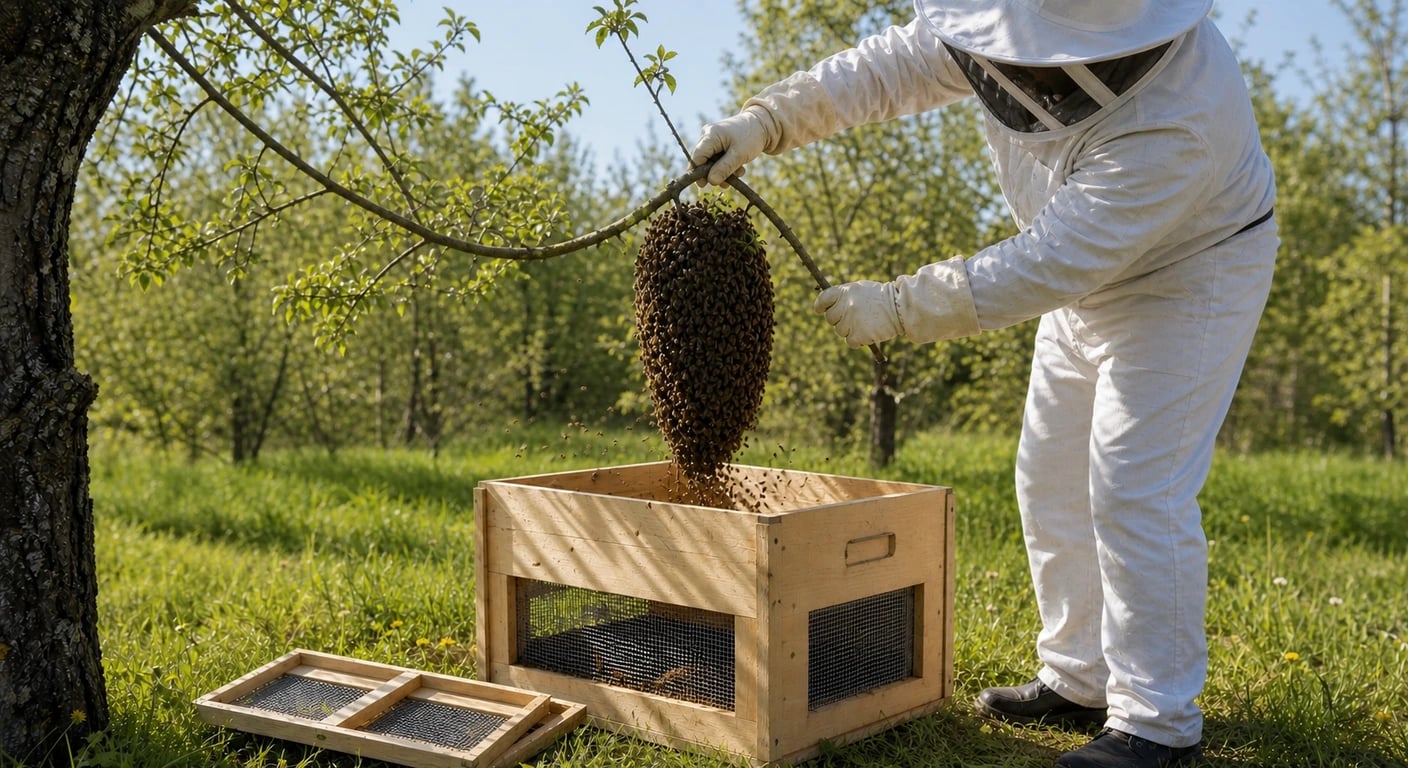
- Catch the swarm with a prepared swarm trap
- Hive the swarm into a new box
- The remaining colony has a young queen and is set for the season
Tip: During swarm season, always have an empty hive or swarm trap ready. If it happens anyway, you are prepared.
Documenting Swarm Control
The weekly swarm check should be documented without gaps. Record for each colony:
- Date of inspection
- Number of queen cells found (play cups, with eggs, with larvae, capped)
- Action taken
- General condition of the colony
With the digital hive records in Hivekraft, this takes seconds. The inspection feature automatically alerts you when the inspection interval is exceeded, and the swarm forecast analyzes five factors to assess risk.
Summary
Swarm season requires attention and consistent action. Check weekly, respond early with space expansion or nucleus formation, and document every finding. This way you maintain control over your colonies and can either prevent swarming or use it deliberately for multiplication.
Annual planning: Planning the Beekeeping Year Properly Beekeeping for Beginners - Your Start into Beekeeping August: The Most Important Varroa Treatment of the Year Read also: May - Managing Swarm Season with Techniques, Timing and Control Using swarm cells: Queen Rearing for Beginners Next in the beekeeping year: Bees in Summer - Nectar Flow, Care and Heat ProtectionOur learning paths cover everything about swarm management:
- Beekeeping for Beginners -- Lesson 8: Understanding and managing swarm season
- Advanced Beekeeping Practice -- Colony multiplication and swarm management
Less paperwork. More time with your bees.
Hivekraft is free for up to 10 hives. Register in 30 seconds.